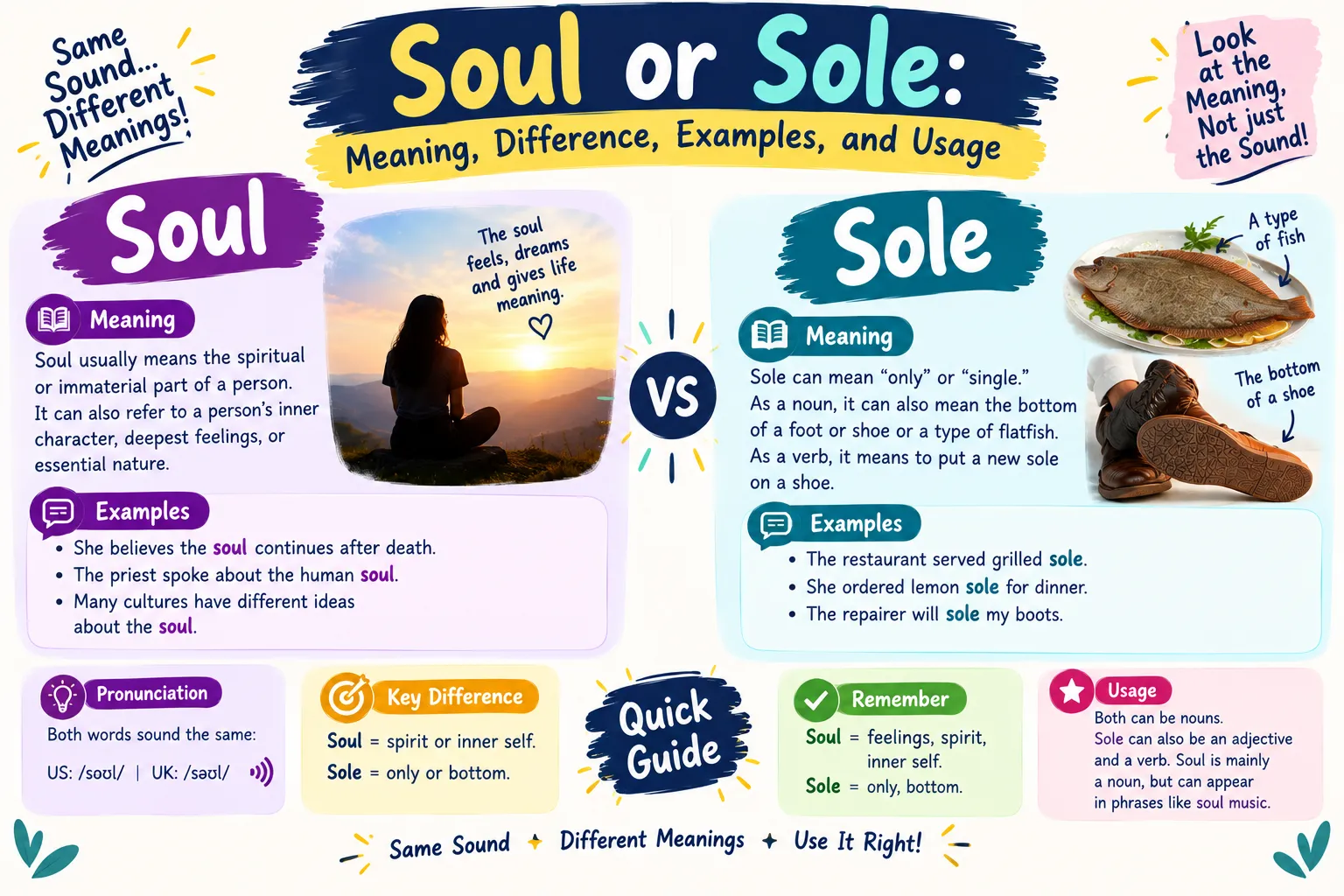
Soul or sole? These two words are easy to confuse because they sound the same when spoken, but they have completely different meanings and spellings. Sole can describe something that is the only one, the bottom of a foot, the bottom of a shoe, or a type of flatfish. Soul usually refers to the spiritual or inner part of a person, and it can also describe a person’s deepest feelings, character, or inner nature.
Imagine someone writing, “She was the sole survivor.” That sentence uses sole because it means she was the only survivor. Now consider, “The music touched his soul.” Here, soul refers to his deepest feelings or inner self.
These words are called homophones because they have the same pronunciation but different meanings and spellings. Learning the difference helps English learners avoid spelling mistakes and helps writers make their sentences clear and precise. This guide explains the meanings, grammar, pronunciation, history, etymology, examples, common mistakes, and practical uses of soul and sole in simple English.
Soul vs. Sole: Quick Answer
Sole is used when you mean only, single, the bottom of a foot or shoe, or a type of flatfish.
Soul is used when you mean the spiritual or inner part of a person, deep feelings, character, or inner nature.
Easy memory trick
- Sole = only or bottom
- Soul = spirit or inner self
Meaning of Sole
Definition
Sole (adjective): the only one or the only person or thing of its kind; it can also mean belonging to one person or group and not shared with others.
Sole (noun): the bottom part of a foot or shoe. It can also mean a type of flat sea fish.
Sole (verb): to put a new sole on a shoe.
Examples
- She was the sole winner of the competition.
- He has sole responsibility for the project.
- The sharp stone hurt the sole of my foot.
- My old shoes need a new sole.
Meaning of Soul
Definition
Soul (noun): the spiritual or immaterial part of a person or living being, especially in religious or philosophical ideas. It can also mean a person’s deepest feelings, inner character, or essential nature.
The word can also refer informally to a person, as in “not a soul” or “poor soul.” It is also used in expressions connected with soul music and Black American musical traditions.
Examples
- She believes that every person has a soul.
- The song touched my soul.
- He searched his soul before making the decision.
- There was not a soul in the empty building.
Connotative Meaning
Sole
- Positive tone: sole can suggest importance, authority, or special status.
Example: “She became the sole owner of the company.” - Negative tone: It can sometimes suggest isolation or a lack of support.
Example: “He carried the sole burden of the work.” - Neutral tone: It is often completely factual.
Example: “The sole entrance is on the north side.”
Soul
- Positive tone: Soul can suggest kindness, depth, beauty, spirit, or emotional strength.
Example: “Her music comes from the soul.” - Negative tone: It can appear in expressions about sadness, suffering, or inner pain.
Example: “The tragedy deeply wounded his soul.” - Neutral tone: It can simply refer to a spiritual or philosophical concept.
Example: “Different religions have different beliefs about the soul.”
Etymology of Sole
Sole meaning “only”
The adjective sole, meaning “only” or “single,” developed through Middle English and Anglo-French from Latin solus, meaning “alone” or “only.”
Sole meaning “bottom of the foot or shoe”
The noun sole, meaning the bottom of the foot or shoe, has a different history. It came through Old French from Latin solea, meaning a sandal or the sole of a shoe.
Sole meaning “flatfish”
The fish sense also has a separate historical development connected with Latin solea, with the name associated with the fish’s shape.
This distinction is important because not every meaning of sole comes from exactly the same Latin word.
Short History of Sole
Old English (450–1100)
The modern English adjective sole was not yet established in its present form. English had other words and expressions for ideas such as being alone or being the only one.
Middle English (1100–1500)
Several forms related to sole entered and developed in English through French and Latin. The adjective developed from the sense of being alone or single, while the noun referring to the foot or shoe developed from the Latin word connected with a sandal or sole.
Modern English (1500–Present)
Sole became established in several grammatical roles. Modern English uses it as an adjective meaning “only,” as a noun for the bottom of a foot or shoe and for certain flatfish, and as a verb meaning to put a new sole on a shoe.
Etymology of Soul
Soul has a completely different history from sole.
The English noun developed through Middle English soule from Old English forms such as sāwol, referring to the spiritual or immaterial part of a person. It belongs to an older Germanic word family.
Unlike sole, its meaning is connected with ideas of spirit, life, inner character, and personal identity rather than physical footwear or exclusivity.
Short History of Soul
Old English (450–1100)
Old English used forms such as sāwol for the spiritual or immaterial part of a person.
Middle English (1100–1500)
The word developed into forms such as soule. Its spelling changed as English pronunciation and spelling developed.
Modern English (1500–Present)
Soul developed a wide range of related meanings. It can refer to spiritual existence, a person’s deepest feelings or inner character, a person in informal expressions, and the distinctive emotional quality of music, art, or culture.
Pronunciation of Soul and Sole
Soul
US: /soʊl/
UK: /səʊl/
Sole
US: /soʊl/
UK: /səʊl/
Syllables
Soul: soul — 1 syllable
Sole: sole — 1 syllable
Affixation and Word Formation
Sole
Root/base: sole
Prefix: none in the basic word
Suffix: none in the basic word
- solely — adverb
- soled — verb form
- soling — verb form
- rubber-soled — adjective/compound form
- leather-soled — adjective/compound form
For example:
- She was solely responsible for the decision.
- The shoes are rubber-soled.
Soul
Root/base: soul
Prefix: none in the basic word
Suffix: none in the basic word
- soulless — adjective
- soulful — adjective
- soulfully — adverb
- soulmate — noun
- soul-searching — noun/adjective use
- soul music — noun phrase
The Main Difference Between Soul and Sole
| Word | Main meaning | Part of speech | Example |
| sole | only or single | adjective | She was the sole winner. |
| sole | bottom of a foot or shoe | noun | The sole of my shoe is worn. |
| sole | a flatfish | noun | We ordered sole for dinner. |
| sole | put a new sole on a shoe | verb | The repairer will sole the boots. |
| soul | spiritual or inner part | noun | She believes the soul lives on. |
| soul | deepest feelings or character | noun | The poem touched my soul. |
| soul | a person, informally | noun | Not a soul was there. |
1. Sole Means “Only”
It describes one person or thing when there are no others of the same relevant kind.
Examples
- She was the sole survivor of the accident.
- His sole purpose was to help his family.
- This is the sole reason I came here.
- They are the company’s sole suppliers.
As an adjective, sole normally appears before a noun. Oxford specifically identifies this adjective as meaning “only; single” and also “belonging to one person or group; not shared.”
2. Sole Means “Not Shared”
Sole can also describe something that belongs to one person or group.
Examples
- She has sole responsibility for the project.
- He is the sole owner of the business.
- The manager has sole control over the budget.
- They have sole authority to approve the request.
Here, sole does not simply mean “one.” It emphasizes that the responsibility, ownership, control, or authority is not shared.
3. Sole Means the Bottom of a Foot
As a noun, sole refers to the underside of a foot that touches the ground when a person stands or walks.
Examples
- The sand was hot under the sole of my foot.
- I injured the sole of my left foot.
- The doctor examined the sole of his foot.
- The cut was on the sole of her foot.
4. Sole Means the Bottom of a Shoe
Sole can also refer to the bottom part of a shoe that touches the ground, usually excluding the heel.
Examples
- The sole of my shoe is damaged.
- These boots have thick rubber soles.
- The old sole began to separate from the shoe.
- I need shoes with a strong sole.
The plural is normally soles when referring to more than one foot or shoe sole.
5. Sole Can Mean a Type of Fish
Sole is also the name for certain flat sea fish that are eaten as food.
Examples
- The restaurant served grilled sole.
- She ordered lemon sole for dinner.
- Fresh sole was available at the market.
This is another noun meaning and has nothing to do with the “only” sense of sole.
6. Sole Can Be a Verb
As a verb, sole means to put a new sole on a shoe.
Examples
- The repairer will sole my boots.
- I had my old shoes soled last week.
- The shop can sole and repair leather shoes.
7. Soul Means the Spiritual Part of a Person
Soul is mainly a noun. In religious, philosophical, and spiritual contexts, it refers to the immaterial or spiritual part of a person.
Examples
- She believes the soul continues after death.
- The priest spoke about the human soul.
- Many cultures have different ideas about the soul.
8. Soul Means a Person’s Inner Self
Soul can also describe a person’s deepest feelings, character, or inner nature.
Examples
- The experience changed his soul.
- Her kindness revealed a beautiful soul.
- The poem speaks to the human soul.
- He felt peace deep in his soul.
9. Soul Can Refer to Deep Feelings
When someone says something “touched my soul,” the word refers to a very deep emotional response.
Examples
- Her story touched my soul.
- The singer put her whole soul into the performance.
- The painting seemed to speak directly to his soul.
This does not mean a literal physical object was touched. It is a figurative use.
10. Soul Can Mean a Person Informally
In some expressions, soul can refer informally to a person.
Examples
- There wasn’t a soul in the room.
- Not a soul knew where he had gone.
- The poor soul looked exhausted.
In these expressions, soul still functions as a noun.
Soul in Expressions Such as “Soul Music”
A common grammatical oversimplification is to say that soul can only be used as an ordinary noun.
A more accurate explanation is that soul is primarily a noun, but it can occur before another noun in established combinations.
Examples include:
- soul music
- soul food
- soul singer
- soul brother
In these combinations, soul appears before another noun and helps identify the type or category being discussed. This is often described as attributive noun use.
Therefore, saying simply “soul is only ever a noun” is too absolute. The word’s basic lexical category is noun, but English allows nouns to modify other nouns in compounds and noun phrases.
Soul vs. Sole: 10 Easy Differences
Difference 1: Meaning
Sole can mean “only.”
Soul can mean a person’s spiritual or inner self.
Difference 2: Physical vs. Abstract
Sole can describe a physical part of the body or a shoe.
Soul usually describes an abstract spiritual or emotional idea.
Difference 3: Grammar
Sole can be an adjective, noun, or verb.
Soul is primarily a noun, although it can occur attributively in noun phrases.
Difference 4: Footwear
Use sole for the bottom of a shoe.
- The sole of my shoe is cracked.
Do not use soul.
Difference 5: Spirituality
Use soul for the spiritual or inner part of a person.
- She believes the soul is eternal.
Do not use sole.
Difference 6: Exclusivity
Use sole for something that is the only one or is not shared.
- He has sole responsibility for the project.
Difference 7: Deep Feelings
Use soul for deep emotional or inner experiences.
- The music touched her soul.
Difference 8: Fish
Use sole for the type of flatfish.
- We had sole for dinner.
Difference 9: Sound
Both words are pronounced alike in standard English.
Difference 10: Spelling
They have different spellings and meanings even though they sound alike.
Common Mistakes: Soul or Sole
Mistake 1
Incorrect: She was the soul survivor.
Correct: She was the sole survivor.
Why?
The sentence means she was the only survivor.
Mistake 2
Incorrect: The music touched my sole.
Correct: The music touched my soul.
Why?
The sentence refers to deep feelings or inner emotion.
Mistake 3
Incorrect: There is a hole in the soul of my shoe.
Correct: There is a hole in the sole of my shoe.
Why?
The bottom of a shoe is its sole.
Mistake 4
Incorrect: He has soul responsibility for the project.
Correct: He has sole responsibility for the project.
Why?
The responsibility belongs entirely to him.
Mistake 5
Incorrect: She searched her sole before making the decision.
Correct: She searched her soul before making the decision.
Why?
The expression refers to examining one’s deepest thoughts and feelings.
Mistake 6
Incorrect: The soul of her foot was bleeding.
Correct: The sole of her foot was bleeding.
Why?
The underside of the foot is the sole.
How to Remember Soul and Sole
Use this simple rule:
Think “only” → Sole
- sole survivor
- sole owner
- sole purpose
- sole responsibility
Imagine “bottom” → Sole
- sole of the foot
- sole of the shoe
Think “spirit” → Soul
- human soul
- spiritual soul
- soul of a person
Think “deep feelings” → Soul
- touched my soul
- search your soul
- speak from the soul.
Soul and Sole in Everyday English
Sole in everyday English
You are likely to see sole in:
- business writing
- legal writing
- formal English
- discussions about responsibility
- footwear descriptions
- medical descriptions of the foot
- food and restaurant contexts involving fish
Examples:
- sole owner
- sole responsibility
- sole purpose
- sole of the foot
- sole of the shoe
Soul in everyday English
You are likely to see soul in:
- religious discussions
- emotional writing
- poetry
- music
- philosophy
- personal conversations
- expressions about character and feelings
Examples:
- kind soul
- troubled soul
- human soul
- soul music
- touch the soul
Semantic Categories
Understanding the meaning categories makes these homophones much easier to remember.
Sole: Exclusivity
These uses focus on being the only one or not being shared.
- sole owner
- sole survivor
- sole purpose
- sole authority
Sole: Foot and Shoes
These uses refer to physical surfaces.
- sole of the foot
- sole of the shoe
- rubber sole
- leather sole
Sole: Fish
This category refers to edible flatfish.
- sole
- lemon sole
- Dover sole
Soul: Spirituality
These uses concern spiritual or philosophical ideas.
- human soul
- immortal soul
- spiritual soul
Soul: Inner Character
These uses concern personality, character, and inner nature.
- kind soul
- beautiful soul
- troubled soul
Soul: Deep Emotion
These uses describe powerful feelings.
- touch the soul
- search the soul
- speak from the soul
Soul: Music and Culture
These uses occur in expressions such as:
- soul music
- soul singer
- soul food
Prototype Meaning
The prototype meaning of sole depends on the context. For many learners, the clearest physical image is the bottom of a foot or shoe. In another very common use, it means “only” or “single.”
The prototype meaning of soul is the spiritual or inner part of a person. From this central idea, the word extends naturally to deep feelings, character, personal essence, and certain cultural expressions.
Soul or Sole: Which One Should You Use?
Are you talking about “only”?
Use sole.
She was the sole winner.
Are you talking about a foot or shoe?
Use sole.
The sole of my shoe is worn.
Are you talking about a flatfish?
Use sole.
We ordered grilled sole.
Are you talking about spirit or inner self?
Use soul.
The experience changed his soul.
Are you talking about deep feelings?
Use soul.
The song touched her soul.
Antonyms.
Antonyms of sole meaning “only”
- multiple
- several
- many
- shared
- joint
- common
Soul
Soul does not have one simple direct antonym in every context because it represents a spiritual or abstract concept. Depending on the context, possible contrasts may include:
- body
- physical matter
- material existence
However, these are contextual contrasts, not perfect dictionary antonyms.
Related Words
Words related to Sole
- solely
- soled
- soling
- soleless
- rubber-soled
- leather-soled
Example
The company is solely responsible for the decision.
Words related to Soul
- soulful
- soulless
- soulfully
- soulmate
- soul-searching
- soulfulness
Examples
She gave a soulful performance.
Soul vs. Sole in Writing
These words are especially important in writing because spellcheck may not always detect the mistake.
For example:
He was the sole survivor.
and
He was a kind soul.
Both sentences are grammatically correct, but changing the spelling changes the meaning completely.
This is why writers should not rely only on pronunciation. They should understand the meaning of the whole sentence.
Why People Confuse Soul and Sole
There are three main reasons.
1. They sound the same
In standard English pronunciation, both words have the same pronunciation.
2. Their spellings are different
The vowel sequence ou appears in soul, while o appears in sole.
3. Both are common words
Because both words occur frequently in English, learners encounter them in many different contexts.
The solution is to connect each spelling with its meaning rather than trying to hear a difference that normally does not exist.
Soul or Sole: Comparison Table
| Feature | Soul | Sole |
| Pronunciation US | /soʊl/ | /soʊl/ |
| Pronunciation UK | /səʊl/ | /səʊl/ |
| Syllables | 1 | 1 |
| Main grammatical role | Noun | Adjective, noun, verb |
| Spiritual meaning | Yes | No |
| Inner feelings | Yes | No |
| Means “only” | No | Yes |
| Bottom of foot | No | Yes |
| Bottom of shoe | No | Yes |
| Type of fish | No | Yes |
| Can mean a person informally | Yes | No |
| Homophone | Yes | Yes |
Grammar Notes
How to use “sole”
When sole means “only,” it is normally an adjective placed before a noun.
Correct
the sole reason
the sole survivor
this sole owner
sole responsibility
Natural pattern
sole + noun
This is especially common in formal and professional writing.
When sole is a noun meaning the bottom of a foot or shoe, it can follow determiners and possessives.
Examples
the sole of the foot
the sole of my shoe
a rubber sole
When sole is a verb, it takes an object.
The repairer will sole the shoes.
How to use “soul”
Soul is primarily a noun.
Examples
the human soul
her soul
a kind soul
his troubled soul
Frequently Asked Questions
Question 1: What does “sole” mean?
Sole can mean “only” or “single.” As a noun, it can also mean the bottom of a foot or shoe or a type of flatfish. As a verb, it means to put a new sole on a shoe.
Question 2: What does “soul” mean?
Soul usually means the spiritual or immaterial part of a person. It can also describe a person’s inner character, deepest feelings, or essential nature.
Question 3: Are “sole” and “soul” pronounced the same?
Yes. In standard American English, both are pronounced /soʊl/. In standard British English, both are pronounced /səʊl/.
Question 4: Are “sole” and “soul” homophones?
Yes. They are homophones because they have the same pronunciation but different spellings and meanings.
Question 5: Which is correct: “sole survivor” or “soul survivor”?
The correct phrase is sole survivor. It means the only survivor.
Question 6: Should I write “sole of my foot” or “soul of my foot”?
Write sole of my foot. The sole is the underside of the foot.
Question 7: Is it “touch my sole” or “touch my soul”?
If you mean deep emotion or feelings, write touch my soul.
Question 8: What is an easy way to remember “sole” and “soul”?
Sole = only or bottom.
Soul = spirit or inner self.
Quick Practice
Choose soul or sole in each sentence.
- She was the _____ survivor.
- The music touched my _____.
- There is a hole in the _____ of my shoe.
- He has _____ responsibility for the project.
- She believes that every person has a _____.
- We ordered grilled _____ at the restaurant.
- He searched his _____ before answering.
- The _____ of my foot was sore.
Answers
- sole
- soul
- sole
- sole
- soul
- sole
- soul
- sole
Final Memory Guide
If the meaning is only, choose sole.
Whether the meaning is the bottom of a foot or shoe, choose sole.
If the meaning is a flatfish, choose sole.
If the meaning is spirit, inner self, deep feelings, or inner character, choose soul.
The pronunciation will not help you choose because the two words are homophones. Context and meaning are your best guides.
Conclusion
Soul or sole helps you write and speak English more accurately. Although both words sound the same, their meanings are very different. Sole can mean only or single, the bottom of a foot or shoe, or a type of flatfish, while soul usually refers to the spiritual or inner part of a person, deep feelings, or inner character. Because pronunciation cannot distinguish these homophones, you must use the meaning and context of the sentence to choose the correct spelling. Learning this simple difference can help you avoid common spelling mistakes, improve your vocabulary, and communicate your ideas with greater confidence. With regular practice, choosing between soul and sole will become quick and natural.

I’m Samia Jamshaid, an English language specialist, SEO specialist, digital publisher, and researcher. I create clear, accurate, and well-researched content on English grammar, vocabulary, word meanings, and language comparisons, helping readers understand and use English with confidence.










1 thought on “Soul or Sole: Meaning, Difference, Examples, and Usage”