Lasagna and lasagne are two accepted spellings for the same Italian pasta dish. The main difference is regional use. American English often uses lasagna, while British English often uses lasagne.
Imagine you are reading a restaurant menu. One menu offers baked lasagna. Another lists vegetable lasagne. You may wonder if they are two different meals. They are not. Both names describe pasta sheets layered with sauce, cheese, and other fillings.
People search for “lasagna or lasagne” because both spellings appear in English. This can make cooking, shopping, and writing confusing. The words also come from Italian, where their forms have a clear singular and plural use. English does not always follow that same rule.
In this guide, you will learn how to spell and say both words. You will also see their history, examples, and common uses. By the end, you will know which form to choose for American, British, and global readers.
Pronunciation of Lasagna and Lasagne
Both words have similar English pronunciations. The exact sound can vary by accent.
| Word | US Pronunciation | UK Pronunciation |
| Lasagna | /ləˈzɑː.njə/ — luh-ZAHN-yuh | /ləˈzæn.jə/ — luh-ZAN-yuh |
| Lasagne | /ləˈzɑː.njə/ — luh-ZAHN-yuh | /ləˈzæn.jə/ — luh-ZAN-yuh |
Cambridge gives the same main pronunciation for both spellings. The US version uses the “ah” sound. The UK version uses the short “a” sound.
A Short Note Before the Main Difference
The two words usually name the same dish in English. The ten points below explain their spelling, history, and use. They do not describe ten different food meanings.
Difference Between Lasagna and Lasagne
1. Spelling
The first difference is the final letter. Lasagna ends in “a.” Lasagne ends in “e.”
Both spellings are correct in English. The choice often depends on the country.
Examples:
- We ordered baked lasagna for dinner.
- We ordered baked lasagne for dinner.
2. Regional Preference
American English usually favors lasagna. British English usually favors lasagne.
Both forms are understood in the UK and the US. The preferred spelling simply changes by region.
Examples:
- The New York restaurant serves lasagna.
- The London restaurant serves lasagne.
3. Italian Grammar
In Italian, lasagna is singular. Lasagne is its plural form.
The words can refer to pasta sheets. They can also name the dish made with those sheets.
Examples:
- In Italian, lasagna can mean one pasta sheet.
- In Italian, lasagne means more than one sheet.
4. English Grammar
English often treats both forms as names of a dish. They are commonly used as food names, not as strict singular and plural forms.
For example, people say “some lasagna” or “some lasagne.” Both can describe one prepared meal.
Examples:
- There is some lasagna in the fridge.
- There is some lasagne in the fridge.
5. Use in Restaurant Menus
Menus in the United States often write lasagna. Menus in the UK often write lasagne.
The recipe may be the same. The spelling may only show the restaurant’s style.
Examples:
- The menu lists meat lasagna.
- The menu lists meat lasagne.
6. Use in Cookbooks
American cookbooks often use lasagna. British cookbooks often use lasagne.
A cookbook may use either form when sharing an Italian recipe. Follow the spelling used by the book or publisher.
Examples:
- The cookbook has a recipe for spinach lasagna.
- The cookbook has a recipe for spinach lasagne.
7. Use in Food Shopping
Food shops use both spellings. The package may say lasagna sheets or lasagne sheets.
These names usually describe flat pasta sheets. Check the package for the product details.
Examples:
- I bought a box of lasagna sheets.
- I bought a box of lasagne sheets.
8. Plural and Pasta Sheets
In Italian, lasagne is the plural of lasagna. English speakers often use lasagne as the name of the whole dish.
This is why the Italian grammar rule does not always match English use.
Examples:
- The Italian recipe calls for several sheets of lasagne.
- We ate a large dish of lasagne.
9. Use in Online Searches
People may search for either spelling. A search for lasagna or lasagne usually leads to recipes for the same layered dish.
Food websites may use one spelling in the title. They may mention the other form in the text.
Examples:
- Search for “easy lasagna recipe.”
- Search for “easy lasagne recipe.”
10. Meaning in a Sentence
In everyday English, both words usually have the same meaning. Changing the final letter does not change the dish.
The recipe may change from home to home. The spelling does not decide its ingredients.
Examples:
- My mother makes lasagna with spinach.
- My mother makes lasagne with spinach.
You May Also Like https://orchoice.com/sari-or-saree/
Nature and Behaviour of Lasagna and Lasagne
Nature of Lasagna
Lasagna is a noun. In American English, it commonly names the baked Italian dish. It is made with layers of wide pasta sheets.
The layers may include meat, tomato sauce, cheese, and white sauce. Vegetable versions are also common.
Nature of Lasagne
Lasagne is also a noun. It is the usual spelling in much of British English. It names the same layered pasta dish.
In Italian, lasagne is the plural form of lasagna. In English, it is often used as the name of the whole meal.
Why People Get Confused About Lasagna and Lasagne
People get confused because both spellings are correct. They also describe the same food.
The Italian language uses lasagna for the singular form. It uses lasagne for the plural form. English speakers often use the two forms by region instead.
This creates a simple problem. An American recipe may say lasagna. A British recipe may say lasagne. A reader may think the recipes are different.
The easy rule is:
- Use lasagna for most US readers.
- Use lasagne for most UK readers.
- Both forms are understood in many English-speaking places.
- Keep one spelling throughout your writing.
Comparison Table
| Feature | Lasagna | Lasagne |
| Correct spelling | Yes | Yes |
| Meaning in English | Layered pasta dish | Same dish |
| Common US use | Preferred | Also understood |
| Common UK use | Also understood | Preferred |
| Italian grammar | Singular | Plural |
| English word type | Noun | Noun |
| Pronunciation | Similar to lasagne | Similar to lasagna |
| Common menu use | US menus | UK menus |
| Pasta sheets | Can name the pasta | Can name the pasta |
| Meaning difference | None in usual English food use | None in usual English food use |
The Origin of Lasagna and Lasagne
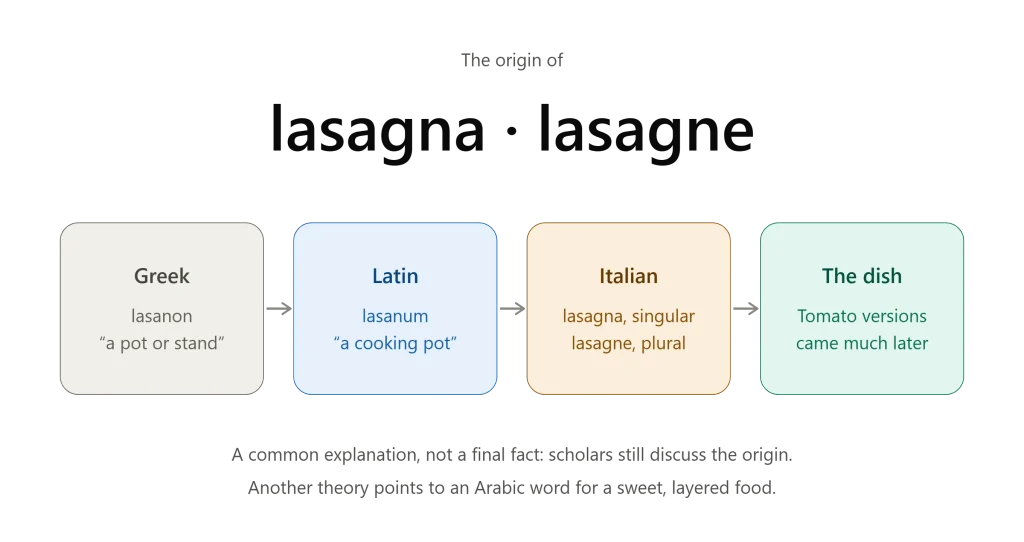
Both spellings come from Italian. The Italian word lasagna is singular. Lasagne is plural.
The word has a long history. Records of the dish go back to medieval Italy. The Italian form appeared in early food writing and cookbooks.
The common word history links lasagna to Latin lasanum. That Latin word meant a cooking pot. It came from the Greek word lasanon, linked to a pot or stand.
However, the exact word origin is still discussed by language scholars. Another theory links it to an Arabic word for a sweet, layered food. It is best to present the Latin and Greek link as a common explanation, not a final fact.
The dish also changed over time. Early recipes used pasta, cheese, butter, and spices. The tomato-based versions people know today came much later.
British vs American English
The main difference is regional spelling. American writers usually choose lasagna. British writers usually choose lasagne.
Both spellings are understood in both countries. Neither is a spelling mistake.
| Point | British English | American English |
| Common spelling | Lasagne | Lasagna |
| Other spelling | Lasagna is understood | Lasagne is understood |
| Pronunciation | Usually luh-ZAN-yuh | Usually luh-ZAHN-yuh |
| Menu wording | Vegetable lasagne | Vegetable lasagna |
| Recipe wording | Easy lasagne recipe | Easy lasagna recipe |
Examples:
- British English: We made vegetable lasagne for lunch.
- American English: We made vegetable lasagna for lunch.
- British English: The shop sells fresh lasagne sheets.
- American English: The shop sells fresh lasagna sheets.
Which One Should You Use?
Your choice depends on your readers.
For American readers: Use lasagna. This is the usual US spelling.
For British readers: Use lasagne. This is the usual UK spelling.
For global readers: Either form is clear. You can use one spelling and mention the other once.
For schoolwork: Follow the spelling your teacher or school guide uses.
For websites: Choose the form that matches your main audience. Use it in the title, headings, and text. You may also include the other spelling in a natural sentence.
Common Mistakes
| Common Mistake | Correct Form | Explanation |
| Calling lasagne a spelling error | Lasagne | It is accepted English spelling. |
| Calling lasagna a spelling error | Lasagna | It is accepted English spelling. |
| Mixing both forms without a reason | Choose one form | Keep the article steady. |
| Saying they are two different dishes | Same dish name | The spelling changes by region. |
| Writing “lasagnas” for the UK style | Lasagnes | This is the usual plural spelling for the word. |
| Writing “lasagne” as an error in US English | Lasagne is understood | US writers usually prefer lasagna. |
| Saying the extra “e” changes the food | Same food | The spelling does not change the recipe. |
| Treating Italian grammar as English grammar | Check the language | Italian and English use the forms in different ways. |
Everyday Usage Examples
Both spellings appear in daily life. The best choice depends on your readers.
In Emails
- Could you share your lasagna recipe?
- Please bring your homemade lasagne to the dinner.
On Social Media
- Tonight, we are making cheese lasagna!
- This vegetable lasagne is perfect for a cold day.
In News
- The food fair served a large tray of lasagna.
- The school event offered vegetarian lasagne.
In Formal Writing
- The menu includes meat and vegetable lasagna.
- The report describes the history of Italian lasagne.
Usage Trends
Both spellings are used around the world. The choice often follows local English.
American websites and cookbooks often use lasagna. British websites and cookbooks often use lasagne. Many international food sites use both.
Online searches also show both forms. People may use the spelling they see on menus or food packs. Search engines can usually connect both terms with the same dish.
There is no need to use both spellings in every sentence. Choose one for your main text. Add the other form where it helps readers.
Metaphors and Similes
Lasagna and lasagne are food words. They do not have many fixed English metaphors or similes. Still, writers can use the dish in creative ways.
Metaphors
- A lasagna of ideas: Many ideas placed in layers.
- A lasagne of memories: Many memories joined together.
- A lasagna of colors: Many colors arranged in layers.
These are creative phrases. They are not standard dictionary meanings.
Similes
- The pasta layers fit together like pages in a book.
- The cheese stretched like a soft ribbon.
- The dish was warm like a hug on a cold day.
Connotative Meaning
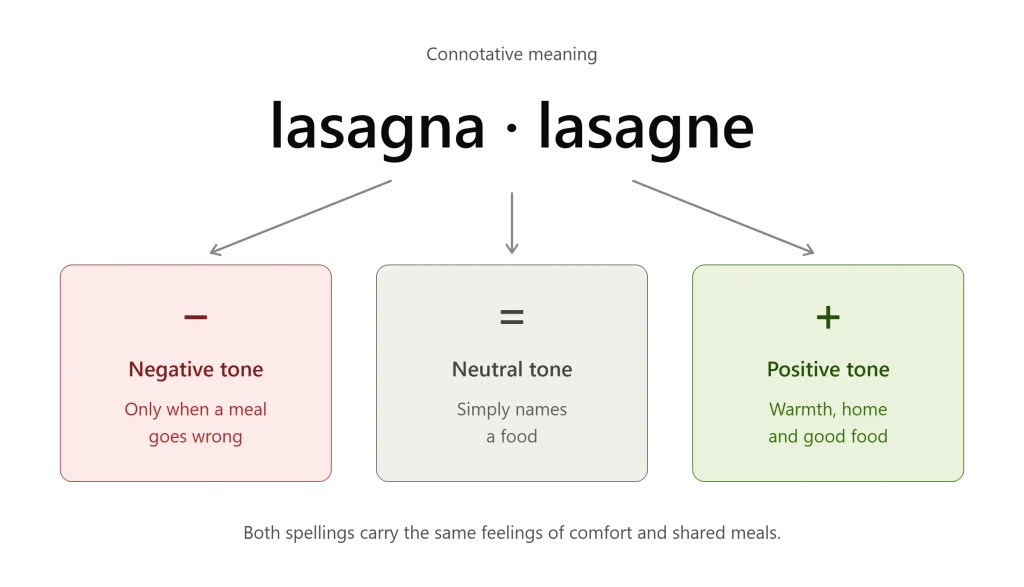
A word’s connotation is the feeling it brings to mind. Lasagna and lasagne often suggest comfort, family, and shared meals.
Positive Meaning
Both words can bring thoughts of warmth, home, and good food.
Examples:
- Grandma’s lasagna made everyone feel at home.
- The family shared a warm dish of lasagne.
Negative Meaning
The words are not negative by themselves. A person may use them in a bad way when talking about a poor meal or too much food.
Examples:
- The lasagna was cold and dry.
- He said the lasagne had too much salt.
Neutral Meaning
Both words can simply name a food. They do not always carry a feeling.
Examples:
- The lasagna is in the oven.
- The lasagne needs ten more minutes.
Idioms and Proverbs
There are no widely known English idioms or proverbs based on lasagna or lasagne. The words are mostly used for food.
Writers may create playful phrases, but they should not call them old sayings.
Examples:
- Layer by layer: She built her project layer by layer, like a lasagna.
- A recipe for success: Careful planning was a recipe for success.
The first is a creative comparison. The second is a common English phrase, but it is not specific to lasagna.
Literature and Movies
Lasagna has appeared in poems, books, and films. It often brings thoughts of food, family, and home.
Literature
“The Englishman in Italy” by Robert Browning (1844) is a poem. It mentions lasagne as part of a meal in Italy. This is a real literary reference to the dish.
Movies
Garfield: The Movie (2004, United States) is a family comedy film. Garfield is famous for his love of lasagna. The food is part of the character’s humor and identity.
The Garfield Movie (2024, United States) also features the famous cat. His love of lasagna remains part of the story.
These examples show how the dish became part of popular culture.
Why This Difference Matters
Knowing the difference helps you write clearly. You may see lasagna in an American recipe and lasagne in a British one. Both can be right.
This is useful for English learners. It helps them avoid calling a correct spelling wrong. It also makes reading menus and food websites easier.
Writers and food shops should think about their readers. A US website may choose lasagna. A UK website may choose lasagne. Both names help people find the same dish.
The lesson is simple. Language can change from place to place. Learning these changes helps people read, write, and share ideas with care.
Usefulness in Daily Life
You may use these words when cooking, shopping, or writing about food.
- At a restaurant: Read the menu and know both spellings.
- At a shop: Look for lasagna or lasagne pasta sheets.
- While cooking: Follow the recipe’s spelling.
- In schoolwork: Use the form your teacher prefers.
- At work: Keep one spelling in menus and reports.
- Online: Add the other form when it helps readers search.
These small steps make food writing clear and easy to follow.
Situational Preference
Use lasagna when writing for people in the United States. It is the usual American spelling. Use lasagne for most readers in the United Kingdom. It is also common in many other places. Both forms are accepted in English, so neither is wrong. If you write for readers around the world, choose one form. Then mention the other spelling once near the start. For schoolwork, follow your teacher’s choice. For a menu or food shop, use the spelling your customers know best. The key is to stay clear and consistent.
Possible Asked Question
1. Are lasagna and lasagne the same food?
Yes. Both words usually name the same layered pasta dish. The spelling often depends on the country.
2. Which spelling is correct in American English?
Lasagna is the usual American spelling. Lasagne is also understood.
3. Which spelling is correct in British English?
Lasagne is the usual British spelling. Lasagna is also understood.
4. How do you pronounce lasagna and lasagne?
Both have similar pronunciations. In the US, they are often said luh-ZAHN-yuh. In the UK, they are often said luh-ZAN-yuh.
5. Is lasagne plural in Italian?
Yes. In Italian, lasagna is singular and lasagne is plural. English often uses both forms as names for the dish.
6. Where did the word lasagna come from?
The word came into English from Italian. Its older roots are often linked to Latin and Greek words for a cooking pot. Some scholars suggest another possible origin.
7. Should I use lasagna or lasagne in an SEO article?
Use the spelling that suits your main readers. You can mention the other form once to help people find the page.
Conclusion
Lasagna and lasagne are two accepted spellings for the same Italian pasta dish. The main difference is regional use. American English usually prefers lasagna. British English often prefers lasagne. Both words are clear and correct. They have similar meanings and pronunciations. In Italian, lasagna is singular and lasagne is plural. English does not always follow this rule. It often uses both forms as names for the whole meal. The dish has a long history. It has also become popular in homes, restaurants, books, and films. When you write about it, think about your readers. Choose one spelling and use it in a steady way. You can mention the other form to help readers understand. This simple choice makes your writing clear and useful.

I’m Samia Jamshaid, an English language specialist, SEO specialist, digital publisher, and researcher. I create clear, accurate, and well-researched content on English grammar, vocabulary, word meanings, and language comparisons, helping readers understand and use English with confidence.











1 thought on “Lasagna or Lasagne: Which Spelling Is Correct? 2026”