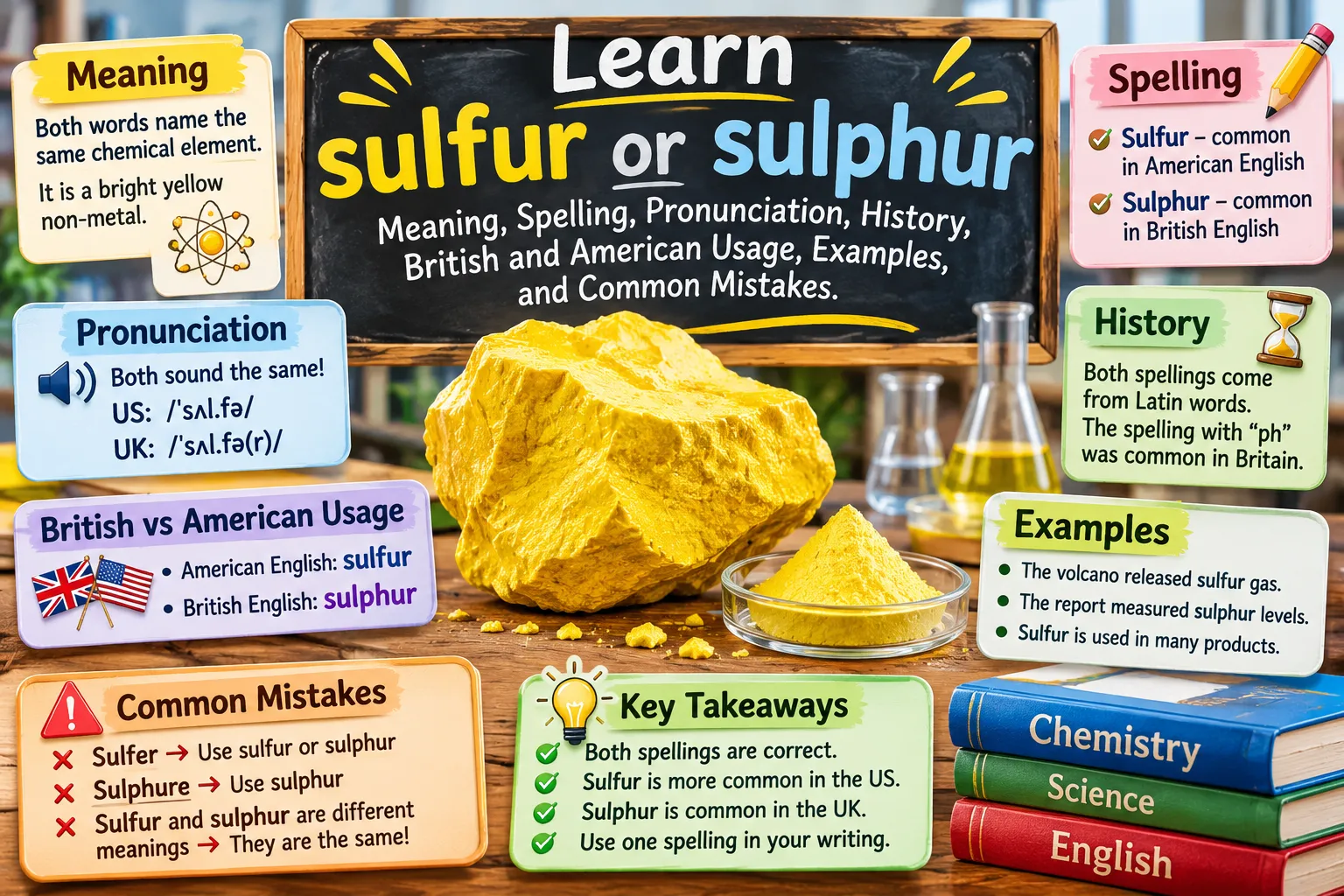
Sulfur and sulphur are two spellings of the same chemical element. Sulfur is common in American English. Sulphur is still common in British English.
Imagine reading a science book from another country. You see the word sulphur, but your school book says sulfur. You may wonder if one word is wrong. There is no need to worry. Both spellings are correct.
Sulfur is a natural element. It is often yellow and has a strong smell in some forms. It is found in rocks, soil, and living things. Also it is also used to make many useful products.
People search for “sulfur or sulphur” because the words look different. The extra letters can cause confusion. But the meaning does not change. Only the spelling changes. This guide explains both forms in simple words. It also shows their history, pronunciation, and use in daily life.
Pronunciation
Both words have almost the same sound. The letters ph in sulphur sound like f.
| Word | US pronunciation | UK pronunciation |
| Sulfur | /ˈsʌl.fɚ/ | /ˈsʌl.fə(r)/ |
| Sulphur | /ˈsʌl.fɚ/ | /ˈsʌl.fə(r)/ |
The stress is on the first part of each word. Both sound like “SUL-fur.”
Difference Between Sulfur and Sulphur
Sulfur and sulphur have the same meaning. Their main difference is spelling and use in different places.
1. Different Spelling
The word sulfur uses the letter f. The word sulphur uses ph instead.
Examples:
- The volcano released sulfur gas.
- The old book used the spelling sulphur.
2. American English
American English usually uses sulfur. This spelling is common in US schools, books, and reports.
Examples:
- The lab tested the sulfur sample.
- Sulfur is listed on the science chart.
3. British English
Many British writers still use sulphur. However, sulfur is also used in British science books.
Examples:
- The report measured sulphur in the soil.
- The science book explained sulfur.
4. Scientific Writing
IUPAC is a group that helps set chemical names. It prefers the spelling sulfur.
Examples:
- Sulfur has the symbol S.
- The student wrote sulfur in the chemistry test.
5. School Books
The spelling may depend on the country and book. Many modern science books use sulfur.
Examples:
- The American textbook uses sulfur.
- An older British book may use sulphur.
6. Dictionary Use
Many English dictionaries accept both spellings. Both words have the same meaning.
Examples:
- The dictionary lists sulphur as a British spelling.
- The sulfur entry gives the same meaning.
7. Related Chemical Words
The spelling can also change in some related chemical names. Science often uses forms that begin with sulf-.
Examples:
- Sulfuric acid is used in some car batteries.
- Copper sulfate is used in some products.
8. History
Both spellings have been used for many years. Sulphur was common in older British writing. Sulfur became the preferred form in science.
Examples:
- The old label says sulphur.
- The modern report says sulfur.
9. Use Around the World
Different countries may use different spellings. Many science groups use sulfur.
Examples:
- A writer in India may use sulphur.
- An international science paper may use sulfur.
10. Writing Style
Both spellings are correct. The best choice depends on your readers and writing style.
Examples:
- Use sulfur in an American science report.
- Use sulphur if your British style guide asks for it.
More information about https://orchoice.com/igniter-or-ignitor/
Nature and Behaviour of Sulfur and Sulphur
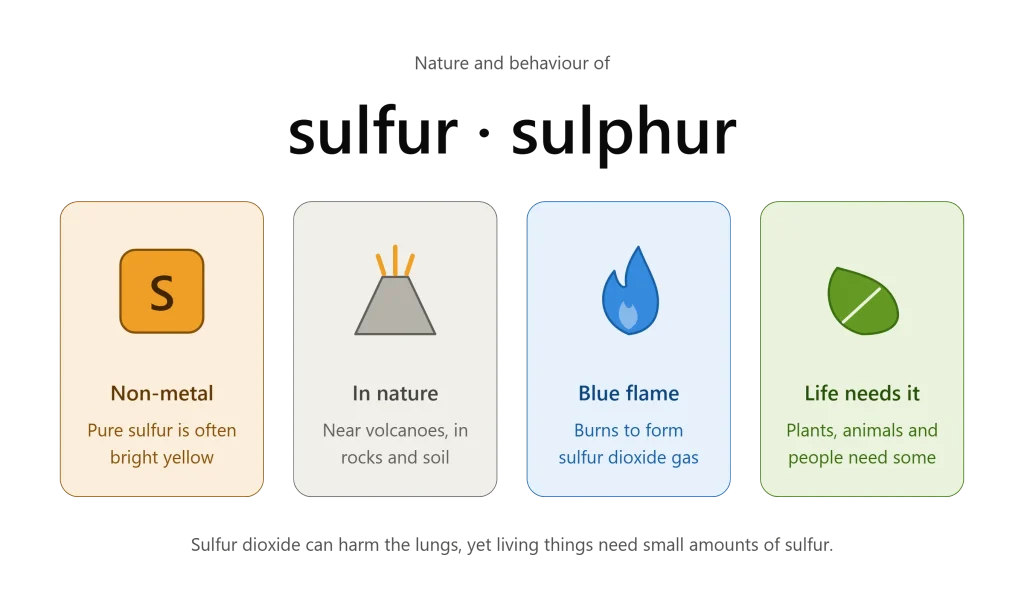
Sulfur is a natural chemical element. It is a non-metal. This means it does not have the same features as metals like iron or copper.
Pure sulfur is often bright yellow. It can be found near volcanoes and in rocks. It is also found in soil and some minerals.
Sulfur can burn with a blue flame. When it burns, it forms a gas called sulfur dioxide. This gas can harm the lungs and make breathing harder.
Sulfur is also important for living things. Plants need small amounts of it to grow. People and animals also need it as part of their bodies.
Why People Get Confused About Sulfur and Sulphur
People get confused because the words look different. One uses f, while the other uses ph.
The spelling also changes by region. American English usually uses sulfur. Traditional British English often uses sulphur.
Science has made the choice easier. IUPAC prefers sulfur as the standard chemical spelling. This spelling is now common in science around the world.
Both forms are still used in English. The meaning stays the same, even when the spelling changes.
Comparison Table
| Feature | Sulfur | Sulphur |
| Meaning | Chemical element | Same chemical element |
| Spelling | Uses f | Uses ph |
| American English | Standard spelling | Less common |
| British English | Used in science | Traditional spelling |
| Pronunciation | SUL-fur | SUL-fur |
| Chemical symbol | S | S |
| Atomic number | 16 | 16 |
| Science use | Preferred by IUPAC | Found in older writing |
| Related forms | Sulfate, sulfide | Sulphate, sulphide may appear |
| Correctness | Correct | Also correct |
The Origin of Sulfur and Sulphur
The word sulfur has a long history. It came into English through old French forms. Older Latin also used forms like sulfur and sulphur.
The deeper start of the word is not fully clear. Some word experts link it to an old word meaning “to burn.”
For many years, British writers often used sulphur. American writers used sulfur. Both forms remained in use.
In 1990, IUPAC chose sulfur as its preferred spelling. The Royal Society of Chemistry followed this choice in 1992. This helped make sulfur common in science.
No single person discovered sulfur. People have known about it since ancient times.
British vs American English
The main difference is simple. American English usually uses sulfur. British English has often used sulphur.
Today, British science also uses sulfur. Many science groups follow the same spelling rules around the world.
| Point | American English | British English |
| Common spelling | Sulfur | Sulphur |
| Science spelling | Sulfur | Sulfur is also common |
| Older books | Both forms appear | Sulphur is common |
| Pronunciation | SUL-fur | SUL-fuh |
| Related forms | Sulfate, sulfide | Sulphate, sulphide may appear |
Examples:
- US: The lab found sulfur in the sample.
- UK: The lab found sulphur in the sample.
- Science: The report measured sulfur dioxide.
- Older text: The report measured sulphur dioxide.
Which One Should You Use?
Your choice depends on your readers.
- For the United States: Use sulfur. It is the standard spelling.
- For the United Kingdom: Sulphur is still common. Sulfur is also accepted.
- For science: Use sulfur. IUPAC prefers this form.
- For global readers: Use sulfur. It is common in science writing.
- For old books: Keep sulphur when you copy the original text.
Common Mistakes
Here are some spelling mistakes to avoid.
| Wrong or Confusing Form | Correct Form | Explanation |
| Sulfer | Sulfur or sulphur | This spelling is wrong. |
| Sulphure | Sulphur | Do not add a final e. |
| Sulfer dioxide | Sulfur dioxide | Use the correct chemical name. |
| Sulphur dioxide | Sulphur dioxide or sulfur dioxide | Both forms are used. |
| Sulfur and sulphur are different elements | They are the same element | Only the spelling changes. |
| Sulphur is always wrong | Both forms are accepted | Use the form that fits your style. |
Tip: Do not mix both spellings in one article without a reason. Pick one form and use it throughout.
Everyday Usage Examples
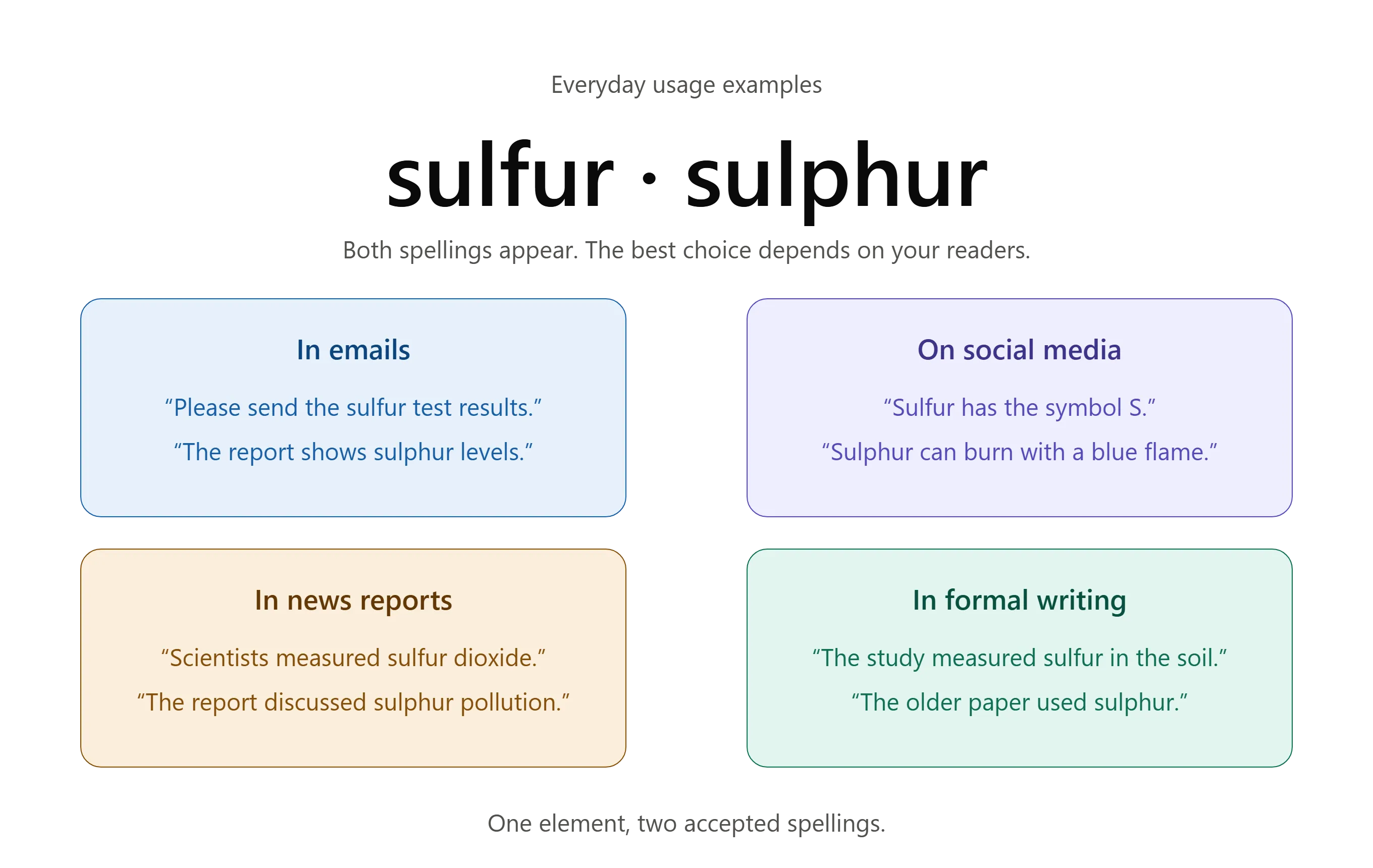
Both spellings appear in books, reports, and daily writing. The best choice depends on your readers.
In Emails
- Please send the sulfur test results today.
- The report shows sulphur levels in the soil.
On Social Media
- I learned that sulfur has the symbol S.
- Did you know sulphur can burn with a blue flame?
In News Reports
- Scientists measured sulfur dioxide near the volcano.
- The report discussed sulphur pollution from factories.
In Formal Writing
- The study measured sulfur in the soil.
- The older paper used the spelling sulphur.
Usage Trends
The spelling sulfur is now common in science. This change grew after IUPAC chose it in 1990.
American English has used sulfur for many years. British English once used sulphur more often.
Today, both forms still appear in British writing. Many science groups around the world prefer sulfur.
Older books may still use sulphur. This is why readers can see both spellings online and in print.
Metaphors and Similes
Sulfur is a real chemical element. It does not have a special meaning for feelings. Still, writers can use it in creative comparisons.
These examples show how a writer might use the word.
Metaphors
- “The sulfur smell was a warning.” This links the smell with danger.
- “His words were sulfur in the room.” This suggests that his words made people feel uneasy.
Similes
- “The air smelled like sulfur.” This gives an image of a strong smell.
- “The yellow rock looked like sulfur.” This compares the rock’s color with sulfur.
Connotative Meaning
The word sulfur has no strong feeling by itself. Its tone depends on how a writer uses it.
Positive Tone
In science and farming, sulfur can suggest growth and useful work.
- Sulfur helps plants grow.
- The farmer tested the soil for sulfur.
Negative Tone
Sulfur can remind people of bad smells, smoke, and dirty air.
- The sulfur smell made us leave the room.
- Sulfur dioxide can harm the lungs.
Neutral Tone
In science, sulfur is simply the name of an element.
- Sulfur has the chemical symbol S.
- The sample contains sulfur.
Idioms and Proverbs
There are few common sayings that use sulfur or sulphur. However, the older word brimstone appears in the phrase “fire and brimstone.”
This phrase can describe strong warnings about punishment or disaster. It often appears in religious or dramatic writing.
Examples:
- The speaker gave a fire-and-brimstone warning.
- The old story spoke of fire and brimstone.
There is no widely used proverb built around sulfur or sulphur.
Literature and Movies
Sulfur and brimstone appear in stories about fire, danger, and volcanoes.
Literature
The Bible’s Book of Genesis tells the story of Sodom and Gomorrah. It describes “brimstone and fire.” Brimstone is an old name for sulfur.
The Wycliffe Bible from 1382 is an early English example of this wording.
Movies
The film Dante’s Peak came out in 1997 in the United States. It tells a story about a dangerous volcano. The film helps show why people study volcanic gases and sulfur dioxide.
Why This Difference Matters
Knowing both spellings helps you read and write with care. You may see sulfur in a new science book. You may see sulphur in an older British text.
This knowledge is useful at school and work. A science report should follow the spelling rules of its guide. A website should also use one spelling style.
Neither form changes the meaning. Learning the difference can help you avoid mistakes. It also helps you read books from different countries.
Usefulness in Daily Life
You may see the word sulfur in science lessons and news reports. It can also appear on product labels and in farming guides.
The word is often used in stories about volcanoes and air pollution. It also appears in lessons about the periodic table.
Knowing both forms helps you understand old and new texts. It also makes online searches easier.
Situational Preference
Use sulfur for American readers and most science writing. It is the spelling preferred by IUPAC. Use sulphur if a British style guide asks for it. Many British readers know both forms. If you write for people around the world, sulfur is a clear choice. When you quote an old book, keep its original spelling. In every case, stay with one form. This keeps your work clear and easy to read.
Possible Asked Question
1. Are sulfur and sulphur the same thing?
Yes. Both words name the same chemical element. Only the spelling is different.
2. Which spelling is correct in American English?
Sulfur is the standard American spelling. It is common in US schools and science books.
3. Which spelling is correct in British English?
Sulphur is still common in British English. However, sulfur is also used, especially in science.
4. How do you pronounce sulfur and sulphur?
Both words have almost the same sound. The stress is on the first part: SUL-fur.
5. What is the chemical symbol for sulfur?
The chemical symbol is S. Its atomic number is 16.
6. Why does science use sulfur instead of sulphur?
IUPAC chose sulfur as its preferred spelling in 1990. This helps keep chemical names clear around the world.
7. Is sulphur a spelling mistake?
No. Sulphur is an accepted English spelling. It is still used in British and other forms of English.
Conclusion
Sulfur and sulphur are two spellings of the same chemical element. They do not have different meanings. The main difference is how people spell the word in different places. American English usually uses sulfur. Traditional British English often uses sulphur. Both forms are correct in English. Science has made the choice easier. IUPAC prefers sulfur as the standard spelling. This is why many modern science books use the f form. You may still find sulphur in older books and British writing. Think about your readers when you choose a spelling. Use sulfur for American readers and most science work. Use sulphur when your style guide asks for it. Keep one form throughout your article. This simple step will help your writing stay clear and correct.

I’m Samia Jamshaid, an English language specialist, SEO specialist, digital publisher, and researcher. I create clear, accurate, and well-researched content on English grammar, vocabulary, word meanings, and language comparisons, helping readers understand and use English with confidence.