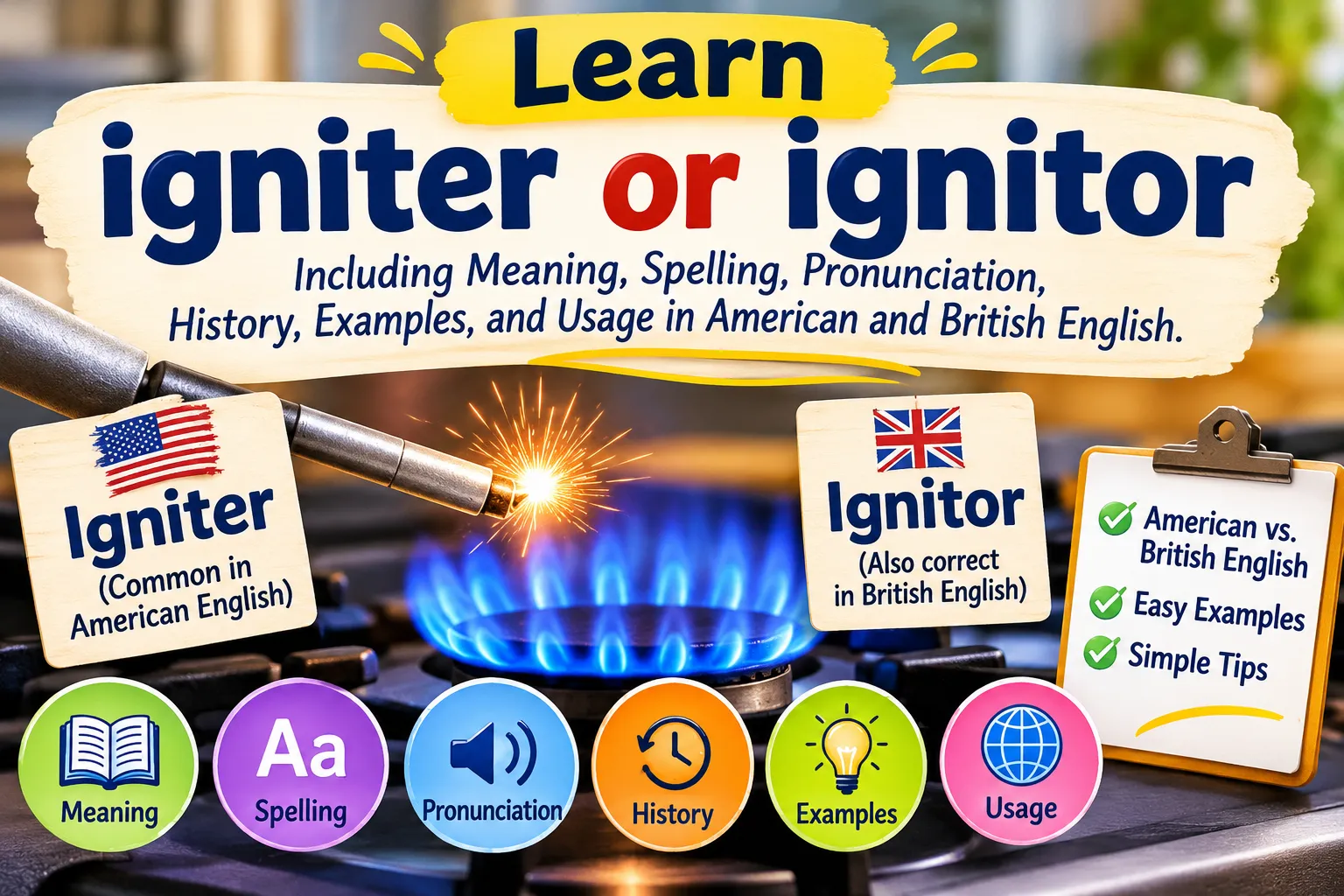
Igniter and ignitor are two accepted spellings of the same word. Both name a device or thing that starts a fire.
Imagine turning on your gas stove. You press the button, but the burner does not light. A small part may have stopped working. That part is often called an igniter.
The word igniter is common in modern English. The spelling ignitor is also correct. It appears in some older books, product names, and technical papers.
Both words come from the verb ignite. This verb means to start a fire or make something burn. An igniter can create a spark or heat. This helps light gas, fuel, or another material.
People often search for “igniter or ignitor” because the two words look almost the same. They may wonder if one is wrong. The good news is that both are accepted. The main difference is spelling and common use. This guide explains both forms with simple rules and examples.
Pronunciation
Both words have almost the same pronunciation. The ending changes in spelling, but not in sound.
| Word | US pronunciation | UK pronunciation |
| Igniter | /ɪɡˈnaɪtər/ | /ɪɡˈnaɪtə/ |
| Ignitor | /ɪɡˈnaɪtər/ | /ɪɡˈnaɪtə/ |
Both sound like “ig-NY-ter.” The stress falls on the second part.
Difference Between Igniter and Ignitor
The words have the same basic meaning. Both can name a device or thing that starts burning. The ten points below explain their spelling and use.
1. Spelling
The main difference is the last part of each word. Igniter ends in -er. Ignitor ends in -or.
Examples:
- The oven igniter needs repair.
- The old manual calls it an ignitor.
2. Common Use
Igniter is the more common choice in general English. Ignitor is less common but still accepted.
Examples:
- The repair shop ordered a new igniter.
- The machine uses a small ignitor.
3. American English
American English usually uses igniter. You will often see it in product guides and repair notes.
Examples:
- The gas grill has an electric igniter.
- The car needs a new igniter.
4. British English
British English uses igniter too. The spelling ignitor also appears in some British writing and technical terms.
Examples:
- The engineer checked the igniter.
- The old guide listed an ignitor.
5. Technical Writing
Both forms can appear in technical writing. The spelling may depend on the maker or the guide being used.
Examples:
- The repair guide explains how the igniter works.
- The factory manual uses the word ignitor.
6. Product Names
Some makers use igniter on their product labels. Others may use ignitor. Always check the name on the product.
Examples:
- I ordered an oven igniter online.
- The box lists a gas ignitor.
7. Meaning
Both words describe something that starts a fire or burning process. Neither spelling has a separate basic meaning.
Examples:
- The igniter creates a spark.
- The ignitor starts the burner.
8. Word History
Both words come from the verb ignite. The ending -er or -or helps form a noun for a person or thing that does an action.
Examples:
- The word igniter comes from ignite plus -er.
- The word ignitor comes from ignite plus -or.
9. Formal Writing
Both spellings can be used in formal writing. Still, igniter is a clear choice for most readers.
Examples:
- The report describes the oven igniter.
- The older report uses the term ignitor.
10. Consistency
The most important rule is to stay consistent. Choose one spelling and use it throughout your work.
Examples:
- Use igniter in every section of your article.
- Keep ignitor if you are copying a manual that uses it.
Learn more about https://orchoice.com/lasagna-or-lasagne/
Nature and Behaviour of Igniter and Ignitor
An igniter is usually a device that helps start a fire. It may create a spark or produce heat. This can light gas or another fuel.
You may find igniters in gas stoves, ovens, grills, heaters, and some engines. The exact design depends on the machine.
The word can also describe a person or thing that starts an event. For example, a small problem may become the igniter of a larger fight.
Ignitor works in the same way. It has the same basic meaning. The spelling does not change how the device works.
Why People Get Confused About Igniter and Ignitor
People get confused because the words look and sound almost the same. Only one letter changes in the ending.
English uses both -er and -or to form nouns. There is no simple rule that works for every word. For example, English has teacher and actor.
The two spellings also appear in product guides and technical papers. A person may see igniter on one product and ignitor on another.
This can make both forms seem like different words. They are not. Both are accepted spellings with the same basic meaning.
Comparison Table
| Feature | Igniter | Ignitor |
| Meaning | A thing that starts burning | Same meaning |
| Part of speech | Noun | Noun |
| Ending | -er | -or |
| US use | More common | Less common |
| UK use | Used | Also appears |
| Pronunciation | ig-NY-ter | ig-NY-ter |
| Word root | Ignite | Ignite |
| Product guides | Common | Found in some guides |
| Technical use | Accepted | Accepted |
| General writing | Often preferred | Less common |
The Origin of Igniter and Ignitor
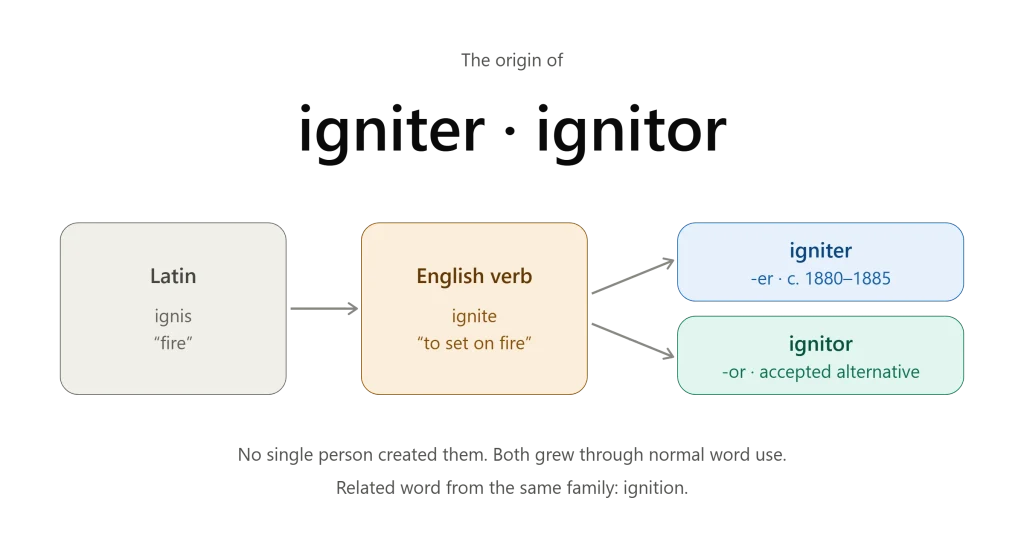
Both words come from the verb ignite. This verb means to set something on fire or make it burn.
The verb has roots in Latin. The Latin word ignis means “fire.” The related word ignition also comes from this word family.
The noun igniter was first recorded in English around 1880–1885. It was formed by adding -er to ignite. The ending -er often names a person or thing that does an action.
The spelling ignitor was formed with -or instead. It is an accepted alternative spelling.
There was no single person who created these two forms. They grew through normal English word use.
British vs American English
American English usually favors igniter. British English also uses this form. The spelling ignitor appears in some British and other English texts.
It is not correct to say that ignitor belongs only to British English. Both forms can appear in different regions.
| Point | American English | British English |
| Common form | Igniter | Igniter |
| Alternative form | Ignitor | Ignitor |
| Pronunciation | /ɪɡˈnaɪtər/ | /ɪɡˈnaɪtə/ |
| Product guides | Often use igniter | May use either form |
| General advice | Use igniter | Use the style guide’s choice |
Examples:
- US: The oven igniter is not working.
- UK: The oven igniter needs to be checked.
- Technical use: The manual lists an ignitor.
- Older use: The guide describes an ignitor system.
Which One Should You Use?
Your choice depends on your readers and the type of writing.
- For the United States: Use igniter. It is the more familiar form.
- For the United Kingdom: Igniter is a safe choice. You may also see ignitor.
- For global readers: Use igniter for simple, clear writing.
- For technical work: Follow the spelling used by the maker or manual.
- For product names: Keep the spelling shown on the product.
Common Mistakes
Here are some mistakes to avoid.
| Mistake | Better Form | Explanation |
| Igniter and ignitor have different meanings. | They have the same basic meaning. | Only the spelling changes. |
| Ignitor is always wrong. | Ignitor is accepted. | It is an alternative spelling. |
| Ignightor | Ignitor | Do not add extra letters. |
| Ignitier | Igniter | The correct ending is -er. |
| The igniter means the act of burning. | Ignition means the act of starting to burn. | An igniter is a thing or device. |
| The ignitor is the fuel itself. | An ignitor starts the burning process. | It is not the fuel. |
Tip: Do not mix the two spellings in one article. Choose one form and keep it.
Everyday Usage Examples
Both spellings can appear in daily writing. Here are simple examples from common settings.
In Emails
- Please order a new igniter for the oven.
- The repair guide lists this part as an ignitor.
On Social Media
- My grill igniter stopped working today.
- Does anyone know where to buy a gas ignitor?
In News Reports
- The team found a fault in the heater igniter.
- The report named the damaged part as an ignitor.
In Formal Writing
- The study explains how an electric igniter starts a flame.
- The old manual describes the use of an ignitor.
Usage Trends
Igniter is the more common spelling in general English sources. It is also widely used in modern product guides and repair writing.
Ignitor is less common, but it has not disappeared. It still appears in older texts, product names, and some technical records.
The use of each form can change by country and industry. There is no need to call ignitor a spelling mistake.
For clear writing, igniter is usually the easier choice. If a company or manual uses ignitor, keep that spelling when you refer to its product.
Metaphors and Similes
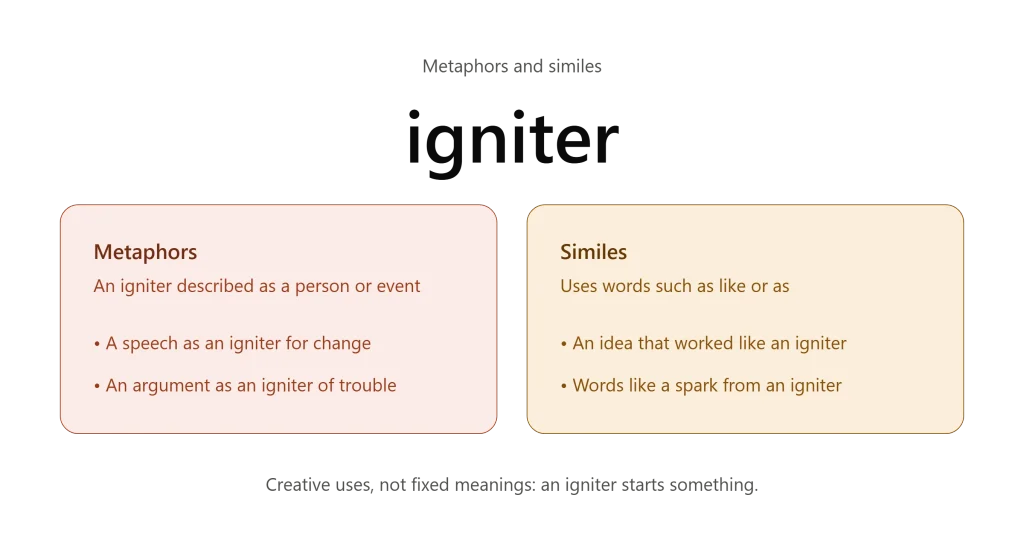
An igniter starts a fire. Writers can also use the word to describe a person, event, or idea that starts change.
These are creative uses, not fixed meanings.
Metaphors
- “Her speech was an igniter for change.” Her speech helped start change.
- “The small argument became an igniter of trouble.” The argument started a bigger problem.
Similes
- “The new idea worked like an igniter.” It started action.
- “His words spread like a spark from an igniter.” His words quickly started a strong reaction.
Connotative Meaning
The word igniter has no fixed good or bad feeling. Its meaning depends on the sentence.
Positive Tone
It can suggest a fresh start, new ideas, or useful action.
- Her plan was an igniter for change.
- The teacher became an igniter of new ideas.
Negative Tone
It can suggest trouble, anger, or a harmful event.
- The rumor became an igniter of conflict.
- His harsh words were an igniter of anger.
Neutral Tone
It can simply name a device or part.
- The stove’s igniter needs repair.
- The machine uses an electric ignitor.
Idioms and Proverbs
There are no widely known idioms or proverbs that use igniter or ignitor as a fixed phrase.
However, English has common fire-related phrases. These can help explain the idea.
Add Fuel to the Fire
This means to make a problem worse.
- His angry reply added fuel to the fire.
Spark an Idea
This means to cause someone to think of something new.
- The book sparked an idea for her project.
Light a Fire Under Someone
This means to make someone act faster.
- The coach’s words lit a fire under the team.
Literature and Movies
The word igniter is mostly used in science and technical writing. It is not a common word in famous stories or film titles.
Literature
Old technical books used the word to name fire-starting devices. For example, Webster’s New International Dictionary (1924) included an entry and drawing for an igniter.
Genre: Reference book and technical dictionary.
Publisher: G. & C. Merriam Company.
Year: 1924.
This is a real reference work, not a novel or play.
Movies
The 2025 Chinese drama film Igniter uses the word as its title. Its story follows a young man who builds a secret network during a time of change.
Country: China.
Year: 2025.
Genre: Drama.
The title also uses the figurative idea of starting a movement or change.
Why This Difference Matters
Knowing both spellings helps you read and write with care. You may see igniter on a new oven. You may find ignitor in an older manual.
This knowledge is useful for students, writers, and workers. It can help you search for the right part when a machine needs repair.
It also helps you avoid calling a correct spelling wrong. Both forms are accepted. The choice often depends on style, region, or product names.
Usefulness in Daily Life
You may see the word igniter when buying or fixing a stove, oven, grill, or heater. It helps you name the part that starts the flame.
You may also see ignitor in an old guide or product list. Knowing both forms helps you find the right information.
The word can also be used in a wider way. A person or event can be an igniter of change. This means it helps start something new.
Situational Preference
Use igniter in most schoolwork, blogs, and general writing. It is the more common form and is easy for readers to know. In the US, it is the usual choice. In the UK, it is also widely understood. Use ignitor if a product label, company guide, or older manual uses it. In technical work, follow the exact name in the source. For global readers, igniter is a clear choice. Most of all, keep one spelling throughout your text.
Possible Asked Question
1. Are igniter and ignitor the same?
Yes. Both words name a person, thing, or device that starts a fire. The main difference is spelling.
2. Which spelling is more common?
Igniter is more common in general English. Ignitor is an accepted alternative.
3. Is ignitor a spelling mistake?
No. Ignitor is a correct alternative spelling. It is less common than igniter.
4. How do you pronounce igniter and ignitor?
Both words sound almost the same. The stress falls on the second part: ig-NY-ter.
5. What does an igniter do?
An igniter starts a fire or burning process. It may create a spark or heat to light fuel.
6. Where can you find an igniter?
You can find igniters in gas stoves, ovens, grills, heaters, and some engines. The type depends on the machine.
7. Which spelling should I use in formal writing?
Use igniter unless your style guide or product manual uses ignitor. Both forms are accepted.
Conclusion
Igniter and ignitor are two accepted spellings of the same word. Both name a person, thing, or device that starts a fire. The main difference is the ending. One uses -er, while the other uses -or. The spelling igniter is more common in modern English. It is a clear choice for schoolwork, blogs, and general writing. The form ignitor is also correct. You may see it in older books, product names, and technical guides. Both words have the same basic meaning and sound almost the same. You do not need to learn two different meanings. Just remember the spelling choice. Use igniter when you want a common form. Keep ignitor when you follow a source that uses it. This simple rule will help you write with care and avoid confusion.

I’m Samia Jamshaid, an English language specialist, SEO specialist, digital publisher, and researcher. I create clear, accurate, and well-researched content on English grammar, vocabulary, word meanings, and language comparisons, helping readers understand and use English with confidence.









1 thought on “Igniter or Ignitor: Which Form Is More Common? 2026”