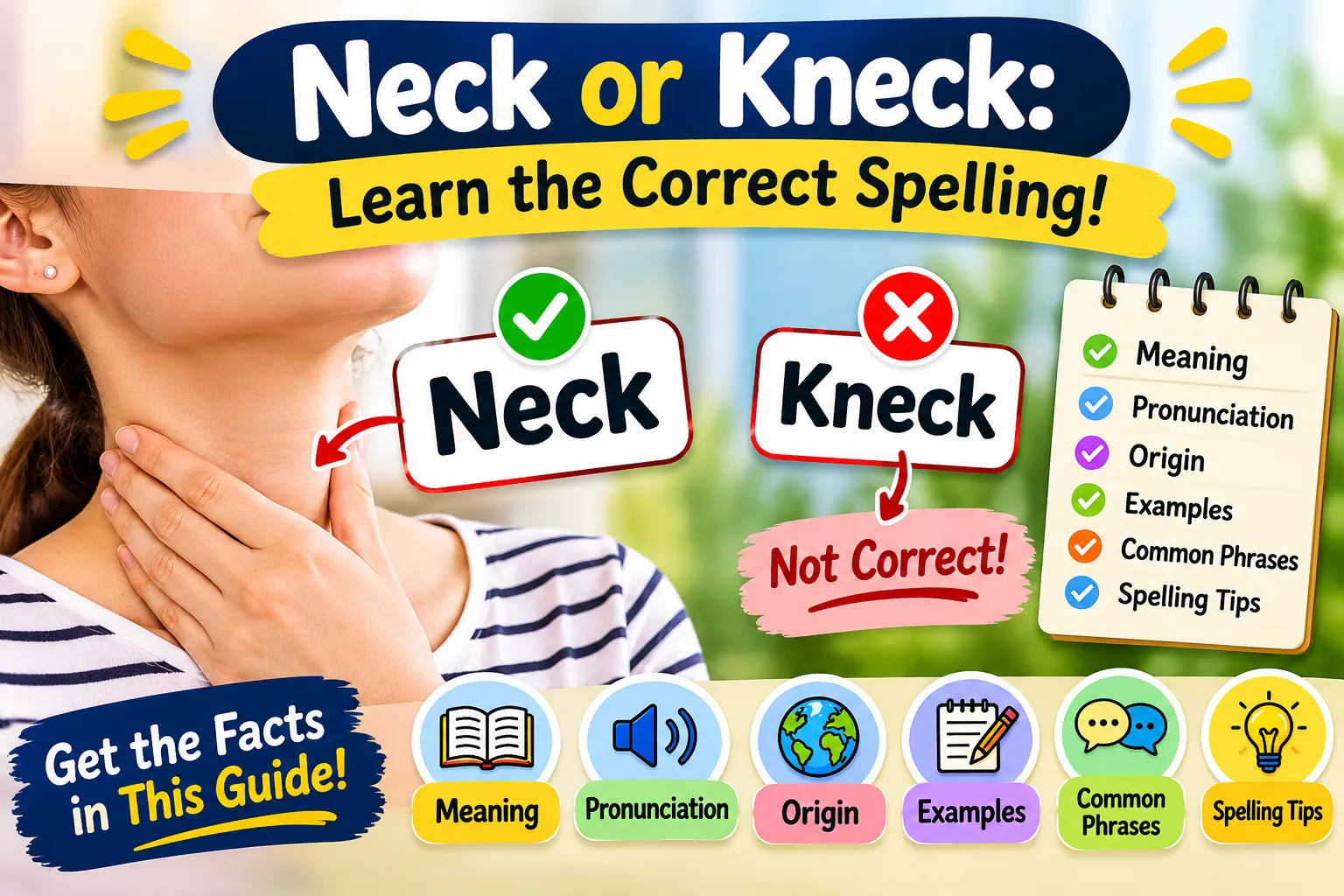
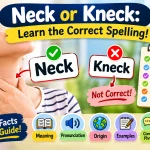
Neck is the correct spelling. Kneck is a spelling mistake.
Have you ever typed a word and wondered if it looked right? Many people face this problem with neck and kneck. The two forms look almost the same. However, only one is accepted in standard English.
The word neck names the part of the body between the head and the shoulders. It is also used for the narrow part of some objects, such as a bottle or guitar. The word can appear in daily talks, emails, books, and news stories.
People search for “neck or kneck” because the letters can be confusing. The silent letter k at the start of kneck may seem possible to some learners. But English does not use that spelling for this word. Learning the correct form helps you write clear messages and avoid spelling errors.
This guide explains the meaning, sound, history, and use of neck. It also shows why kneck is incorrect and how to avoid this mistake.
Pronunciation of Neck and Kneck
| Word | US pronunciation | UK pronunciation | Status |
| Neck | /nek/ | /nek/ | Correct |
| Kneck | No standard pronunciation | No standard pronunciation | Misspelling |
Transition: Now, let’s look at ten simple points that show how these two spellings differ.
Difference Between Neck and Kneck
There are not ten separate meanings to learn here. Neck is a real English word, while kneck is a misspelling. The points below explain the difference from ten useful angles.
1. Correct Spelling
Neck is the correct spelling. It appears in standard English dictionaries. Kneck is not the standard spelling.
Examples:
- Correct: She wore a scarf around her neck.
- Incorrect: She wore a scarf around her kneck.
2. Meaning
Neck means the body part that joins the head to the rest of the body. Kneck has no standard English meaning.
Examples:
- Correct: My neck hurts after a long day.
- Incorrect: My kneck hurts after a long day.
3. Part of Speech
Neck is mainly used as a noun. It can also be used as a verb in informal English. Kneck is not a standard noun or verb.
Examples:
- Noun: The giraffe has a long neck.
- Verb: The narrow part of the bottle forms its neck.
4. Pronunciation
Neck sounds like “nek.” It begins with the /n/ sound. The spelling kneck has no accepted standard pronunciation.
Examples:
- Correct: Please move your neck slowly.
- Incorrect: Please move your kneck slowly.
5. First Letter
The word neck starts with n. The letter k does not belong at the start of this word.
Examples:
- Correct: He felt pain in his neck.
- Incorrect: He felt pain in his kneck.
6. Use in Body Parts
People use neck when they talk about the body. It connects the head and the trunk. Kneck cannot be used in this meaning.
Examples:
- Correct: The doctor checked my neck.
- Incorrect: The doctor checked my kneck.
7. Use for Objects
The word neck can also name a narrow part of an object. For example, a bottle or guitar has a neck.
Examples:
- Correct: Hold the bottle by its neck.
- Incorrect: Hold the bottle by its kneck.
8. Use in Common Phrases
The word neck appears in many common English phrases. Examples include “neck and neck” and “neck of the woods.” Kneck is not used in these phrases.
Examples:
- The two runners were neck and neck.
- I live in a quiet neck of the woods.
9. Use in Writing
Writers use neck in schoolwork, emails, books, and reports. Writing kneck can make a sentence look incorrect.
Examples:
- Correct: The animal has a thick neck.
- Incorrect: The animal has a thick kneck.
10. Dictionary Use
Neck has clear dictionary meanings and a long history. Kneck is not the standard English spelling for those meanings.
Examples:
- Correct: Look up the word neck in a dictionary.
- Incorrect: Look up the word kneck in a dictionary.
You May Also Like https://orchoice.com/response-or-responce/
Nature and Behaviour of Neck and Kneck
Neck
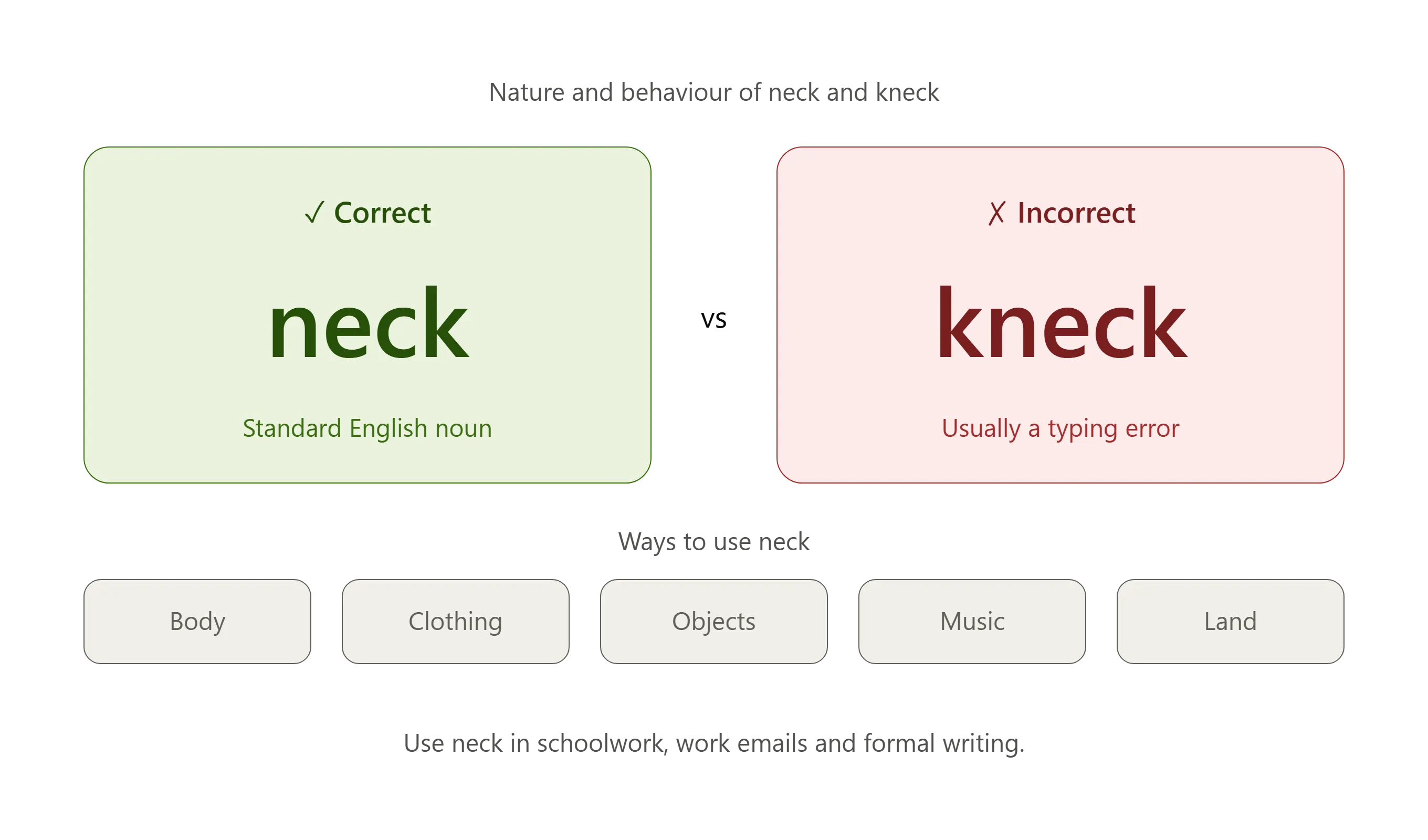
Neck is a common English noun. It names the body part between the head and the trunk. It is also used for narrow parts of objects.
The word has several uses:
- Body: The neck supports the head.
- Clothing: A shirt can have a high neck.
- Objects: A bottle has a narrow neck.
- Music: A guitar has a long neck.
- Land: A narrow strip of land can be called a neck.
It can also be a verb in informal English. In this use, it can mean to kiss or embrace someone.
Kneck
Kneck is not a standard English word for the body part or the narrow part of an object. It is usually a typing or spelling error.
Do not use it in schoolwork, work emails, reports, or formal writing.
Why People Get Confused About Neck and Kneck
People may add a silent k because English has words that begin with kn. For example, knee, knife, and know begin with a silent k.
This pattern may make kneck look possible. But the correct spelling is different.
The word neck starts with n. It does not need a k before the n.
Another reason is typing speed. People may add an extra letter by mistake. Spell-check tools can help find this error.
Remember this simple rule:
Write neck, not kneck.
Comparison Table
| Feature | Neck | Kneck |
| Spelling | Correct | Incorrect |
| Standard English word | Yes | No |
| Meaning | Body part; narrow part of an object | No standard meaning |
| Part of speech | Noun; also an informal verb | Not standard |
| US pronunciation | /nek/ | Not established |
| UK pronunciation | /nek/ | Not established |
| Dictionary use | Listed in English dictionaries | Not a standard spelling |
| Formal writing | Accepted | Avoid |
| Everyday use | Common | Spelling error |
| Example | My neck feels stiff. | My kneck feels stiff. |
The Origin of Neck
The word neck has a long history. It comes from Old English hnecca, which meant the neck or the back of the neck.
It later appeared in Middle English as nekke. Over time, the spelling became neck.
The word is related to words in other Germanic languages. For example, Dutch has nek, and German has Nacken, which means the nape or back of the neck.
The word gained other uses over time. People began using it for narrow parts of objects. Today, we speak of a bottle neck, a guitar neck, and a neck of land.
The spelling kneck is not the standard form that developed from this history.
British vs American English
There is no spelling difference between British and American English for this word.
Both use neck. Both pronounce it /nek/.
| Point | American English | British English |
| Correct spelling | Neck | Neck |
| Incorrect spelling | Kneck | Kneck |
| Pronunciation | /nek/ | /nek/ |
| Body meaning | Same | Same |
| Object meaning | Same | Same |
Examples:
- US: My neck hurts today.
- UK: My neck hurts today.
- US: The bottle has a narrow neck.
- UK: The bottle has a narrow neck.
Which One Should You Use?
Use neck in every type of standard English writing.
- In the US: Write neck.
- In the UK: Write neck.
- In other countries: Write neck.
- In schoolwork: Use neck.
- In work emails: Use neck.
- In formal writing: Use neck.
Common Mistakes
Here are common errors and their corrections.
| Incorrect form | Correct form |
| Kneck | Neck |
| My kneck hurts. | My neck hurts. |
| A long kneck | A long neck |
| Neck pain in the kneck | Neck pain in the neck |
| The kneck of a bottle | The neck of a bottle |
| A scarf around my kneck | A scarf around my neck |
Tips to Remember the Correct Spelling
- Start the word with n.
- Do not add a silent k.
- Remember the simple sound: /nek/.
- Read the word aloud when you check your writing.
- Use a spell-check tool if you are unsure.
Everyday Usage Examples
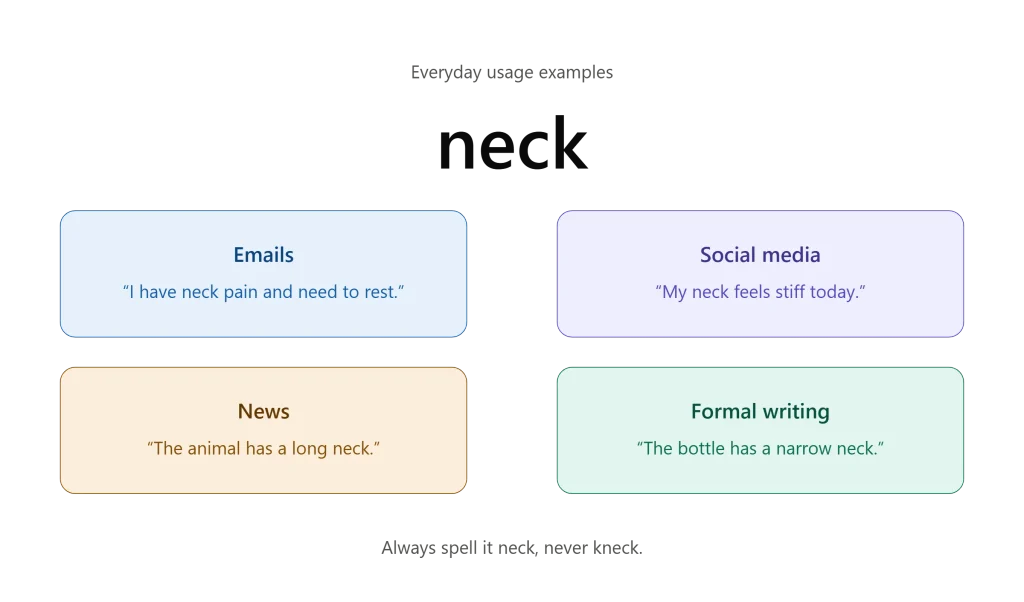
The word neck appears in many types of writing.
1. Emails
- I have neck pain and need to rest today.
- Please choose a shirt with a comfortable neck.
2. Social Media
- My neck feels stiff after sitting all day.
- This scarf looks great around the neck.
3. News
- Doctors warn that poor posture can cause neck pain.
- The animal has a long neck that helps it reach leaves.
4. Formal Writing
- The neck connects the head to the trunk.
- The bottle has a narrow neck that controls the flow of liquid.
In each example, neck is the correct spelling. Do not replace it with kneck.
Usage Trends
Neck is a common word in English. People use it in health, clothing, sports, music, and daily life.
You may see it in searches about neck pain, neck exercises, shirt necklines, and guitar parts. It also appears in common phrases such as “neck and neck.”
Kneck is not a standard spelling. It does not have a normal place in formal or everyday English. If it appears online, it is usually a typo or a spelling mistake.
Metaphors and Similes
The word neck can appear in figurative language. These uses give it meanings beyond the body part.
1. Neck and Neck
This phrase means two people or teams are very close in a race or contest.
Example: The two teams were neck and neck until the final minute.
2. Stick Your Neck Out
This phrase means to take a risk.
Example: She stuck her neck out to help her friend.
3. Up to Your Neck
This phrase means to have too much work or trouble.
Example: I am up to my neck in homework.
4. A Neck of the Woods
This phrase means a local area or neighborhood.
Example: Welcome to my neck of the woods.
5. As Stiff as a Board
This simile can describe a very stiff neck or body.
Example: After the long drive, my neck felt as stiff as a board.
These phrases use neck, not kneck.
Connotative Meaning
The word neck has a mostly neutral meaning. It names a body part. Its tone can change in phrases and sentences.
Positive Tone
The word can appear in warm or caring situations.
- She placed a soft scarf around her neck.
- He gave his child a gentle hug around the neck.
Negative Tone
It can appear in sentences about pain, injury, or danger.
- He felt sharp pain in his neck.
- The tight collar pressed against her neck.
Neutral Tone
It can describe a body part or an object.
- The neck joins the head to the trunk.
- The neck of the bottle is narrow.
Kneck has no standard positive, negative, or neutral meaning. It is a misspelling.
Idioms and Proverbs
Several common English expressions use the word neck. There are no standard idioms that use kneck as the correct form.
| Expression | Meaning | Example |
| Neck and neck | Very close in a race | The two runners were neck and neck. |
| Stick your neck out | Take a risk | I will stick my neck out and support the plan. |
| Up to your neck | Very busy or deeply involved | She is up to her neck in work. |
| Neck of the woods | A local area | He grew up in this neck of the woods. |
| Breathe down someone’s neck | Watch or pressure someone closely | My manager keeps breathing down my neck. |
| Save your neck | Avoid trouble or danger | He told the truth to save his neck. |
These expressions show how a body-part word can gain figurative meanings.
Literature and Movies
The word neck appears in many kinds of writing and film. Writers may use it to describe the body, show fear, or create a common phrase.
It can appear in:
- Fiction: A writer may describe a character’s neck or neck pain.
- Mystery stories: A neck injury may be part of a crime scene.
- Adventure stories: A character may risk their neck to help someone.
- Sports films: “Neck and neck” may describe a close race.
- Family films: A hug around the neck may show love.
There is no well-known literary or movie distinction between neck and kneck. The spelling kneck is not a standard form. It should not be presented as a separate word in a book or film title without checking the exact source.
Why This Difference Matters
Correct spelling helps readers understand your message. A small mistake can make writing look careless.
The difference matters for English learners because kneck may look possible. Words such as knee and knife begin with a silent k. But neck does not.
Using the correct spelling also helps with:
- School tasks and exams.
- Work emails and reports.
- Online searches.
- Health questions.
- Clear messages to other people.
When you use neck, readers know the word you mean. When you write kneck, they may think it is a typo.
Usefulness in Daily Life
We may need the word neck in many daily situations.
You can use it when you talk to a doctor about pain. You can use it when you buy a shirt or scarf. We can also use it when you describe a bottle, guitar, or animal.
For example:
- My neck hurts when I turn my head.
- This shirt has a round neck.
- The giraffe has a very long neck.
- Hold the bottle by its neck.
Situational Preference
Use neck in every situation where you mean the body part or a narrow part of an object. This rule applies in the US, the UK, and other English-speaking places. Use it in school tasks, job applications, emails, reports, and social media posts. If you see kneck in a message, treat it as a spelling mistake unless a source clearly shows it is a special name. Do not use kneck as a normal English word. When in doubt, check a trusted dictionary and choose neck.
Common Questions and Answers
1. Is neck or kneck correct?
Neck is correct. Kneck is a misspelling.
2. What does neck mean?
A neck is the body part that joins the head to the trunk. It can also mean a narrow part of an object.
3. Is kneck a real English word?
Kneck is not a standard English word for the body part. Use neck instead.
4. How do you pronounce neck?
Both US and UK English pronounce neck as /nek/. It has one syllable.
5. Why do people spell neck as kneck?
Some people may add a silent k because words such as knee and knife begin with kn. But neck does not follow that spelling pattern.
6. Does neck have a plural form?
Yes. The plural is necks.
Example: The giraffes have long necks.
7. Is neck spelled the same in British and American English?
Yes. Both British and American English use neck.
Conclusion
The correct spelling is neck, not kneck. Neck is the body part that joins the head to the trunk. It can also mean a narrow part of an object, such as a bottle or guitar. The word has been used in English for many years. It comes from Old English hnecca and later appeared as Middle English nekke. Both US and UK English use the same spelling and pronunciation. The word sounds like /nek/. You can use it in schoolwork, emails, reports, and daily talks. The mistake often happens because English has words such as knee and knife, which begin with a silent k. But neck does not need that letter. Remember this simple rule: write neck every time. This small step will help you write with more care and confidence.

I’m Samia Jamshaid, an English language specialist, SEO specialist, digital publisher, and researcher. I create clear, accurate, and well-researched content on English grammar, vocabulary, word meanings, and language comparisons, helping readers understand and use English with confidence.









1 thought on “Neck or Kneck: Correct Spelling, Meaning, and Examples”