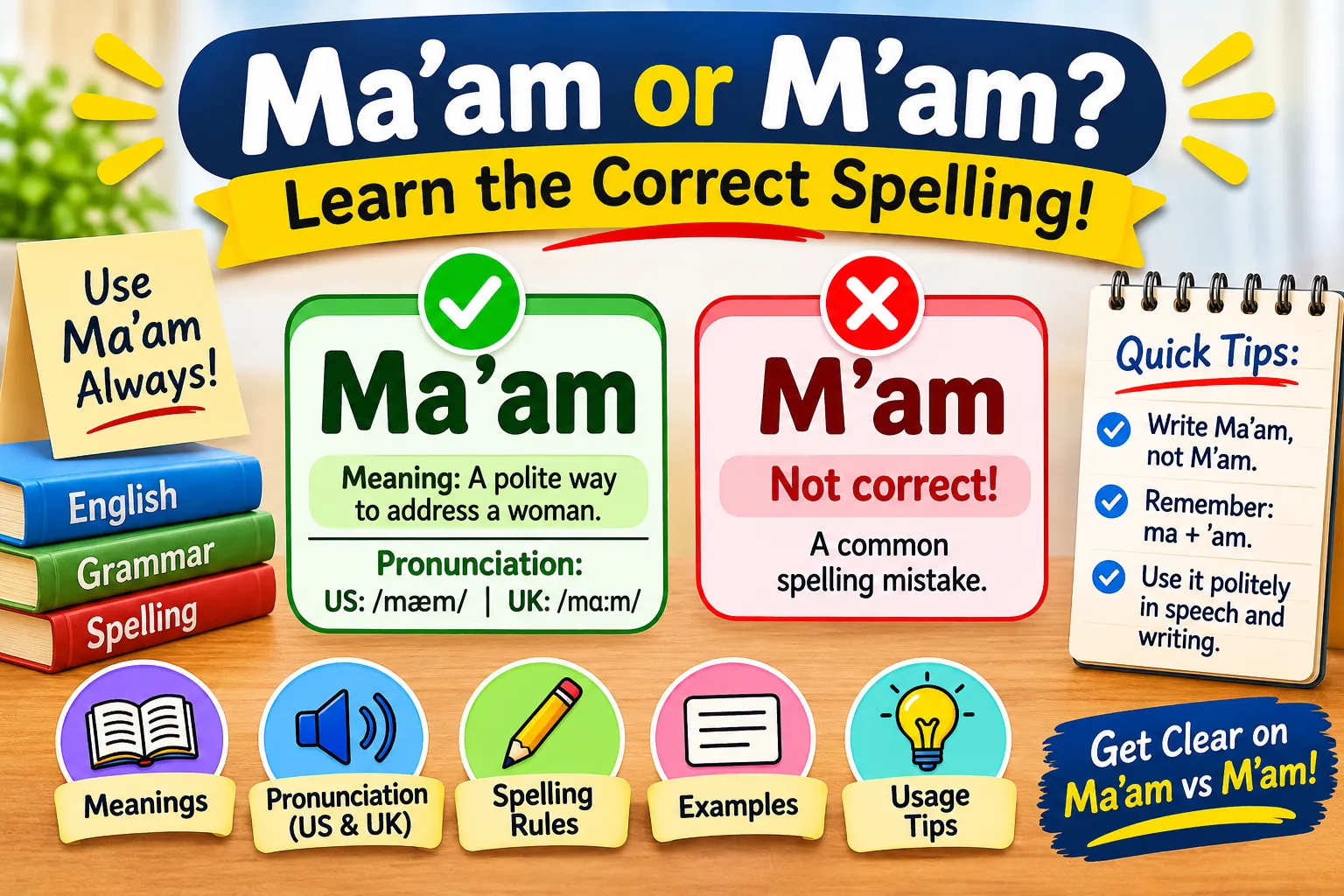
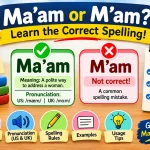
Ma’am is the correct spelling. M’am is a common spelling mistake.
Imagine you are speaking to a woman at a shop. You want to sound polite, so you say, “Excuse me, ma’am.” You may wonder whether to write ma’am or m’am. Both forms may look possible because they are short forms of a longer word. However, only one is the standard spelling.
Ma’am is a short form of madam. People use ma’am or m’am as a polite way to address a woman. It is common in the United States. In Britain, it is often used for the Queen or women in certain senior roles.
The spelling m’am is not the standard form. It is usually a typing or spelling error. Many people search for ma’am or m’am because the apostrophe can be confusing. They want to know where it belongs and which form to use in writing.
This guide explains the correct spelling, meaning, pronunciation, and history. It also gives simple examples and useful writing tips.
Difference Between Ma’am or M’am
The main difference is simple: ma’am is correct, while m’am is not standard English. They do not have two separate meanings. The points below explain how to use the correct form.
1. Correct Spelling
Ma’am is the accepted spelling. M’am is not the standard form.
Examples:
- Yes, ma’am, I understand.
- Good morning, ma’am.
2. Meaning
Ma’am is a polite way to address a woman. M’am has no separate standard meaning.
Examples:
- Can I help you, ma’am?
- Thank you, ma’am, for your time.
3. Word Origin
Ma’am comes from the longer word madam. M’am is not the accepted short form.
Examples:
- The customer said, “Thank you, ma’am.”
- The student asked, “May I come in, ma’am?”
4. Apostrophe Placement
In ma’am, the apostrophe shows that letters have been left out of madam. The apostrophe comes after the first ma.
Examples:
- Please wait here, ma’am.
- Yes, ma’am, I will do that.
5. Pronunciation
Ma’am has a clear spoken form. M’am is not a standard written word with its own accepted pronunciation.
Examples:
- “Can I help you, ma’am?” asked the worker.
- “Yes, ma’am,” replied the student.
6. Use in Conversation
People use ma’am to speak politely to a woman. M’am should not be used in place of it.
Examples:
- Excuse me, ma’am. You dropped your bag.
- Would you like some help, ma’am?
7. Use in Formal Writing
Ma’am can appear in letters, emails, and other formal messages. M’am should be corrected before sending.
Examples:
- Dear Ma’am, I am writing about my application.
- Thank you for your reply, ma’am.
8. Use in American English
Ma’am is common in American English. People often use it when speaking to a woman they do not know.
Examples:
- How can I help you, ma’am?
- Yes, ma’am. Your order is ready.
9. Use in British English
Ma’am is used in Britain in certain formal settings. It is used when addressing the Queen and some senior women in the police or armed forces.
Examples:
- The officer replied, “Yes, ma’am.”
- The royal visitor was addressed as “Ma’am.”
10. Use in Everyday Messages
Ma’am is suitable when you want to show respect. M’am is a spelling error and should be avoided.
Examples:
- Good evening, ma’am. I have sent the file.
- Thank you, ma’am. I will check it today.
You May Also Like https://orchoice.com/neck-or-kneck/
Nature and Behaviour of Ma’am or M’am
Ma’am
Ma’am is a noun used as a form of address. ma’am or m’am is a polite way to speak to a woman. It comes from the word madam.
People often use it with strangers, customers, teachers, and women in senior roles. Its use depends on the place and the situation.
Examples:
- May I ask you a question, ma’am?
- The teacher said, “Please sit down, ma’am.”
M’am
M’am is not the standard spelling of this title. It is usually a mistake made when writing ma’am.
It does not have a separate meaning or a different use in standard English. If you see it in a message, the writer may have meant ma’am.
Examples:
- Incorrect: Thank you, m’am.
- Correct: Thank you, ma’am.
Why People Get Confused
People often confuse these spellings because both are short. Ma’am or M’am also look similar when written.
The apostrophe can make the spelling harder to remember. Some writers place it after the first letter by mistake. Others may type too quickly and leave out the second a.
Another reason is the longer word madam. People know that ma’am is a short form, but they may not remember its exact spelling.
The easiest way to remember it is this:
- Ma’am: Correct spelling.
- M’am: Nonstandard spelling; avoid it.
Comparison Table
| Feature | Ma’am | M’am |
| Spelling | Correct | Not standard |
| Meaning | Polite form of address | No separate standard meaning |
| Origin | Short form of madam | Not an accepted short form |
| Apostrophe | After “ma” | Placed incorrectly |
| Pronunciation | Has accepted pronunciations | No standard pronunciation |
| Grammar | Noun used when speaking to someone | Not standard English |
| American English | Common | Avoid |
| British English | Used in formal settings | Avoid |
| Formal writing | Accepted | Incorrect |
| Everyday use | Suitable when respectful address is needed | Should be corrected |
The Origin of Ma’am
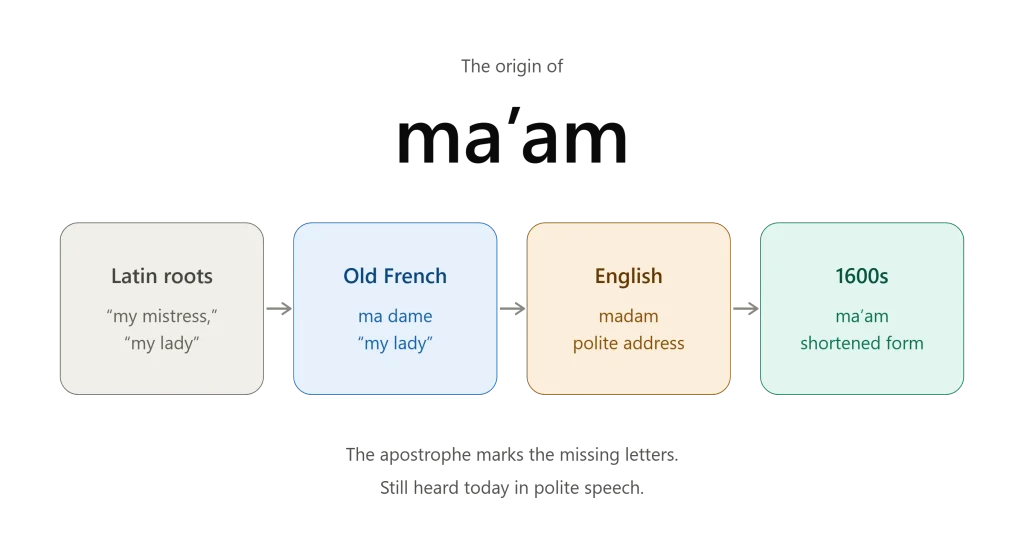
The word ma’am comes from madam. It became a shorter form of the word during the 1600s.
The word madam came into English through Old French ma dame. This phrase means “my lady.” Its older roots are linked to Latin words meaning “my mistress” or “my lady.”
Over time, people shortened madam to ma’am in speech and writing. The apostrophe marks the missing letters.
The form ma’am has been used for centuries. It is still found in modern English, especially in polite speech.
British vs American English
Both British and American English use ma’am. However, the situations in which people use it can differ.
| Feature | American English | British English |
| Spelling | Ma’am | Ma’am |
| Pronunciation | Usually /mæm/ | Often /mɑːm/; usage depends on context |
| Common use | Polite way to address a woman | Often used for the Queen and senior women in some roles |
| Daily speech | Common in many areas | Less common in everyday speech |
| Formal settings | Used in service and official settings | Used in royal, police, and military settings |
| M’am | Not standard | Not standard |
American English Examples
- Can I help you, ma’am?
- Yes, ma’am. I have your order.
British English Examples
- The officer answered, “Yes, ma’am.”
- The royal greeting was followed by “Ma’am.”
The main point is that the spelling stays the same. The sound and common use can change by region.
Which One Should You Use?
Use ma’am in both American and British English. Do not use m’am in standard writing.
- For American readers: Use ma’am when speaking politely to a woman. It is common in many parts of the United States.
- For British readers: Use ma’am in the right formal settings. It is linked with royal and senior official forms of address.
- For global readers: Use ma’am when a respectful title is suitable. If you are unsure, using the person’s name may sound more natural.
Always check the apostrophe before sending an email or message.
Common Mistakes
Here are common errors and their correct forms.
| Incorrect Form | Correct Form | Explanation |
| M’am | Ma’am | The standard spelling is ma’am. |
| Mam | Ma’am | Mam can mean mother in some regions, but it is not the standard spelling of this title. |
| Maam | Ma’am | The apostrophe is needed in standard writing. |
| Ma’am’s | Ma’ams or ma’ams | Use the plural form when needed; avoid adding an apostrophe for a simple plural. |
| Dear M’am | Dear Ma’am | Use the correct spelling in greetings. |
| Yes, m’am | Yes, ma’am | The apostrophe must follow “ma.” |
Tips to Avoid These Mistakes
- Remember that ma’am comes from madam.
- Keep the first two letters together: ma.
- Place the apostrophe after ma.
- Check the spelling before sending formal messages.
- Do not use m’am as an alternative.
Everyday Usage Examples
Ma’am is often used when someone wants to sound polite. Here are examples from common situations.
In Emails
- Dear Ma’am, I am writing to ask about the job.
- Thank you, ma’am, for your quick reply.
On Social Media
- Thank you for your kind words, ma’am.
- Yes, ma’am! I will share the details soon.
On News and Reports
- The officer said, “Yes, ma’am.”
- The woman was addressed as ma’am during the meeting.
In Formal Writing
- Dear Ma’am, please find my application attached.
- I would like to thank you, ma’am, for your support.
In Daily Conversation
- Excuse me, ma’am. Is this seat free?
- Could you help me, ma’am?
Usage Trends
Ma’am remains common in American English, especially in polite replies and customer service. It is also used in formal settings in Britain.
In some places, people use it often. In others, it may sound too formal or old-fashioned. Many speakers now prefer a person’s name or another simple greeting.
The spelling m’am is not a standard form. It should not be used as a new spelling or a regional version.
Usage can change with age, place, and social setting. When in doubt, choose a polite form that suits the person and situation.
Metaphors and Similes
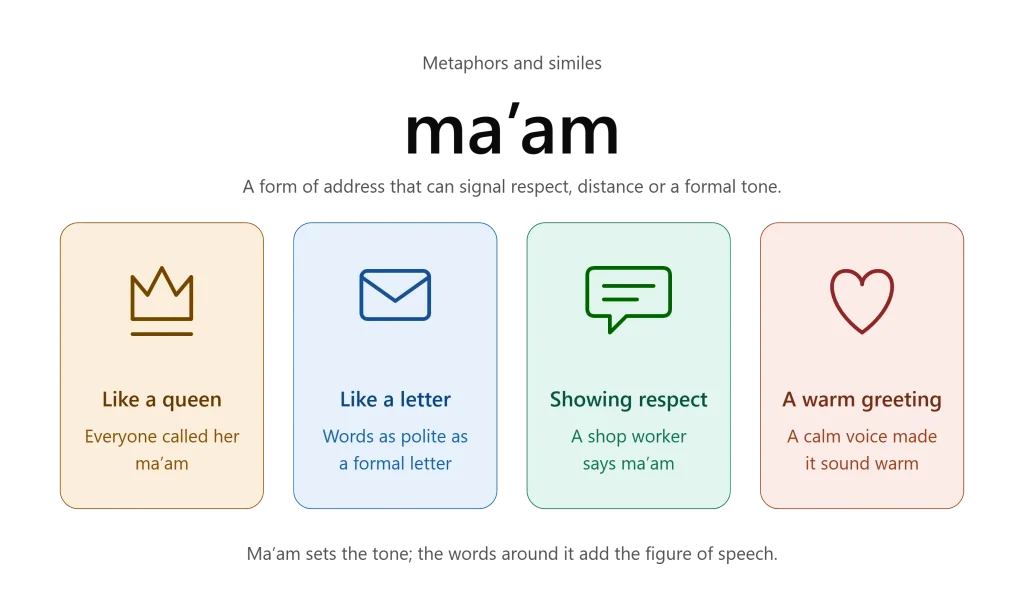
Ma’am is a form of address, not a word with its own figurative meaning. Still, writers may use it in dialogue to show respect, distance, or a formal tone.
Here are some simple examples:
- “She spoke like a queen, and everyone called her ma’am.”
- “His words were as polite as a formal letter.”
- “The shop worker used ma’am to show respect.”
- “Her calm voice made the greeting sound warm.”
Connotative Meaning
The word ma’am can create different feelings based on the speaker and setting.
Positive Tone
Ma’am can sound polite, kind, and respectful.
Examples:
- Thank you, ma’am, for your help.
- Good morning, ma’am. It is nice to meet you.
Negative Tone
In some situations, ma’am can sound cold or sarcastic. This depends on the speaker’s voice and the words around it.
Examples:
- “Yes, ma’am,” he said in an angry voice.
- “Whatever you say, ma’am,” she replied with a sharp tone.
Neutral Tone
Ma’am can simply be a polite way to address someone. It does not always show strong feelings.
Examples:
- Excuse me, ma’am. Your bag is here.
- Ma’am, your appointment is ready.
Idioms and Proverbs
There are no widely known English idioms or proverbs built around the word ma’am. It is mainly used as a title when speaking to a woman.
However, it appears in common polite phrases.
| Phrase | Meaning | Example |
| Yes, ma’am | A polite reply | “Yes, ma’am. I understand.” |
| No, ma’am | A polite negative reply | “No, ma’am. I did not see it.” |
| Excuse me, ma’am | A polite way to get attention | “Excuse me, ma’am. You dropped this.” |
| Thank you, ma’am | A polite way to show thanks | “Thank you, ma’am, for your help.” |
Literature and Movies
Ma’am appears in many stories and films as a form of polite address. It often helps show a character’s manners, job, age, or place in society.
Literature
In Oliver Twist (1838), Charles Dickens uses forms of polite address in dialogue. The book shows how people speak to others based on their place in society.
Movies
In the American film The Help (2011), characters speak across lines of class and social position. Respectful forms of address help show these relationships. Check the film’s exact dialogue before using it as proof of a particular spelling.
Why This Difference Matters
Correct spelling helps readers understand your message. It also makes your writing look careful and clear.
Using ma’am in the right place can show respect. Writing m’am may distract the reader because it is not the standard form.
This matters in emails, school work, office messages, and customer service. English learners also need to know when a title sounds natural.
The goal is not to use formal words all the time. The goal is to choose words that fit the person and the situation.
Usefulness in Daily Life
You may use ma’am when speaking to a woman you do not know. It can also be useful when speaking to a teacher, customer, or senior officer.
Here are some daily situations:
- At a shop: “Can I help you, ma’am?”
- At school: “May I ask a question, ma’am?”
- At work: “I have sent the report, ma’am.”
- In an email: “Dear Ma’am, thank you for your time.”
- In a public place: “Excuse me, ma’am. You dropped your phone.”
Situational Preference
Use ma’am when you need a polite way to address a woman. It works in American and British English, but its use differs by place. In the United States, it is common in daily speech and customer service. Also in Britain, it is more common in royal and formal settings. In global English, it can be useful when you do not know a woman’s name. However, some people may feel that it sounds too formal. Use the person’s name when that feels more natural. Never use m’am in standard writing.
Possible Questions and Answers
1. Is ma’am or m’am correct?
Ma’am is correct. M’am is not the standard spelling.
2. What does ma’am mean?
Ma’am is a short form of madam. It is a polite way to address a woman.
3. How do you pronounce ma’am in American English?
In common American English, ma’am is pronounced /mæm/. It rhymes with “ham.”
4. How do you pronounce ma’am in British English?
A common British pronunciation is /mɑːm/. The sound can change with the setting and speaker.
5. Does ma’am mean the same as madam?
Yes. Ma’am is a shorter form of madam. Both can be used as polite forms of address.
6. Should I use ma’am in a formal email?
Yes, when you do not know the woman’s name and the setting calls for formal address. If you know her name or title, use that when suitable.
7. Is ma’am rude?
No. It is often polite. However, some people may find it too formal or may not like being addressed that way.
Conclusion
The correct spelling is ma’am, not m’am. Ma’am is a short form of madam. People use it as a polite way to address a woman. It has been part of English for hundreds of years. American and British speakers both use ma’am. However, they do not always use it in the same way. In the United States, it is common in daily speech. The apostrophe is easy to remember. It comes after the letters ma. So, write ma’am in emails, messages, and other formal work. Avoid m’am because it is not standard English. Good spelling makes your message clear. Good manners make your words feel kind. Choose the form that fits the person and the moment.

I’m Samia Jamshaid, an English language specialist, SEO specialist, digital publisher, and researcher. I create clear, accurate, and well-researched content on English grammar, vocabulary, word meanings, and language comparisons, helping readers understand and use English with confidence.






1 thought on “Ma’am or M’am: Correct Spelling, Meaning, and Explanation”