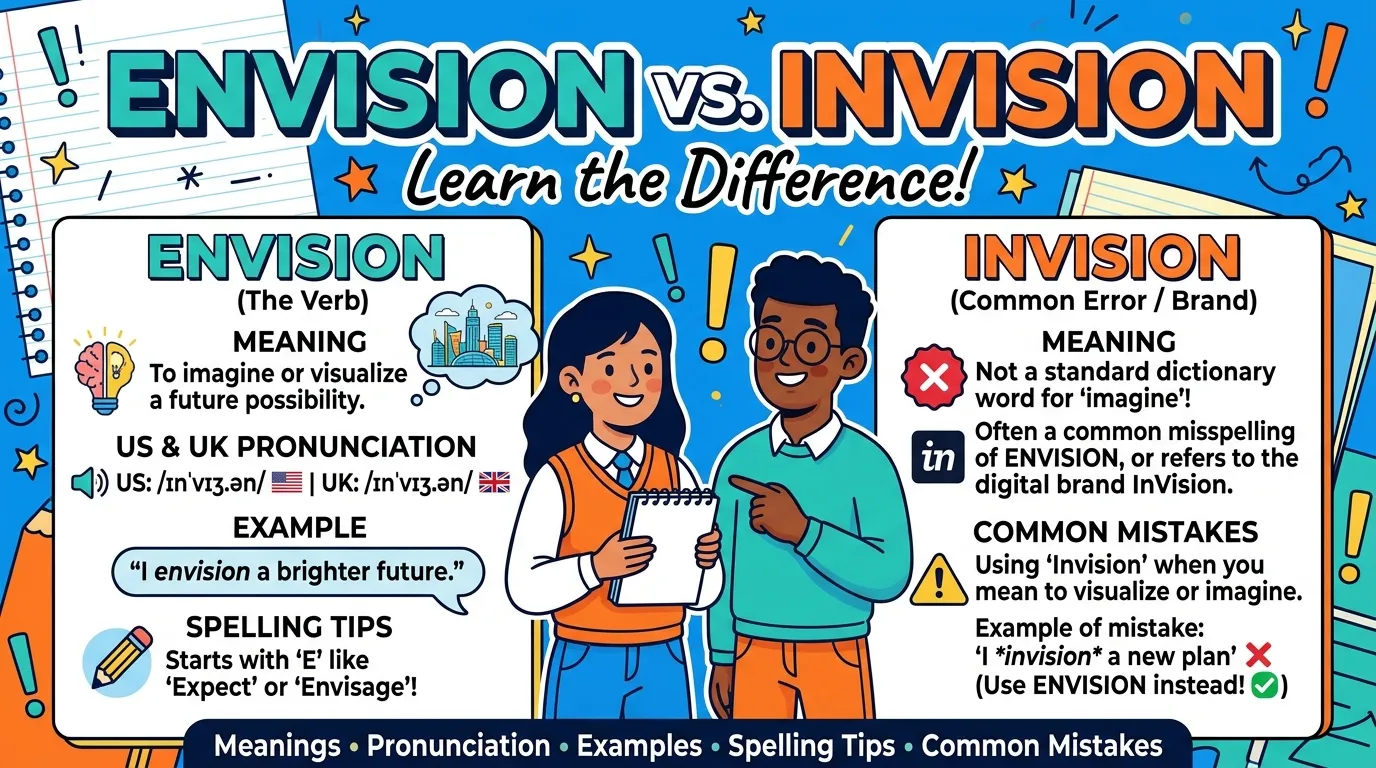
Envision is the correct spelling when you mean to imagine something. Invision is usually a spelling mistake.
Imagine you are planning your dream home. You think about its rooms, garden, and colors. Also you can picture the home in your mind. You are envisioning your future home.
The word envision means to imagine or picture something that may happen. It is often used for plans, goals, and hopes. Many people write invision because it sounds almost the same. The first sound can make the spelling hard to remember.
People often search for envision or invision because they want to know which spelling is right. They may also think that one spelling belongs to British English and the other to American English. That is not the case. Invision is not the standard spelling of the verb. British English also uses envisage, which has a similar meaning.
This guide explains the meanings, sounds, examples, and common mistakes. It will help you choose the right word in daily writing.
Pronunciation of Envision and Invision
| Word | US pronunciation | UK pronunciation |
| Envision | /ɪnˈvɪʒ.ən/ | /ɪnˈvɪʒ.ən/ |
| Invision | No standard pronunciation as an ordinary English word | No standard pronunciation as an ordinary English word |
The words sound almost the same when people say them. This is one reason people mix up their spelling.
Note: Dictionary.com lists invision as a frequent misspelling of envision. The name InVision has also been used as a brand name. A brand name is not the same as a standard English word.
Difference Between Envision and Invision
There is one key spelling rule: use envision when you mean to imagine something. Do not use invision as its replacement.
The ten points below explain the difference from different angles. They do not mean that invision has ten separate meanings.
1. Correct Spelling
Envision is the standard spelling of the verb. Invision is a common spelling error when people mean envision.
Examples:
- I envision a bright future.
- She can envision a new home.
Incorrect examples and corrections:
- Incorrect: I invision a bright future.
- Correct: I envision a bright future.
2. Meaning
Envision means to imagine something or picture it in your mind.
Invision has no standard meaning as a common verb in modern English.
Examples:
- He can envision a better world.
- We envision a new school in our town.
Corrections:
- Incorrect: I invision a better world.
- Correct: I envision a better world.
3. Part of Speech
Envision is a verb. It tells us what someone imagines or expects.
Invision is not the standard verb spelling.
Examples:
- They envision a safe city.
- She envisions a new business.
Corrections:
- Incorrect: He invisions a new life.
- Correct: He envisions a new life.
4. Use in Daily Speech
People use envision when they talk about future plans and goals.
People may say invision by mistake, but it is not the correct spelling for this meaning.
Examples:
- I envision a happy family.
- She envisions a long career in teaching.
Corrections:
- Incorrect: I invision a happy family.
- Correct: I envision a happy family.
5. Use in Formal Writing
Envision is suitable for schoolwork, reports, plans, and business writing.
Invision should not replace it in formal work.
Examples:
- The team envisions a better service.
- The plan envisions a clean city.
Corrections:
- Incorrect: The team invisions a better service.
- Correct: The team envisions a better service.
6. Use for Future Goals
Envision often describes a future goal or plan. It helps readers understand what someone hopes to achieve.
Invision is not the correct spelling for this use.
Examples:
- I envision becoming a teacher.
- They envision opening a shop.
Corrections:
- Incorrect: She invisions becoming a doctor.
- Correct: She envisions becoming a doctor.
7. Use in Business
Businesses use envision when they talk about future plans, growth, or change.
Invision is a spelling mistake when used as this verb.
Examples:
- The company envisions a new market.
- We envision better service for our customers.
Corrections:
- Incorrect: The company invisions more growth.
- Correct: The company envisions more growth.
8. Use in Creative Writing
Writers use envision to describe an idea, place, or future event in the mind.
Invision is not the standard spelling for this meaning.
Examples:
- The writer envisions a world of peace.
- She envisions a city full of green parks.
Corrections:
- Incorrect: The writer invisions a new world.
- Correct: The writer envisions a new world.
9. Word Forms
Envision has several correct forms:
- Envision
- Envisions
- Envisioned
- Envisioning
Do not change the first letter to i.
Examples:
- She envisions a better future.
- They are envisioning a new project.
Corrections:
- Incorrect: He invisioned a new home.
- Correct: He envisioned a new home.
10. Use Across English-Speaking Countries
Envision is the standard spelling in American English. It is also used in British English, though envisage is often preferred in the UK.
Invision is not the British spelling of envision.
Examples:
- US: I envision a better future.
- UK: I envisage a better future.
Corrections:
- Incorrect: I invision a better future.
- Correct: I envision a better future.
Learn more about https://orchoice.com/eating-or-eatting/
Nature and Behaviour of Envision and Invision
Nature of Envision
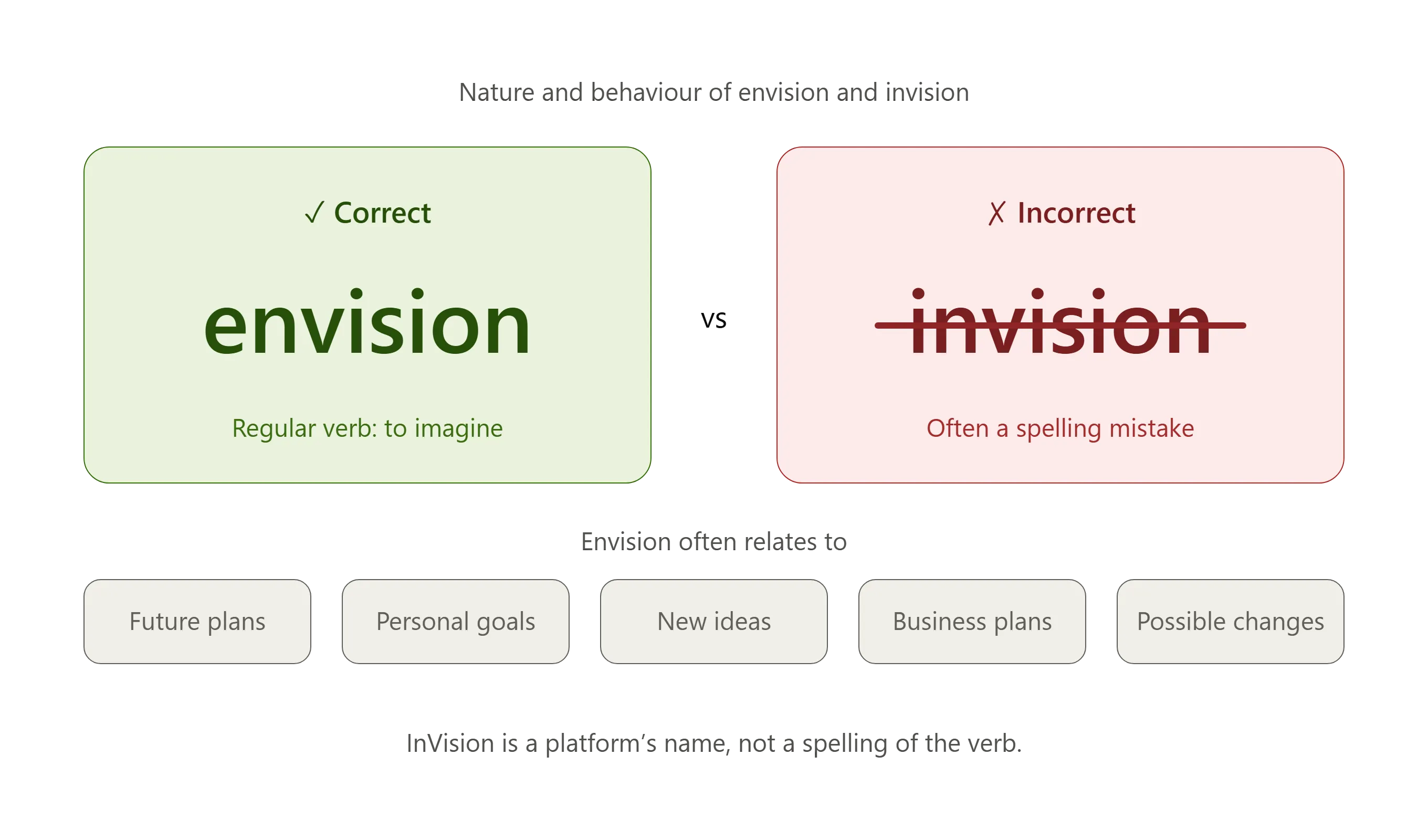
Envision is a regular verb. It means to imagine or picture something that may happen.
It often relates to:
- Future plans
- Personal goals
- New ideas
- Business plans
- Possible changes
Examples:
- I envision a peaceful life.
- The school envisions a better learning space.
Its verb forms are easy to learn:
| Form | Example |
| Base form | envision |
| Third-person form | envisions |
| Past form | envisioned |
| -ing form | envisioning |
Nature of Invision
Invision is not the standard spelling of the verb envision. It is often a spelling mistake.
For example:
- Incorrect: I invision a bright future.
- Correct: I envision a bright future.
There is one special case. InVision has been used as the name of a digital design platform. It is a proper name, not a spelling choice for the verb.
Why People Get Confused About Envision and Invision
People often confuse these spellings because they sound alike. When someone says envision quickly, the first sound may sound like “in.”
This can lead people to write invision. The mistake may also happen when someone types quickly or does not know the correct spelling.
Another reason is the name InVision. People may see this name and think invision is another form of the verb.
Remember this simple rule:
Use envision when you mean to imagine something.
Comparison Table
| Feature | Envision | Invision |
| Standard spelling | Yes | No, not for the verb |
| Part of speech | Verb | No standard verb use |
| Meaning | To imagine or picture | Usually a misspelling of envision |
| Pronunciation | /ɪnˈvɪʒ.ən/ | No standard verb pronunciation |
| Daily use | Common | Uncommon as a spelling |
| Formal writing | Correct | Incorrect for the verb |
| US English | Used | Not an accepted variant |
| UK English | Used; envisage is often preferred | Not an accepted variant |
| Word forms | Envisions, envisioned, envisioning | Do not use as verb forms |
| Special use | Common English verb | InVision was a brand name |
The Origin of Envision
The word envision comes from the prefix en- and the word vision. It began to appear in English in the early 1900s. Its meaning is linked to forming a picture in the mind.
The word vision has a much longer history. It comes from Latin visio, which means sight or the act of seeing.
The spelling invision has a separate history in older English records. Etymonline lists an older noun use from the 1640s with the meaning “want of vision.” However, this old use does not make invision a standard modern spelling of the verb envision.
British vs American English
British and American English both use envision. However, British speakers often prefer envisage.
Envisage also means to imagine or expect something. It is a common choice in British English.
| Feature | American English | British English |
| Common choice | Envision | Envisage |
| Is envision correct? | Yes | Yes |
| Is invision correct for the verb? | No | No |
| Past form | Envisioned | Envisaged |
| -ing form | Envisioning | Envisaging |
American examples:
- I envision a new future.
- She envisioned a large garden.
British examples:
- I envisage a new future.
- She envisaged a large garden.
The spelling invision is not a British alternative.
Which One Should You Use?
Use envision when you mean to imagine something. It is correct in both American and British English.
Here is a simple guide:
- US English: Use envision.
- UK English: Use envision or the often-preferred envisage.
- Global English: Use envision for a clear and widely understood choice.
- Formal writing: Use envision or envisage, based on your audience.
- Daily speech: Use envision or the simpler word imagine.
Do not use invision as the verb. If you are writing about the old design platform, use its proper name, InVision.
Common Mistakes
Here are common mistakes and their corrections.
| Common mistake | Correct form |
| I invision a new home. | I envision a new home. |
| She invisions success. | She envisions success. |
| He invisioned a better life. | He envisioned a better life. |
| They are invisioning a new plan. | They are envisioning a new plan. |
| I invision that it will work. | I envision that it will work. |
| I envision about a new future. | I envision a new future. |
| She has a clear invision. | She has a clear vision. |
Remember:
- Write envision, not invision, when you mean imagine.
- Use envisions with he, she, or it.
- Use envisioned for the past.
- Use envisioning for an action in progress.
- Do not add about after envision.
Everyday Usage Examples
1. In Emails
Use envision when you share a plan or goal.
- I envision a strong team for this project.
- We envision a new way to help our customers.
2. On Social Media
People use envision when they share hopes and dreams.
- Envision the life you want to build.
- I envision a world with more kindness.
3. In News
News writers may use envision when they report plans or future goals.
- City leaders envision a new park.
- The company envisions more jobs next year.
4. In Formal Writing
Use envision in reports, plans, and work documents.
- The report envisions a safer road system.
- The school envisions a better future for its students.
Usage Trends
Envision is a common verb in modern English. People use it when they talk about goals, plans, and future events.
It appears in business writing, news reports, schoolwork, and daily speech. It is also used in personal writing about dreams and hopes.
Invision is much less common as a normal word. Dictionary.com lists it as a frequent misspelling of envision.
There is also the proper name InVision, which was used for a digital design platform. This special name may appear in older technology articles.
For most writing, choose envision.
Metaphors and Similes
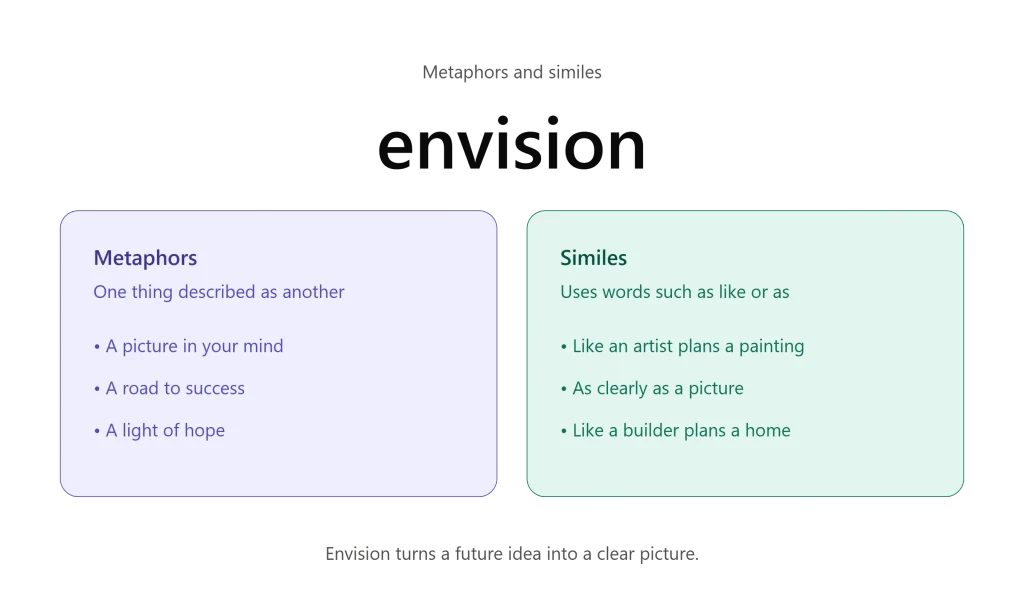
Envision can help us describe ideas and future plans in a creative way.
Metaphors
A metaphor describes one thing as another.
- A picture in your mind: She has a clear picture of her future.
- A road to success: He envisions a road filled with new chances.
- A light of hope: They envision a bright light after a hard time.
Similes
A simile uses words such as like or as.
- She envisions her future like an artist plans a painting.
- He sees his goal as clearly as a picture.
- They envision a better town like a builder plans a new home.
These examples show how envision can describe a clear idea of the future.
Connotative Meaning
A word can carry a feeling as well as a meaning. This feeling is called its connotation.
Positive Tone
Envision often has a positive tone. It can show hope, plans, and big goals.
Examples:
- She envisions a happy future.
- We envision a better school for all children.
Negative Tone
The word itself is not usually negative. However, it can appear in a sentence about a bad plan or result.
Examples:
- He envisions a future full of fear.
- They envisioned a plan that could harm the town.
Neutral Tone
Envision can also have a neutral tone. It can simply describe what someone imagines.
Examples:
- I envision a house near the sea.
- The team envisions three possible plans.
Invision does not have a standard modern meaning as a common verb. It is usually a spelling mistake.
Idioms and Proverbs
There are no widely used English idioms or proverbs built around envision or invision. However, some common phrases express similar ideas.
Picture It
Meaning: Imagine something in your mind.
Example:
- Picture it: a small home beside a lake.
Dream Big
Meaning: Have large hopes and goals.
Example:
- Dream big and work hard for your future.
Look Ahead
Meaning: Think about what may happen in the future.
Example:
- We must look ahead and plan for change.
See the Big Picture
Meaning: Understand the whole plan or situation.
Example:
- Try to see the big picture before making a choice.
These phrases can help you talk about hopes, plans, and future ideas.
Literature and Movies
Writers and film makers often explore dreams, plans, and future hopes. These themes connect with the meaning of envision.
Literature
The Great Gatsby — F. Scott Fitzgerald, 1925, Novel
This novel tells the story of Jay Gatsby. He dreams of a future with Daisy. His hopes shape many of his choices. The story shows how people can picture a future they want.
Movies
The Pursuit of Happyness — 2006, United States, Drama
This film follows Chris Gardner as he faces many problems. He works toward a better life for himself and his son. His goal connects with the idea of envisioning a brighter future.
These works explore related ideas. They are examples of the theme, not proof that the word envision appears in them.
Why This Difference Matters
Correct spelling helps readers understand your message. It also makes your writing look clear and careful.
The word envision is useful when you talk about a future plan or goal. If you write invision by mistake, readers may notice the error. They may also think you are unsure about the word.
This difference matters in schoolwork, job letters, reports, and online posts. It is also useful when you write for people in other countries.
Remember that British English often uses envisage. Both envision and envisage are correct. The spelling invision is not the standard form of the verb.
Usefulness in Daily Life
You can use envision in many parts of daily life.
- At school: Envision the kind of student you want to become.
- At work: Envision a better way to finish a task.
- In business: Envision a new product or service.
- At home: Envision how you want your home to look.
- In personal goals: Envision the future you hope to build.
- In writing: Use envision to explain a plan or dream.
Situational Preference
Use envision when you talk about a clear future plan, goal, or idea. It is a good choice in American English and is understood in British English. In the UK, envisage is often the more common choice. In daily speech, imagine may sound simpler and more natural. Also in schoolwork and business writing, envision works well. Do not use invision as the verb. If you mean the old design platform, write its name as InVision. Choose the word that best fits your reader and your meaning.
Possible Asked Question
1. Is envision or invision correct?
Envision is the correct spelling of the verb. Invision is usually a spelling mistake.
2. What does envision mean?
Envision means to imagine or picture something in your mind. It often relates to a future plan or goal.
3. Is invision a real English word?
Invision is listed by Dictionary.com as a frequent misspelling of envision. It is not the standard spelling of the verb. InVision has also been used as a brand name.
4. Is envision used in British English?
Yes. British English uses envision, but envisage is often preferred.
5. What is the past tense of envision?
The past tense is envisioned.
Example: She envisioned a better future.
6. What are some synonyms for envision?
Common synonyms include imagine, picture, visualize, foresee, and envisage. The best choice depends on the sentence.
7. Is envision the same as imagine?
They have similar meanings. Imagine is more general. Envision often suggests a clear picture of a future plan or goal.
Conclusion
Envision is the correct spelling when you mean to imagine or picture something in your mind. It is often used for goals, plans, dreams, and future events. The spelling invision is usually a mistake. It is not the standard form of the verb. You may also see InVision as a brand name in older technology writing. British and American English both use envision. However, British speakers often prefer envisage. You can also use simple words like imagine or picture in daily speech. The main rule is easy to remember: write envision with an E when you mean to imagine something. This small spelling tip can help you write better emails, schoolwork, reports, and online posts. Always choose the word that makes your meaning clear.

I’m Samia Jamshaid, an English language specialist, SEO specialist, digital publisher, and researcher. I create clear, accurate, and well-researched content on English grammar, vocabulary, word meanings, and language comparisons, helping readers understand and use English with confidence.








1 thought on “Envision or Invision: Find the Correct Spelling and Avoid Mistakes”