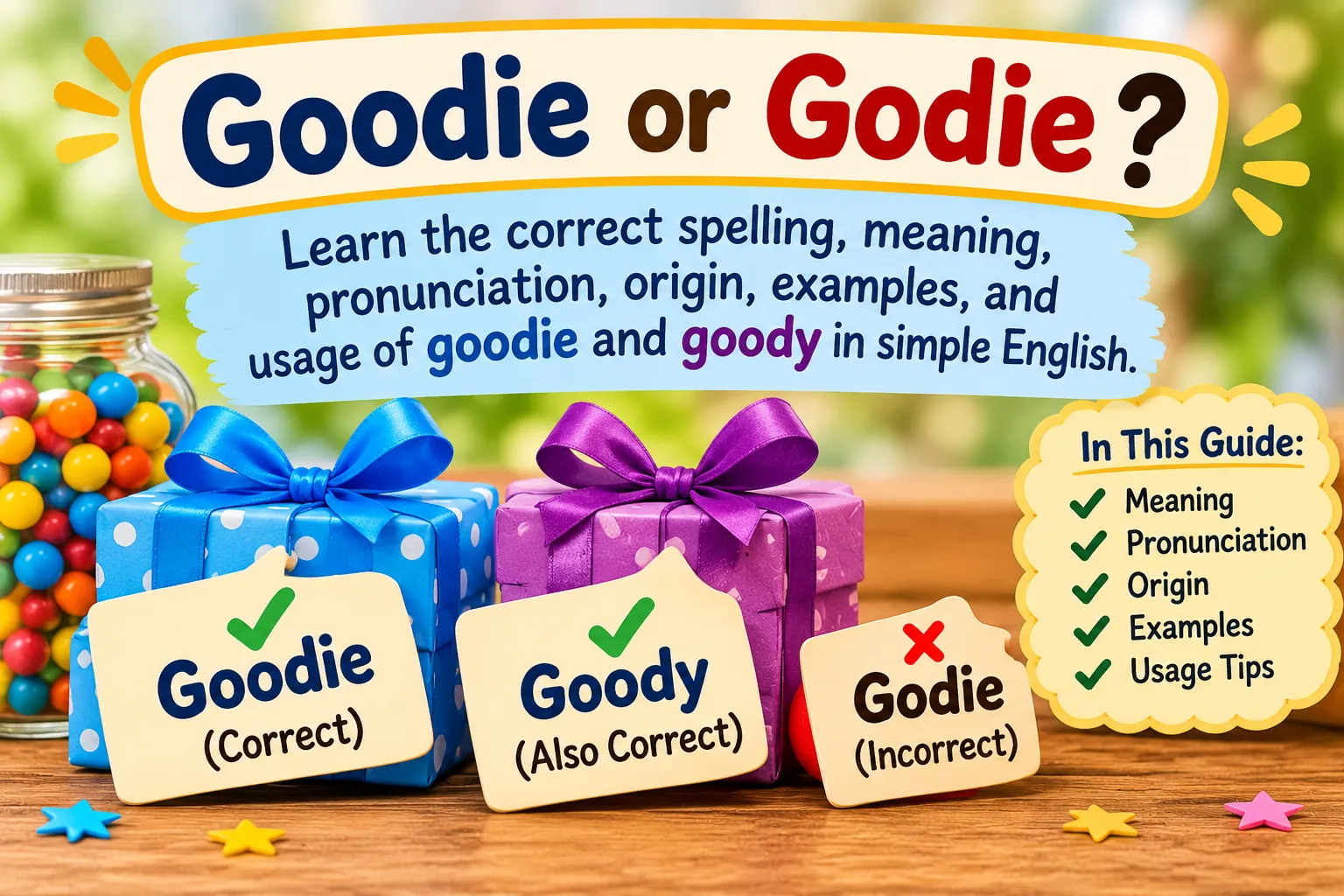
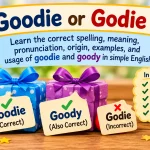
Goodie is a correct spelling. Godie is a spelling mistake. You may also see the word spelled goody.
Imagine you are planning a birthday party. You want to give each guest a small bag of sweets and toys. You write, “Every child will get a godie bag.” But is that spelling right?
The correct phrase is goodie bag or goody bag. Both forms are used in English. The spelling godie is not a standard form.
A goodie is something nice, fun, or pleasing. It often means a small treat, gift, or special item. People also use the word for a hero or a good person in a story. The plural form is goodies.
People search for goodie or godie because the words sound alike. They may also forget which letters belong in the word. This guide explains the correct spelling, meaning, history, and use of each form. It also shows how to use the word in daily life.
Pronunciation
- Goodie — US: /ˈɡʊdi/
- Goodie — UK: /ˈɡʊdi/
- Goody — US: /ˈɡʊdi/
- Goody — UK: /ˈɡʊdi/
- Godie: This is not a standard English word, so it has no standard pronunciation.
Difference Between Goodie or Godie
There is one key point to remember: goodie is correct, while godie is not. The spelling goody is also correct. The ten points below explain their use.
1. Correct Spelling
Goodie is a correct English word. Goody is another accepted spelling.
Godie is not a standard spelling of this word.
Examples:
- Correct: The children got a goodie bag.
- Incorrect: The children got a godie bag.
2. Meaning
A goodie is something nice or fun. It can be a sweet, small gift, or special item.
Godie has no standard meaning in this use.
Examples:
- The box was full of goodies.
- Each guest received a goodie bag.
3. Part of Speech
Goodie is a noun. It names a treat, gift, or pleasing item.
Godie is not a standard noun.
Examples:
- This goodie is for you.
- The shop gave us free goodies.
4. Spelling Pattern
The word goodie has two letters o and ends with ie.
The word goody has two letters o and ends with y.
Both are accepted spellings. Godie has only one o and is not the standard form.
Examples:
- Correct: I found a goodie in the box.
- Correct: I found a goody in the box.
5. Use in Goodie Bags
A goodie bag is a small bag of treats or gifts. People often give these bags at parties and events.
A godie bag is an incorrect spelling.
Examples:
- We made goodie bags for the party.
- The children loved their goodie bags.
6. Singular Form
Use goodie or goody when you mean one treat or item.
Do not use godie.
Examples:
- This goodie is my favorite.
- She picked one goody from the box.
7. Plural Form
The plural of goodie is goodies. The plural of goody is also goodies.
Examples:
- The children shared their goodies.
- The gift box held many goodies.
8. Use in Informal Speech
People often use goodie in casual talk. It can describe a small treat or something fun.
Examples:
- Look at all these goodies!
- I brought some goodies for everyone.
Godie is not used as a standard spelling in casual English.
9. Use in Stories and Films
The word goody can describe a good person or hero in a story or film. The word is often used when people talk about the good side and the bad side.
Examples:
- The hero is one of the goodies.
- The film shows a fight between the goodies and the baddies.
10. Use in Formal Writing
You can use goodie in writing about gifts, treats, and event bags. It is an informal word, so a more formal word may fit better in some reports.
Examples:
- The event team prepared goodie bags.
- The company gave guests small gifts.
Do not use godie in formal or informal writing.
You May Also Like https://orchoice.com/maam-or-mam/
Nature and Behaviour of Goodie or Godie
Goodie
Goodie is an informal noun. It often names a small treat or gift. It can also mean something pleasing or special.
People often use it in phrases such as:
- goodie bag
- goodie box
- goodie basket
- free goodie
The word is friendly and cheerful. Its plural form is goodies.
Godie
Godie is not a standard English spelling for a treat or gift. It is usually a typing or spelling error.
If you want to write about party gifts, sweets, or small treats, use goodie or goody.
Why People Get Confused About Goodie or Godie
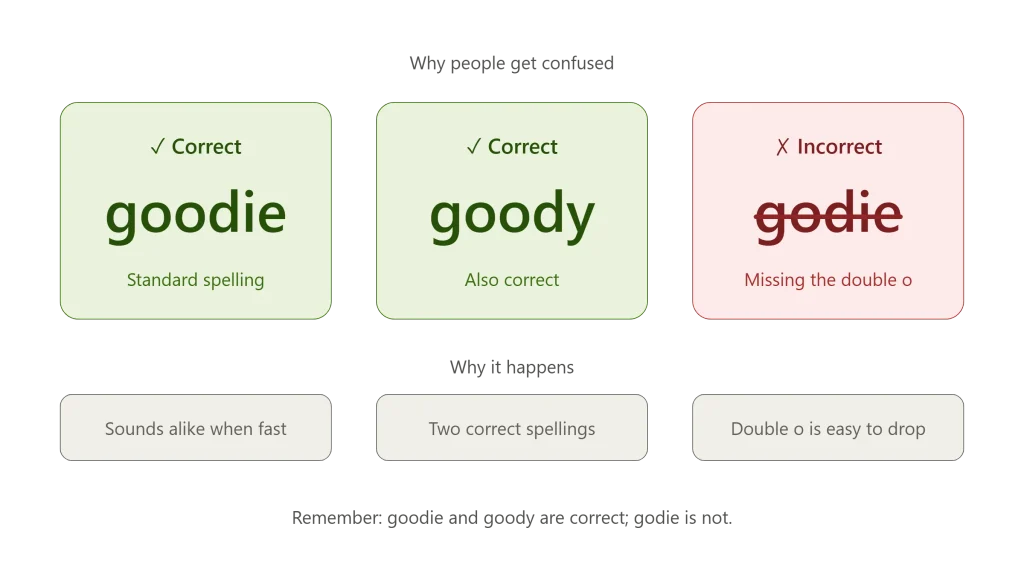
People get confused because goodie and godie sound almost the same when spoken quickly.
The word also has two correct spellings: goodie and goody. This can make the spelling seem less clear.
Another reason is that English has many words with unusual letter patterns. People may forget the double o in goodie and write only one.
Remember these forms:
- Goodie — correct
- Goody — correct
- Godie — incorrect for this meaning
Comparison Table
| Point | Goodie | Goody | Godie |
| Correct spelling | Yes | Yes | No |
| Meaning | A treat or nice item | A treat or nice item | No standard meaning here |
| Part of speech | Noun | Noun | Not standard |
| Pronunciation | /ˈɡʊdi/ | /ˈɡʊdi/ | No standard pronunciation |
| Plural | Goodies | Goodies | Not standard |
| Goodie bag | Accepted | Goody bag is accepted | Incorrect |
| Use in speech | Informal | Informal | Avoid |
| Use in writing | Accepted | Accepted | Avoid |
| US English | Used | Used | Not standard |
| UK English | Used | Used | Not standard |
The Origin of Goodie or Godie
The word goodie comes from the word good with the ending -ie. The spelling goody comes from the same base word with the ending -y.
The word goody has been used for something tasty since the 1700s. It first referred to food or treats, such as cakes and sweets. Later, it also came to mean something pleasing or special.
The word goody has another old meaning. It was once used as a polite title for a married woman of humble social rank. It also appears in the name Goody Two-Shoes, the main character in an old children’s story.
The spelling godie does not have this standard word history. It is not an accepted spelling for a treat or gift.
British vs American English
Both goodie and goody are used in British and American English. The spelling choice can vary by writer and publisher.
| English type | Accepted spelling | Example |
| American English | Goodie | The kids got goodie bags. |
| American English | Goody | She found a goody in the box. |
| British English | Goodie | The guests received goodie bags. |
| British English | Goody | The children shared their goodies. |
Godie is not the standard spelling in either form of English.
Which One Should You Use?
Use goodie or goody when you mean a treat, gift, or nice item.
- For American English: Both spellings are understood. Goodie is common in phrases such as goodie bag.
- For British English: Both forms are also used.
- For global English: Choose goodie if you want a clear spelling for a gift or treat. You can also use goody.
Common Mistakes
Here are some common errors and their correct forms.
| Incorrect | Correct |
| Godie bag | Goodie bag |
| Godies | Goodies |
| A godie for you | A goodie for you |
| Party godies | Party goodies |
| Free godie | Free goodie |
| Gift godie | Gift goodie |
| Goody bag | Goody bag |
| Goodie box | Goodie box |
The last two examples are already correct. Both goodie and goody are accepted spellings.
Everyday Usage Examples
In Emails
- We have prepared a goodie bag for each guest.
- Please collect your goodie box before you leave.
On Social Media
- Look at all the goodies from today’s event!
- These goodie bags are ready for the party.
In News
- The event team gave goodie bags to the children.
- The store offered free goodies to its first customers.
In Formal Writing
- The company prepared gift bags for its guests.
- The event included small gifts for all visitors.
Usage Trends
Goodie and goody are both used in modern English. They often appear in the plural form goodies.
You may see them in:
- Party plans
- Gift bags
- Food boxes
- Product offers
- Event news
- Social media posts
The phrase goodie bag is common at parties, school events, and public events. The word goodies can also mean free or special items.
Godie is not a standard spelling. Its use usually comes from a typing error or a lack of spelling knowledge.
Metaphors and Similes
People sometimes use goodie in a wider way. It can mean something special or pleasing, not just food.
A Box of Goodies
This can mean a box full of nice or useful things.
Example: “The new phone came with a box of goodies.”
Full of Goodies
This means something has many nice things inside.
Example: “The shop is full of goodies for children.”
An Oldie but a Goodie
This phrase means something old that is still liked or useful.
Example: “That song is an oldie but a goodie.”
These phrases use goodie or goodies in a friendly way.
Connotative Meaning
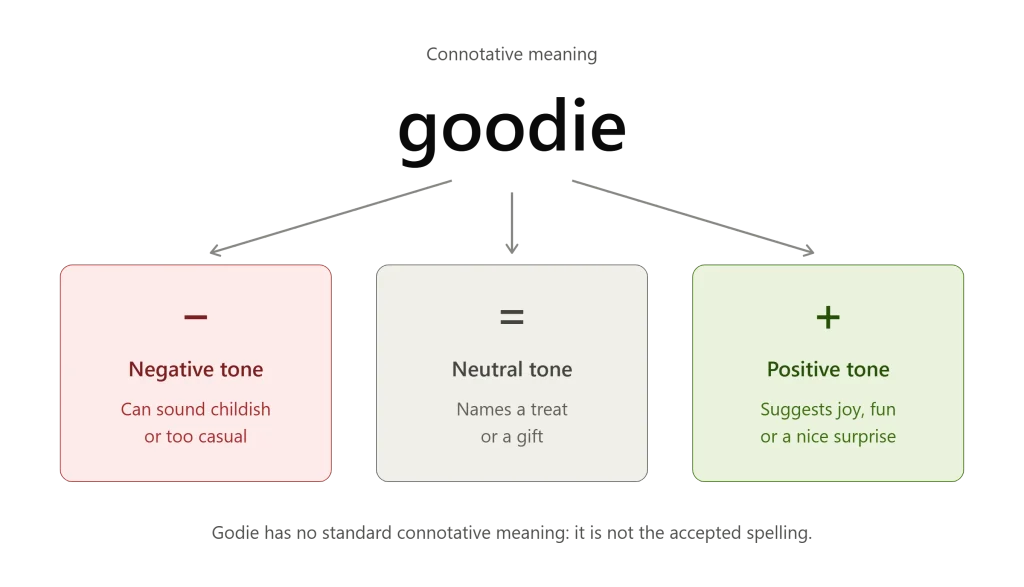
The word goodie often has a positive or cheerful feeling. Its exact feeling depends on the sentence.
Positive Meaning
It can suggest joy, fun, or a nice surprise.
Examples:
- The children were happy with their goodie bags.
- She brought goodies for the whole team.
Negative Meaning
The word itself is not usually negative. But it can sound childish or too casual in a formal setting.
Examples:
- The report called the free gifts “goodies,” which sounded too casual.
- The manager asked the team to use “free gifts” instead.
Neutral Meaning
It can simply name a treat or gift.
Examples:
- Each guest received a goodie.
- The box held several goodies.
Godie has no standard connotative meaning because it is not the accepted spelling.
Idioms and Proverbs
There are a few common phrases with goodie or goody. They are often informal.
Oldie but a Goodie
Meaning: Something old that people still enjoy.
Example: “This film is an oldie but a goodie.”
Goody-Goody
Meaning: A person who always tries to seem very good or well-behaved. It can sound unkind.
Example: “He called his classmate a goody-goody because she always followed the rules.”
The Goodies
Meaning: The good people or heroes in a story, film, or show.
Example: “The goodies win at the end of the story.”
There is no common proverb that depends on the spelling godie.
Literature and Movies
The word goody has a place in children’s literature. One famous example is The History of Little Goody Two-Shoes, published in 1765. It is an old children’s story about a girl named Margery. The story helped make the name “Goody Two-Shoes” well known.
In books and films, goodies can also mean the heroes or good characters. People often use it when they compare the good side with the bad side.
The spelling goodie is also used in modern writing about treats and gifts. For example, writers may mention goodie bags at events.
There is no well-known literary or movie use that makes godie a standard spelling. If you see it in a title or text, check whether it is a name or a deliberate spelling choice.
Why This Difference Matters
Correct spelling helps people understand your message. It also makes your writing look neat and clear.
The difference matters because goodie and goody are both correct. But godie is not a standard spelling for a treat or gift.
This can help English learners avoid mistakes in schoolwork, emails, and online posts. It can also help people write clear event plans and product details.
For example, a party planner should write “goodie bags” or “goody bags.” A store should use the same accepted forms when it talks about free gifts.
Learning these spellings makes daily writing easier.
Usefulness in Daily Life
You may see goodie in many daily situations.
You can use it when you talk about:
- Sweets in a party bag
- Small gifts for guests
- Free items from a shop
- Special treats in a box
- Nice extras in a product pack
For example, you can write, “We made goodie bags for the children.”
You can also use goodies for more than one treat. For example, “The box is full of goodies.”
If you want a more formal word, use gift, treat, or free item.
Situational Preference
Use goodie or goody when you write about a treat, gift, or nice item. Both forms work in American and British English. Goodie is a clear choice for phrases such as “goodie bag” and “goodie box.” Goody is also correct and appears in older writing and common phrases. Use goodies when you mean more than one item. In formal reports, you may choose words such as “gifts” or “free items.” Do not use godie as a spelling choice.
Common Questions and Answers
1. Is goodie or godie correct?
Goodie is correct. Godie is not a standard English spelling for a treat or gift.
2. Is goody also correct?
Yes. Goody is an accepted spelling. It has the same meaning as goodie in this use.
3. What does goodie mean?
A goodie is something nice or pleasing. It often means a small treat, gift, or special item.
4. What is the plural of goodie?
The plural is goodies.
Example: “The children shared their goodies.”
5. Is goodie American or British English?
It is used in both. Goody is also used in both forms of English.
6. How do you spell goodie bag?
You can write goodie bag or goody bag. Do not write godie bag.
7. What does oldie but a goodie mean?
It means something old that people still enjoy or value.
Example: “That song is an oldie but a goodie.”
Conclusion
Goodie or goody are both correct English spellings. They can mean a small treat, gift, or something nice. The plural form is goodies. You may see these words in phrases such as “goodie bag,” “goody bag,” and “oldie but a goodie.” The spelling godie is not a standard form for this meaning. It is usually a spelling mistake. Both British and American English accept goodie and goody. So, you do not need to choose a different spelling for each country. Use goodie when you want a clear and familiar form. Use goody when it fits your style or phrase. In formal writing, words such as “gift,” “treat,” or “free item” may work better. Keep this simple rule in mind: write goodie or goody, never godie.

I’m Samia Jamshaid, an English language specialist, SEO specialist, digital publisher, and researcher. I create clear, accurate, and well-researched content on English grammar, vocabulary, word meanings, and language comparisons, helping readers understand and use English with confidence.








1 thought on “Goodie or Godie: Learn the Right Spelling with Examples 2026”