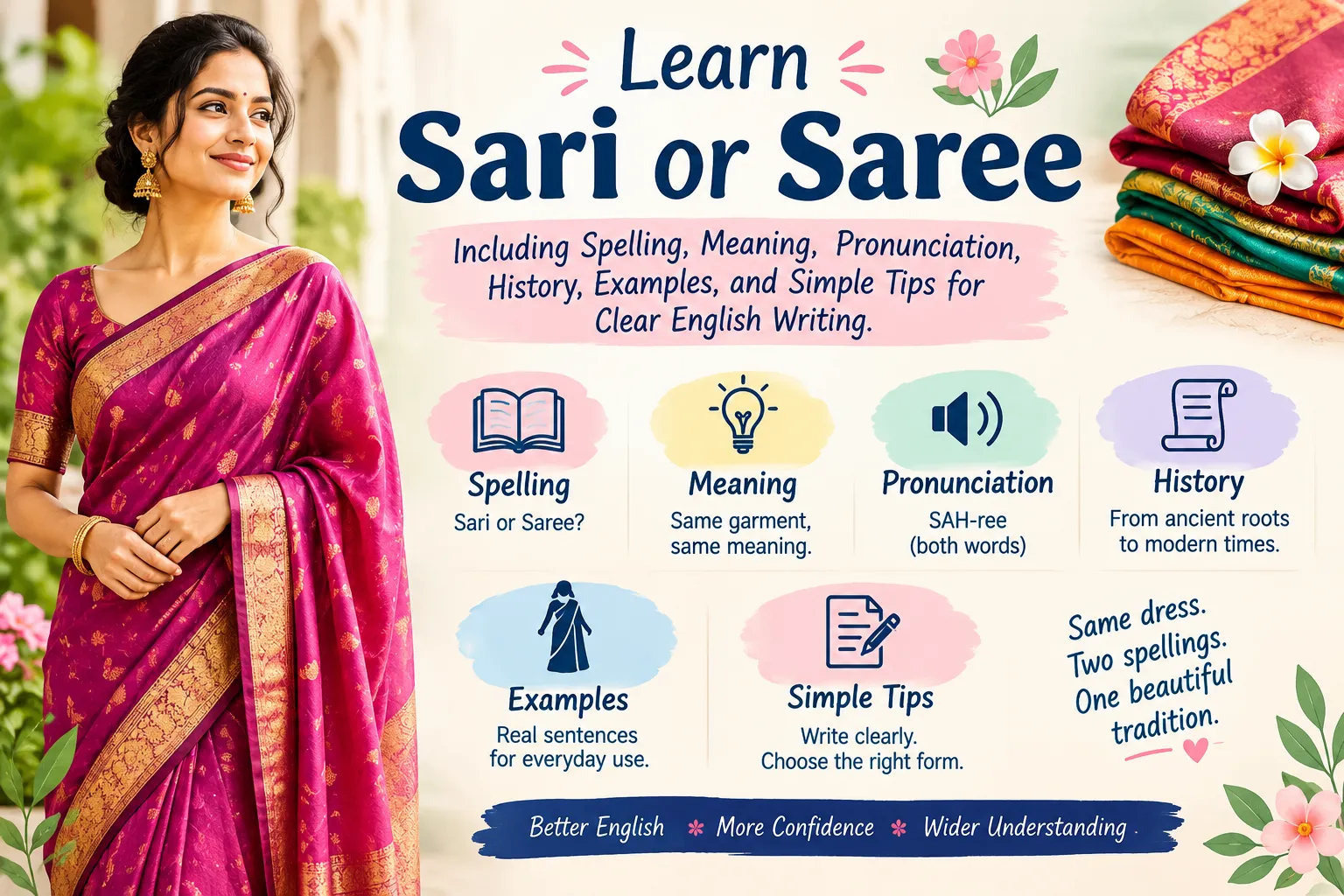
Sari and saree are two correct spellings for the same traditional South Asian garment.
Imagine you are shopping for a wedding outfit. You search online for a beautiful saree. Then you see another shop using the word sari. You may wonder if these words describe different clothes. They do not. Both words name the same long piece of fabric. It is wrapped around the body and often draped over one shoulder.
People search for “sari or saree” because both spellings appear in books, shops, and websites. The spelling can change from one country to another. Some writers prefer sari, while others use saree. This can make writing and online searches confusing.
Both forms are accepted in English. The main difference is how people spell and use them. The word also has a long history in South Asia. Today, people wear saris at weddings, festivals, family events, and formal gatherings.
This guide explains both spellings, their history, pronunciation, and use. It also gives simple examples to help you choose the right form.
Pronunciation of Sari and Saree
Both words have the same basic pronunciation. The final sound is like the word “see.”
| Word | US Pronunciation | UK Pronunciation |
| Sari | /ˈsɑːri/ — SAH-ree | /ˈsɑːri/ — SAH-ree |
| Saree | /ˈsɑːri/ — SAH-ree | /ˈsɑːri/ — SAH-ree |
The spelling does not change the usual pronunciation. Some speakers may have small accent differences. Both words have two syllables.
A Quick Note Before the Main Difference
There is no meaning difference between these two spellings. The points below explain their spelling, style, and use in different settings.
Difference Between Sari and Saree
1. Spelling
The first difference is the way people write the word. Sari has four letters. Saree has five letters.
Both spellings are correct in English. They describe the same garment.
Examples:
- She wore a red sari to the wedding.
- She wore a red saree to the wedding.
2. Number of Letters
The word sari has four letters. The word saree has five letters. The extra “e” does not add a new sound.
Both words are easy to say and understand.
Examples:
- The word sari is short and simple.
- The word saree has one extra letter.
3. Meaning
Both words have the same meaning. They describe a long piece of cloth worn around the body.
The cloth may cover the waist and legs. One end often goes over the shoulder.
Examples:
- My aunt bought a silk sari.
- My aunt bought a silk saree.
4. Part of Speech
Both words are nouns. A noun names a person, place, thing, or idea.
Here, each word names a piece of clothing. Neither word is normally used as a verb.
Examples:
- Her sari has a gold border.
- Her saree has a gold border.
5. Regional Preference
The spelling sari is common in many English dictionaries. The spelling saree is also widely used, especially in South Asian English.
The choice may depend on the writer and audience.
Examples:
- The museum displayed a traditional sari.
- The local shop sells wedding sarees.
6. Formal Writing
Both spellings can appear in formal writing. The most important rule is to stay consistent.
If your school or publisher has a style guide, follow it. Do not switch between spellings without a reason.
Examples:
- The report describes the history of the sari.
- The report describes the history of the saree.
7. Shopping and Product Names
Clothing shops use both spellings. Some online stores write “sari,” while others write “saree.”
Product titles may also include both words. This helps shoppers find the item they want.
Examples:
- I searched for a silk sari online.
- I searched for a silk saree online.
8. Plural Forms
The usual plural of sari is saris. The usual plural of saree is sarees.
Both forms mean more than one garment.
Examples:
- The shop sells colorful saris.
- The shop sells colorful sarees.
9. Search and Online Content
People may type either spelling into a search engine. Both can lead to the same type of clothing.
Writers should use the spelling that suits their readers. They can also mention the other form naturally.
Examples:
- Our guide explains how to wear a sari.
- Our guide explains how to choose a saree.
10. Meaning in Different Sentences
The sentence meaning stays the same when you change one spelling to the other.
The fabric, style, and way of wearing it do not change. Only the written form changes.
Examples:
- She chose a blue sari for the party.
- She chose a blue saree for the party.
You May Also Like https://orchoice.com/genuine-or-ungenuine/
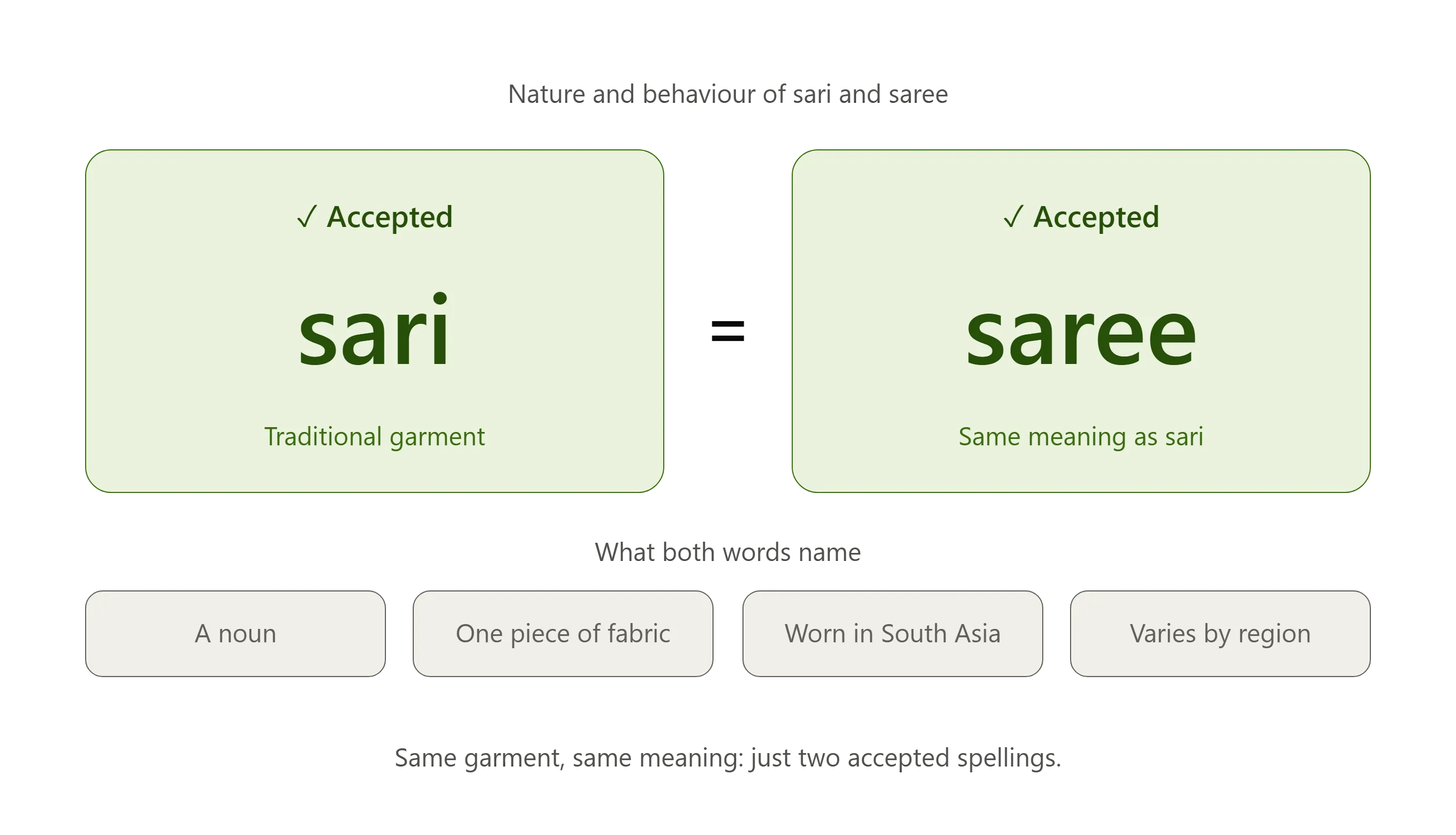
Nature and Behaviour of Sari and Saree
Nature of Sari
Sari is a noun. It names a traditional garment worn across South Asia. It is made from one long piece of fabric.
The cloth is wrapped around the body. One end is often placed over the shoulder. The style can change by region and occasion.
Nature of Saree
Saree is also a noun. It has the same meaning as sari. It is another accepted spelling of the garment.
People use it in clothing shops, wedding writing, and everyday speech. Its meaning does not change with the extra letter.
Why People Get Confused About Sari and Saree
People get confused because both spellings are correct. They also look and sound almost the same.
Some dictionaries list sari as the main spelling. Other writers and shops often use saree. This can make readers think they are two different clothes.
The word also comes from South Asian languages. English speakers may write its sound in different ways. This is common with words borrowed from other languages.
The best way to remember the rule is simple:
- Sari and saree have the same meaning.
- Both spellings are correct.
- Choose one form and use it consistently.
Comparison Table
| Feature | Sari | Saree |
| Correct spelling | Yes | Yes |
| Meaning | Traditional South Asian garment | Same garment |
| Word type | Noun | Noun |
| Pronunciation | SAH-ree | SAH-ree |
| Number of letters | Four | Five |
| Plural | Saris | Sarees |
| Use in English | Common | Common, especially in South Asian English |
| Formal writing | Accepted | Accepted |
| Shopping use | Used by many shops | Used by many shops |
| Meaning difference | None | None |
The Origin of Sari and Saree
The word has roots in South Asian languages. English borrowed sari from Hindi and related forms. Its older roots are linked to Sanskrit.
The Sanskrit word śāṭī meant a garment or petticoat. A related Prakrit form was sāḍī. Hindi later used the word sāṛī for the garment.
English dictionaries record the word in the late 1700s. The Online Etymology Dictionary gives 1785 as an early recorded date. This date refers to written English use. It does not mark the start of the garment itself.
The spelling saree developed as another English form. It represents the same word and meaning.
The garment has a much older history than its English name. People in South Asia have worn sari-like wrapped clothes for many centuries.
British vs American English
Both sari and saree are understood in British and American English. Neither spelling belongs only to one country.
However, sari is a common dictionary headword. Saree is also widely used, especially in South Asian communities and shops.
| Use | British English | American English |
| Sari | Accepted | Accepted |
| Saree | Accepted | Accepted |
| Main dictionary form | Often sari | Often sari |
| Pronunciation | SAH-ree | SAH-ree |
| Plural of sari | Saris | Saris |
| Plural of saree | Sarees | Sarees |
Examples:
- British English: She wore a silk sari to the event.
- British English: She wore a silk saree to the event.
- American English: The museum has a beautiful sari.
- American English: The museum has a beautiful saree.
Which One Should You Use?
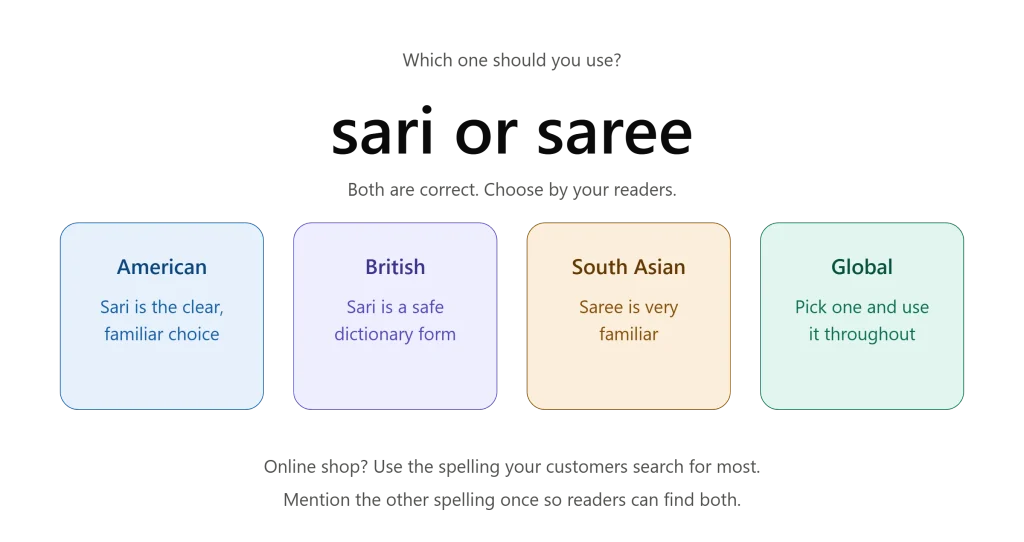
Your choice depends on your readers and the style of your writing.
For American readers: Use sari as a clear, familiar choice. Saree is also correct.
For British readers: Sari is a safe dictionary form. Saree is also accepted and understood.
For South Asian readers: Saree is very familiar in many communities. Sari is also widely understood.
For global writing: Choose one spelling and use it throughout your article. You can mention the other spelling once. This helps readers find both forms.
For an online shop, use the spelling your customers search for most. You may include both forms in product details when useful.
Common Mistakes
Here are some mistakes to avoid:
| Common Mistake | Correct Form | Explanation |
| Treating sari and saree as different clothes | Sari = Saree | Both name the same garment. |
| Writing “sareys” | Sarees | Add “s” to form the plural. |
| Writing “saries” | Saris | The plural of sari is saris. |
| Saying the extra “e” changes the sound | Same basic sound | Both are usually said as SAH-ree. |
| Calling saree incorrect | Both are correct | Saree is an accepted spelling. |
| Changing spellings in one article | Stay consistent | Pick one form for clear writing. |
| Using “sari” as a verb | Use it as a noun | It names a piece of clothing. |
| Assuming every sari is silk | Check the fabric | Saris can be made from many fabrics. |
Everyday Usage Examples
Both spellings work in daily life. Here are examples from common settings.
In Emails
- Thank you for helping me choose my sari.
- Please send the price of the red saree.
On Social Media
- I love the colors in this silk sari.
- My new saree is ready for the wedding!
In News
- The exhibition displays traditional saris from South Asia.
- Local designers showed new sarees at the fashion event.
In Formal Writing
- The museum holds a collection of historic saris.
- The report explains how sarees are made and worn.
Usage Trends
Both spellings appear in English around the world. Sari is often used in dictionaries and general writing. Saree is also common in South Asian English and clothing shops.
The spelling may depend on the country, shop, writer, or reader. Online stores may use both words to help customers find products.
There is no need to treat one form as wrong. The two spellings have the same meaning. For clear writing, choose one and use it in a steady way.
Metaphors and Similes
Sari and saree are clothing words. They do not have a large set of fixed English metaphors or similes. Still, writers can use the garment in creative comparisons.
Metaphors
- A sari of colors: A mix of many bright colors.
- A sari of memories: A collection of special moments.
- A sari of stories: Many stories joined together.
These are creative phrases. They are not fixed dictionary meanings.
Similes
- Her sari flowed like a river.
- The silk shone like sunlight.
- The bright border sparkled like gold.
Connotative Meaning
A word’s connotation is the feeling it may bring to mind. Sari and saree can suggest many ideas. These feelings depend on the person and culture.
Positive Meaning
Both words may bring thoughts of beauty, pride, tradition, and celebration.
Examples:
- Her bright saree made the wedding feel joyful.
- The museum showed a beautiful silk sari.
Negative Meaning
The words do not have a negative meaning by themselves. However, a person may connect a garment with a bad memory or an unfair rule.
Examples:
- She disliked the sari because it reminded her of an unhappy event.
- He wrongly said a saree was not suitable for modern life.
Neutral Meaning
In most everyday sentences, sari and saree simply name clothing. They do not show praise or dislike.
Examples:
- The sari is made from cotton.
- The saree has a blue border.
Idioms and Proverbs
There are no widely established English idioms or proverbs built around the words sari or saree.
Writers may use the garment in creative phrases. These should not be presented as traditional sayings.
Examples:
- A sari of colors: The garden looked like a sari of colors.
- A sari of memories: Her old sari held a sari of memories from family events.
The second example is a creative phrase, not a standard idiom. For clear writing, use simple phrases such as “a traditional sari” or “a beautiful saree.”
Literature and Movies
The sari appears in writing and films about South Asian life. It can show culture, family, style, and social change.
Literature
The Eloquent Sari is a real academic article by Dorothy Jones. It appeared in the journal Textile: Cloth and Culture in 2004. The article studies the sari in Indian writing and culture.
It discusses how clothing can show identity and personal feelings. It is an academic article, not a novel. Double-check the full publication details before using it in formal references.
Movies
Monsoon Wedding (2001, India) is a drama directed by Mira Nair. It follows a family preparing for a wedding in Delhi. The film shows Indian wedding customs and clothing.
The Namesake (2006, United States and India) is a drama directed by Mira Nair. It follows an Indian family living between two cultures. Clothing helps show family life and cultural identity.
These works offer useful cultural context. They do not create a spelling difference between sari and saree.
Why This Difference Matters
Knowing both spellings helps you read and write with care. You may see sari in a dictionary and saree in a shop. Both can be correct.
This knowledge also helps English learners avoid false mistakes. You do not need to correct someone who uses either spelling. Instead, focus on the meaning and the sentence.
For writers, steady spelling makes an article easier to read. It also helps online shops reach the right readers. A clear title and product name can help people find the garment they want.
Most of all, both words name a garment with deep cultural value. Using the words with care shows respect for the people and traditions linked to it.
Usefulness in Daily Life
You may need these words when shopping, writing, or talking about clothing. Both spellings are useful.
- Shopping: Search for both sari and saree to find more choices.
- Travel: Use either word when asking about traditional clothing.
- Schoolwork: Explain that both spellings name the same garment.
- Work: Use one spelling in reports and product lists.
- Social media: Choose the spelling your readers know best.
- Fashion writing: Explain the fabric, design, and way it is worn.
Situational Preference
Use sari when you want a short, common dictionary spelling. It works well in general English writing. Use saree when it suits your audience or shop style. Many South Asian shops and readers know this form well. In British and American English, both are accepted. For a global website, you can use one spelling in the title and mention the other in the introduction. This helps readers find your page with either search term. Do not use both forms at random. Keep your spelling steady from start to end.
Common Questions and Answers
1. Are sari and saree the same thing?
Yes. Both words name the same traditional South Asian garment. The difference is only in spelling.
2. Which spelling is correct, sari or saree?
Both spellings are correct in English. Sari is a common dictionary form. Saree is also widely used.
3. How do you pronounce sari and saree?
Both are usually pronounced SAH-ree. The extra “e” in saree does not change the basic sound.
4. Is sari British or American English?
Sari is used in both British and American English. Saree is also accepted in both.
5. What is the plural of sari and saree?
The plural of sari is saris. The plural of saree is sarees.
6. Where does the word sari come from?
The English word came from Hindi. Its older roots are linked to Sanskrit words for cloth or clothing.
7. Should I write sari or saree in an SEO article?
Choose the form your readers use most. You can mention the other spelling naturally to help readers find your page.
Conclusion
Sari or saree are two spellings for the same traditional garment. Both are correct in English. Neither word has a different meaning or pronunciation. The main choice depends on your readers and writing style. Sari is a common dictionary spelling. Saree is also popular, especially in South Asian shops and daily use. Both work in British and American English. The plural forms are saris and sarees. When writing an article, choose one spelling and use it throughout. You can mention the other form near the start. This helps readers understand the link between them. It also makes your content easier to find. The sari is more than a piece of cloth. It can show art, skill, family, and culture. Use both words with care and respect.

I’m Samia Jamshaid, an English language specialist, SEO specialist, digital publisher, and researcher. I create clear, accurate, and well-researched content on English grammar, vocabulary, word meanings, and language comparisons, helping readers understand and use English with confidence.












1 thought on “Sari or Saree: What Is the Real Difference? 2026”