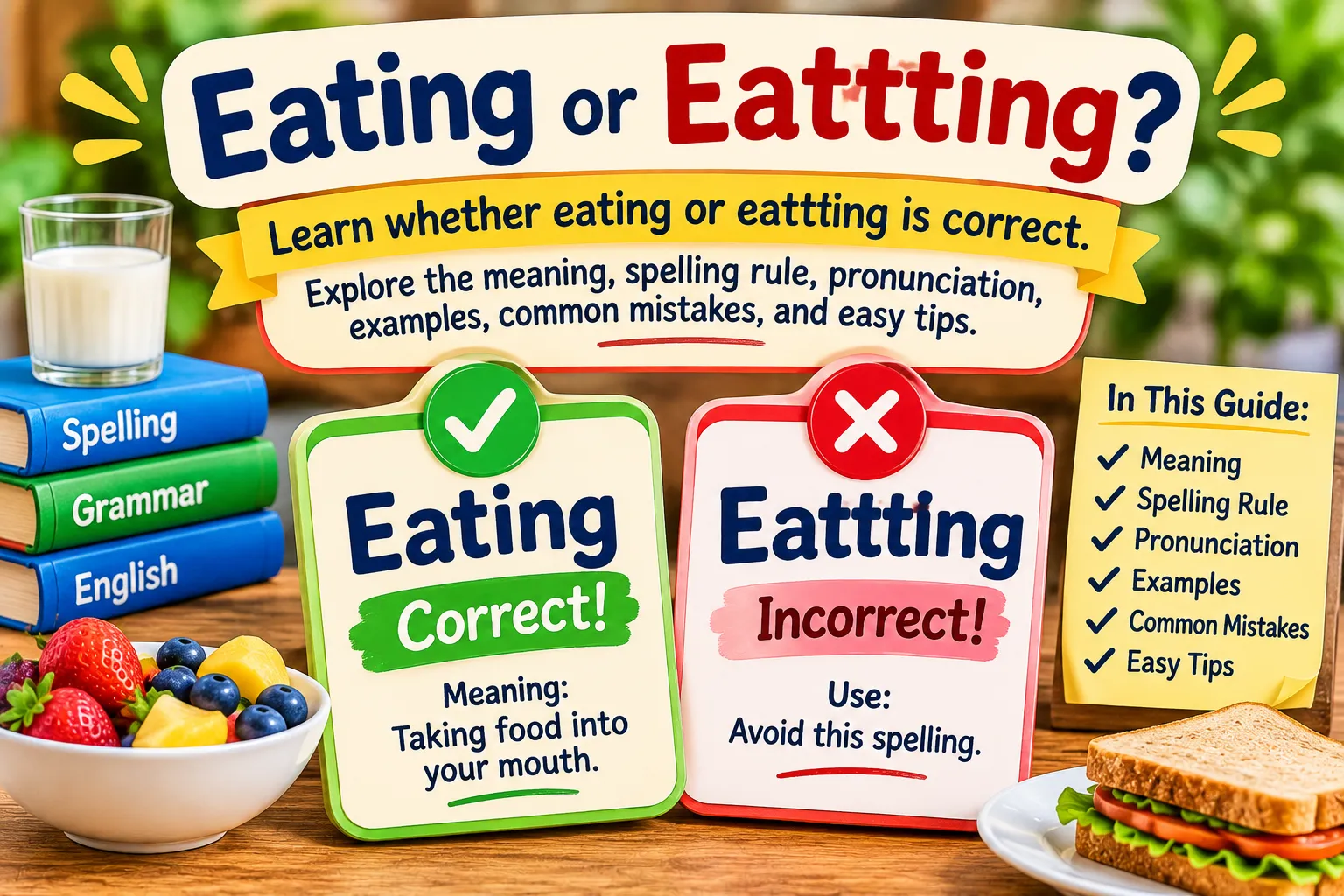
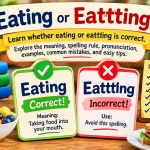
Eating is the correct spelling. Eatting is incorrect in standard English.
Imagine writing a message to a friend. You want to say that you are eating lunch. You type, “I am eatting lunch.” The meaning is clear, but the spelling is wrong. The correct sentence is, “I am eating lunch.”
This small mistake can happen to anyone. Many people think they should double the final letter when they add -ing to a verb. This rule is correct for some words, such as sit and running. But it does not apply to every verb.
The word eating comes from the verb eat. It means taking food into your mouth, chewing it, and swallowing it. Eating or eatting can also describe the act of having a meal. The word eatting is not a standard English word. People often search for eating or eatting because they want to check the spelling before writing a text, email, school task, or online post.
This guide explains the correct form, the spelling rule, and common examples.
Pronunciation
- Eating — US: /ˈiːtɪŋ/
- Eating — UK: /ˈiːtɪŋ/
- Eatting: This is a misspelling, so it has no standard dictionary pronunciation. If you mean eating, say it the same way.
Difference Between Eating or Eatting
There are not ten real meaning differences between these forms. Eating is a correct word, while eatting is a misspelling. The points below explain ten ways to understand and use them.
1. Correct Spelling
Eating is the correct spelling. It follows the verb eat with the ending -ing.
Eatting has an extra letter t. Do not use it in standard English.
Examples:
- Correct: She is eating an apple.
- Incorrect: She is eatting an apple.
2. Meaning
Eating means taking food into your mouth and swallowing it. It can also mean having a meal.
Eatting has no separate standard meaning.
Examples:
- Correct: Eating fruit can be part of a healthy diet.
- Incorrect: Eatting fruit can be part of a healthy diet.
3. Part of Speech
Eating can work as a verb form or a noun.
As a verb form, it appears in sentences such as “I am eating.” As a noun, it can describe the act of eating.
Eatting is not a standard verb form or noun.
Examples:
- Correct: The baby is eating.
- Correct: Healthy eating is important.
4. Grammar Rule
To make the -ing form of eat, add -ing to the whole word.
The word does not need another t.
Examples:
- eat + ing = eating
- walk + ing = walking
Do not write eat + ting.
5. Use in Present Continuous Tense
Use eating with a form of be to describe an action happening now.
The usual forms are am eating, is eating, and are eating.
Examples:
- I am eating breakfast.
- They are eating dinner.
Do not write am eatting or are eatting.
6. Use in Questions
Use eating when asking whether someone is having food.
Examples:
- Are you eating lunch?
- Is the baby eating well?
The spelling eatting is still wrong in questions.
7. Use in Negative Sentences
Use eating after words such as not when the sentence needs the present continuous form.
Examples:
- She is not eating her vegetables.
- We are not eating at home tonight.
Do not add an extra t.
8. Use in Formal Writing
Use eating in schoolwork, reports, emails, and other formal writing.
Examples:
- The report explains the benefits of healthy eating.
- Eating too quickly may cause discomfort.
The spelling eatting should be corrected before you share your work.
9. Use in Daily Speech
People use eating when they talk about meals and food.
Examples:
- I am eating with my family.
- We enjoy eating together.
The incorrect spelling does not change the spoken word people intend to say.
10. Use in Online Writing
Use eating in social media posts, comments, blogs, and messages.
Examples:
- I am eating my favorite meal.
- Eating fresh food makes me happy.
You May Also Like https://orchoice.com/goodie-or-godie/
Nature and Behaviour of Eating or Eatting
Eating
Eating is a real and common English word. It is the -ing form of the verb eat. It can describe an action happening now.
Example: “The children are eating lunch.”
It can also work as a noun.
Example: “Healthy eating is a good habit.”
Eatting
Eatting is not a standard English word. It is usually a typing or spelling error. It has no separate meaning, grammar role, or accepted use in standard English.
If you see it in a sentence, the writer most likely means eating.
Why People Get Confused About Eating or Eatting
People often double the last letter when they add -ing to a verb. For example:
- sit → sitting
- run → running
- swim → swimming
This can make people think that eat should become eatting.
But English spelling has different rules. In many short verbs, the last consonant is doubled when the verb ends in a consonant-vowel-consonant pattern. The word eat does not follow that pattern. It ends with two vowels followed by one consonant.
So, add -ing without doubling the t:
eat → eating
This is why eating is correct.
Comparison Table
| Point | Eating | Eatting |
| Spelling | Correct | Incorrect |
| Meaning | The act of eating food | No standard meaning |
| Part of speech | Verb form or noun | No standard role |
| Grammar | Correct -ing form of eat | Incorrect form |
| Pronunciation | /ˈiːtɪŋ/ | No standard pronunciation |
| Present action | “I am eating.” | Incorrect |
| Questions | “Are you eating?” | Incorrect |
| Formal writing | Accepted | Should be corrected |
| Daily use | Common | A spelling error |
| British and American English | Same spelling | Not a standard variant |
The Origin of Eating or Eatting
The word eating comes from the verb eat. The verb has a long history in English.
The Old English form was etan. It came from an old Germanic word. Related forms can still be found in languages such as Dutch and German.
Over time, the spelling changed into the modern word eat. English speakers then formed eating by adding -ing.
The extra t in eatting is not part of the standard word’s history. It is usually caused by confusion about the spelling rule for adding -ing.
British vs American English
There is no spelling difference between British and American English here.
Both use eating.
| English type | Correct spelling | Example |
| American English | Eating | I am eating dinner. |
| British English | Eating | I am eating dinner. |
| Both | Eatting is incorrect | Avoid this spelling. |
Which One Should You Use?
Always use eating.
- For American English: Write “I am eating breakfast.”
- For British English: Write “I am eating breakfast.”
- For global English: Use “eating” in emails, reports, school tasks, and online posts.
There is no need to choose between two accepted forms. Eattting is not a standard spelling in either country. Remember this simple rule: add -ing to eat without doubling the final letter.
Common Mistakes
Here are common errors and their corrections:
| Incorrect | Correct |
| I am eatting lunch. | I am eating lunch. |
| She is eatting rice. | She is eating rice. |
| They are eatting now. | They are eating now. |
| He enjoys eatting fruit. | He enjoys eating fruit. |
| Eatting healthy food is good. | Eating healthy food is good. |
| We were eatting dinner. | We were eating dinner. |
Remember: The correct form is always eating.
Everyday Usage Examples
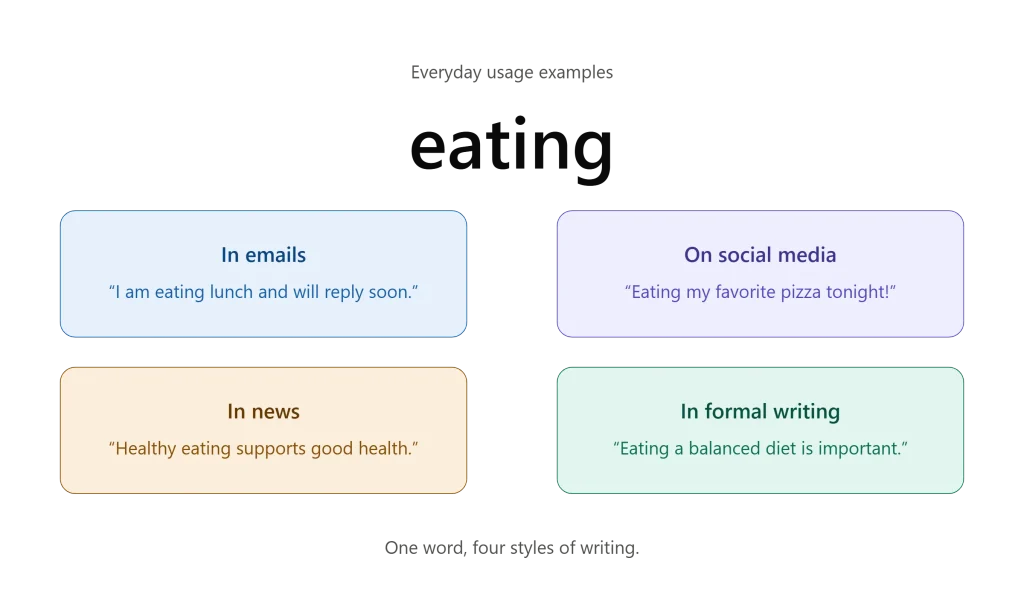
In Emails
- I am eating lunch and will reply soon.
- We are eating at the office today.
On Social Media
- Eating my favorite pizza tonight!
- I love eating with my friends.
In News
- Healthy eating can support good health.
- The report discusses eating habits among young people.
In Formal Writing
- Eating a balanced diet is important.
- The study looks at eating habits in children.
Usage Trends
Eating is a common word in everyday English. People use it when talking about food, meals, health, and habits.
It also appears in phrases such as:
- healthy eating
- mindful eating
- eating habits
- eating disorder
- eating out
Eattting is not a standard spelling. It may appear in online searches, comments, or messages because people make typing mistakes. Its appearance does not make it correct.
Metaphors and Similes
The word eating can appear in phrases that do not describe a person eating food.
Here are some examples:
Eating Away at Something
This means slowly damaging or using something.
Example: “Rust is eating away at the metal.”
Eating Someone Up
This can mean causing strong worry or guilt.
Example: “The secret was eating him up inside.”
Eating Like a Horse
This means eating a large amount of food.
Example: “My brother eats like a horse after football practice.”
These phrases use the correct word eating or its related verb forms. They do not use eatting.
Connotative Meaning
Eating usually has a neutral meaning. It can also create positive or negative feelings, based on the sentence.
Positive Meaning
Eating can suggest health, joy, and time with family.
Examples:
- Eating fresh fruit helps me feel good.
- We enjoy eating together on Sundays.
Negative Meaning
Eating can suggest worry or a harmful habit in some contexts.
Examples:
- Stress is affecting her eating habits.
- He was eating too much junk food.
Neutral Meaning
Eating can simply describe the act of having food.
Examples:
- The children are eating lunch.
- Eating takes time.
Eattting has no accepted positive, negative, or neutral meaning because it is a spelling error.
Idioms and Proverbs
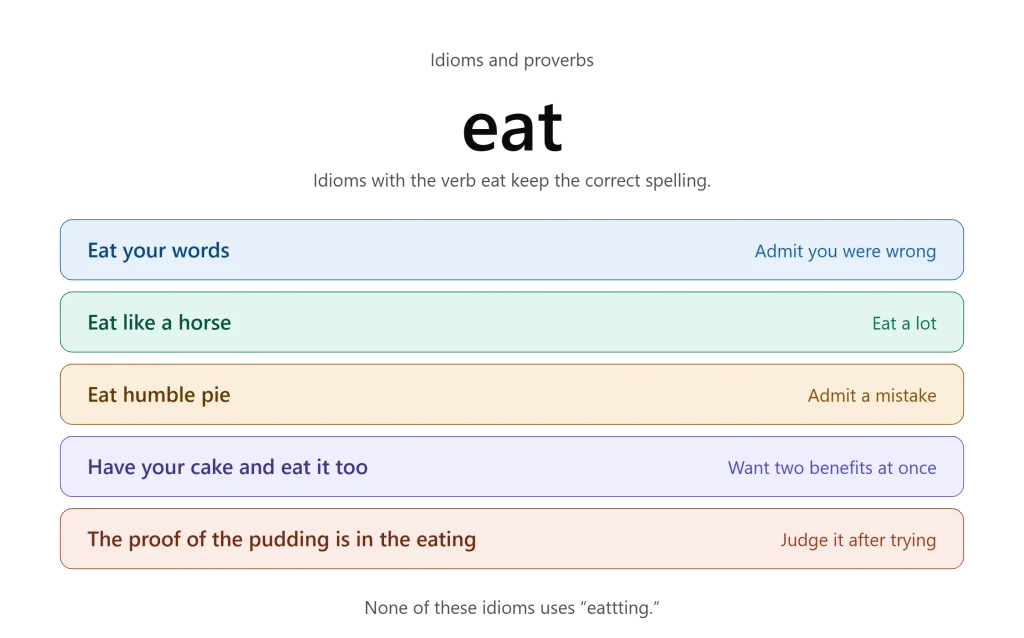
English has many idioms with the verb eat. They keep the correct spelling.
Eat Your Words
Meaning: To admit that something you said was wrong.
Example: “He said I could not win, but he had to eat his words.”
Eat Like a Horse
Meaning: To eat a lot.
Example: “The young athlete eats like a horse.”
Eat Humble Pie
Meaning: To admit a mistake and feel sorry.
Example: “She had to eat humble pie after blaming the wrong person.”
Have Your Cake and Eat It Too
Meaning: To want two benefits that may not go together.
Example: “You cannot have your cake and eat it too.”
The Proof of the Pudding Is in the Eating
Meaning: You can judge something only after trying it.
Example: “Try the new plan first. The proof of the pudding is in the eating.”
None of these idioms uses eattting.
Literature and Movies
The correct word eating appears in writing about food, family life, health, and daily habits. It is also part of many familiar phrases and titles.
For example, the phrase “The proof of the pudding is in the eating” appears in English proverb collections. It means that results show whether something works.
The incorrect spelling eattting has no known standard role in English literature or movie titles. If it appears in a book, script, or online post, it may be a typo or a character’s deliberate spelling mistake.
Do not use the misspelling as if it were a separate English word.
Why This Difference Matters
Correct spelling helps readers understand your message. A small spelling error can make schoolwork, emails, and reports look less clear.
The difference between eating and eattting is also useful for learning English spelling rules. Some verbs double their last letter before -ing. Others do not.
For example:
- sit → sitting
- run → running
- eat → eating
- read → reading
Learning these forms eating or eatting can help you avoid common errors. It can also make your writing easier to read.
Usefulness in Daily Life
You may use eating many times each day. It is useful when you talk about meals, food, health, or daily habits.
You can write:
- “I am eating breakfast.”
- “Are you eating with us?”
- “Healthy eating is important.”
- “We enjoy eating together.”
You may also use it in work emails, school tasks, recipes, and social media posts.
When you type the word, remember not to add another t. This small check can help you write with more care.
Situational Preference
Use eating in every situation. It is the correct spelling in American English, British English, and other forms of standard English. Use it in school essays, work emails, text messages, blog posts, and formal reports. You may also use it as a noun, as in “healthy eating,” or as a verb form, as in “I am eating.” Do not use eattting as an alternative. It is a spelling mistake, not a regional form or a different word.
Possible Asked Question
1. Is eating or eatting correct?
Eating is correct. Eattting is a misspelling.
2. Why is eating spelled with one t?
The verb eat does not double its final letter before -ing. Add the ending directly: eat + ing = eating.
3. Is eatting ever correct?
No. It is not a standard English spelling. Use eating instead.
4. Is eating the same in British and American English?
Yes. Both British and American English use eating.
5. What is the meaning of eating?
Eating means taking food into your mouth, chewing it, and swallowing it. It can also mean having a meal.
6. What part of speech is eating?
It can be a verb form or a noun. For example, “I am eating” uses it as a verb form. “Healthy eating” uses it as a noun.
7. How do you remember the correct spelling?
Remember this simple rule: eat already ends with two vowels and one consonant. Add -ing without doubling the t.
Conclusion
The correct spelling is eating, not eattting. Eating is the -ing form of the verb eat. It means taking food into your mouth and swallowing it. It can also describe the act of having a meal. The mistake often happens because some English verbs double their last letter before adding -ing. For example, sit becomes sitting. But eat follows a different pattern. Add -ing directly, and the word becomes eating. Both American and British English use the same spelling. You should use it in schoolwork, emails, reports, and daily messages. If you see eattting, correct it to eating. Keep this simple rule in mind, and you can avoid this common spelling mistake with confidence.

I’m Samia Jamshaid, an English language specialist, SEO specialist, digital publisher, and researcher. I create clear, accurate, and well-researched content on English grammar, vocabulary, word meanings, and language comparisons, helping readers understand and use English with confidence.






1 thought on “Eating or Eatting: How to Spell It Correctly 2026”