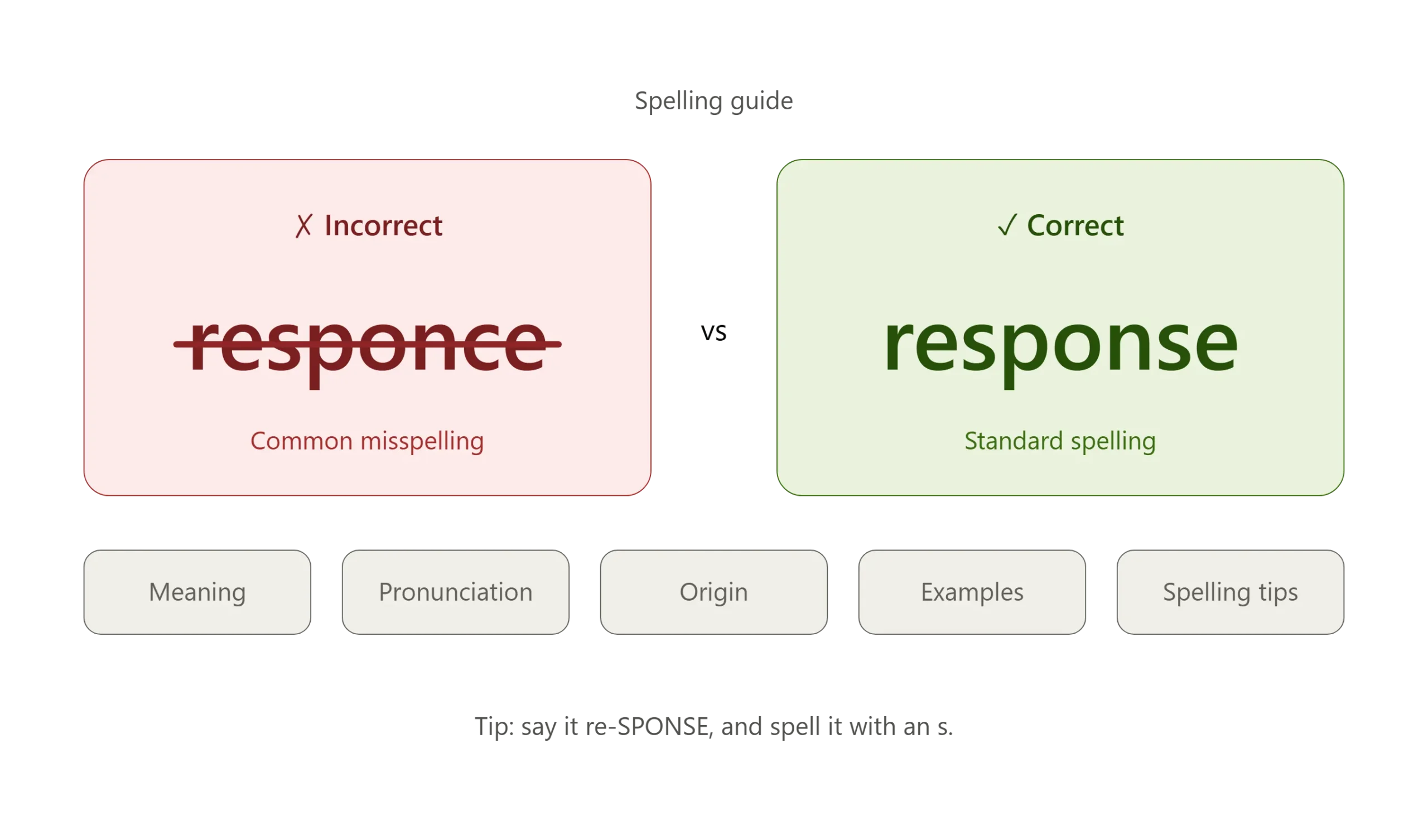
Response is the correct spelling in modern English. Responce is a common spelling mistake.
Imagine you send an email to your teacher. You wait for an answer. After some time, your teacher replies. That reply is a response.
Now imagine you write, “Thank you for your responce.” The reader will likely understand you. However, the spelling is wrong. The correct sentence is, “Thank you for your response.”
Many people search for “response or responce” because both forms sound the same. The letter c can make the wrong spelling look right. But English spelling does not always follow sound rules.
This guide explains the correct spelling, meaning, pronunciation, grammar, and use of response. It also shows why responce is incorrect in modern standard English. You will learn how to avoid this mistake in emails, schoolwork, social media posts, and formal writing.
Pronunciation of Response and Responce
The two spellings are often read in the same way. However, only response is the correct modern English spelling.
| Word | US pronunciation | UK pronunciation |
| Response | /rɪˈspɑːns/ | /rɪˈspɒns/ |
| Responce | Not a standard spelling | Not a standard spelling |
The stress falls on the second part of the word. The final sound is /s/.
Difference Between Response and Responce
There is one main difference: response is correct, while responce is a misspelling. The points below explain this difference in useful writing situations.
1. Correct Spelling
Response is the accepted spelling in modern English. Responce is not the standard form.
- Correct: I received your response.
- Incorrect: I received your responce.
2. Meaning
Response means an answer or a reaction. Responce has no separate standard meaning in modern English.
- Her response was clear.
- The team gave a quick response.
3. Use in Emails
Use response when you ask someone to reply to an email.
- Thank you for your response.
- I am waiting for your response.
Do not write responce in a work email.
4. Use in Schoolwork
Students should use response in essays, tests, and homework.
- Write a short response to the question.
- The teacher liked my response.
The spelling responce may be marked as an error.
5. Use in Formal Writing
Reports, letters, and business documents need correct spelling.
- We received a positive response.
- The company sent a written response.
The wrong form can make formal writing look careless.
6. Use in Daily Speech
People use the word response when they talk about answers or reactions.
- His response made me smile.
- I did not expect that response.
The spoken word does not change because someone spells it incorrectly.
7. Grammar
Response is a noun. It names an answer or reaction.
- Her response was polite.
- We need a quick response.
Responce is not the correct noun form.
8. Singular and Plural
The plural of response is responses.
- One response was enough.
- We received five responses.
Do not write responces.
9. Word Family
The correct word family includes respond, responded, and responding.
- Please respond to my message.
- She responded to the question.
- He is responding now.
These words share the same spelling pattern. Responce does not belong in this word family.
10. Professional and Public Use
Use response in customer service, news, reports, and public messages.
- The company gave a quick response.
- The public response was positive.
More About https://orchoice.com/possess-or-posess/
Nature and Behaviour of Response and Responce
Response
Response is a noun. It can mean an answer, reply, or reaction.
It can describe spoken words, written messages, feelings, or actions. A response can be quick, slow, positive, negative, or unclear.
Examples:
- The manager gave a helpful response.
- Her response to the news was surprising.
Responce
Responce is a spelling error in modern standard English. It is not a separate noun with its own meaning.
If you see it in a message, the writer most likely means response.
Example:
- Incorrect: We are waiting for your responce.
- Correct: We are waiting for your response.
Why People Get Confused About Response and Responce
People often confuse these spellings because they sound alike. The final sound is /s/. This can make the letter c seem possible.
English also has many words with a c that makes an /s/ sound. Examples include city, face, and place. This pattern may lead people to write responce.
Another reason is typing quickly. People may write what they hear without checking the spelling.
Comparison Table
| Feature | Response | Responce |
| Spelling | Correct | Incorrect |
| Meaning | Answer or reaction | No separate standard meaning |
| Part of speech | Noun | Not a standard English form |
| Pronunciation | /rɪˈspɑːns/ US; /rɪˈspɒns/ UK | No standard pronunciation entry |
| Plural | Responses | Not standard |
| Email use | Correct | Incorrect |
| Schoolwork | Correct | Incorrect |
| Formal writing | Correct | Incorrect |
| Word family | Respond, responded, responding | Not part of the standard word family |
| Modern usage | Standard worldwide | Spelling error |
The Origin of Response
The word response has a long history. It entered English through Old French and Latin forms. It comes from Latin responsum, meaning “an answer” or “a reply.”
The word is linked to the Latin verb respondere, which means “to answer” or “to reply.” English records the word in Middle English around the 13th or 14th century.
Older French and English records contain several related spellings. Some historical forms look different from the spelling used today. This does not make responce a correct modern English spelling.
British vs American English
There is no spelling difference between British and American English.
Both use response. Both reject responce as a standard spelling.
The main difference is pronunciation:
- US English: /rɪˈspɑːns/
- UK English: /rɪˈspɒns/
Examples in both forms of English:
- Thank you for your response.
- We are waiting for a response.
- Her response was very helpful.
The spelling stays the same in both countries.
Which One Should You Use?
Use response in every type of modern English writing.
- In the US: Write response.
- In the UK: Write response.
- In global English: Write response.
- In schoolwork: Write response.
- In business: Write response.
Do not use responce as an alternative. It is not a regional spelling.
Common Mistakes
Here are common errors and their corrections.
| Incorrect | Correct |
| Responce | Response |
| Responces | Responses |
| Thank you for your responce. | Thank you for your response. |
| I need a responce today. | I need a response today. |
| No responce was given. | No response was given. |
| Please responce soon. | Please respond soon. |
Remember: Response is a noun. Respond is a verb.
- Noun: I received a response.
- Verb: Please respond to my email.
Everyday Usage Examples
In Emails
- Thank you for your quick response.
- I look forward to your response.
- We have not received a response yet.
On Social Media
- Her response made everyone laugh.
- The post received a positive response.
- I did not expect such a strong response.
In News
- The public response was mixed.
- Officials gave a response to the report.
- The new rule received a strong response.
In Formal Writing
- The study records the body’s response to heat.
- The company prepared a written response.
- The report explains the response to the new policy.
Usage Trends
Response is used around the world. It appears in daily speech, schoolwork, business, science, and news.
People use it to describe answers and reactions. For example, a teacher may ask for a written response. A doctor may study the body’s response to a medicine. A company may measure customer responses to a new product.
Responce is not a standard modern spelling. It may appear in online posts or messages because of typing or spelling mistakes. This does not make it correct.
Metaphors and Similes
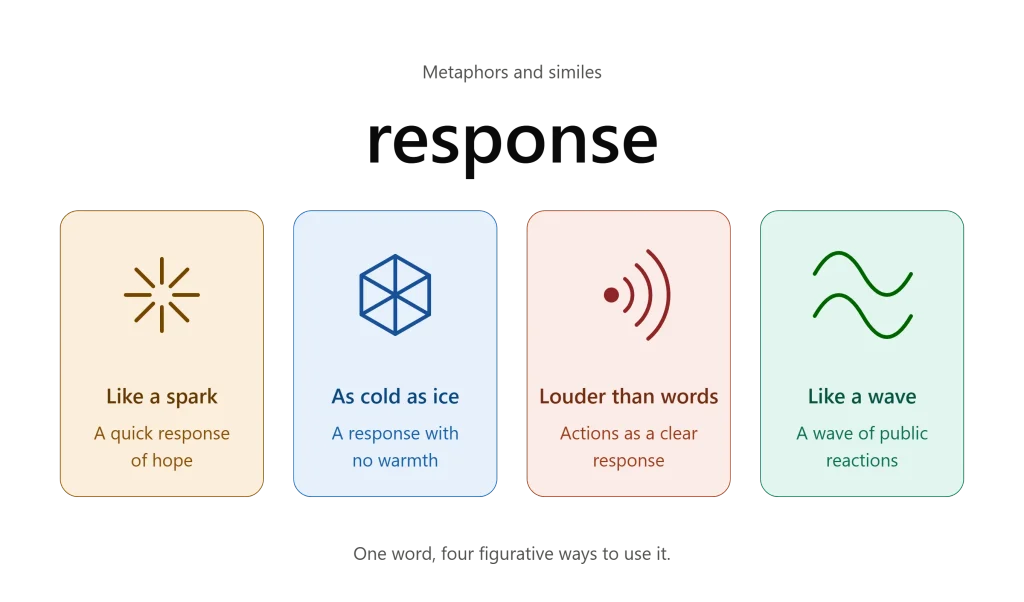
The word response can also appear in figurative language. These examples use it to describe feelings or actions.
- A response like a spark: Her kind words caused a quick response of hope.
- A response as cold as ice: His response showed no warmth.
- A response that speaks louder than words: Her actions were a clear response.
- A response like a wave: The news caused a wave of public reactions.
Connotative Meaning
The word response is neutral by itself. The words around it can give it a positive or negative tone.
Positive Tone
A positive response shows support, care, or approval.
- The team gave a warm response.
- Her idea received an encouraging response.
Negative Tone
A negative response may show anger, dislike, or refusal.
- His angry response upset the group.
- The plan received a poor response.
Neutral Tone
A neutral response gives information without showing strong feelings.
- The office sent a written response.
- The teacher asked for a short response.
Idioms and Proverbs
There is no common English idiom that uses responce as a correct word. However, several useful expressions use response or the related verb respond.
In Response To
This means “because of” or “as an answer to” something.
- The school changed its rules in response to student requests.
- The company acted in response to customer complaints.
No Response
This means that no answer or reaction came.
- I sent two emails but received no response.
- The phone rang, but there was no response.
Call and Response
This describes a pattern where one person speaks or sings and others reply.
- The song used a call-and-response pattern.
- The teacher used call and response to involve the class.
Literature and Movies
The word response is a normal English word. Writers use it to describe answers, feelings, and reactions. It is not limited to one book, poem, or film.
For example, a story may describe a character’s response to danger. A film review may discuss the audience’s response to a new movie.
There is no standard literary or movie category that compares response with responce. The second spelling is an error, not a separate word with its own history in modern English.
Why This Difference Matters
Correct spelling helps readers understand your message. It also makes your writing look clear and careful.
Using responce may distract readers. A teacher may mark it wrong. A customer may notice it in a business email. A website may look less professional if it contains spelling errors.
Learning the correct form also helps you remember related words. Response, respond, and responding belong to the same word family.
A small spelling check can prevent a common mistake. Always use response when you mean an answer or reaction.
Usefulness in Daily Life
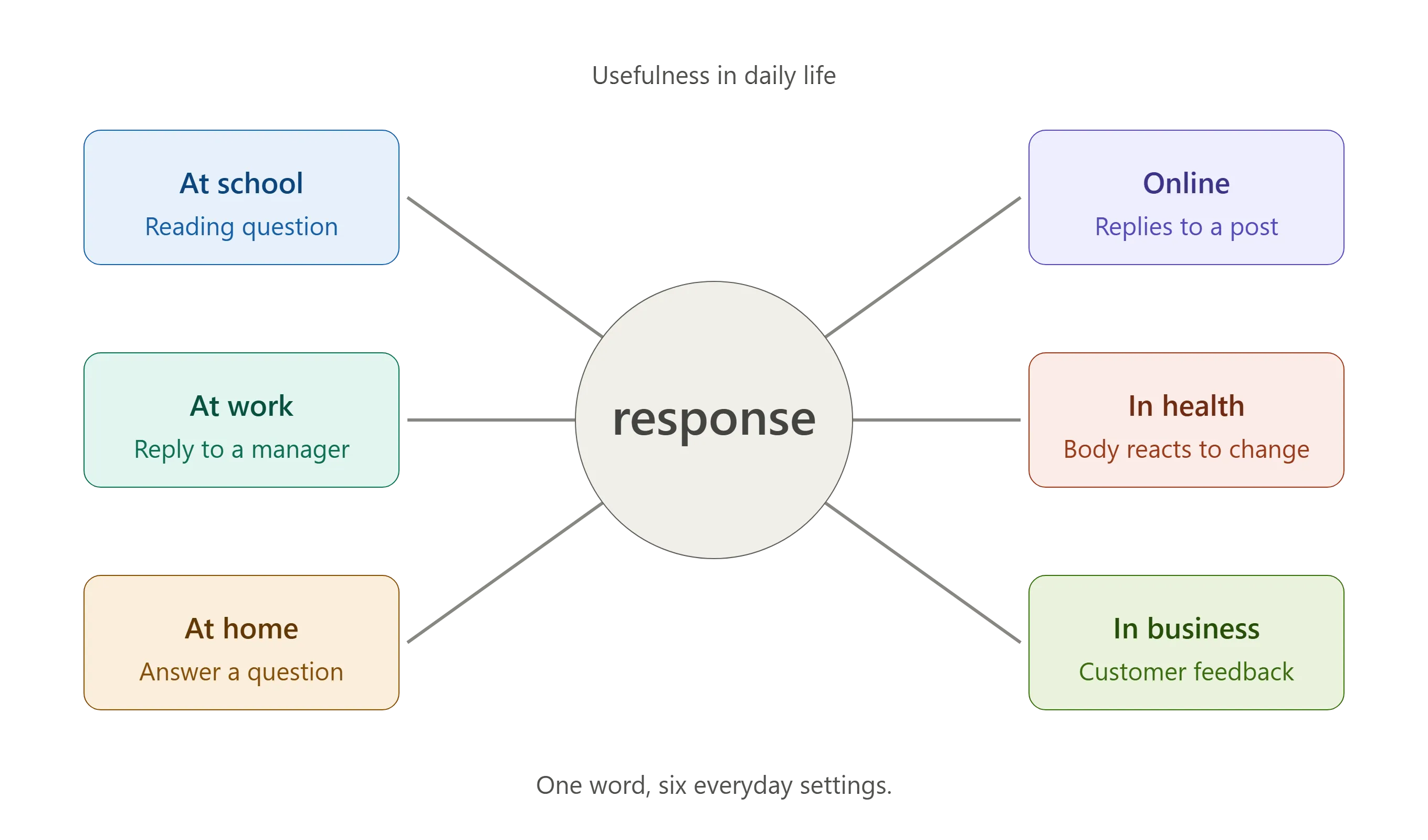
You may need the word response in many daily situations.
- At school: Write a response to a reading question.
- At work: Send a response to a manager.
- At home: Give a response when someone asks you a question.
- Online: Read the responses to a post.
- In health: Learn how your body responds to changes.
- In business: Check customer responses to a service.
Situational Preference
There is no situation in modern standard English where responce is the better choice. Use response in every setting. It is correct in casual messages, school assignments, business emails, news reports, and formal documents. If you are writing about one answer, use response. If you are writing about more than one, use responses. Whether you want to tell someone to give an answer, use respond. Checking these forms before you send or publish your writing will help you avoid this spelling error.
Possible Asked Questions
1. Is response or responce correct?
Response is correct. Responce is a common misspelling.
2. What does response mean?
A response is an answer or a reaction to something.
3. Is responce a real English word?
It is not a standard modern English spelling. Use response instead.
4. How do you spell the plural of response?
The plural is responses.
5. Is response spelled the same in the US and UK?
Yes. Both American and British English use response.
6. What is the difference between respond and response?
Respond is a verb. It means to answer or react. Response is a noun. It means an answer or reaction.
7. How can I remember the correct spelling?
Remember the ending -se in response. You can also learn the word pair: respond → response.
Conclusion
The correct spelling is response. The spelling responce is not accepted in modern standard English. Both forms may sound alike, but only one is right for everyday writing. A response can be an answer to a question. It can also be a reaction to news, events, or actions. You can use it in emails, schoolwork, reports, social media, and business writing. Remember the difference between respond and response. Respond is an action word, while response is a naming word. The plural form is responses. British and American English use the same spelling. You do not need to choose a different form for either country. Use response every time you mean an answer or reaction. This small habit will make your writing clearer and help you avoid a common spelling mistake.

I’m Samia Jamshaid, an English language specialist, SEO specialist, digital publisher, and researcher. I create clear, accurate, and well-researched content on English grammar, vocabulary, word meanings, and language comparisons, helping readers understand and use English with confidence.









1 thought on “Response or Responce: How To Spell It 2026”