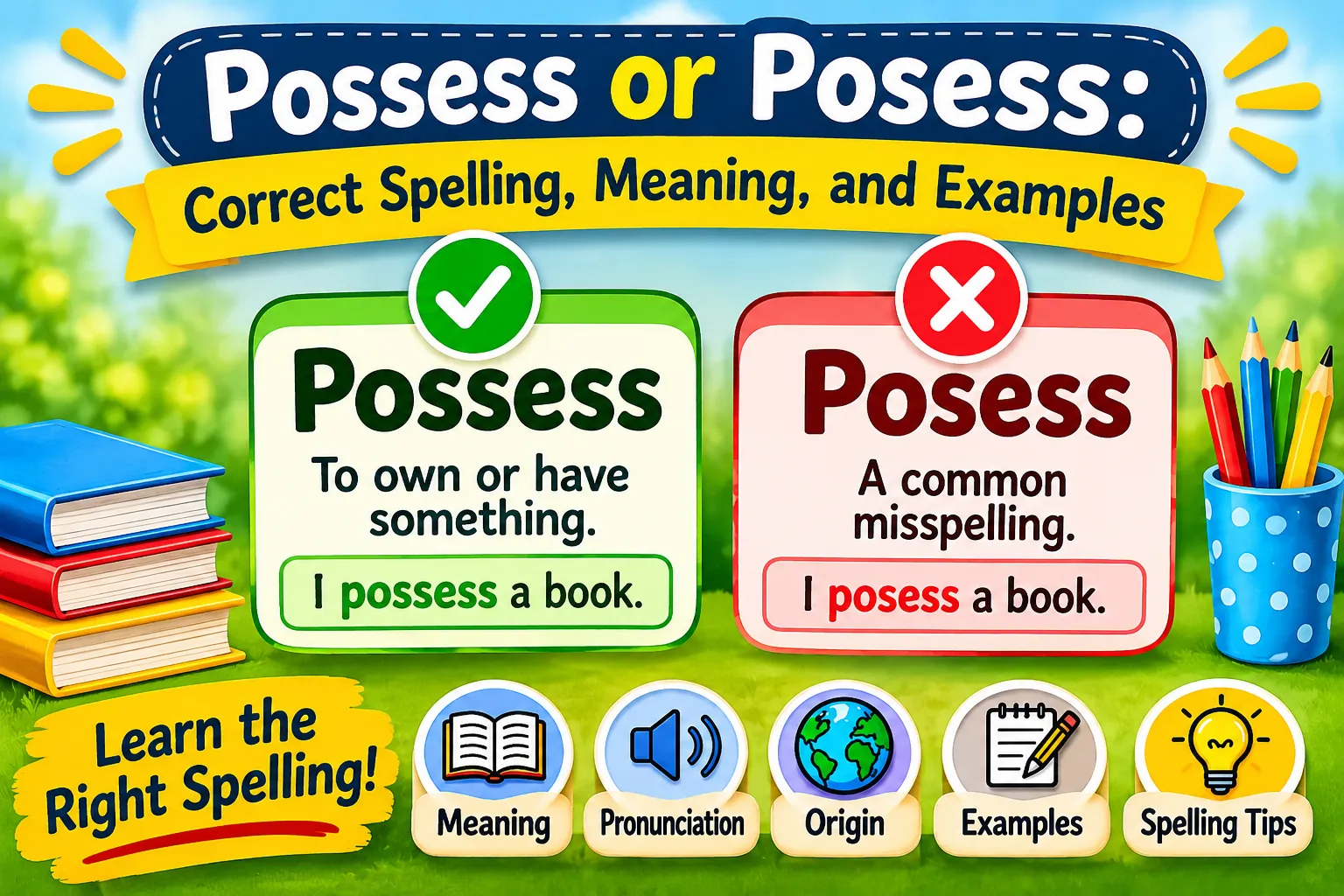
Possess is the correct English word. Posess is an incorrect spelling.
Imagine you are writing a school essay. You want to say that a person owns a car. You type, “She posess a new car.” The meaning is clear, but the spelling is wrong. The correct sentence is, “She possesses a new car.”
The word possess means to own, have, or hold something. It can also describe a quality or skill that someone has. For example, a person may possess great courage or special talent.
Many people search for “possess or posess” because the two forms look very similar. The extra letter s is easy to miss. Some people also type the word quickly and forget one letter. This guide explains the correct spelling, meaning, pronunciation, grammar, and use of possess. It also shows why posess is not accepted in standard English. You will learn simple ways to remember the right spelling.
Pronunciation of Possess and Posess
The correct word is possess. The spelling posess is not standard, so it has no accepted dictionary pronunciation. People who write it usually mean possess.
| Word | US pronunciation | UK pronunciation |
| Possess | /pəˈzɛs/ | /pəˈzɛs/ |
| Posess | Not a standard spelling | Not a standard spelling |
The stress falls on the second part of possess. The word ends with an /s/ sound.
Difference Between Possess and Posess
There is one main difference: possess is correct, while posess is a spelling error. Here are ten points to help you understand the difference.
1. Correct Spelling
Possess is the correct spelling. Posess leaves out one letter.
- Correct: I possess a new phone.
- Incorrect: I posess a new phone.
2. Meaning
Possess means to own, have, or hold something. Posess has no separate standard meaning.
- They possess a large house.
- She possesses great skill.
3. Part of Speech
Possess is a verb. It describes having or owning something.
- I possess a valid passport.
- He possesses a rare book.
Posess is not a correct verb form.
4. Grammar
Use possess when the sentence needs the base form of the verb.
- Do you possess a driving licence?
- They may possess useful skills.
Do not write posess in these sentences.
5. Present-Tense Use
Use possess with I, you, we, and they. Add -es for he, she, and it.
- I possess a small shop.
- She possesses a small shop.
6. Past-Tense Use
The past tense of possess is possessed.
- He possessed a red car.
- They possessed the land years ago.
Do not write posessed or posessd.
7. Use With Helping Verbs
Use possess after do, does, and did.
- Does she possess a passport?
- Did he possess the old house?
The correct form after did is possess, not possessed.
8. Use in Formal Writing
Possess is correct in reports, essays, and business letters.
- The company may possess important records.
- The student must possess basic computer skills.
The spelling posess should be corrected before you publish your work.
9. Word Family
The correct word family includes possesses, possessed, possessing, and possession.
- She possesses great talent.
- He has a valuable possession.
The incorrect spelling posess is not part of this word family.
10. Use in Daily Life
People use possess when they talk about things, skills, or qualities they have.
- I possess a copy of the book.
- She possesses a kind heart.
You May Also Like https://orchoice.com/feisty-or-fiesty/
Nature and Behaviour of Possess and Posess
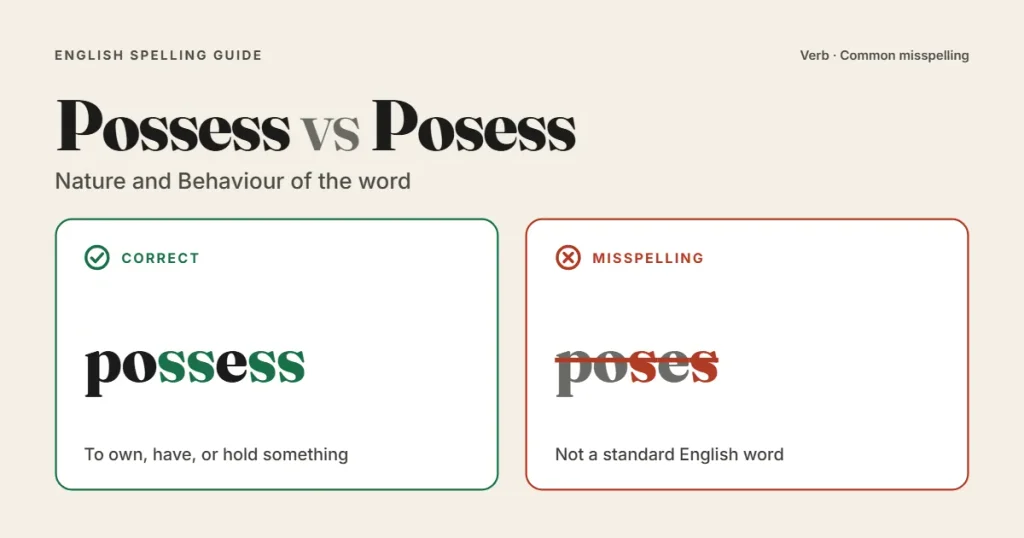
Possess
Possess is a verb. It means to own, have, or hold something.
Possess can describe physical things, such as a home, car, or phone. It can also describe qualities, such as courage, skill, or knowledge.
Examples:
- They possess a family home.
- She possesses strong leadership skills.
Posess
Posess is not a standard English word. It is usually a spelling mistake for possess.
If you see it in a message, the writer most likely means possess.
- Incorrect: I posess a new laptop.
- Correct: I possess a new laptop.
Why People Get Confused About Possess and Posess
People often forget one s when they write possess. The word has two s letters at the start of its final part. This spelling can be easy to miss.
People may also type too quickly. They may write the word as it sounds instead of checking each letter.
Another reason is that English has many words with one or two repeated letters. This can make spelling rules hard to remember.
The best way to avoid this mistake is to learn the full spelling:
P-O-S-S-E-S-S
Comparison Table
| Feature | Possess | Posess |
| Spelling | Correct | Incorrect |
| Meaning | To own, have, or hold | No separate standard meaning |
| Part of speech | Verb | Not a standard word |
| Pronunciation | /pəˈzɛs/ | No standard pronunciation |
| Present form | Possess | Incorrect |
| Third-person form | Possesses | Incorrect |
| Past form | Possessed | Incorrect |
| Word family | Possession, possessive | Not standard |
| US usage | Correct | Misspelling |
| UK usage | Correct | Misspelling |
The Origin of Possess
The word possess has roots in Latin. It comes from possidere, which means “to own” or “to hold.”
The word entered English through Old French. It has been used in English for many centuries.
At first, it mainly described owning or holding something. Today, it has a wider use. A person can possess a house, money, knowledge, or a special skill.
The past form is possessed. English forms it by adding -ed to possess.
The spelling posess is not a historical form that should be used today. It is a spelling error.
British vs American English
British and American English use the same spelling: possess.
Neither form uses posess. There is also no difference in the spelling of its main forms.
| Form | American English | British English |
| Base form | Possess | Possess |
| He/she/it form | Possesses | Possesses |
| Past form | Possessed | Possessed |
| -ing form | Possessing | Possessing |
| Noun form | Possession | Possession |
Examples:
- US: I possess a valid driver’s license.
- UK: I possess a valid driving licence.
- US: She possessed a small house.
- UK: She possessed a small house.
The spelling of the verb stays the same. Some related words, such as license and licence, have different US and UK forms. But possess does not.
Which One Should You Use?
Use possess in all forms of standard English.
- In the US: Write possess.
- In the UK: Write possess.
- In global English: Write possess.
- In schoolwork: Use the correct spelling in every answer.
- In business: Check the spelling before sending a report or email.
Common Mistakes
Here are some common spelling and grammar mistakes.
| Incorrect | Correct |
| Posess | Possess |
| Posesses | Possesses |
| Posessed | Possessed |
| Posessing | Possessing |
| Posession | Possession |
| She posess a car. | She possesses a car. |
| He posess a skill. | He possesses a skill. |
| Did she possessed it? | Did she possess it? |
Remember: Possess is the base verb. Possesses is used with he, she, or it. Possessed is the past form.
Everyday Usage Examples
In Emails
- I possess the files you requested.
- Do you possess the latest report?
- She possesses the skills for this job.
On Social Media
- He possesses a great sense of humor.
- She possesses a kind heart.
- I wish to possess that old book.
In News
- The group may possess useful information.
- The owner possesses the land legally.
- Police said the man possessed stolen items.
In Formal Writing
- Every worker must possess the right skills.
- The company may possess valuable records.
- The report explains what rights the owner may possess.
Usage Trends
Possess is used around the world. It appears in books, news reports, schoolwork, legal writing, and daily speech.
People use it to talk about ownership. They also use it to describe skills and personal qualities.
For example, a job notice may say that a person must possess good computer skills. A report may say that a person possesses a home or a piece of land.
The spelling posess may appear in online posts or quick messages. However, it is not accepted in standard English. Use possess in both British and American writing.
Metaphors and Similes
The word possess can appear in figurative language. It can describe strong feelings or personal qualities.
- Possess a heart of gold: She possesses a heart of gold.
- Possessed by fear: He seemed possessed by fear.
- Possess a sharp mind: She possesses a sharp mind.
- Possessed by joy: The child seemed possessed by joy.
Connotative Meaning
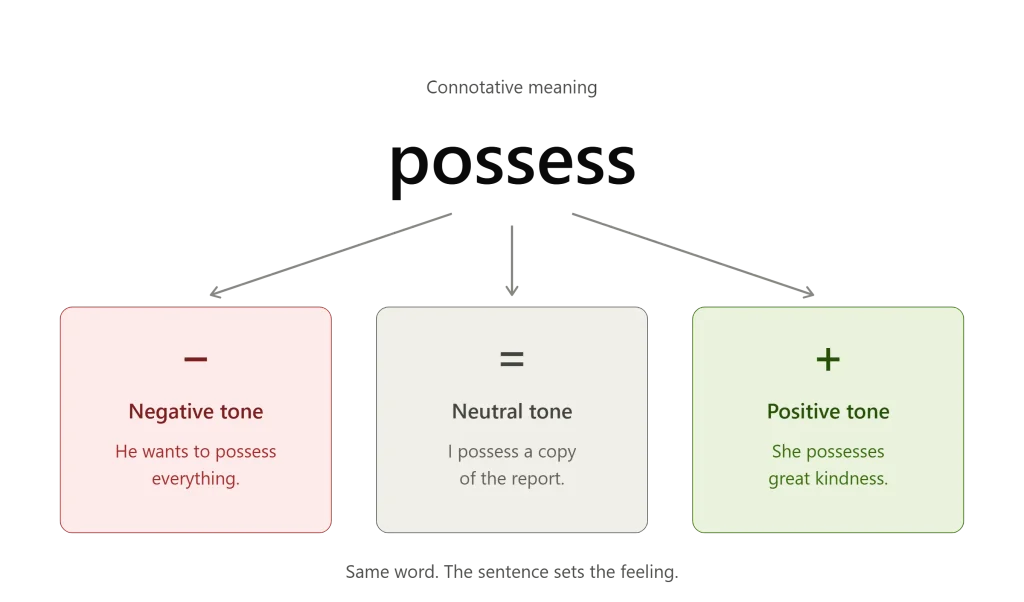
The word possess is often neutral. It can also carry a positive or negative feeling. The sentence gives it that tone.
Positive Tone
It can describe good skills, qualities, or things.
- She possesses great kindness.
- He possesses the courage to help others.
Negative Tone
It can describe control, greed, or strong feelings.
- He wants to possess everything.
- The character seemed possessed by anger.
Neutral Tone
It can describe simple ownership.
- I possess a copy of the report.
- They possess a small farm.
Idioms and Proverbs
There is no common English idiom that uses posess as a correct word. However, several useful expressions use possess or a related form.
Possess a Heart of Gold
This means to be very kind.
- My teacher possesses a heart of gold.
Be Possessed by Something
This can mean to be strongly controlled by a feeling or idea.
- He seemed possessed by fear.
Take Possession Of
This means to take control or ownership of something.
- The family took possession of their new home.
Literature and Movies
The word possess and its forms can appear in many kinds of stories. Writers may use them to describe ownership, power, or strong feelings.
Literature
Fyodor Dostoevsky’s novel The Possessed was first published in Russian in 1872. It is also known in English as Demons. The story explores political ideas and social conflict.
The word possessed also appears in ghost stories. It can describe a person who seems to be controlled by a spirit.
Movies
The Exorcist (1973) is an American horror film. It tells the story of a young girl believed to be controlled by a spirit.
Possession (1981) is a drama and horror film made in France and West Germany. Its title uses a related form of the word.
These examples show how the word family appears in stories and films. They do not make posess a correct spelling.
Why This Difference Matters
Correct spelling helps people understand your writing. It also makes your work look clear and careful.
If you write posess, readers may notice the mistake. A teacher may mark it wrong. A customer may also lose trust in a business message with spelling errors.
Learning the correct form helps you use other related words. These include possesses, possessed, possessing, and possession.
The rule is simple. Keep both pairs of s letters in possess. This small habit can help you avoid the same mistake in emails, essays, reports, and online posts.
Usefulness in Daily Life
You may use possess in many daily situations.
- At school: Write about the skills a person may possess.
- At work: List the skills you possess.
- At home: Talk about things your family may possess.
- Online: Describe the good qualities a person possesses.
- In news: Read reports about items a person may possess.
- In law: Read rules about what a person may legally possess.
Situational Preference
There is no need to choose between possess and posess. Only possess is correct. Use it in schoolwork, emails, reports, and daily messages. Use possesses with he, she, or it. Utilize possessed when you talk about the past. British and American English follow the same spelling rule. The spelling posess is wrong in both. Before you send or publish your writing, check that the word has all its letters. This simple step can help you write with care.
Common Questions and Answers
1. Is possess or posess correct?
Possess is correct. Posess is a common spelling mistake.
2. What does possess mean?
Possess means to own, have, or hold something.
3. Is posess a real English word?
No. Posess is not a standard English word. Use possess.
4. How do you spell possess?
The correct spelling is possess. It has two s letters at the start of the ending and two at the end.
5. Is possess spelled the same in the US and UK?
Yes. Both American and British English use possess.
6. What is the past tense of possess?
The past tense is possessed.
7. What is the noun form of possess?
The noun form is possession. It means something that a person owns or has.
Conclusion
The correct spelling is possess. The spelling posess is wrong in modern standard English. Both forms may look alike, but only one is accepted. The word possess means to own, have, or hold something. You can use it for things, skills, and personal qualities. For example, a person may possess a home, a book, or great courage. Remember the spelling. The word has two s letters at the start and two at the end. Do not leave one out. The form possesses is used with he, she, or it. The past form is possessed. In British and American English use the same spelling. You do not need a different form for either country. Use possess every time you mean to own or have something. This simple rule will help you avoid a common spelling mistake.

I’m Samia Jamshaid, an English language specialist, SEO specialist, digital publisher, and researcher. I create clear, accurate, and well-researched content on English grammar, vocabulary, word meanings, and language comparisons, helping readers understand and use English with confidence.






1 thought on “Possess or Posess: Correct Spelling, Meaning, and Examples”