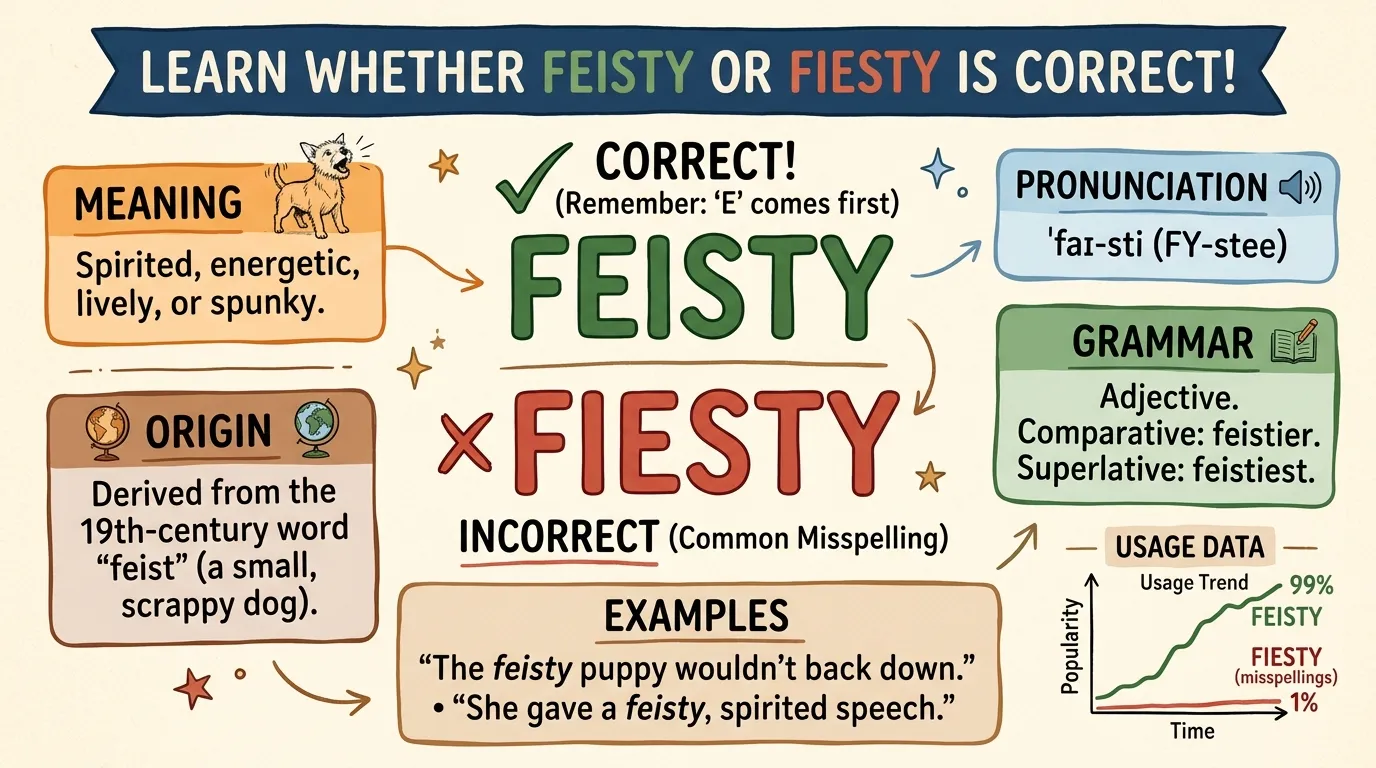
Feisty is the correct spelling. Fiesty is a common spelling mistake.
Imagine you are describing a small child who speaks up for herself. She is brave, lively, and not afraid to share her views. You might call her feisty. But when you type the word, you may wonder if it needs an extra “i.” This is why many people search for “feisty or fiesty.”
The word feisty describes someone with a strong and lively spirit. It can also describe a person who is brave and ready to stand up for themselves. The word often has a positive tone. However, it can sometimes suggest that someone is quick to argue.
The spelling fiesty may look right because the sound can make people think of the letter “i.” But standard English uses feisty. This guide explains its meaning, spelling, pronunciation, and use. You will also see simple examples to help you remember the correct form.
Pronunciation of Feisty or Fiesty
The correct word feisty has the same pronunciation in American and British English. Fiesty is not a standard spelling. When people write it by mistake, they usually intend to write feisty.
| Word | American English | British English |
| Feisty | /ˈfaɪsti/ | /ˈfaɪsti/ |
| Fiesty | Incorrect spelling; intended sound is /ˈfaɪsti/ | Incorrect spelling; intended sound is /ˈfaɪsti/ |
The word has two syllables. The first syllable has the main stress.
Difference Between Feisty and Fiesty
There is no standard meaning difference between these two spellings. Feisty is correct, while fiesty is usually a mistake. The points below explain how they differ in spelling, grammar, and use.
1. Correct Spelling
Feisty is the correct spelling in standard English. Fiesty is incorrect.
Examples:
- The feisty girl stood up for her friend.
- Our feisty dog loves to play.
2. Meaning
Feisty means lively, brave, and full of spirit. Fiesty has no separate standard meaning.
Examples:
- Her feisty nature makes her stand out.
- He gave a feisty answer during the talk.
3. Part of Speech
Feisty is an adjective. An adjective describes a person, place, or thing. Fiesty is not a standard adjective.
Examples:
- She is a feisty young player.
- The feisty team never gave up.
4. Pronunciation
The correct spelling feisty is said as /ˈfaɪsti/. People who write fiesty usually mean the same spoken word.
Examples:
- The feisty child asked many questions.
- A feisty cat may not back away from a larger animal.
5. Grammar
Use feisty before a noun or after a linking verb. Do not use fiesty in standard writing.
Examples:
- She has a feisty spirit.
- The little dog seems feisty.
6. Spelling Pattern
The correct word begins with “f-e-i.” The letters “i-e” in fiesty are in the wrong order.
Examples:
- Correct: The feisty player scored again.
- Incorrect: The fiesty player scored again.
7. Tone and Feeling
Feisty often gives a positive feeling. It can show courage, energy, and confidence. In some cases, it can suggest a person is ready to argue.
Examples:
- Her feisty reply showed great courage.
- The feisty child refused to give up.
8. Everyday Use
People use feisty to describe people, animals, and teams. They may also use it for a strong or lively style.
Examples:
- The feisty puppy chased the ball.
- Our feisty team played until the end.
9. Formal Writing
Use feisty in schoolwork, reports, books, and work emails. Avoid fiesty because it is a spelling error.
Examples:
- The report described her as a feisty leader.
- The writer created a feisty main character.
10. Related Word Forms
Feisty has related forms and common word uses. Feistiness is the noun form. Feistily is the adverb form, though it is less common.
Examples:
- Her feistiness helped her face the challenge.
- She spoke feistily during the debate.
You May Also Like https://orchoice.com/transferring-or-transfering/
Nature and Behaviour of Feisty and Fiesty
Feisty
Feisty describes someone who is lively, bold, and full of energy. A feisty person may speak up when something feels unfair. They may also face problems with courage.
The word can describe:
- A brave child.
- A lively pet.
- A strong sports team.
- A person who speaks with confidence.
- Someone who does not give up easily.
Examples:
- The feisty girl defended her friend.
- Our feisty dog stood its ground.
The word can be positive or slightly negative. It depends on the action and the speaker’s tone.
Fiesty
Fiesty is not a standard English word. It is usually a spelling error for feisty.
You may see it in quick messages or online posts. However, use feisty in schoolwork, emails, and formal writing.
Examples:
- Incorrect: She is a fiesty little girl.
- Correct: She is a feisty little girl.
Why People Get Confused About Feisty and Fiesty
People often confuse these spellings because they hear the word before they learn to write it. The first sound is like “fye.” This may lead them to place “i” before “e.”
The correct spelling is f-e-i-s-t-y. The incorrect spelling is f-i-e-s-t-y.
Another reason is that the word does not follow the spelling pattern many learners expect. People may also type it quickly and miss the letter order.
A simple way to remember it is to learn the whole word: feisty. Read it, say it, and use it in a sentence.
Comparison Table
| Point | Feisty | Fiesty |
| Standard spelling | Correct | Incorrect |
| Meaning | Lively, brave, and full of spirit | No separate standard meaning |
| Part of speech | Adjective | Not a standard word |
| Pronunciation | /ˈfaɪsti/ | Usually intended to sound like feisty |
| First letters | F-E-I | F-I-E |
| Grammar | Used to describe a person or thing | Not used in standard grammar |
| Formal writing | Accepted | Avoid |
| Everyday use | Common | Common spelling mistake |
| Related noun | Feistiness | No standard form |
| Best choice | Use this spelling | Correct it to feisty |
The Origin of Feisty
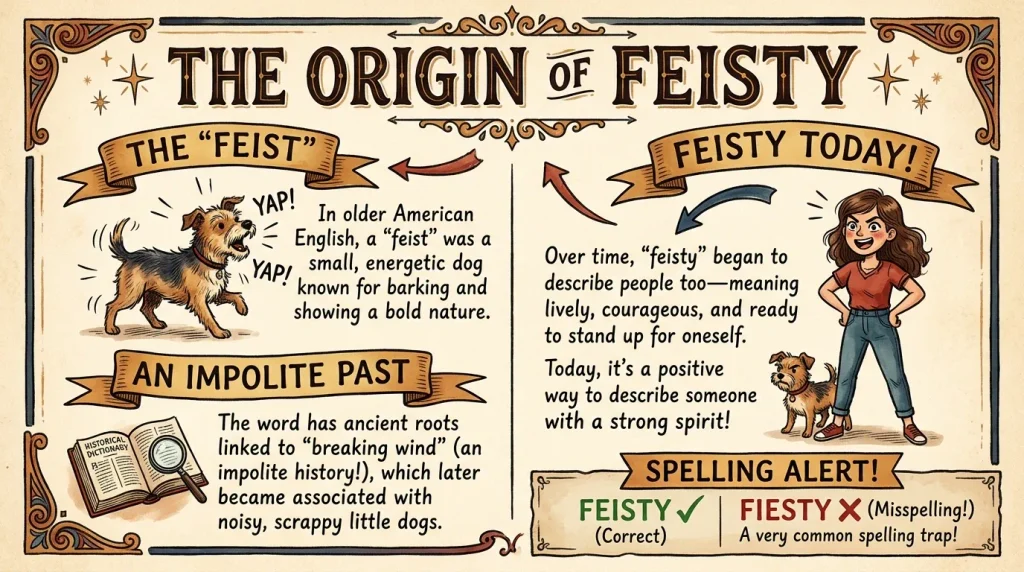
The word feisty comes from the word feist. In older American English, a feist was a small dog. The word was also linked to dogs that barked or showed a bold nature.
Over time, feisty began to describe people too. It came to mean lively, brave, and ready to stand up for oneself.
The word has roots in older English words linked to breaking wind. Its history is not very polite, but its modern meaning is different.
Today, feisty is often used in a friendly or positive way. It can describe a person with courage and a strong spirit.
Fiesty does not have the same accepted word history. It is usually a misspelling of feisty.
British vs American English
American and British English both use feisty. The spelling does not change between the two forms of English.
| Point | American English | British English |
| Correct spelling | Feisty | Feisty |
| Incorrect spelling | Fiesty | Fiesty |
| Meaning | Lively and brave | Lively and brave |
| Pronunciation | /ˈfaɪsti/ | /ˈfaɪsti/ |
| Part of speech | Adjective | Adjective |
| Related noun | Feistiness | Feistiness |
Examples in American English:
- She is a feisty young coach.
- The feisty dog barked at the stranger.
Examples in British English:
- He has a feisty attitude.
- The feisty player kept fighting for the ball.
Which One Should You Use?
Always use feisty in standard English.
- For American English: Write feisty in schoolwork and emails.
- For British English: Use feisty in the same way.
- For global English: Choose feisty because it is accepted worldwide.
- For formal writing: Avoid fiesty because it is incorrect.
- For social media: Use feisty when you want to describe a lively person.
Remember the letter order: F-E-I-S-T-Y.
Common Mistakes
Here are some common spelling mistakes and their correct forms.
| Incorrect Form | Correct Form | Example |
| Fiesty girl | Feisty girl | The feisty girl spoke up. |
| Fiesty dog | Feisty dog | Our feisty dog loves to play. |
| Very fiesty | Very feisty | She is very feisty. |
| Fiesty attitude | Feisty attitude | He has a feisty attitude. |
| Fiesty reply | Feisty reply | She gave a feisty reply. |
| Fiesty team | Feisty team | The feisty team won the match. |
| Fiestiness | Feistiness | Her feistiness surprised us. |
Everyday Usage Examples
The word feisty appears in daily talks, emails, news, and stories. It helps describe someone who is lively and brave.
In Emails
- Your feisty spirit helped the team.
- We enjoyed your feisty ideas during the meeting.
- She is a feisty leader who speaks with care.
On Social Media
- My feisty little dog runs the whole house.
- She is small but feisty.
- A feisty heart never gives up.
In News
- The feisty team fought hard until the final whistle.
- The feisty leader spoke out during the meeting.
- The young player gave a feisty display.
In Formal Writing
- The writer created a feisty main character.
- The coach praised the team’s feisty spirit.
- Her feisty reply showed her strong views.
Usage Trends
Feisty is used in many English-speaking countries. It appears in books, news stories, sports reports, and daily talks.
People often use it to describe someone who is brave or full of energy. It can also describe a small animal with a bold nature.
The word is common in both American and British English. Its spelling stays the same in both places.
Fiesty may appear in online searches, comments, and quick messages. This does not make it correct. It is still a spelling mistake in standard English.
Metaphors and Similes
Feisty can help describe more than a person’s actions. It can also create a clear picture of courage and energy.
1. A Firecracker Full of Energy
A firecracker is small but makes a strong sound. A feisty person may also have a bold and lively nature.
Example: The little girl was like a firecracker, full of feisty energy.
2. A Small Dog With a Big Heart
Some small dogs are brave and do not back away easily. This can describe a person who stands up for themselves.
Example: He is like a small dog with a big heart and a feisty spirit.
3. A Fighter Who Never Gives Up
A feisty person may keep trying when life gets hard.
Example: She faced each problem like a fighter with a feisty heart.
Connotative Meaning
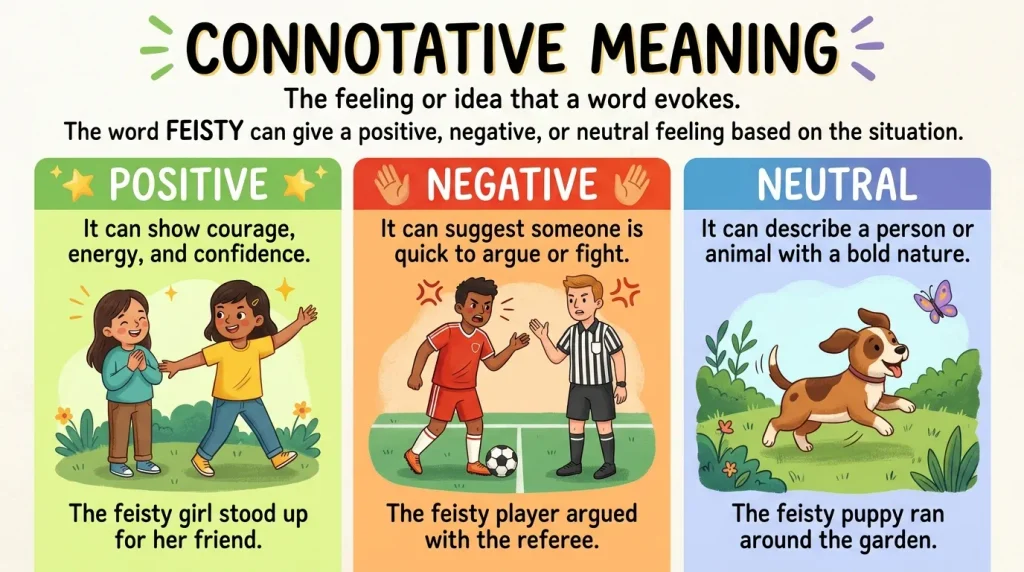
The word feisty can give a positive, negative, or neutral feeling. The meaning depends on the person and the situation.
Positive Meaning
It can show courage, energy, and confidence.
Examples:
- The feisty girl stood up for her friend.
- Her feisty spirit helped her win the race.
Negative Meaning
It can suggest that someone is quick to argue or fight.
Examples:
- The feisty player argued with the referee.
- His feisty reply made the talk tense.
Neutral Meaning
It can simply describe a person or animal with a bold nature.
Examples:
- The feisty puppy ran around the garden.
- The feisty child asked many questions.
Idioms and Proverbs
There is no well-known English idiom that uses the exact word feisty. However, some common expressions share a similar idea.
1. Stand Your Ground
Meaning: Stay firm when someone challenges you.
Example: She stood her ground and gave a feisty reply.
2. Fight Back
Meaning: Try to stop someone who is hurting or unfair to you.
Example: The feisty player fought back after the team fell behind.
3. Full of Life
Meaning: Have lots of energy and joy.
Example: The feisty child is full of life.
4. A Force to Be Reckoned With
Meaning: Someone who should be taken seriously.
Example: The feisty young player became a force to be reckoned with.
These phrases can help you describe courage, energy, and a strong spirit.
Literature and Movies
The word feisty is often used in stories and film reviews. It can describe a bold hero, a strong friend, or a character who speaks up.
Literature
In children’s books and adventure stories, a feisty character may face danger or stand up to unfair treatment. The word helps readers understand that the character is brave and full of spirit.
There is no single famous book that defines the spelling difference between feisty and fiesty. Check a book’s exact wording before using it as a direct example.
Movies
Films often show feisty characters who face problems with courage. This type of character may appear in comedy, family films, and adventure stories.
The spelling pair itself is not the subject of a well-known film. Use feisty when writing about a bold character.
Why This Difference Matters
Correct spelling helps people understand your writing. It also makes your work look neat and clear.
A spelling mistake can make a good message look less careful. This matters in school tasks, job letters, emails, and online posts.
For English learners, this word is a useful spelling lesson. The sound may lead you to write “fie,” but the correct letters are “fei.”
Learning the correct form also helps you use the word with confidence. You can describe a brave child, a bold pet, or a strong team.
Remember, feisty is correct in both American and British English. Fiesty is not a standard spelling.
Usefulness in Daily Life
You can use feisty in many daily situations. It helps you describe people and animals with strong, lively spirits.
- Family: My feisty little sister loves to speak her mind.
- School: The feisty student asked a bold question.
- Work: Our feisty team shared new ideas.
- Sports: The feisty player never gave up.
- Pets: We have a feisty little dog.
- Stories: The feisty hero saved the day.
- Social media: She is small but feisty.
Situational Preference
Use feisty in every standard writing situation. It is correct in American, British, and global English. At schoolwork, you can write, “The feisty girl stood up for her friend.” In a work email, you might say, “She has a feisty spirit and shares bold ideas.” In a story, the word can describe a brave hero or lively animal. Avoid fiesty in formal and informal writing. If you are unsure, remember the first five letters: F-E-I-S-T.
Common Questions and Answers
1. Is feisty or fiesty correct?
Feisty is correct. Fiesty is a common spelling mistake.
2. What does feisty mean?
Feisty means lively, brave, and full of spirit. It often describes someone who is not afraid to speak up.
3. How do you pronounce feisty?
It is pronounced /ˈfaɪsti/ in both American and British English.
4. Is feisty a good or bad word?
It can be both. It often means brave and full of energy. Sometimes, it can suggest that someone is quick to argue.
5. Is feisty correct in British English?
Yes. British English uses feisty. The spelling is the same in American English.
6. What is the noun form of feisty?
The noun form is feistiness. It means a lively, bold, or spirited nature.
7. How can I remember the spelling of feisty?
Remember the letter order: F-E-I-S-T-Y. Do not write “F-I-E-S-T-Y.”
Conclusion
Knowing whether to use feisty or fiesty will help you avoid a common spelling mistake. Remember that feisty is the correct spelling. Both American and British English use feisty. It describes someone who is lively, brave, and full of spirit. You can use it for a person, animal, team, or character. The word can have a good or bad tone. It may show courage and energy. It can also suggest that someone is quick to argue. The key is to look at the sentence and the action. Learning the correct spelling between feisty or fiesty will help you write with more care. It will also help you describe people in a clear way. Remember the simple spelling: F-E-I-S-T-Y. Use feisty in your schoolwork, emails, stories, and daily talks.

I’m Samia Jamshaid, an English language specialist, SEO specialist, digital publisher, and researcher. I create clear, accurate, and well-researched content on English grammar, vocabulary, word meanings, and language comparisons, helping readers understand and use English with confidence.









1 thought on “Feisty or Fiesty: Which Spelling Is Correct? 2026”