Transferring is the correct spelling. Transfering is incorrect because it is missing one “r.”
Imagine you need to move money from one bank account to another. You might write, “I am transferring money.” But if you type too quickly, you may write “I am transfering money.” The two forms look almost the same, but only one is correct.
The word transfer means to move something or someone from one place, person, or system to another. When you add “-ing” to this word, you must double the final “r.” This gives us transferring.
Many English learners search for “transferring or transfering” because they are unsure about the spelling rule. Some words keep their final letter when we add “-ing.” Others need a double letter. This article explains the correct spelling, pronunciation, grammar rule, and everyday uses. You will also learn how to avoid this common mistake.
Pronunciation of Transferring and Transfering
The correct spelling is transferring. The word transfering is a spelling mistake, not a separate standard English word. Both forms are usually read with the same intended sound.
| Word | American English | British English |
| Transferring | /trænsˈfɝːɪŋ/ | /trænsˈfɜːrɪŋ/ |
| Transfering | Incorrect spelling | Incorrect spelling |
The main stress falls on the second syllable of transfer. The ending sounds like “ing.”
Now, let’s look at the main differences and the spelling rule.
Difference Between Transferring and Transfering
1. Correct Spelling
Transferring is the correct spelling. It has two “r” letters before “-ing.” Transfering has only one “r” and is incorrect.
Examples:
- She is transferring to another school.
- I am transferring money to my savings account.
2. Meaning
The word transferring means moving something or someone from one place to another. Transfering is usually written by mistake when someone wants to use this meaning.
Examples:
- The company is transferring its office to a new building.
- He is transferring his files to a new computer.
3. Grammar Rule
The word transfer ends with a consonant-vowel-consonant pattern in its final syllable. The final syllable also has the main stress. So, we double the last letter before adding “-ing.”
Examples:
- Transfer + ing = transferring
- Refer + ing = referring
4. Part of Speech
Transferring is the “-ing” form of the verb transfer. It can be part of a verb phrase. It can also work as a noun-like word in a sentence.
Examples:
- They are transferring the patient now.
- Transferring large files can take time.
5. Verb Form
We use transferring to describe an action that is happening now. We can also use it after certain verbs and prepositions.
Examples:
- We are transferring the records today.
- She finished transferring the photos.
6. Spelling Pattern
The correct form doubles the final “r” before adding “-ing.” This rule also applies to some other verbs.
Examples:
- Transfer → Transferring
- Prefer → Preferring
7. Pronunciation
The correct word has the same basic pronunciation in American and British English. The extra “r” changes the spelling, not the intended sound.
Examples:
- He is transferring to a new team.
- They are transferring the call now.
8. Everyday Use
People use transferring when they talk about money, files, jobs, schools, and travel. The incorrect form may appear when someone types too quickly.
Examples:
- I am transferring money to my brother.
- The student is transferring to another college.
9. Formal Writing
Use transferring in schoolwork, emails, reports, and business documents. Avoid transfering because spelling mistakes can make your writing look careless.
Examples:
- We are transferring the records to the main office.
- The bank is transferring the payment today.
10. Related Word Forms
Transferring belongs to a family of words. Other forms include transfer, transfers, and transferred. Each form has its own spelling rule.
Examples:
- The money was transferred yesterday.
- She is transferring to another department.
You May Also Like https://orchoice.com/reckless-or-wreckless/
Nature and Behaviour of Transferring and Transfering
Transferring
Transferring is the correct “-ing” form of the verb transfer. It describes the act of moving something or someone to another place, person, or system.
We use it in many situations:
- Moving money between bank accounts.
- Moving files between computers.
- Changing from one school to another.
- Moving a worker to another office.
- Passing a phone call to another person.
It can also show that an action is happening now.
Examples:
- The bank is transferring the money.
- We are transferring the files today.
Transfering
Transfering is not a standard English spelling. It is usually a mistake made when someone forgets to double the final “r.”
You may see it in online posts, messages, or other informal writing. However, it should be corrected to transferring in standard English.
Examples:
- Incorrect: She is transfering to another school.
- Correct: She is transferring to another school.
Why People Get Confused About Transferring and Transfering
People often feel unsure about this word because English has different spelling rules. When we add “-ing” to a verb, we sometimes keep the final letter. In other cases, we double it.
Look at these examples:
- Help → Helping
- Read → Reading
- Run → Running
- Stop → Stopping
- Transfer → Transferring
The word transfer follows the doubling rule. Its final syllable has the main stress. It also ends with one vowel followed by one consonant.
People may forget the second “r” when typing quickly. The two forms also have the same intended sound, so it can be hard to notice the mistake by listening.
Comparison Table
| Point | Transferring | Transfering |
| Standard spelling | Correct | Incorrect |
| Meaning | Moving something or someone | Intended to mean the same thing |
| Part of speech | Verb form; can also act as a gerund | Not a standard form |
| Pronunciation | /trænsˈfɝːɪŋ/ in US English | Intended to sound the same |
| Final letters | Double “r” | Single “r” |
| Grammar | Follows the doubling rule | Does not follow the rule |
| Formal writing | Accepted | Avoid |
| Everyday use | Common | Common spelling mistake |
| Related forms | Transfer, transferred, transfers | No standard word family |
| Best choice | Use this spelling | Correct it to transferring |
The Origin of Transfer and Transferring
The word transfer comes from Latin. It is linked to the Latin word transferre. This word means to carry or move something across.
The word later entered English through French and Latin forms. Over time, people began using it for many kinds of movement.
Today, transfer has several common uses:
- Money: Moving money between accounts.
- Education: Moving from one school to another.
- Work: Moving an employee to another role.
- Technology: Moving files between devices.
- Travel: Changing from one bus, train, or plane to another.
The word transferring is made by adding “-ing” to transfer. We double the final “r” because the last syllable is stressed and ends with a consonant-vowel-consonant pattern.
British vs American English
American and British English use the same spelling: transferring. Neither uses transfering as the standard form.
| Point | American English | British English |
| Correct spelling | Transferring | Transferring |
| Incorrect spelling | Transfering | Transfering |
| Base word | Transfer | Transfer |
| Past tense | Transferred | Transferred |
| Pronunciation | /trænsˈfɝːɪŋ/ | /trænsˈfɜːrɪŋ/ |
| Spelling rule | Double the final “r” | Double the final “r” |
Examples in American English:
- She is transferring to a new college.
- The bank is transferring the funds.
Examples in British English:
- He is transferring to another department.
- They are transferring the records.
Which One Should You Use?
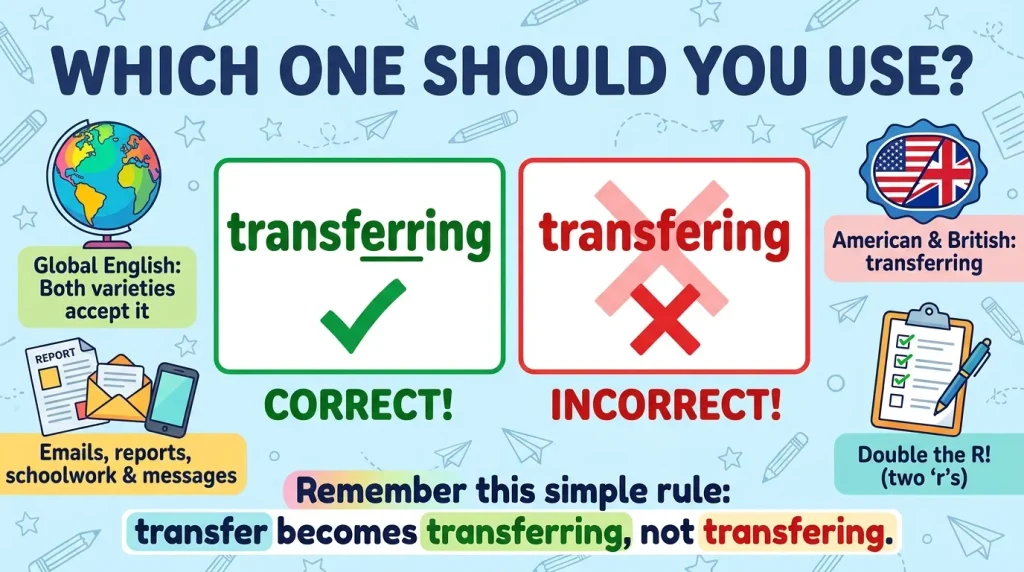
Always use transferring in standard English.
- American English: Write transferring in emails, reports, and schoolwork.
- British English: Use transferring in the same way.
- Global English: Choose transferring because both varieties accept it.
- Formal writing: Check that the word has two “r” letters.
- Online messages: Use the correct spelling, even in short texts.
Common Mistakes
Here are some common spelling errors and their correct forms.
| Incorrect Form | Correct Form | Example |
| Transfering money | Transferring money | I am transferring money today. |
| Transfering files | Transferring files | She is transferring her files. |
| Transfering schools | Transferring schools | He is transferring schools next year. |
| Transfering the call | Transferring the call | I am transferring the call now. |
| Transfered | Transferred | The funds were transferred yesterday. |
| Transfering data | Transferring data | We are transferring the data. |
| Transfered files | Transferred files | They transferred the files safely. |
Everyday Usage Examples
The word transferring appears in many parts of daily life. Here are some simple examples.
In Emails
- I am transferring the files to the shared folder.
- We are transferring your request to the correct team.
- The payment is being transferred to your account.
On Social Media
- I am transferring my photos to my new phone.
- We are transferring our website to a new server.
- She is transferring to a new school next month.
In News
- The company is transferring workers to another office.
- The bank is transferring funds after a system update.
- The player is transferring to a new football club.
In Formal Writing
- The school is transferring the student to another class.
- The office is transferring the records to its main branch.
- The team is transferring the data to a secure system.
Usage Trends
Transferring is a common word in modern English. People use it in banking, education, work, travel, and technology.
Online banking has made the word more common in daily life. People often talk about transferring money between accounts.
Technology has also increased its use. People transfer photos, videos, and files between phones and computers.
The incorrect form transfering may appear in online searches and messages. This often happens because people forget to double the final “r.” However, it is not a standard spelling in American or British English.
Metaphors and Similes
Transferring usually describes a real action. However, it can also help explain how ideas, feelings, and skills move between people.
1. Transferring Knowledge
This means sharing what one person knows with another person.
Example: The teacher is transferring her knowledge to the students.
2. Transferring Energy
This can describe passing energy from one person or thing to another.
Example: The coach’s words were transferring energy to the tired team.
3. Like Passing a Baton
In a relay race, one runner passes a baton to the next runner. This can be compared to giving a task to another person.
Example: The old manager was transferring his duties like a runner passing a baton.
Connotative Meaning
The word transferring usually has a neutral meaning. It does not show a good or bad feeling by itself. The feeling depends on the situation.
Positive Meaning
It can suggest progress, new chances, and growth.
Examples:
- She is transferring to a better school.
- The company is transferring him to a new role.
Negative Meaning
It can suggest an unwanted move or a sudden change.
Examples:
- He is transferring because his old office closed.
- The family is transferring after losing their home.
Neutral Meaning
It can simply describe moving something from one place to another.
Examples:
- I am transferring money between accounts.
- They are transferring files to another computer.
Idioms and Proverbs
There is no well-known English idiom built around the exact word transferring. However, several common expressions share a similar idea.
1. Pass the Baton
Meaning: Give a task or duty to another person.
Example: The manager passed the baton to his new assistant.
2. Hand Over
Meaning: Give control or responsibility to someone else.
Example: She handed over the files to her team leader.
3. Move On
Meaning: Leave one place or situation and begin another.
Example: He moved on to a new job after five years.
4. Pass the Torch
Meaning: Give a role or duty to someone who will continue the work.
Example: The founder passed the torch to his daughter.
These expressions can help you talk about changes, duties, and movement.
Literature and Movies
The idea of transferring appears in many stories. Characters may move to new places, change schools, join new teams, or pass duties to others.
Literature
School and young adult stories often show students moving to new schools. These stories may explore friendship, change, and fresh starts.
Movies
Sports and workplace films often show people moving between teams or jobs. These stories can show the challenges of starting a new role.
There is no single famous book or movie that explains the spelling difference between transferring and transfering. These are common story themes, not examples of a work about this spelling rule.
Why This Difference Matters
Choosing correct spelling of transferring or transfering helps readers understand your message. It also makes your writing look clear and careful.
A small spelling error can cause problems in schoolwork, job applications, and business emails. Spell-check tools may catch the mistake, but it is still helpful to know the rule yourself.
For English learners, this word is a useful example of the final-letter doubling rule. Learning it can also help with words like referring and preferring.
Remember, transferring is correct in both American and British English. The other form is a spelling mistake.
Usefulness in Daily Life

You may use transferring more often than you think. It appears in many daily tasks.
- Banking: I am transferring money to my account.
- School: She is transferring to another school.
- Work: He is transferring to the London office.
- Technology: We are transferring photos to a laptop.
- Travel: They are transferring to another train.
- Sports: The player is transferring to a new club.
- Files: I am transferring the report to the shared folder.
Situational Preference
Use transferring in every standard writing situation. It is the correct form in American, British, and global English. In schoolwork, write, “The student is transferring to another school.” In a work email, write, “We are transferring the records today.” For a bank message, write, “I am transferring money to my account.” You may see transfering online, but it is still a spelling mistake. Do not use it in formal or informal writing. If you are unsure, remember to double the final “r.”
Possible Asked Question
1. Is transferring or transfering correct?
Transferring is correct. Transfering is a spelling mistake.
2. Why does transferring have two r’s?
The last syllable of transfer has the main stress. It ends with a consonant-vowel-consonant pattern. So, double the final “r” before adding “-ing.”
3. Is transferring correct in American English?
Yes. American English uses transferring. The spelling transfering is incorrect.
4. Is transferring correct in British English?
Yes. British English also uses transferring. There is no spelling change between the two varieties.
5. How do you pronounce transferring?
In American English, it is /trænsˈfɝːɪŋ/. In British English, it is /trænsˈfɜːrɪŋ/. The main stress falls on the second syllable.
6. What is the past tense of transfer?
The past tense is transferred. It also doubles the final “r.”
Example: She transferred the money yesterday.
7. What are the other forms of transfer?
Common forms include transfer, transfers, transferred, and transferring. The related noun is transfer.
Conclusion
Transferring or Transfering Which Spelling Is Correct?”. The correct spelling is transferring. The spelling transfering is wrong in standard English. Both American and British English use the same correct form. The word transfer means to move something or someone to another place. When you add “-ing,” double the final “r.” This gives you transferring. You can use it when talking about money, files, jobs, schools, or travel. It can also describe sharing duties, skills, or knowledge. Learning this small spelling rule can help you avoid common writing errors. It can also help you spell other words, such as referring and preferring. Remember this simple rule: transfer + ing = transferring. Use this form in emails, schoolwork, reports, and daily messages.

I’m Samia Jamshaid, an English language specialist, SEO specialist, digital publisher, and researcher. I create clear, accurate, and well-researched content on English grammar, vocabulary, word meanings, and language comparisons, helping readers understand and use English with confidence.












1 thought on “Transferring or Transfering: Learn the Correct Spelling 2026”