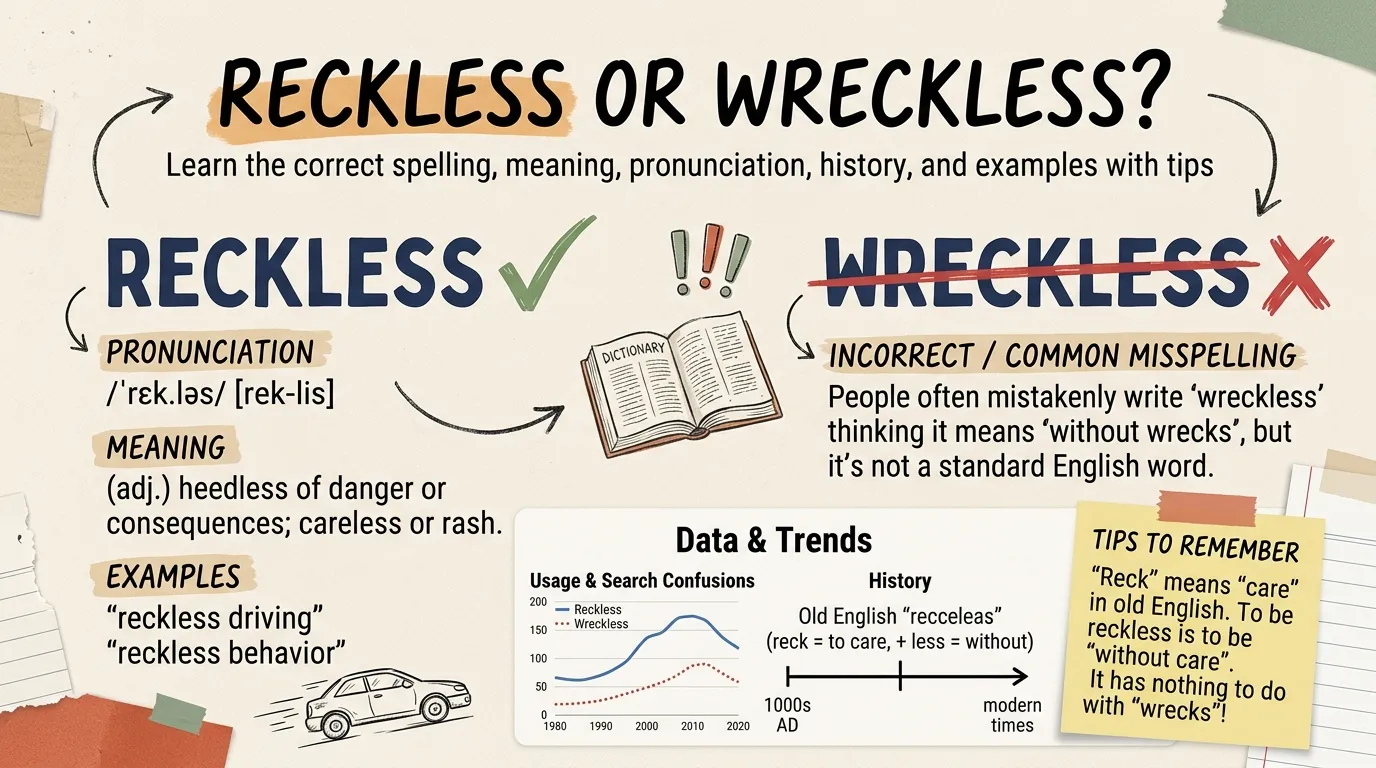
Reckless is the correct spelling. Wreckless is usually a spelling mistake. The two forms may sound alike, but only reckless is the standard English word.
Imagine a driver speeding through a busy street. The driver ignores the danger and puts others at risk. You could call that driver reckless. Now imagine someone writes wreckless driving in a report. The writer has used the wrong spelling.
The word reckless means acting without enough care. It describes actions that may cause harm or trouble. People often search for reckless or wreckless because both forms sound the same. The word wreck may also make wreckless look correct. However, the correct word comes from an old word linked to care and attention. It does not come from wreck. This guide explains the meaning, spelling, pronunciation, and history of reckless. It also gives simple examples to help you use it with confidence.
Pronunciation
The standard word reckless has the same pronunciation in American and British English.
| Word | American English | British English |
|---|---|---|
| Reckless | /ˈrɛkləs/ | /ˈrɛkləs/ |
| Wreckless | Not a standard word | Not a standard word |
Easy sound guide: Reckless sounds like “REK-luhs.” The first part has the same sound as wreck. The second part sounds like less.
If someone writes wreckless by mistake, they may still say it like reckless. The sound does not make the spelling correct.
Difference Between Reckless or Wreckless
The main difference is spelling. Reckless is the correct English word. Wreckless is not the standard spelling of this word.
The points below explain ten ways to understand the difference.
1. Correct Spelling
Reckless is the correct spelling. It appears in standard English dictionaries.
Wreckless is usually a spelling error. Do not use it when you mean careless or unsafe.
Examples:
- The reckless driver ignored the road signs.
- His reckless choice caused a serious problem.
2. Meaning
Reckless means acting without enough care. A reckless person does not think enough about danger or results.
Wreckless has no standard meaning as a normal English spelling. People may use it as a joke or a made-up name.
Examples:
- It was reckless to swim during the storm.
- Her reckless actions upset her family.
3. Part of Speech
Reckless is an adjective. An adjective describes a person, thing, or action.
Wreckless is not the standard adjective for this meaning.
Examples:
- He made a reckless choice.
- The team stopped the reckless plan.
4. Use in Everyday English
Reckless is used in daily speech and writing. People use it to describe unsafe or careless actions.
Wreckless should not replace it in normal writing.
Examples:
- Driving too fast can be reckless.
- It was reckless to spend all his savings.
5. Use in Formal Writing
Reckless is correct in schoolwork, reports, news, and legal writing. It can describe actions that ignore clear risks.
Wreckless is not the correct spelling for formal work.
Examples:
- The report described the act as reckless.
- The court heard a case about reckless driving.
6. Use in Informal Writing
You can use reckless in texts, posts, and casual messages. It keeps the same meaning in every setting.
Do not use wreckless just because the writing is informal. It remains a spelling mistake when you mean careless.
Examples:
- That was a reckless thing to do!
- His reckless post caused an argument.
7. Word History
Reckless comes from an Old English word linked to care and attention. The ending -less means “without.”
Wreckless looks as if it comes from wreck. That is not the history of the standard word.
Examples:
- The reckless act showed a lack of care.
- The old word behind reckless was linked to paying attention.
8. Meaning in Safety and Risk
Reckless often describes actions that may hurt people or cause damage. It can also describe careless choices about money or work.
Wreckless does not carry this standard meaning.
Examples:
- Reckless driving can cause road accidents.
- It was reckless to ignore the warning.
9. Related Word Forms
Reckless has common related forms. These include recklessly and recklessness.
Wreckless does not form the standard word family.
Examples:
- He drove recklessly through the town.
- Her recklessness put the whole group at risk.
10. Best Choice for Readers and Writers
Use reckless whenever you mean careless, rash, or unsafe. This spelling works in American, British, and other forms of English.
Avoid wreckless unless you are using it on purpose as a name or a joke. Make sure readers understand the wordplay.
Examples:
- The reckless driver lost control of the car.
- Please avoid reckless choices at work.
More About https://orchoice.com/coming-or-comming/
Nature and Behaviour of Reckless and Wreckless
Reckless
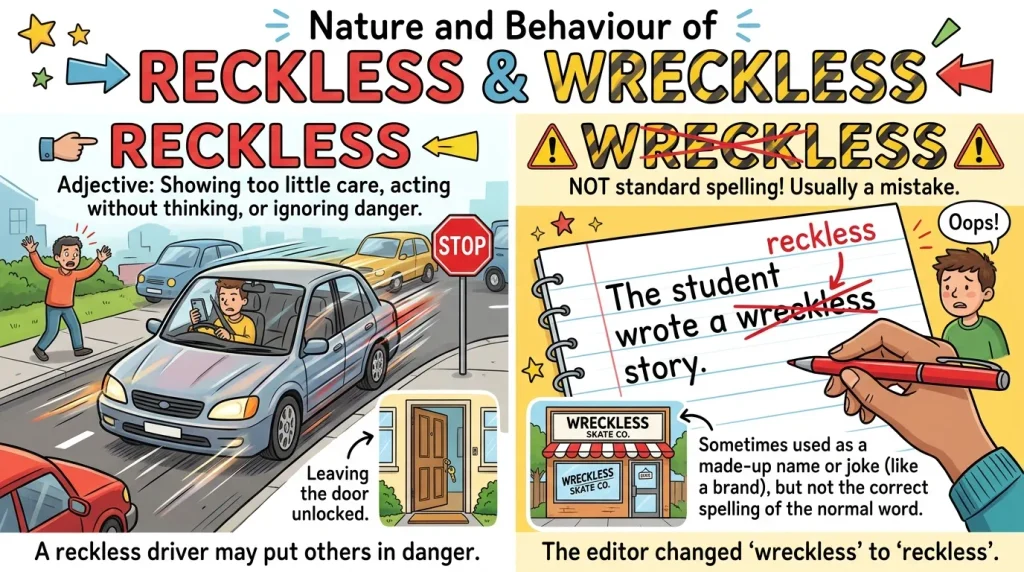
Reckless is an adjective. It describes a person, choice, or action that shows too little care.
A reckless person may act before thinking. They may ignore danger or fail to consider what could happen next.
The word often has a negative meaning. It can describe unsafe driving, careless spending, or risky plans.
Examples:
- A reckless driver may put others in danger.
- It was reckless to leave the door unlocked.
Wreckless
Wreckless is not the standard spelling of reckless. It is usually a mistake caused by the word wreck.
Some people may use wreckless as a made-up name or a joke. For example, a company might choose it as a brand name. Such special use does not make it the correct spelling of the normal word.
Examples:
- The student wrote wreckless by mistake.
- The editor changed wreckless to reckless.
Why People Get Confused About Reckless and Wreckless
People often confuse these words because they sound alike. The letter w in wreck is silent. This means wreck and reck begin with the same sound.
The word wreckless may also look right to some readers. They may think it means “without a wreck.” But the word reckless has a different history.
Its old root was linked to care or attention. The ending -less means “without.” So, reckless means without care.
Remember: The correct word has no w.
Comparison Table
| Point | Reckless | Wreckless |
|---|---|---|
| Standard spelling | Correct | Usually incorrect |
| Meaning | Careless or unsafe | No standard meaning for this use |
| Part of speech | Adjective | Not a standard adjective |
| Pronunciation | /ˈrɛkləs/ | Often said the same by mistake |
| Word origin | Old English roots linked to care | Not the origin of reckless |
| Everyday use | Common | Usually a spelling error |
| Formal writing | Correct | Avoid |
| American English | Correct | Not standard |
| British English | Correct | Not standard |
| Related forms | Recklessly, recklessness | No standard word family |
The Origin of Reckless
The word reckless has roots in Old English. It came from an old word meaning careless or thoughtless. That word was linked to reck, which meant to care or pay attention.
The ending -less means “without.” You can see this ending in words such as hopeless, careless, and fearless.
Over time, the spelling changed. The modern form became reckless. It has been used in English for many centuries.
The word does not come from wreck. A wreck is something damaged or destroyed. This is why wreckless is not the correct spelling for careless behaviour.
British vs American English
There is no spelling difference between American and British English here. Both use reckless.
The word also keeps the same meaning in both forms. It describes a lack of care about danger or possible results.
| Point | American English | British English |
|---|---|---|
| Correct spelling | Reckless | Reckless |
| Incorrect spelling | Wreckless | Wreckless |
| Pronunciation | /ˈrɛkləs/ | /ˈrɛkləs/ |
| Common phrase | Reckless driving | Reckless driving |
| Related noun | Recklessness | Recklessness |
| Related adverb | Recklessly | Recklessly |
American English examples:
- The police stopped a reckless driver.
- His reckless spending left him with no savings.
British English examples:
- The driver was charged with reckless driving.
- It was reckless to ignore the safety rules.
The spelling stays the same in both countries. You should always write reckless.
Which One Should You Use?
Use reckless in all standard forms of English. It is correct in the United States, the United Kingdom, Canada, Australia, and other English-speaking places.
Use it when you describe an unsafe or careless action. It works in school essays, work reports, news stories, and daily messages.
Do not use wreckless as a normal spelling. It may appear in a brand name, a joke, or a creative title. In those cases, it is a special choice, not the standard word.
If you are unsure, remember this rule: reckless has no W.
Common Mistakes
Here are common mistakes and their correct forms.
| Incorrect Form | Correct Form | Example |
|---|---|---|
| Wreckless driving | Reckless driving | Reckless driving can cause harm. |
| Wreckless behaviour | Reckless behaviour | His reckless behaviour worried us. |
| Wreckless spending | Reckless spending | Reckless spending can cause debt. |
| Wrecklessly | Recklessly | She acted recklessly. |
| Wrecklessness | Recklessness | His recklessness caused trouble. |
| More wreckless | More reckless | That plan is more reckless. |
| Most wreckless | Most reckless | It was the most reckless choice. |
Easy tip: Do not add a w to reckless. The correct spelling starts with r.
Everyday Usage Examples
In Emails
Use reckless when you need to describe an unsafe or careless choice.
- The report points to reckless spending.
- Please avoid reckless actions during the project.
On Social Media
You may see the word in posts about sports, driving, or public events.
- That was a reckless move!
- Sharing private details online can be reckless.
In News
News writers often use reckless to describe unsafe actions.
- Police reported a case of reckless driving.
- The leader faced questions about a reckless decision.
In Formal Writing
Use reckless in school essays, work reports, and official records.
- The study examined the effects of reckless behaviour.
- The company was warned about reckless safety choices.
Usage Trends
Reckless is a common word in modern English. It appears in news, books, schoolwork, and everyday speech.
People often use it with words such as driving, spending, behaviour, and disregard. These phrases describe actions that show little care.
Wreckless may appear online because people confuse it with reckless. It may also appear as a brand name or a joke. However, it is not the standard spelling.
For clear writing, choose reckless every time you mean careless or unsafe.
Metaphors and Similes
People sometimes use reckless in a figurative way. It can describe actions that are not about physical danger.
Metaphor: His reckless words were a fire that spread through the office.
This means his words caused anger and trouble.
Simile: She spent money like a reckless gambler.
This compares her spending to someone who takes big risks.
More examples:
- His reckless plan was a train with no brakes.
- The team rushed forward like reckless players.
- Their reckless promises opened the door to trouble.
Connotative Meaning
The word reckless usually has a negative meaning. It suggests poor judgment and a lack of care.
Positive Tone
People may sometimes use reckless in a playful way. They may use it to describe bold or wild behaviour. This is more common in creative or informal writing.
Example: Their reckless spirit made the trip exciting.
Even here, the word can suggest risk.
Negative Tone
The most common meaning is negative. It can suggest danger, poor choices, or harm to others.
Examples:
- His reckless driving caused an accident.
- Her reckless spending caused money problems.
Neutral Tone
In reports, reckless can describe an action without showing personal anger. It still points to a lack of care.
Examples:
- The report examined reckless behaviour.
- The court reviewed the charge of reckless driving.
Idioms and Proverbs
There is no common idiom that uses the word wreckless. However, several phrases express ideas close to reckless.
Reckless Abandon
This phrase means doing something freely, without much care or control.
Example: The children ran through the garden with reckless abandon.
Throw Caution to the Wind
This means taking a risk without thinking enough about the danger.
Example: He threw caution to the wind and spent all his savings.
Play with Fire
This means doing something risky that may cause trouble.
Example: You are playing with fire by ignoring the safety rules.
Look Before You Leap
This saying tells people to think before they act.
Example: Look before you leap when making a big choice.
Literature and Movies
The word reckless appears in book titles and movie titles. It can also describe a character who takes risks without thinking.
Literature
Reckless (2010) — Cornelia Funke
This young adult fantasy novel follows Jacob and Will. The story takes them into a strange world filled with danger and magic. The title uses the correct spelling, Reckless.
Movies
Reckless (1984) — United States
This American romance and drama film was directed by James Foley. It stars Aidan Quinn and Daryl Hannah. Its title also uses the correct spelling, Reckless.
Why This Difference Matters
Correct spelling helps readers understand your message. A spelling mistake can make your work look careless. It may also confuse people who are learning English.
The difference matters in school essays, work emails, news stories, and reports. It is also important when writing about road safety or risky actions.
Using reckless shows that you know the correct word. It also helps search engines match your page with the right spelling. Most importantly, it helps readers trust your writing.
Usefulness in Daily Life
You may need the word reckless in many daily situations. It can describe unsafe driving, careless spending, or rushed choices.
For example, you might warn a friend about reckless driving. You might also describe a risky plan at work. In school, you may use it in an essay about safety or good choices.
The word can help you explain why an action is unsafe. It can also help you talk about the results of poor choices.
Remember to use reckless, not wreckless. This small spelling rule can improve your writing.
Situational Preference
Use reckless in every normal writing situation. It is the correct choice for schoolwork, emails, reports, news, and social media. Use it in both American and British English. Choose it when you mean careless, rash, or unsafe. Do not use wreckless just because it looks linked to the word wreck. You may see Wreckless in a brand name or a joke. That is a special use, not standard spelling. When writing for school or work, always choose reckless. This keeps your message clear and correct.
Common Questions and Answers
1. Is reckless or wreckless correct?
Reckless is correct. Wreckless is usually a spelling mistake.
2. What does reckless mean?
It means acting without enough care about danger or results. A reckless action may hurt someone or cause trouble.
3. Is wreckless ever a real word?
It is not the standard spelling of reckless. It may appear as a name, brand, or joke.
4. Do reckless and wreckless sound the same?
They may sound the same when someone says them. The correct spelling is still reckless.
5. Is reckless spelled the same in American and British English?
Yes. Both American and British English use reckless.
6. What is the noun form of reckless?
The noun form is recklessness. It means behaviour that shows too little care.
7. What is the adverb form of reckless?
The adverb form is recklessly. It describes doing something without enough care.
Conclusion
Reckless or wreckless may look like two possible spellings, but only reckless is correct in standard English. It means acting without enough care about danger or results. The word has roots in Old English and is linked to care and attention. It does not come from the word wreck. This is why adding a w makes the spelling wrong.
Use reckless in American and British English. You can use it to describe unsafe driving, careless spending, or risky choices. Its related forms are recklessly and recklessness. Remember the simple rule: reckless has no W. This small tip can help you avoid a common spelling error. Use the correct form in your emails, schoolwork, reports, and daily writing. Clear spelling makes your message easier to read and understand.

I’m Samia Jamshaid, an English language specialist, SEO specialist, digital publisher, and researcher. I create clear, accurate, and well-researched content on English grammar, vocabulary, word meanings, and language comparisons, helping readers understand and use English with confidence.










1 thought on “Reckless or Wreckless: Correct Spelling, Meaning, and Explanation”