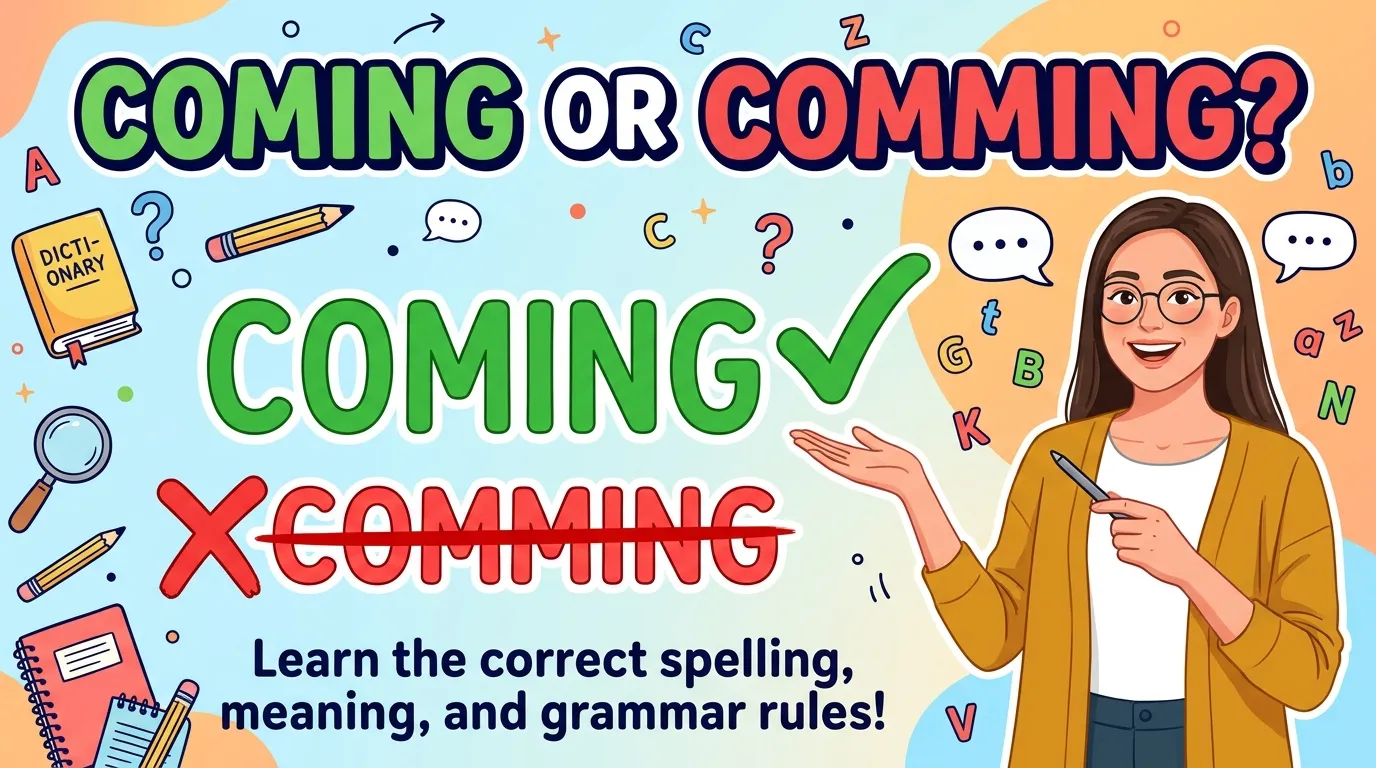
Coming is the correct spelling. Comming is a common spelling mistake.
Imagine you are texting a friend. You want to say that you are on your way. You type, “I am comming home.” Your friend understands you, but the spelling is wrong. The correct sentence is, “I am coming home.”
Many English learners confuse coming or comming because both spellings look similar. The word coming comes from the verb come. It means moving toward a person or place. It can also mean that something will happen soon. The word comming is not a standard English word. People often add an extra “m” by mistake.
This spelling rule is useful in schoolwork, emails, messages, and daily writing. It can help you avoid simple errors and make your English clear. In this guide, you will learn the correct spelling, meaning, grammar rule, and examples. You will also learn why the extra “m” is not needed.
Pronunciation of Coming and Comming
Both spellings may be read with the same sound. However, only coming is correct in standard English.
| Word | US Pronunciation | UK Pronunciation | Syllables |
| Coming | /ˈkʌmɪŋ/ | /ˈkʌmɪŋ/ | 2 |
| Comming | Same intended sound | Same intended sound | 2 |
The stress is on the first syllable. Say the word in two parts: com-ing.
Difference Between Coming and Comming
The main difference is spelling. Coming is correct, while comming is incorrect in standard English. Here are ten points to help you understand the difference.
1. Correct Spelling
- Coming: The correct spelling.
- Comming: An incorrect spelling of coming.
Examples:
- She is coming to my house.
- He is coming home after work.
Do not write:
- She is comming to my house.
- He is comming home after work.
2. Meaning
- Coming: Means moving toward someone or something. It can also mean happening soon.
- Comming: Has no standard meaning in English.
Examples:
- My brother is coming today.
- The coming winter may be cold.
3. Part of Speech
- Coming: It can be a verb form, adjective, or noun.
- Comming: It is not a standard English form.
Examples:
- They are coming to dinner. (Verb form)
- The coming weeks will be busy. (Adjective)
4. Grammar Rule
The verb come changes to coming when we add -ing.
We remove the final silent e before adding -ing.
Examples:
- Come + ing = coming.
- Write + ing = writing.
We do not double the letter m in coming.
5. Everyday Use
- Coming: Used in normal speech and writing.
- Comming: Usually appears because of a spelling mistake.
Examples:
- Are you coming with us?
- The bus is coming now.
6. Formal Writing
- Coming: Correct in reports, letters, schoolwork, and emails.
- Comming: Incorrect in standard formal writing.
Examples:
- The coming meeting will start at noon.
- We look forward to your coming visit.
7. Informal Writing
People use coming in text messages and social media posts. The spelling stays the same in casual writing.
Examples:
- I am coming in five minutes.
- Are you coming to the party?
Writing comming is still a spelling error, even in a quick message.
8. Word History
Coming comes from the verb come. It follows a common spelling rule for verbs that end in a silent e.
When we add -ing, we remove that final e.
Examples:
- Come → Coming
- Make → Making
- Take → Taking
This rule explains why coming has one m in the middle.
9. Related Word Forms
Coming is linked to the verb come.
| Word | Meaning |
| Come | Move toward a place or person |
| Comes | Used with he, she, or it |
| Came | Past form of come |
| Coming | Moving toward or happening soon |
Examples:
- She comes here every day.
- He came home late.
- They are coming tomorrow.
10. Which One Should You Use?
Always use coming in standard English.
Use it when someone is moving toward a place or when something will happen soon.
Examples:
- My parents are coming tomorrow.
- The coming year will bring new chances.
More About Flower Meanings https://orchoice.com/toward-or-towards/
Nature and Behaviour of Coming and Comming
Coming
Coming is a form of the verb come. It can describe movement toward a person or place.
Example: The children are coming inside.
It can also describe something that will happen soon.
Example: The coming holiday will be fun.
It can also work as a noun.
Example: Her coming made everyone happy.
Comming
Comming is not a standard English word. It is usually a spelling error made when someone adds an extra m.
For example:
- Incorrect: I am comming soon.
- Correct: I am coming soon.
Why People Get Confused About Coming and Comming
People often make this mistake for a few simple reasons:
- The extra letter: Some people think the word needs two “m” letters.
- Typing too fast: People may add an extra letter by mistake.
- Other spelling rules: Words such as running double their final consonant. This can confuse learners.
- Limited practice: Some learners do not know the rule for words ending in silent “e.”
- Autocorrect: A phone or computer may not catch every mistake.
Comparison Table
| Point | Coming | Comming |
| Correct spelling | Yes | No |
| Meaning | Moving toward or happening soon | No standard meaning |
| Part of speech | Verb form, adjective, or noun | Not standard |
| Grammar | Come + ing | Incorrect form |
| Middle letters | One “m” | Two “m” letters |
| Pronunciation | /ˈkʌmɪŋ/ | Usually intended to sound the same |
| Formal writing | Correct | Incorrect |
| Informal writing | Correct | Spelling mistake |
| US English | Coming | Incorrect |
| UK English | Coming | Incorrect |
The Origin of the Word Coming
The word coming comes from the verb come. The verb has a long history in English. It comes from Old English cuman, which meant to move or arrive at a place.
Over time, the word became come in modern English.
The form coming follows a simple spelling rule. When we add -ing to a verb that ends in a silent e, we usually remove the e.
For example:
- Come → Coming
- Give → Giving
- Move → Moving
- Write → Writing
British vs American English
There is no spelling difference between British and American English.
Both use coming. Both treat comming as an incorrect spelling.
| Use | American English | British English |
| Correct spelling | Coming | Coming |
| Incorrect spelling | Comming | Comming |
| Example | I am coming home. | I am coming home. |
| Grammar rule | Remove the final e | Remove the final e |
You should use coming in both forms of English.
Which One Should You Use?
Always choose coming.
- For US English: Write coming.
- For UK English: Write coming.
- For global English: Write coming.
The rule is the same around the world. Do not add another “m.” Use coming in schoolwork, job applications, emails, reports, and messages.
Common Mistakes
Here are common errors and their correct forms.
| Incorrect | Correct |
| I am comming home. | I am coming home. |
| She is comming today. | She is coming today. |
| They are comming soon. | They are coming soon. |
| He is comming to school. | He is coming to school. |
| The comming days will be busy. | The coming days will be busy. |
| Thanks for comming. | Thanks for coming. |
| Are you comming with us? | Are you coming with us? |
Easy Spelling Tip
Remember:
Come + ing = Coming
First, remove the silent e. Then add -ing.
Do not double the letter m.
Everyday Usage Examples
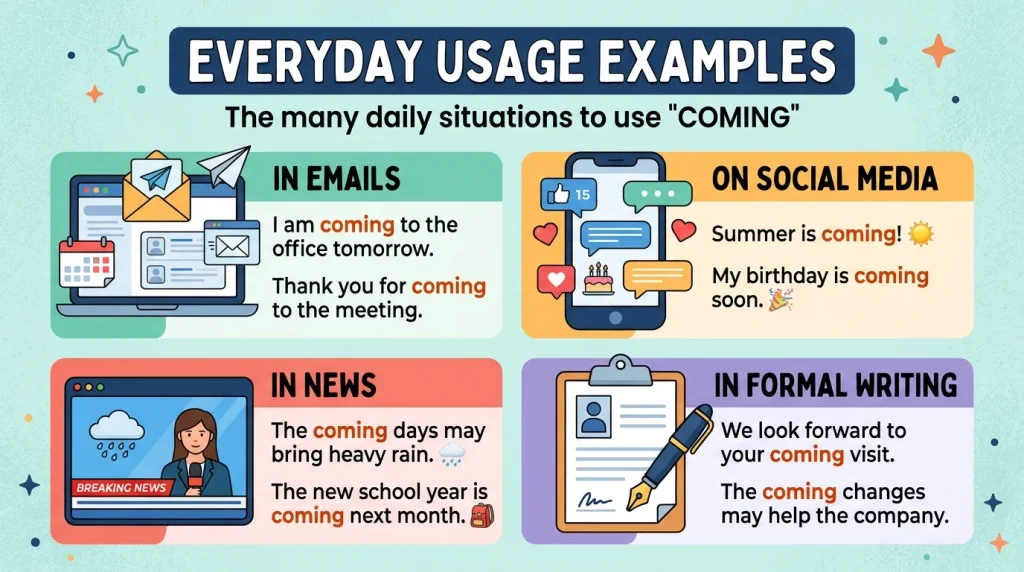
The word coming is useful in many daily situations.
In Emails
- I am coming to the office tomorrow.
- Thank you for coming to the meeting.
On Social Media
- Summer is coming!
- My birthday is coming soon.
In News
- The coming days may bring heavy rain.
- The new school year is coming next month.
In Formal Writing
- We look forward to your coming visit.
- The coming changes may help the company.
Usage Trends
The word coming is common around the world. People use it in daily speech, books, news, emails, and online posts.
It appears in phrases such as:
- Coming soon
- Coming home
- Coming tomorrow
- Coming next week
- The coming year
- Coming to town
The spelling comming may appear in online messages or comments. These uses are usually mistakes. Standard English uses coming.
Metaphors and Similes
The word coming can also be used in creative and figurative ways. It can suggest that a new time, event, or change is near.
Here are some examples:
1. A New Day Is Coming
This means a better or different time may begin soon.
Example: Keep working hard. A new day is coming.
2. Trouble Is Coming
This means a problem may happen soon.
Example: The dark clouds showed that trouble was coming.
3. Like a Storm Coming
This compares an event to a storm that is getting closer.
Example: The loud noise was like a storm coming toward us.
These phrases use coming to show that something is near or about to happen.
Connotative Meaning
The word coming can create different feelings based on the sentence.
Positive Meaning
It can suggest hope, joy, or a good event.
Examples:
- A happy day is coming.
- The coming festival will bring joy.
Negative Meaning
It can suggest fear, danger, or trouble.
Examples:
- Trouble is coming.
- A difficult time is coming for the town.
Neutral Meaning
It can simply show movement or a future event.
Examples:
- My friend is coming home.
- The coming week starts on Monday.
Idioms and Proverbs
There are many common expressions that use coming or related forms.
| Expression | Meaning | Example |
| Coming of age | Reaching the age when a person becomes an adult | The story is about a boy’s coming of age. |
| Coming to terms with | Learning to accept something | She is coming to terms with the news. |
| What is coming to you | What you deserve | He got what was coming to him. |
| A storm is coming | Trouble or a hard time may be near | The dark sky made us think a storm was coming. |
| Come what may | No matter what happens | I will support you, come what may. |
Literature and Movies
The word coming appears in book and movie titles. It can suggest a new event, a new stage of life, or something that is about to happen.
Literature: The Coming of the Third Reich (2003)
This history book was written by Richard J. Evans. It explains how Adolf Hitler and the Nazi Party rose to power in Germany. It uses coming to describe the arrival of a major historical period.
Movie: Coming to America (1988)
Coming to America is an American comedy film directed by John Landis. It tells the story of a prince who travels from his home country to the United States.
These titles show how coming can be used in books and films.
Why This Difference Matters
Correct spelling helps people understand your writing. It also makes your work look clear and careful.
If you write comming, readers may think you made a spelling mistake. This can affect schoolwork, emails, job forms, and other written tasks.
The correct spelling is easy to remember:
- Coming is correct.
- Comming is incorrect in standard English.
- Both may be meant to sound the same.
- Use one “m” in coming.
Usefulness in Daily Life
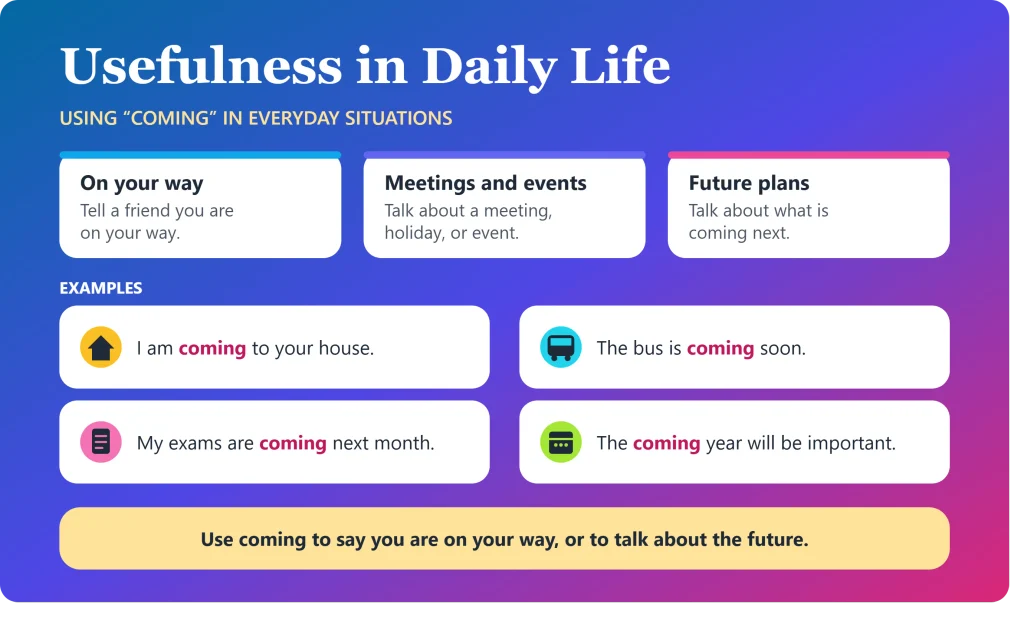
You can use coming in many everyday situations.
You may use it to tell a friend that you are on your way. We can use it to talk about a meeting, holiday, or event. It can also help you talk about future plans.
For example:
- I am coming to your house.
- The bus is coming soon.
- My exams are coming next month.
- The coming year will be important.
Situational Preference
Use coming in every normal writing situation. It is correct in schoolwork, emails, news, social media, and formal reports. Use it when someone is moving toward a place or when an event will happen soon. It works in both British and American English. Do not use comming as an alternative spelling. If you are unsure, remember the base word come. Remove its final silent “e” and add “-ing.” This gives you the correct form: coming.
Common Questions and Answers
1. Is it coming or comming?
Coming is correct. Comming is a spelling mistake in standard English.
2. Why does coming have only one m?
The base word is come. We remove its final silent “e” before adding “-ing*. We do not double the “m.”
3. What does coming mean?
Coming means moving toward a person or place. It can also mean that something will happen soon.
4. Is comming ever correct?
No. Comming is not the standard spelling of the word coming. It may appear as a name or special creative spelling.
5. Do coming and comming sound the same?
They may be read with the same sound. But coming is the correct spelling.
6. Is coming used in British and American English?
Yes. Both British and American English use coming.
7. What is the past form of come?
The past form is came.
Example: She came home early yesterday.
Conclusion
The difference between coming or comming is simple. Coming is the correct spelling in standard English. Comming is usually a spelling mistake. The word coming comes from the verb come. It means moving toward someone or something. It can also describe an event that will happen soon. Both British and American English use the same spelling. The main grammar rule is easy to learn. Remove the silent “e” from come and add “-ing.” This gives you coming, with only one “m.” You can use this word in messages, emails, schoolwork, and formal writing. Remember this simple rule whenever you write about someone arriving or an event that is near. With practice, you can avoid this common spelling mistake and write with more care.

I’m Samia Jamshaid, an English language specialist, SEO specialist, digital publisher, and researcher. I create clear, accurate, and well-researched content on English grammar, vocabulary, word meanings, and language comparisons, helping readers understand and use English with confidence.






1 thought on “Coming or Comming: Correct Spelling, Meaning, and Examples”