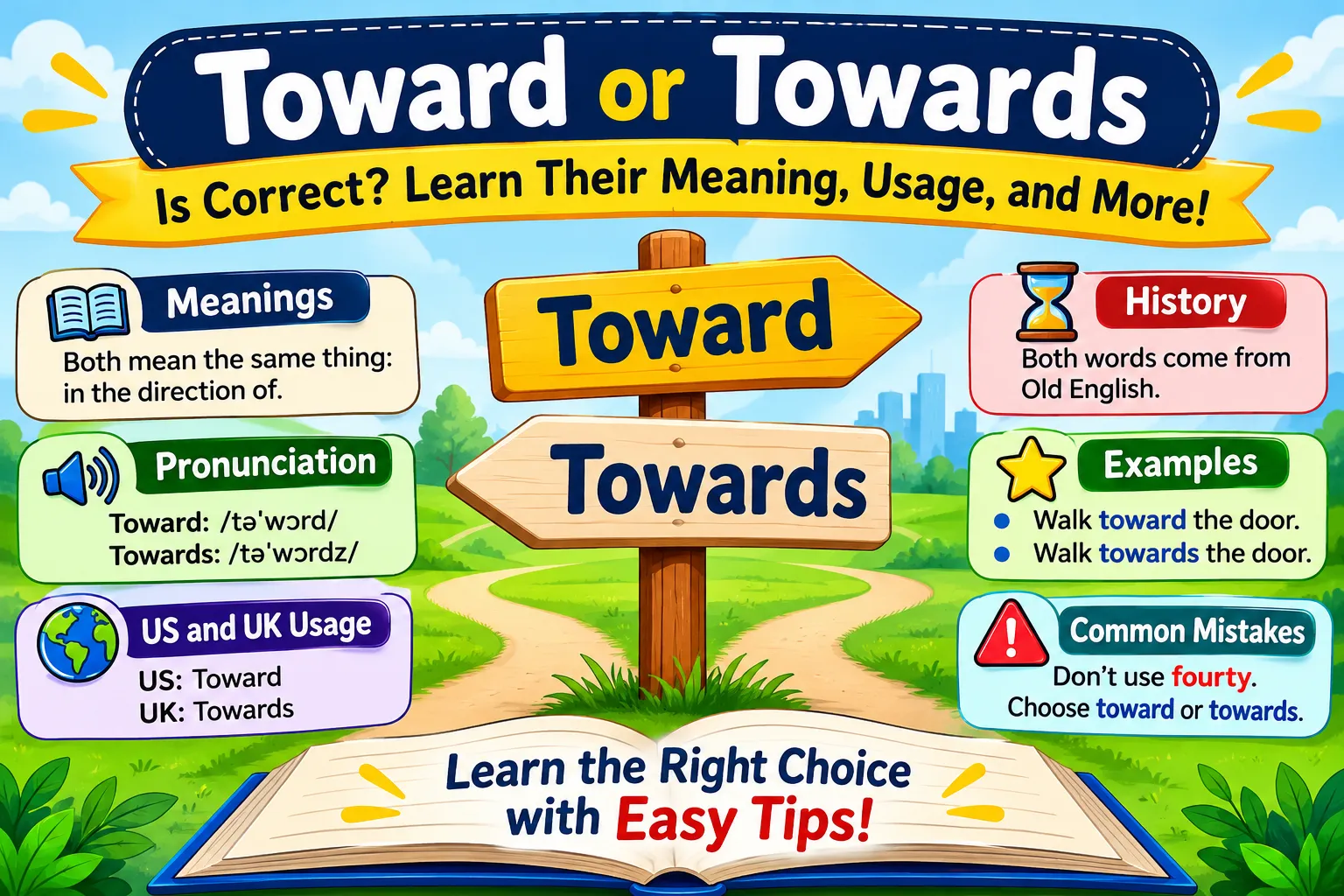
Both “toward” and “towards” are correct and have the same meaning.
Imagine you are walking to a park. You tell a friend, “I am walking toward the park.” Another person says, “I am walking towards the park.” Both sentences are correct. They describe the same action.
The words toward or towards are prepositions. They show direction, movement, time, feelings, or purpose. The main difference is the type of English people use. American English usually prefers toward. British English usually prefers towards.
Many people search for toward or towards because the final s can make one form look wrong. Some also wonder if the two words have different meanings. They do not have a clear meaning difference in modern use. The choice mostly depends on regional style and personal preference.
This guide explains their meanings, pronunciation, history, and common uses. It also gives simple examples to help you choose the right form.
Pronunciation of Toward and Towards
The pronunciation can change slightly with the speaker’s accent.
| Word | US pronunciation | UK pronunciation |
| Toward | /təˈwɔrd/ | /təˈwɔːd/ |
| Towards | /təˈwɔrdz/ | /təˈwɔːdz/ |
Difference Between Toward or Towards
There are no major meaning or grammar differences between these words. Both can show direction, time, feelings, and purpose. The points below explain how they work in common situations.
1. Direction of Movement
Both words show movement in the direction of a person, place, or thing.
Toward:
- The child ran toward his mother.
- We walked toward the river.
Towards:
- The child ran towards his mother.
- We walked towards the river.
2. Movement Near a Person
Both words can show that someone is moving closer to another person.
Toward:
- She moved toward the teacher.
- He stepped toward his friend.
Towards:
- She moved towards the teacher.
- He stepped towards his friend.
3. A Place or Location
Both words can show the position or direction of a place.
Toward:
- Our house faces toward the sea.
- The road leads toward the village.
Towards:
- Our house faces towards the sea.
- The road leads towards the village.
4. Time
Both words can mean near a time or just before it.
Toward:
- I feel tired toward evening.
- We reached home toward midnight.
Towards:
- I feel tired towards evening.
- We reached home towards midnight.
5. Feelings About Someone
Both words can describe how a person feels about another person.
Toward:
- She feels kindness toward animals.
- He showed respect toward his parents.
Towards:
- She feels kindness towards animals.
- He showed respect towards his parents.
6. Attitude or Behaviour
Both words can describe a person’s attitude toward someone or something.
Toward:
- His attitude toward work is positive.
- They showed care toward the children.
Towards:
- His attitude towards work is positive.
- They showed care towards the children.
7. Progress and Goals
Both words can show movement toward a goal or result.
Toward:
- We are moving toward success.
- She took one step toward her dream.
Towards:
- We are moving towards success.
- She took one step towards her dream.
8. Money or Help
Both words can describe money or help given for a purpose.
Toward:
- I saved money toward a new phone.
- They gave money toward the school project.
Towards:
- I saved money towards a new phone.
- They gave money towards the school project.
9. A Change or Result
Both words can show that something is changing or moving in a new direction.
Toward:
- The town is moving toward a greener future.
- The talks are moving toward an agreement.
Towards:
- The town is moving towards a greener future.
- The talks are moving towards an agreement.
10. Formal and Everyday Writing
Both forms are correct in everyday and formal writing. The main choice is regional style.
Toward:
- The report shows progress toward the goal.
- The team is working toward a solution.
Towards:
- The report shows progress towards the goal.
- The team is working towards a solution.
Nature and Behaviour of Toward or Towards
Toward
Toward is a preposition. It often shows direction or a goal. It is common in American English.
Examples:
- The dog ran toward the gate.
- We are working toward a better plan.
- Her feelings toward him changed.
It can also show time or purpose.
- The shop closes toward evening.
- This money will go toward your fees.
Towards
Towards is also a preposition. It has the same meanings as toward. It is more common in British English.
Examples:
- The dog ran towards the gate.
- We are working towards a better plan.
- Her feelings towards him changed.
It can also show time or purpose.
- The shop closes towards evening.
- This money will go towards your fees.
For further Information https://orchoice.com/forty-or-fourty/
Why People Get Confused About Toward or Towards
People often think the final s changes the meaning. It does not.
The two words look different. One has an s, and the other does not. This can make learners think they follow different grammar rules.
The regional difference adds to the confusion. American writers often use toward. British writers often use towards. Both forms are still understood in both places.
Some people also think toward is only for places and towards is only for feelings. This is not true. Both words can describe places, feelings, time, and goals.
Comparison Table
| Point | Toward | Towards |
| Part of speech | Preposition | Preposition |
| Main meaning | In the direction of | In the direction of |
| Direction | Correct | Correct |
| Feelings | Correct | Correct |
| Time | Correct | Correct |
| Goals | Correct | Correct |
| Money or help | Correct | Correct |
| American English | More common | Also used |
| British English | Also used | More common |
| Meaning difference | None in normal modern use | None in normal modern use |
The Origin of Toward and Towards
Both words have roots in Old English.
Toward comes from the Old English word tōweard. It meant “in the direction of” or “coming closer.” The word joined to with -ward, a part that shows direction.
Towards comes from an older form, tōweardes. The final s came from an old word ending. Over time, both forms became common in English.
The words have kept the same main meaning. They both show direction, relation, time, or purpose.
Their use later became linked to regional style. American English came to prefer toward. British English kept a stronger preference for towards. Both forms remain correct today.
British vs American English
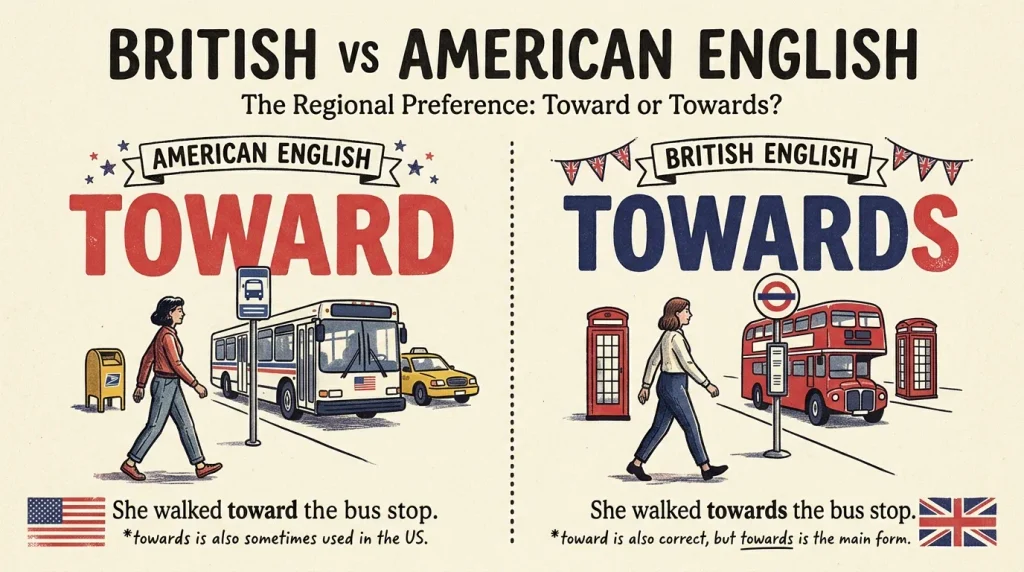
The main difference is regional preference.
American English
American English usually uses toward.
Examples:
- She walked toward the bus stop.
- We are working toward a better future.
- His feelings toward her were kind.
American writers may also use towards. It is not wrong.
British English
British English usually uses towards.
Examples:
- She walked towards the bus stop.
- We are working towards a better future.
- His feelings towards her were kind.
British writers may also use toward. It is correct too.
Which Form Do Style Guides Prefer?
The Chicago Manual of Style says that toward is more common in American English, while towards is the main form in British English.
Which One Should You Use?
- For US readers: Use toward in most writing.
- For UK readers: Use towards in most writing.
- For Australian readers: Towards is common, but toward is also understood.
- For global readers: Choose one form and use it throughout your article.
- For school or work: Follow your teacher’s, school’s, or company’s style guide.
Common Mistakes
Mistake 1: Thinking One Word Is Wrong
Incorrect idea: “Towards” is always wrong.
Correct: Both forms are correct.
Mistake 2: Giving Them Different Meanings
Incorrect: Toward means movement, but towards means feelings.
Correct: Both words can describe movement and feelings.
Mistake 3: Mixing Styles Without a Reason
Less consistent: The team moved toward the goal. Later, it worked towards success.
Better US style: The team moved toward the goal. Later, it worked toward success.
Better UK style: The team moved towards the goal. Later, it worked towards success.
Mistake 4: Adding Another Preposition
Incorrect: She walked toward to the door.
Correct: She walked toward the door.
Mistake 5: Using “Toward” With “To” Again
Incorrect: He moved towards to his friend.
Correct: He moved towards his friend.
Mistake 6: Thinking the Final S Shows Plural
Incorrect idea: Towards means more than one direction.
Correct: The final s does not make it plural.
Everyday Usage Examples
In Emails
US style:
- We are working toward a final decision.
- Thank you for your support toward this project.
UK style:
- We are working towards a final decision.
- Thank you for your support towards this project.
On Social Media
- Every small step takes you toward your dream.
- Keep moving towards a better life.
- Be kind toward others.
- Show respect towards every person.
In News
- The talks moved toward a peace deal.
- The country is moving towards new rules.
- The storm is moving toward the coast.
- The storm is moving towards the coast.
In Formal Writing
- The study points toward a new result.
- The plan is a step towards change.
- The report shows progress toward the main goal.
- The report shows progress towards the main goal.
Usage Trends
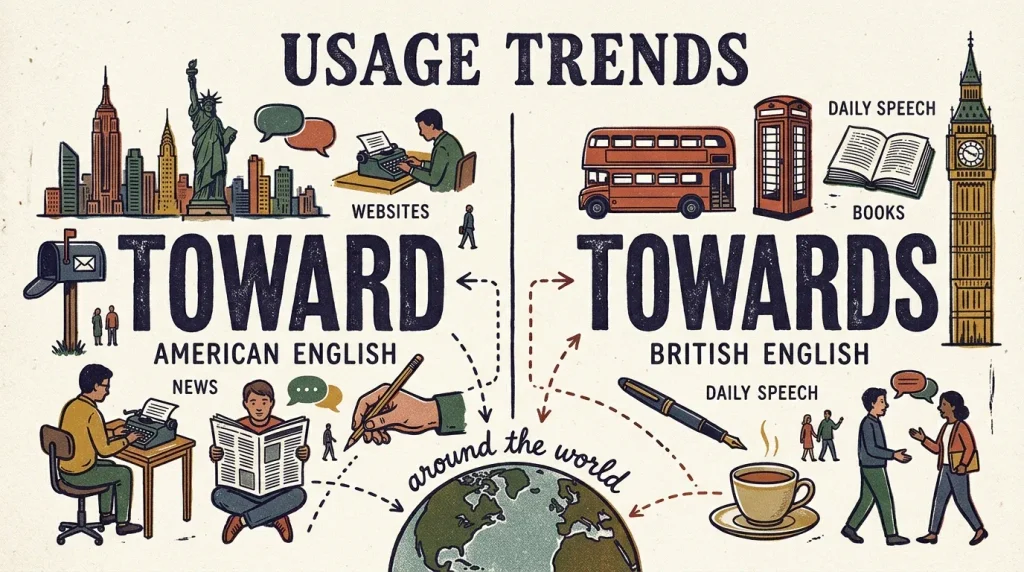
Both forms are used around the world. Their popularity often depends on the type of English people learn and read.
American English usually favors toward. British English usually favors towards. Both forms appear in books, news stories, websites, and daily speech.
The difference is not a strict grammar rule. It is mainly a writing preference. Some writers use both forms, even in the same country.
For a clear style, choose one form for your article or website. If your readers use American English, toward is a safe choice. If they use British English, towards is a natural choice.
Metaphors and Similes
These words can also appear in sentences about goals, hope, and change. They do not create a new meaning. They help show a person’s path or aim.
Metaphors
- Every lesson is a step toward success.
- Her hard work led her towards a brighter future.
- Kindness is a path toward peace.
Similes
- He moved toward his goal like a runner near the finish line.
- She worked towards her dream like a seed growing toward sunlight.
- The team moved toward success like a boat sailing toward shore.
Connotative Meaning
Toward and towards do not have different emotional meanings. The feeling comes from the words around them.
Positive Meaning
They can show hope, care, and progress.
Examples:
- She showed love toward her family.
- We are moving towards a better future.
Negative Meaning
They can describe anger, hate, or unfair behaviour.
Examples:
- His anger toward the driver grew.
- They showed cruelty towards the weak.
Neutral Meaning
They can simply show direction, time, or place.
Examples:
- The bus moved toward the station.
- We arrived towards the end of the day.
Idioms and Proverbs
There are no major fixed idioms that depend on choosing toward instead of towards. Both forms can appear in common expressions.
A Step Toward Change
Meaning: One small action that helps create change.
Example: Learning a new skill is a step toward a better job.
Work Toward a Goal
Meaning: Make an effort to reach something.
Example: She works towards her goal every day.
Look Forward to
Meaning: Feel happy about something that will happen.
Example: I look forward to seeing you.
Note: Look forward to is a fixed phrase. Do not replace to with toward or towards.
Literature and Movies
Both forms appear in books, poems, news writing, and films. Writers choose them based on their style and the type of English they use.
The words are common in many kinds of writing:
- Fiction: A character may walk toward a door or towards a friend.
- Poetry: A writer may use either form to describe hope, love, or a journey.
- History books: The words can show movement toward a place or event.
- News and films: They can describe a person, group, or event moving in a direction.
Why This Difference Matters
Knowing the difference helps you write with care. It also helps you understand American and British English.
You may see toward in an American article and towards in a British one. Both are correct. You do not need to stop reading or think that one writer made a mistake.
The choice also matters when you write for a set group of readers. A consistent style makes your work look neat and clear.
For English learners, this is a useful lesson. It shows that spelling can change across regions without changing meaning. It also helps you avoid false grammar rules.
Usefulness in Daily Life
You can use both words in many daily situations.
- At home: Walk toward the kitchen.
- At school: Work towards better grades.
- At work: We are moving toward a clear plan.
- With friends: Show kindness towards others.
- While travelling: The train is moving toward the city.
- When talking about time: We will arrive towards evening.
- When saving money: I am saving money toward a new laptop.
Situational Preference
Use toward if you write for people in the United States. It is also a clear choice for many international readers. Use towards if your readers are mainly in the United Kingdom or follow British English. In Australia and other places, both forms are understood. In school, work, or formal writing, follow the style guide you have been given. If there is no guide, choose one form and use it throughout your text. Do not change the word to create a new meaning. The two forms mean the same thing.
Common Questions and Answers
1. Is “toward” or “towards” correct?
Both are correct. They have the same meaning.
2. What is the main difference between toward and towards?
The main difference is regional use. American English prefers toward. British English often prefers towards.
3. Is “towards” wrong in American English?
No. Americans use towards too. However, toward is more common in US writing.
4. Is “toward” wrong in British English?
No. British speakers and writers also use toward. But towards is more common.
5. Do toward and towards have different meanings?
No. Both can show direction, time, feelings, and purpose.
6. Which form should English learners use?
Choose the form used in the English style you are learning. Use toward for US English and towards for UK English.
7. Can I use both words in one article?
You can, but it is better to stay consistent. Choose one form that fits your readers.
Conclusion
The words toward or towards are both correct. They have the same meaning and work in the same way. Both can show direction, time, feelings, goals, and purpose. The main difference is the type of English people use. American English usually prefers toward. British English usually prefers towards. Still, both forms can appear in both varieties. You do not need to learn two sets of grammar rules. You only need to know which form fits your readers. If you write for an American audience, choose toward. If you write for a British audience, choose towards. Both words point in the same direction. Once you know this, you can use them with confidence in emails, schoolwork, articles, and daily talks.

I’m Samia Jamshaid, an English language specialist, SEO specialist, digital publisher, and researcher. I create clear, accurate, and well-researched content on English grammar, vocabulary, word meanings, and language comparisons, helping readers understand and use English with confidence.







1 thought on “Toward or Towards: Meaning, Difference, and How to Use Them”