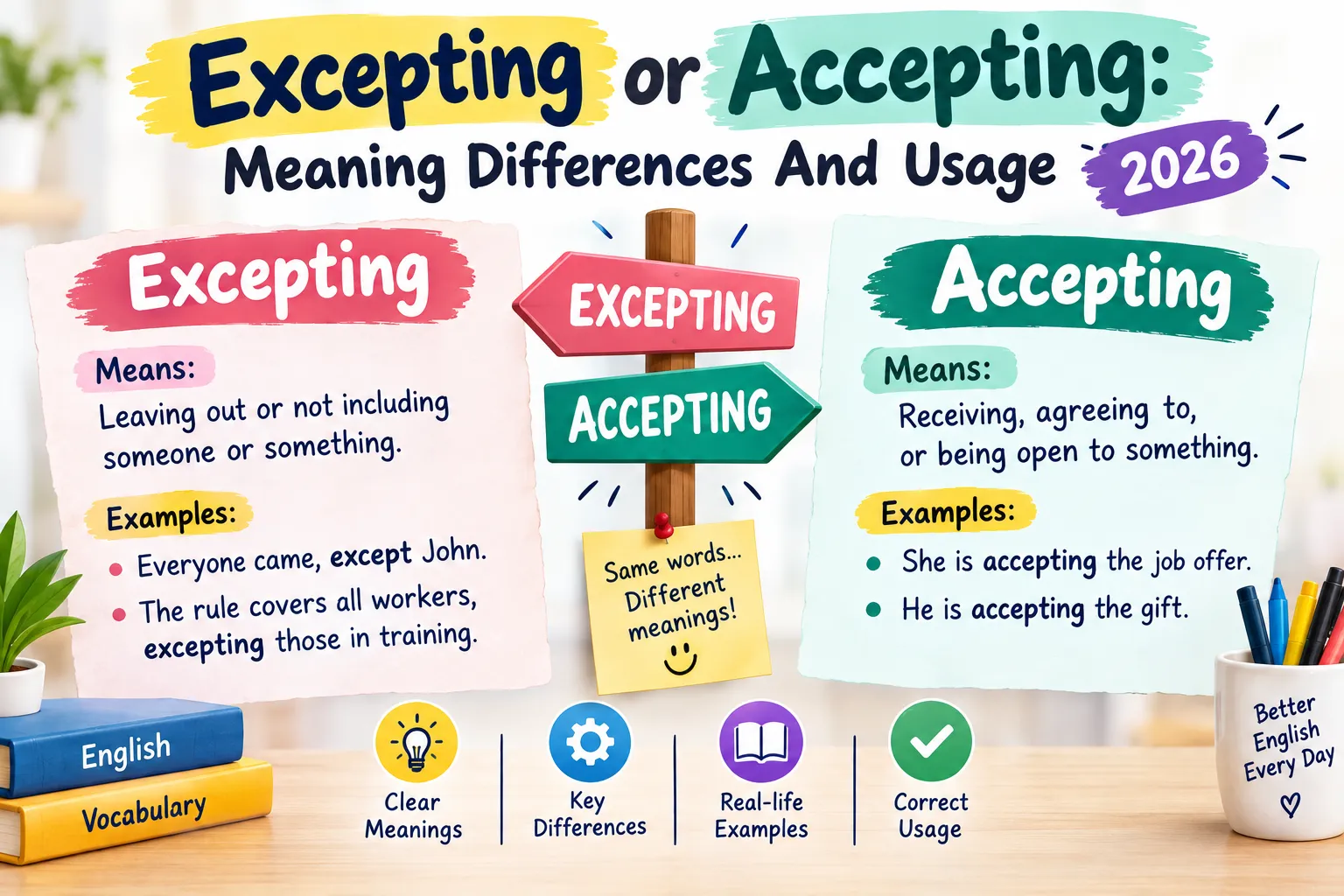
Excepting and accepting look and sound almost the same, but they have very different meanings. Excepting means leaving something out or not including it. Accepting means receiving, agreeing to, or being open to something.
Imagine your teacher says that every student can join a trip except one student. That student is being left out. This is the idea behind excepting. Now imagine that your teacher offers you a place on the trip and you say yes. You are accepting the offer.
Many people search for the difference between these words because they look so much alike. The words accept, except, accepting, and excepting can make the problem even harder. The good news is that the main difference is easy to remember.
Excepting = leaving out. Accepting = saying yes, receiving, or being open.
What Does Excepting Mean?
Excepting means not including someone or something. It can also mean leaving someone or something out.
It is related to the word except.
For example:
- Everyone came, excepting John.
- The rule covers all workers, excepting those in training.
The meaning is that John and the workers in training are not included.
However, excepting is a formal word. In everyday U.S. English, these sentences often sound more natural:
- Everyone came except John.
- The rule covers all workers except those in training.
Simple meaning
Excepting = not including
What Does Accepting Mean?
Accepting is the -ing form of accept. It can mean receiving something, agreeing to something, or saying yes to something.
Examples:
- She is accepting the job offer.
- He is accepting the gift.
- They are accepting the new plan.
Accepting can also describe someone who is open and welcoming toward people ideas.
Examples:
- She is very accepting of other people.
- The school has an accepting environment.
Simple meaning
Accepting = receiving, agreeing, or being open
Excepting vs Accepting at a Glance
| Word | Simple Meaning | Main Idea |
|---|---|---|
| Excepting | Not including | Leaving out |
| Accepting | Receiving or agreeing | Saying yes |
| Except | Not including | Leaving out |
| Accept | Receive or agree to | Saying yes |
Easy memory trick
Remember:
EXcepting → EXcluding
The EX can remind you of excluding.
And:
ACcepting → ACcept
When you accept something, you receive it, agree to it, or allow it.
Pronunciation of Excepting and Accepting
Excepting
U.S. English: /ɪkˈseptɪŋ/
Accepting
U.S. English: /əkˈseptɪŋ/
10 Key Differences Between Excepting and Accepting
1. They have different meanings
Excepting means leaving something out.
Accepting means receiving or agreeing to something.
Examples:
- Everyone joined the game, excepting Mike.
- Sarah is accepting the job.
2. Excepting shows exclusion
When something is excepting a person or thing, that person or thing is not included.
Examples:
- The rule covers everyone, excepting new workers.
- All rooms are open, excepting Room 4.
3. Accepting shows agreement
Accepting can show that someone agrees to something.
Examples:
- I am accepting your offer.
- She is accepting the new plan.
4. Excepting is linked to “except”
The word excepting comes from except.
Both have the idea of leaving something out.
Examples:
- Everyone came except Tom.
- Everyone came, excepting Tom.
The second sentence is more formal.
5. Accepting is linked to “accept”
Accepting comes from accept.
It keeps the main idea of receiving or agreeing.
Examples:
- He accepted the gift.
- He is accepting the gift.
6. Excepting is less common in daily U.S. English
You can use excepting, but most Americans will often choose except instead.
Examples:
Formal:
- All members are included, excepting Jane.
More natural:
- All members are included except Jane.
7. Accepting is common in daily English
People use accepting in many normal situations.
Examples:
- She is accepting the invitation.
- He is accepting responsibility for his mistake.
8. Accepting can describe a person
Accepting can describe someone who is open and welcoming.
Examples:
- My new friends are very accepting.
- The group is accepting of different ideas.
This use has nothing to do with leaving something out.
9. Excepting can be used in formal writing
You may see excepting in rules, contracts, legal writing, or formal statements.
Examples:
- The rule applies to all cases, excepting those listed below.
- All employees are covered, excepting temporary workers.
In plain U.S. writing, except or excluding may be easier to understand.
10. They cannot replace each other
This is the most important difference.
If you mean “leave out,” use excepting or, more naturally in many cases, except or excluding.
If you mean “receive, agree, or welcome,” use accepting.
Examples:
- Everyone was invited excepting John. → John was left out.
- Everyone was accepting John. → People welcomed or approved of John.
Nature and Behavior of Excepting and Accepting
Excepting
Excepting focuses on something being outside a group.
Think about a list:
Everyone is on the list except one person.
That is the basic idea of excepting.
Accepting
Accepting focuses on taking, agreeing, or welcoming something.
Think about an open door:
You open the door and let something in.
That is a simple way to remember accepting.
In simple words
Excepting closes something out. Accepting lets something in.
Why Are Excepting and Accepting Confused?
These words cause trouble for several simple reasons.
They look alike
Compare:
excepting accepting
Only a few letters are different.
They sound alike
The middle sounds are very close, especially in fast speech.
They are related to similar words
- accept
- except
Adding -ing makes the words look even more alike.
Excepting is less familiar
Many people use except but rarely use excepting. This can make excepting harder to recognize.
Excepting vs Accepting: Comparison Table
| Point | Excepting | Accepting |
| Main meaning | Not including | Receiving or agreeing |
| Basic idea | Leaving out | Saying yes |
| Word family | Except, exception | Accept, acceptance |
| Main use | Exclusion | Receiving, agreeing, openness |
| Common in daily U.S. English | Less common | Very common |
| Style | Often formal | Normal and common |
| Can describe a person? | Usually no | Yes |
| Example | Everyone came excepting Tom. | She is accepting the offer. |
| Easy clue | EX = excluding | Accept = receive or agree |
| Common alternative | Except, except for, excluding | Receive, agree, welcome, depending on context |
Origin and Etymology
Origin of Excepting
Excepting comes from except. The word family has the idea of taking something out or leaving it out.
Over time, except became common in English for showing that someone or something is not included. The -ing form, excepting, can carry the same idea.
Excepting is still correct, but it is more formal than except in many uses.
Simple timeline
Older English:
The word family developed through French and Latin forms linked to the idea of taking out.
Modern English:
Except became a common word for showing exclusion. Excepting developed as its -ing form and is also used to mean “not including.”
Origin of Accepting
Accepting comes from accept.
The basic idea of accept is to receive or take something willingly. The word later gained other uses, such as agreeing to an offer, approving something, or recognizing something as okay.
Accepting can also describe someone who is open and welcoming.
Simple timeline
Older English:
The word entered English through French from Latin.
Modern English:
Accept became common in many situations involving receiving, agreeing, or approving. Accepting is its -ing form and can also be an adjective.
British vs. American English
The basic meanings are the same in American and British English.
The main difference for your U.S. audience is style and everyday use.
In American English, except is much more common in normal speech and writing.
For example:
Everyone came except David.
This sounds natural.
You can also write:
Everyone came, excepting David.
This is possible, but it sounds more formal.
Accepting is common in both American and British English.
For U.S. readers
Use:
- accepting for receiving, agreeing, or being open.
- except for most everyday cases of exclusion.
- excluding when it clearly means leaving something out.
- excepting when its formal style fits the sentence.
Which One Should You Use?
In U.S. English
Use accepting when you mean:
- receiving something
- saying yes
- agreeing
- approving
- being open to someone or something
Use excepting when you mean:
- not including
- leaving out
But in everyday American English, except is often the better choice.
Example
Less common:
Everyone attended, excepting John.
Natural:
Everyone attended except John.
Common Mistakes
Mistake 1: Using “accepting” when you mean “excepting”
Incorrect: Everyone came, accepting John.
Correct: Everyone came except John.
If you mean John was left out, use except, not accepting.
Mistake 2: Using “excepting” when you mean “accepting”
Incorrect: She is excepting the job offer.
Correct: She is accepting the job offer.
If she is saying yes to the job, use accepting.
Mistake 3: Thinking “excepting” and “accepting” mean the same thing
They have different meanings:
- Excepting = not including or leaving out
- Accepting = receiving, agreeing to, or being open to something
Mistake 4: Using “excepting” in every sentence about exclusion
Excepting is correct, but it is formal and less common in everyday U.S. English. In most daily writing, these words sound more natural:
- except
- except for
- excluding
Incorrect: All students attended, excepting Tom.
Correct: All students attended, except Tom.
Mistake 5: Confusing four similar words
Remember:
| Word | Meaning |
| Accept | Receive or agree |
| Accepting | Receiving, agreeing, or being open |
| Except | Not including |
| Excepting | Not including; formal |
Everyday Usage Examples
In an Email
We approved all requests except the late ones.
This is more natural than using excepting in a normal email.
In a Text
I’m accepting the invitation.
At Work
She is accepting responsibility for the error.
In a School
All students can join, except those who have not signed the form.
In a Rule
The rule applies to all workers, excepting those covered by a different agreement.
The last example has a more formal tone.
In Business Writing
The price includes all services, excluding delivery.
Here, excluding is a clear alternative to excepting.
Excepting in Formal Writing
You may see excepting in formal documents.
For example:
All cases are covered, excepting those listed in Section 4.
It can also appear in legal language.
However, formal does not mean better.
If a simple word makes your sentence clearer, use it.
For example:
All cases are covered except those listed in Section 4.
This is shorter and easier to read.
For a U.S. audience, clear writing is usually better than using a more formal word just to sound advanced.
Accepting in Everyday English
Accepting is much more common in normal conversation.
You may use it when talking about:
Offers
She is accepting the job offer.
Invitations
We are accepting the invitation.
Responsibility
He is accepting responsibility.
Ideas
They are accepting the new idea.
People
The group is accepting of new members.
Situations
She is accepting the change.
Usage Trends
For modern U.S. English, accepting is a normal everyday word.
Excepting is correct but is less common in casual speech and everyday writing.
When Americans want to show that something is not included, they often choose:
except
Everyone came except Sam.
Or:
except for
The room was clean except for one small box.
Or:
excluding
The price is $50, excluding tax.
Excepting can still be useful when the writing has a formal tone.
So the simple U.S. rule is:
Use accepting normally. Use excepting when you need its formal “not including” meaning.
Metaphors and Similes
Excepting is like closing a door
Imagine a group entering a room. One person is kept outside.
That person is left out.
This is the idea of excepting.
Accepting is like opening a door
Imagine someone standing outside. You open the door and welcome them inside.
This is the idea of accepting.
Easy memory
Excepting = out Accepting = in
This is not a full grammar rule. It is simply an easy way to remember the meanings.
Connotative Meaning
Excepting
Excepting can suggest:
- exclusion
- limits
- rules
- separation
Accepting
Accepting can suggest:
- kindness
- openness
- welcome
- agreement
- understanding
For example:
She works in an accepting community.
This sounds positive because it suggests that people are welcomed.
Idioms and Common Expressions
Except for
This means not including.
Everyone was ready except for Mike.
Present company excepted
This means the people you are talking to are not included in a negative statement.
I don’t trust most salespeople, present company excepted.
Take exception to
This means to object to something.
She took exception to his rude comment.
Accept responsibility
This means to agree that you are responsible for something.
He accepted responsibility for the mistake.
Accept an offer
This means to say yes to an offer.
She accepted the job offer.
These expressions show how often accept and except appear in normal English.
Literature and Movies
Writers often show a character who wants to be accepted by a family, school, group, or community. Other stories show people being left out because of their choices, background, or beliefs.
These themes help readers understand the difference between the two ideas:
- accepting connects with welcome and belonging.
- excepting connects with leaving something out.
You do not need to use excepting just because a story deals with exclusion. In modern U.S. English, excluding or except may sound more natural.
Why Does the Difference Matter?
A small spelling change can create a very different meaning.
Compare:
The school is accepting new students.
This means the school is taking or welcoming new students.
Now compare:
The school is excepting new students.
This suggests that new students are being left out.
The difference matters in:
- school work
- emails
- job applications
- business writing
- reports
- websites
- social media
- everyday messages
Usefulness in Daily Life
Knowing the difference between excepting and accepting helps you avoid a common word mistake. You may use accepting when talking about an offer, gift, idea, responsibility, or person. You may use excepting when something is not included, especially in formal writing. For most everyday U.S. writing, except or excluding is often a better choice for this meaning. Once you remember excepting = leaving out and accepting = receiving or being open, the difference becomes much easier.
Situational Preference
For U.S. readers, accepting is the better word when you mean receiving, agreeing, approving, or being open to something. Excepting is used when you mean not including or leaving something out, but it sounds formal in many situations. In everyday American English, except, except for, and excluding are often more natural choices. Use excepting when the formal style fits your sentence. If you are writing a simple email, school paper, website, or social post, choose the clearest word. Good writing is not about using the hardest word. It is about making your meaning easy to understand.
Common Questions About Excepting and Accepting
Question 1: Is “excepting” the same as “accepting”?
No. These words have different meanings. Excepting means leaving something out or not including it, while accepting means receiving, agreeing to, or being open to something.
Question 2: What is the easiest way to remember “excepting”?
Think of EX = excluding. If something is being left out or not included, excepting may be the word you need.
Question 3: What is the easiest way to remember “accepting”?
Connect accepting with the word accept. If someone receives, agrees to, or welcomes something, accepting is the correct choice.
Question 4: Is “excepting” common in American English?
Yes, excepting is correct in American English, but it is less common in everyday U.S. writing. Except, except for, and excluding often sound more natural.
Question 5: Can I use “excluding” instead of “excepting”?
Often, yes. Excluding also means “not including” and works well in both everyday and formal writing. The right choice depends on the sentence and the meaning you want.
Conclusion
Excepting or accepting look and sound similar, but they have different meanings. Excepting means leaving something out or not including it, while accepting means receiving, agreeing to, or being open to something. For U.S. English, remember that excepting is correct but formal, so except, except for, or excluding may sound more natural in daily writing. A simple way to remember the difference is EX = excluding and accepting = receiving or saying yes. Knowing this difference can help you avoid mistakes and make your writing clear and easy to understand.

I’m Samia Jamshaid, an English language specialist, SEO specialist, digital publisher, and researcher. I create clear, accurate, and well-researched content on English grammar, vocabulary, word meanings, and language comparisons, helping readers understand and use English with confidence.












1 thought on “Excepting or Accepting: Meaning Differences And Usage 2026”