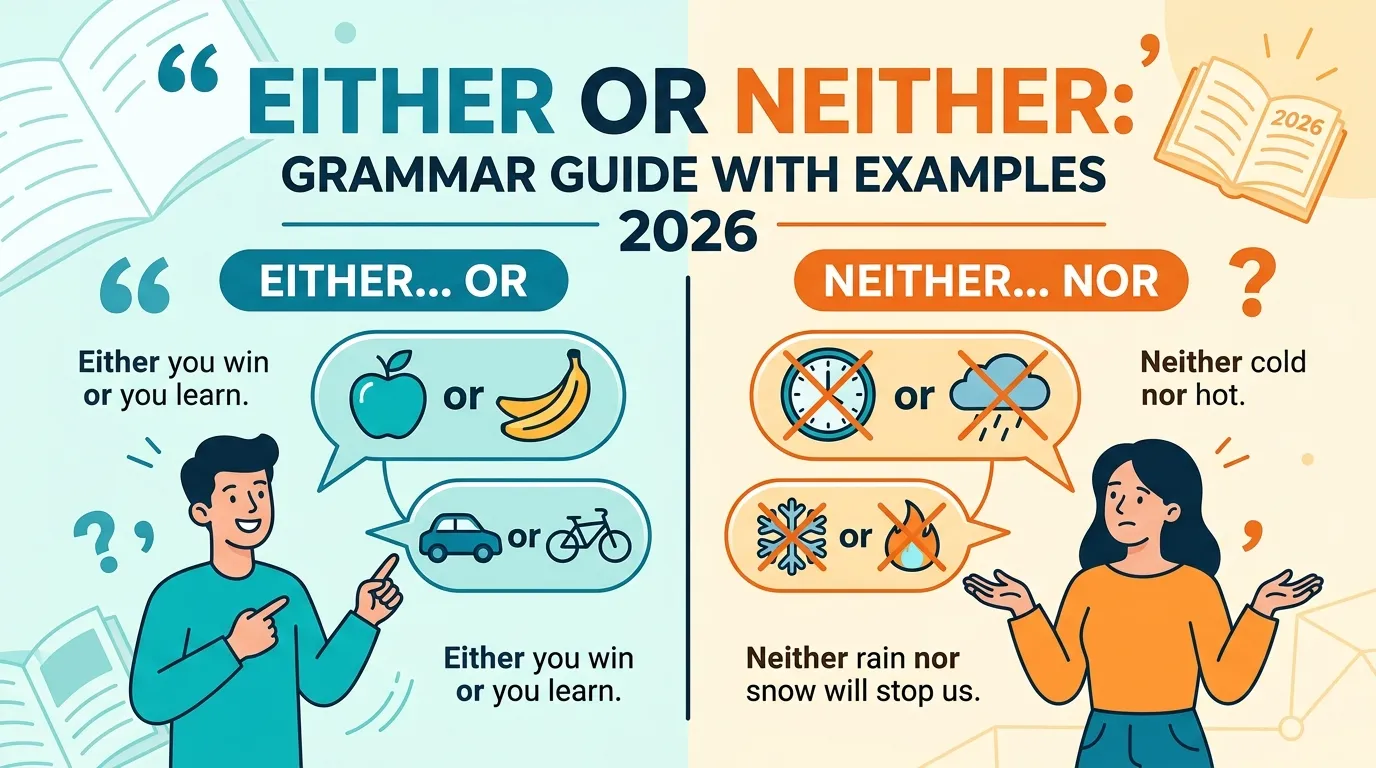
Imagine you are at a café with a friend. The server asks, “Would you like tea or coffee?” You say, “I will have either tea or coffee.” You want one choice. Later, your friend says, “I want neither tea nor coffee.” Your friend wants none of the two choices.
This simple situation shows the main difference between either or neither. Either…or connects two possible choices. Neither…nor connects two things that are both rejected or untrue. People often search for either or neither because the two forms look similar. They also use similar sentence patterns, which can cause mistakes in speaking and writing.
Learning either or neither helps you make clear choices, write better sentences, and avoid double negatives. The key is simple: either…or = one of two, while neither…nor = not one and not the other.
Pronunciation
- Either
- US: /ˈiːðɚ/ or /ˈaɪðɚ/
- UK: /ˈaɪðə/ or /ˈiːðə/
- Neither
- US: /ˈniːðɚ/ or /ˈnaɪðɚ/
- UK: /ˈnaɪðə/ or /ˈniːðə/
Difference Between Either and Neither
1. Basic Meaning
Either…or presents two choices.
- You can either walk or take the bus.
- We can either eat at home or go outside.
Neither…nor rejects both choices.
- I want neither tea nor coffee.
- She likes neither football nor tennis.
2. Positive Choice vs Negative Choice
Either…or usually gives a positive choice between two options.
- You can either call me or text me.
- We can either stay here or leave.
Neither…nor says that both options are not wanted or not true.
- He neither called nor texted.
- She likes neither option.
3. One Option vs Zero Options
With either…or, at least one option is possible.
- Either John or Mark will come.
- You can choose either red or blue.
With neither…nor, both options are excluded.
- Neither John nor Mark came.
- I chose neither red nor blue.
4. Sentence Structure
The common pattern is:
either + A + or + B
- She is either tired or sick.
- We will either drive or walk.
The negative pattern is:
neither + A + nor + B
- She is neither tired nor sick.
- We will neither drive nor walk.
5. Meaning of “Or”
Or normally introduces alternatives.
- Would you like tea or coffee?
- Is the answer A or B?
When used with either, it clearly marks two alternatives.
- You can either stay or leave.
- He will either study or work.
6. Meaning of “Nor”
Nor normally follows neither.
- Neither Tom nor Jack was there.
- She speaks neither Spanish nor French.
It means that the second item is also not included.
7. Verb Agreement
When either…or connects two subjects, the verb often agrees with the subject closest to it.
- Either the teacher or the students are responsible.
- Either the students or the teacher is responsible.
The same idea can apply to neither…nor.
- Neither the teacher nor the students are ready.
- Neither the students nor the teacher is ready.
8. Using “Either” Alone
Either can also mean one of two things.
- You can take either road.
- Either answer is acceptable.
It does not always need or.
9. Using “Neither” Alone
Neither can mean not one and not the other.
- Neither answer is correct.
- Neither of them came.
When neither is used alone, it still has a negative meaning.
10. Avoiding Double Negatives
Do not normally use another negative word with neither.
Incorrect:
- I don’t like neither option.
Correct:
- I like neither option.
- I don’t like either option.
This is one of the most common mistakes learners make.
Explore related topics https://orchoice.com/excepting-or-accepting/
Nature and Behaviour of Either and Neither
Either
Either is mainly used to show a choice, possibility, or one of two options. It can appear before nouns, pronouns, adjectives, and verbs.
Examples:
- Either answer is fine.
- You can either call or email me.
It can also appear at the end of a negative sentence.
- I don’t like coffee either.
- She isn’t coming either.
Neither
Neither has a negative meaning. It refers to two things and says that both are excluded.
Examples:
- Neither answer is correct.
- Neither child wanted to leave.
It is also used in the structure neither…nor.
- Neither Sam nor Alex came.
- She is neither angry nor upset.
Why People Get Confused About Either and Neither
The words look and sound similar. Both can talk about two people or things.
The main difference is the meaning:
- Either = one of two
- Neither = not one of two
Another problem is the pair of connecting words:
- either…or
- neither…nor
Learners sometimes mix them:
- Incorrect: Either…nor
- Incorrect: Neither…or
- Correct: Either…or
- Correct: Neither…nor
Comparison Table
| Feature | Either…or | Neither…nor |
| Main meaning | One of two choices | Not one and not the other |
| Basic idea | Choice | Rejection |
| Common pair | either + or | neither + nor |
| Number of options | Two | Two |
| Result | One or another | Zero |
| Example | Either tea or coffee | Neither tea nor coffee |
| Tone | Neutral and useful | Negative |
| Used in questions | Yes | Sometimes |
| Used in formal writing | Yes | Yes |
| Used in daily speech | Very common | Very common |
The Origin of Either and Neither
Either
Either comes from Old English ǣgther, which was related to the idea of “each of two” or “one or the other.” Over time, its spelling and pronunciation changed into the modern word either.
Today, either can show one of two choices or refer to each of two possibilities.
Neither
Neither developed from older English forms related to not + either. Its meaning became “not one and not the other.”
This connection explains why either and neither are so closely related.
Modern English
Modern English uses these words in everyday conversation, academic writing, business writing, and formal speech.
The paired forms remain:
- either…or
- neither…nor
British vs American English
The grammar is almost the same in American and British English..
Either:
- US: /ˈiːðɚ/ or /ˈaɪðɚ/
- UK: /ˈaɪðə/ or /ˈiːðə/
Neither:
- US: /ˈniːðɚ/ or /ˈnaɪðɚ/
- UK: /ˈnaɪðə/ or /ˈniːðə/
Both varieties use:
- Either…or
- Neither…nor
Examples:
- US: You can either stay or leave.
- UK: You can either stay or leave.
The spelling and basic grammar do not change.
Which One Should You Use?
Use either…or when you are giving two choices or possibilities.
- You can either stay or go.
Use neither…nor when both choices are rejected.
- I want neither tea nor coffee.
For global English, keep the structure simple. If you mean one choice, use either…or. If you mean zero choices, use neither…nor.
Common Mistakes
Mistake 1: Using “either…nor”
Incorrect: You can either stay nor leave.
Correct: You can either stay or leave.
Mistake 2: Using “neither…or”
Incorrect: She likes neither tea or coffee.
Correct: She likes neither tea nor coffee.
Mistake 3: Double Negative
Incorrect: I don’t like neither option.
Correct: I like neither option.
Correct: I don’t like either option.
Mistake 4: Wrong Verb Agreement
Incorrect: Either the students or the teacher are responsible.
Correct: Either the students or the teacher is responsible.
Mistake 5: Confusing the Meaning
Incorrect: I will choose neither cake or ice cream.
This mixes the two patterns.
Correct: I will choose either cake or ice cream.
If you mean no choice, use:
Correct: I will choose neither cake nor ice cream.
Everyday Usage Examples
In Emails
- You can either reply by email or call our office.
- Neither option is available at this time.
On Social Media
- I can’t decide. I’ll either watch a movie or play a game.
- Neither team played well today.
In News
- The company will either expand or close the location.
- Neither side agreed to the proposal.
In Formal Writing
- The study found that either method could produce useful results.
- Neither explanation fully answers the question.
Usage Trends
Either and neither remain common in modern English. They appear in everyday speech, online writing, school work, business communication, books, news, and academic writing.
The paired forms either…or and neither…nor are especially useful because they make relationships between two ideas clear.
In casual speech, people may sometimes use simpler forms such as:
- You can choose A or B.
- I don’t want A or B.
Metaphors and Similes
These words are mainly grammar words, so they do not have many fixed metaphors or similes. However, writers can use them in creative comparisons.
Either
- Either road is like a door to a new future.
- You can either face the storm or hide from it.
Neither
- Neither answer was as clear as daylight.
- She chose neither path, like a traveler waiting for a better road.
Connotative Meaning
Positive Meaning
Either can sound positive or neutral because it gives freedom of choice.
- You can choose either seat.
This suggests that both choices are acceptable.
Negative Meaning
Neither usually has a negative meaning because it rejects both options.
- Neither plan will work.
It shows that both choices are unsuitable.
Neutral Meaning
In formal writing, both words can simply present facts.
- Either method may be used.
- Neither method produced the expected result.
Idioms and Proverbs
There are no major fixed English proverbs built specifically around either…or or neither…nor.
However, either way is a common expression.
- Either way, we need to finish the project today.
Another common expression is neither here nor there.
It means that something is not important to the main issue.
- His personal opinion is neither here nor there.
Literature and Movies
Literature
Either and neither appear naturally in many types of English literature because they are basic grammar structures.
For example, Pride and Prejudice by Jane Austen, a romance and social novel published in 1813, contains the kind of choice and contrast that commonly uses these structures.
The Great Gatsby by F. Scott Fitzgerald, a classic American novel published in 1925, also uses everyday English structures such as alternatives and negative contrasts in its narration and dialogue.
Movies
These structures are also common in movie dialogue because characters often make choices or reject options.
For example, The Social Network (2010, United States) contains modern conversational English where speakers discuss alternatives and disagreements.
The King’s Speech (2010, United Kingdom) also provides examples of formal and conversational English patterns in dialogue.
Why This Difference Matters
Knowing the difference between either and neither helps you express your ideas clearly.
A small word can change the whole meaning of a sentence.
Compare:
- I can choose either option.
- I can choose neither option.
The first sentence means both choices are available, and one can be selected. The second means both choices are rejected.
This difference matters in school, work, travel, shopping, emails, conversations, and everyday decisions.
Usefulness in Daily Life
You can use either…or when making decisions.
- We can either drive or take the train.
- You can either pay online or pay in cash.
You can use neither…nor when rejecting two choices.
- I want neither option.
- Neither restaurant is open.
You will often hear these forms when people discuss food, travel, work, school, shopping, and plans.
Situational Preference
Use either…or when both choices are possible and you need to select one. For example, “You can either call me or send an email.” Use neither…nor when both choices are not wanted, not possible, or not true. For example, “Neither answer is correct.” In casual speech, simple or and not sentences can sometimes sound more natural. In formal writing, however, either…or and neither…nor make the relationship between two ideas very clear. Choose the form based on your meaning, not just on the similarity of the words.
FAQs
1. What is the difference between either and neither?
Either means one of two choices. Neither means not one and not the other.
2. What is the correct pair: either or neither nor?
The correct pairs are:
- either…or
- neither…nor
3. Can I say “either one”?
Yes. Either one means one of two choices.
- Either one is fine.
4. Can I say “neither one”?
Yes. Neither one means not one of the two.
- Neither one is correct.
5. Is “neither…or” correct?
No. The standard pair is neither…nor.
- Incorrect: Neither John or Mary came.
- Correct: Neither John nor Mary came.
6. Is “either…or” always a choice?
Usually, it presents two alternatives or possibilities.
- You can either stay or leave.
7. Can “either” and “neither” be used in American and British English?
Yes. Both forms are standard in American and British English. Pronunciation may differ, but the basic grammar is the same.
Conclusion
Either or neither is easier to use when you understand their simple grammar rules. Use “either” when you want to offer choices or present positive options between two things. Use “neither” when you want to reject both options completely. Remember that “either” pairs with “or,” while “neither” pairs with “nor.”Avoid double negatives by keeping “neither” away from negative verbs like “do not.” Always remember that both words strictly refer to two items, not three or more. By practicing these simple rules in your daily emails, conversations, and writing, you will speak and write with perfect confidence. Start using these words today to elevate your English skills.

I’m Samia Jamshaid, an English language specialist, SEO specialist, digital publisher, and researcher. I create clear, accurate, and well-researched content on English grammar, vocabulary, word meanings, and language comparisons, helping readers understand and use English with confidence.












1 thought on “Either Or Neither: Grammar Guide With Examples 2026”