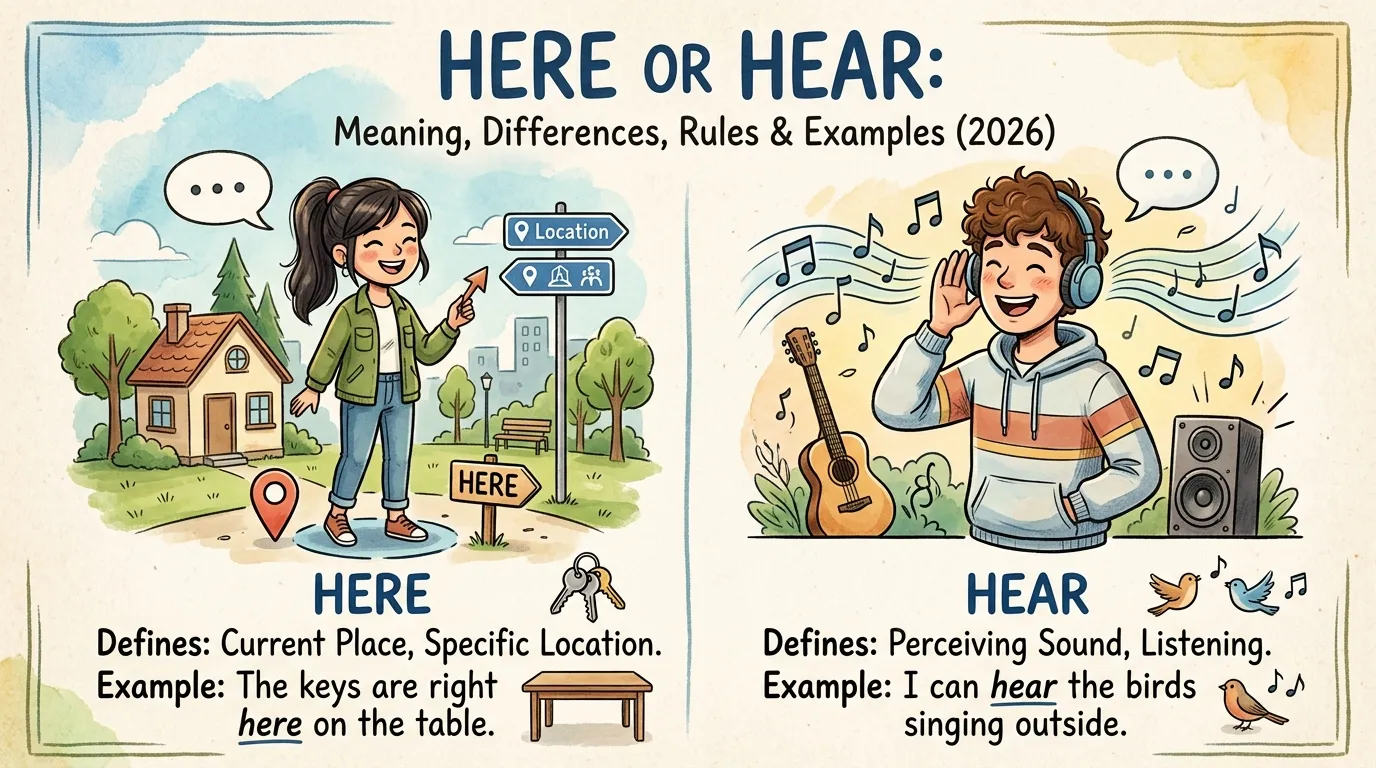
If you are not sure whether to write here or hear, remember this simple rule: here is mainly about a place, while it is mainly about sound or information. The two words sound the same, but they have different spellings, meanings, and grammar. That is why many English learners mix them up in texts, emails, schoolwork, and everyday writing.
Imagine someone sends you a message saying, “Are you hear?” It looks close to the correct word, but the sentence needs here because the person is asking about a place. On the other hand, “Can you here me?” is wrong because the sentence is about sound. The correct word is hear.
This guide explains them in simple English. You will learn their meanings, pronunciation, differences, common mistakes, origins, everyday uses, and easy ways to remember them. You will also see examples that show when each word belongs in a sentence.
What Does Here Mean?
Here is mainly an adverb that refers to a place, position, or point near the speaker or the place being discussed.
For example:
- Please sit here.
- I live here.
- Come here for a minute.
- Your keys are here.
But here has some other common uses too. It can introduce or point out someone or something:
- Here is your coffee.
- Here comes the bus.
- Here they are!
- Here we go again.
It can also refer to the present point or situation:
- We can stop here.
- This is where the story ends here.
Oxford and Cambridge both show that here has uses beyond simply naming a physical location, so saying that “here always means a place” would be too broad.
What Does Hear Mean?
It is a verb. It mainly means to notice or receive a sound through your ears.
Examples:
- I can hear music.
- Can you hear me?
- We heard a loud noise.
- She heard someone calling her.
It can also mean receiving or learning information:
- Did you hear the news?
- I heard about the new job.
Hear Does Not Always Mean Listen
Hear and listen are related, but they are not exactly the same.
It often describes a sound that reaches your ears, whether you try to hear it or not.
- I heard a dog barking outside.
Listen usually means that you pay attention to a sound on purpose.
- I listened to the teacher carefully.
Explore related topics https://orchoice.com/either-or-neither/
Here vs. Hear: 10 Key Differences
1. Here Refers to a Place, While Second Relates to Sound
Here points to a place or position.
- Please wait here.
- My phone is here on the desk.
It relates to receiving sound.
- Can you hear the music?
- I can hear someone outside.
2. Here Is Usually an Adverb, While Second Is a Verb
Here commonly works as an adverb.
- Come here.
- I live here.
It is a verb.
- I hear music.
- Did you hear that?
This grammatical difference can help you choose the right word.
3. Here Shows Where Something Is
Use here when you want to show a location.
- Put your bag here.
- The restaurant is right here.
You can often ask “Where?” and answer with here.
4. Hear Shows What You Receive Through Your Ears
Use it when the sentence is about a sound.
- I can hear the rain.
- Did you hear that noise?
You can often ask “What did you hear?”
5. Here Can Introduce Something
Here is often used to introduce or present something.
- Here is your ticket.
- Here are the documents.
This is an important use that many short explanations leave out.
6. Hear Can Mean “Receive Information”
It can also mean that you learn information.
- Did you hear the news?
- I heard about the meeting.
In these examples, the word is not simply about a sound. It means receiving or learning information.
7. Here Can Be Used in Common Expressions
Here appears in many everyday expressions.
- Here we go again.
- Here you are.
- Here comes the bus.
- Here and there.
These expressions show why it is too simple to say that here only means “this place.”
8. Hear Has Different Verb Forms
Because it is a verb, it changes form.
- Present: hear
- Past: heard
- -ing form: hearing
Examples:
- I hear music every morning.
- I heard a strange noise last night.
- I enjoy hearing birds in the morning.
9. Here Can Point to the Present Situation
Here can sometimes mean the current point or situation.
- Let’s stop here.
- From here, what should we do next?
10. Two Words Have Different Spelling but the Same Sound
This is the reason they are so easy to confuse.
Both are homophones. They normally sound alike within the same accent, but they have different spellings and meanings.
- Here → place or position
- Hear → sound or information
Here vs. Hear Comparison Table
| Feature | Here | Hear |
| Main meaning | A place or position | Receive or notice sound |
| Part of speech | Mainly adverb | Verb |
| Main question | Where? | What sound? / What information? |
| Example | Come here. | Can you hear me? |
| Related idea | Place, position, presence | Sound, listening, information |
| Past form | No past form | Heard |
| -ing form | Not applicable as a verb | Hearing |
| Common phrase | Here we go | Hear about |
| Memory clue | HERE = place | HEAR = sound |
| Sound | Same as “hear” | Same as “here” |
Why Do People Confuse?
The biggest reason is simple: they sound the same.
When people speak, you cannot see the spelling. The difference becomes clear when you write the words.
For example:
“Are you here?”
and
“Can you hear me?”
The pronunciation is similar, but the meanings are completely different.
How to Remember
Use this easy memory rule:
HERE = PLACE
Think:
Come here.
You are talking about a location.
HEAR = SOUND
Think:
I can hear you.
You are talking about sound.
Another useful memory clue is:
hear → ear → sound
Pronunciation
American English
- here: /hɪr/
- hear: /hɪr/
British English
- here: /hɪə(r)/
- hear: /hɪə(r)/
Origin and Etymology
Origin of Here
Here comes from Old English hēr, meaning “in this place.” It belongs to the Germanic family of words.
Over time, its use expanded beyond simple location. Modern English also uses here in expressions such as here we go, here you are, and here comes the bus.
Origin of Hear
It also comes from Old English and has a long history connected with the idea of receiving or noticing sound.
Modern English has kept this main meaning, but it also developed uses connected with listening and receiving information.
For example:
- It a sound
- Its about something
- hear someone speak
Here vs. Hear in British and American English
There is no basic spelling difference between American and British English for these two words.
Americans write:
Come here.
Can you hear me?
British speakers write the same words:
Come here.
Can you hear me?
The main pronunciation difference is that standard dictionary transcriptions show a final /r/ in the American forms, while British dictionary forms commonly show /r/ in parentheses. Actual pronunciation also varies by regional accent.
Common Mistakes
Mistake 1
Incorrect: I can here you.
Correct: I can hear you.
The sentence is about sound.
Mistake 2
Incorrect: Come hear and sit down.
Correct: Come here and sit down.
The sentence is about a place.
Mistake 3
Incorrect: Did you here the news?
Correct: Did you hear the news?
The sentence is about receiving information
Mistake 4
Incorrect: Are you hear for the meeting?
Correct: Are you here for the meeting?
The sentence asks about someone’s presence.
Mistake 5
Incorrect: Put the box over hear.
Correct: Put the box over here.
The sentence gives a location.
Everyday Usage Examples
In Conversation
Here:
“Come here for a second.”
Hear:
“Can you hear me?”
In Text Messages
Here:
“I’m here now.”
Hear:
“Did you hear what happened?”
In Emails
Here:
“The information is included here.”
Hear:
“I was glad to hear from you.”
In School
Here:
“Write your answer here.”
Hear:
“Did you hear the teacher?”
In News and Media
Here:
“Here are the latest results.”
Hear:
“We heard the news this morning.”
Here or Hear in Formal Writing
Both words are common in formal and informal English.
Use here when you are referring to a place, point, document, or situation:
The answer can be found here.
Use hear when you are referring to sound or information:
We were pleased to hear the results.
The important thing is not the level of formality. The important thing is meaning.
Usage Trends
Today, people often type quickly on phones and computers. Because both words sound the same, they can easily be confused when someone writes from memory.
The problem is especially noticeable in informal messages and online writing, where people may type quickly without checking spelling.
However, it is better not to claim that one word is “used far more often” than the other unless reliable corpus data is provided. The important point for learners is that both are common words, but they serve different grammatical and semantic roles.
Metaphors and Simple Memory Examples
A simple way to picture the difference is:
Here is a place.
Imagine pointing at a chair and saying:
“Sit here.”
Your finger points to a location.
Second word is a sound.
Imagine someone speaking to you:
“Can you hear me?”
Your ears receive the sound.
So remember:
HERE = where
HEAR = ear
Connotative Meaning
The words themselves are mostly neutral. Their emotional meaning usually comes from the sentence around them.
Here
Positive:
“I’m always here for you.”
This can suggest support and care.
Neutral:
“Your order is here.”
It simply gives information.
Hear
Positive:
“It was great to hear from you.”
This can suggest happiness or connection.
Negative:
“I was upset to hear the news.”
Idioms and Common Expressions
Here We Go
Means that something is starting or happening again.
Here we go!
Here You Are
Used when giving something to someone.
“Here you are. Your receipt.”
Here and There
Means in different places.
We saw small shops here and there.
Hear, Hear!
Hear, hear! is an expression used to show strong agreement with what someone has just said. It is hear, not here.
Example:
“Everyone deserves a fair chance.”
“Hear, hear!”
This is a particularly useful spelling point because “here, here” is a common mistake.
Literature and Movies
Both words are extremely common in English literature, films, television, and everyday dialogue because they are basic English words.
Here often appears when a character points to a place, arrives, gives something, or introduces an idea.
Second word often appears when characters talk about sounds, conversations, news, or information.
For example, everyday movie dialogue may include lines such as:
“Come here.”
or
“Did you hear that?”
Why the Difference Between Here and Hear Matters
Knowing the difference helps you avoid simple spelling errors that can change the meaning of a sentence.
Compare:
Come here.
Can you hear me?
One asks someone to move to a place. The other asks whether the person can receive a sound.
A mistake can make a sentence look careless, especially in:
- School assignments
- Emails
- Job applications
- Social media posts
- Business messages
- Everyday texts
Usefulness in Daily Life
You will see here and hear every day.
We use here when talking about where you are, where something is, or what is happening at a particular point.
You use second word when talking about sounds, conversations, music, news, or information.
The words are simple, but choosing the correct spelling makes your writing clearer.
A good habit is to stop for one second and ask:
Am I talking about a place?
→ Use here.
Am I talking about sound or information I received?
→ Use hear.
Which One Should You Use?
For US English
Use here for a place or position:
I am here.
Use second word for sound or information:
I can hear you.
For UK English
The same spelling and basic rule applies:
Come here.
Did you hear that?
For Global English
The same simple distinction works:
HERE = place
HEAR = sound or information
Situational Preference
Choose here when the sentence answers a question about where someone or something is, or when it points to a place, position, or situation. Choose second word when the sentence is about receiving a sound, listening to someone, or getting information. If you can replace the idea with “in this place,” here is probably correct. If the sentence is about something reaching your ears or learning news, second word is the better choice. When you are unsure, look at the meaning instead of the sound because the two words are homophones.
FAQs
1. Is it “here or hear”?
It depends on the meaning. Use here for a place or position. Use it for sound or information.
2. Are here and hear homophones?
Yes. They normally sound the same but have different spellings and meanings.
3. Is “I can here you” correct?
No. The correct sentence is:
I can hear you.
4. Is “Come hear” correct?
Usually, no, if you mean someone should come to a place. Write:
Come here.
5. What is the easiest way to remember here and hear?
Remember:
HERE = place
HEAR = sound
6. What is the difference between hear and listen?
It usually means that a sound reaches your ears. Listen means that you pay attention to or try to hear a sound.
Conclusion
Here and hear sound the same, but they have different meanings and spellings. Here is mainly used for a place, position, or point, while second word relates to sound, listening, or receiving information. For example, we say “Come here” for a place and “Can you hear me?” for sound. You can also connect it with ear as a spelling clue, but this is only a memory trick, not the real origin of the word. Once you focus on the meaning instead of the sound, choosing between two words becomes much easier and can help you write clearly in texts, emails, schoolwork, and everyday communication.

I’m Samia Jamshaid, an English language specialist, SEO specialist, digital publisher, and researcher. I create clear, accurate, and well-researched content on English grammar, vocabulary, word meanings, and language comparisons, helping readers understand and use English with confidence.












1 thought on “Here or Hear: Differences, Grammar Rules & Examples 2026”