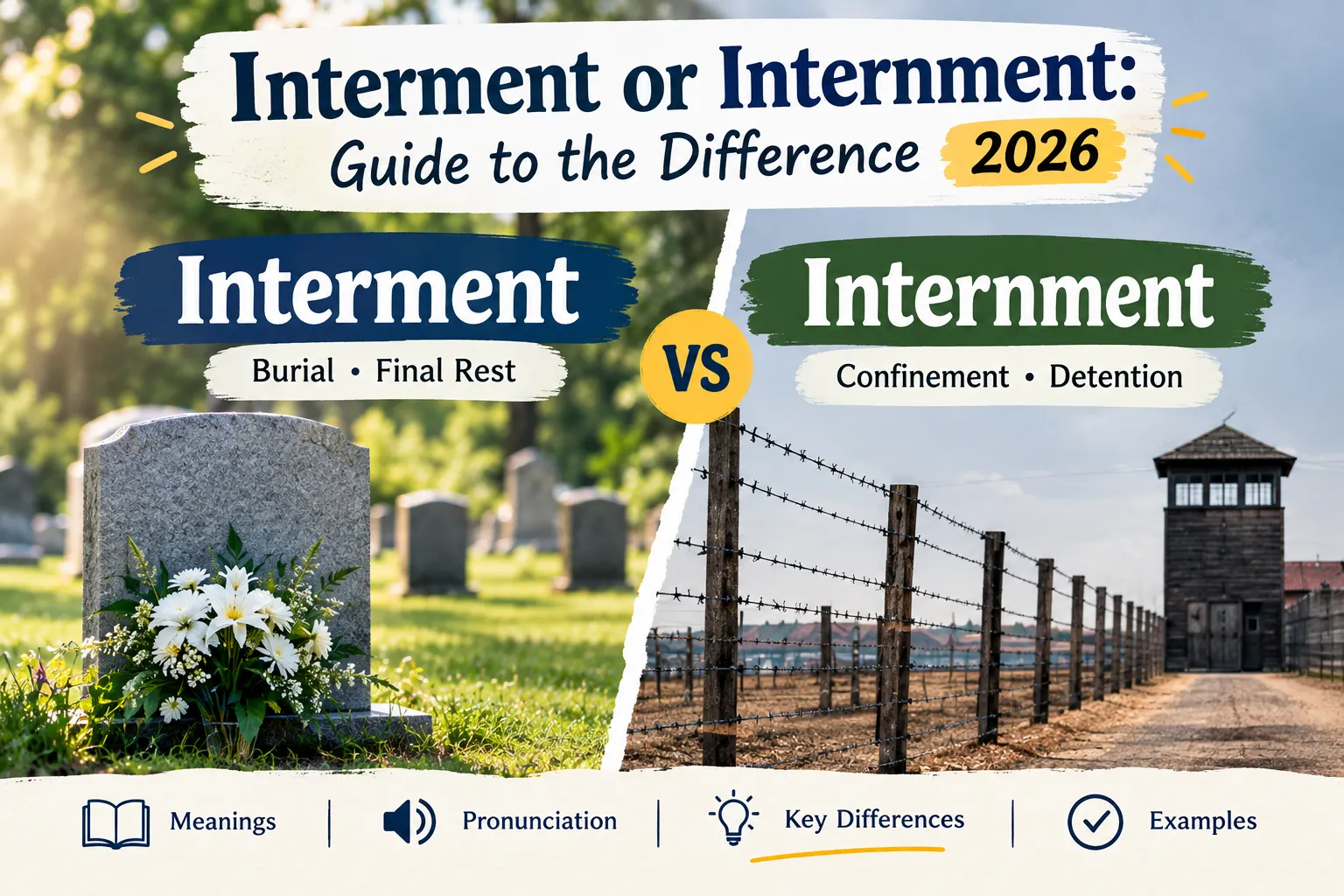
Interment means burying a dead person. Internment means keeping a person in a place where they cannot leave, often for political or military reasons.
Have you ever seen the words interment and internment and wondered which one is right? They look almost the same. They also sound very close. But they do not mean the same thing.
Interment is about burial. It is the act of burying a dead person or placing human remains in a final resting place. Internment is about keeping people in a place where they are not free to leave, especially for political or military reasons.
For example, a family may attend the interment of a loved one after a funeral. A history book may talk about the internment of people during a war.
People often search for interment vs internment because one small letter changes the meaning. A spelling mistake can also cause a serious problem in a funeral notice or history report.
This guide explains interment vs internment in simple English. You will learn the meanings, differences, pronunciation, word origins, common mistakes and examples. Also easy ways to remember interment vs internment.
Pronunciation
| Word | US Pronunciation | UK Pronunciation |
|---|---|---|
| Interment | /ɪnˈtɝːmənt/ | /ɪnˈtɜːmənt/ |
| Internment | /ɪnˈtɝːnmənt/ | /ɪnˈtɜːnmənt/ |
Difference Between Interment and Internment
1. Basic Meaning
Interment means burying a dead person.
Internment means keeping a person in a place where they are confined or detained.
Examples:
- The family attended the interment after the funeral.
- The book tells the story of wartime internment.
2. What Is Each Word About?
Interment is about death and burial.
Internment is about detention and loss of freedom.
Examples:
- The cemetery was ready for the interment.
- The class studied the history of internment.
3. Who Is Involved?
Interment is connected with a person who has died and their remains.
Internment is connected with living people who are being held or confined.
Examples:
- The interment of her grandfather took place on Sunday.
- Many families suffered during their internment.
4. Where Does It Happen?
Interment take place in a grave, cemetery, or another place where human remains are placed.
Internment may take place in a camp, prison, or other restricted place.
Examples:
- The interment took place in the family cemetery.
- The families were taken to an internment camp.
5. What Is the Purpose?
The purpose of interment is to bury or lay a dead person to rest.
The purpose of internment is to confine or detain people.
Examples:
- The family made plans for the interment.
- The government ordered the internment of the group.
6. How Long Does It Last?
Interment describes the act of burial. It is not defined by the length of the funeral or ceremony.
Internment can last for a long or short time. It may continue for weeks, months, or years.
Examples:
- The interment followed the funeral service.
- His internment lasted several months.
7. What Is the Root Word?
Interment comes from inter, which means “to bury.”
Internment comes from intern, which can mean “to confine.”
Examples:
- The soldiers were interred in the cemetery.
- The people were interned during the conflict.
8. What Is the Spelling Difference?
The words differ by one important n.
Interment:
inter + ment
Internment:
intern + ment
Examples:
- The funeral notice used interment.
- The history book used internment.
9. Where Are They Commonly Used?
Interment is often used in writing about:
- funerals
- burial
- cemeteries
- graves
- human remains
Internment is often used in writing about:
- war
- history
- political detention
- military detention
- internment camps
Examples:
- The newspaper gave details about the interment.
- The documentary discussed wartime internment.
10. What Feeling Does Each Word Have?
Interment can have a sad, quiet, or respectful feeling because it is linked to death and burial.
Internment often has a negative feeling because it is linked to loss of freedom.
Examples:
- The family gathered for a quiet interment.
- The survivors spoke about their painful internment.
Also explore related topics https://orchoice.com/soul-or-sole/
Nature and Behaviour of Interment and Internment
Nature of Interment
Interment is a formal noun. It is used when talking about burial.
You may see it in:
- funeral notices
- obituaries
- cemetery records
- religious writing
- burial records
Nature of Internment
Internment is also a formal noun. It is used when people are held or confined, especially for political or military reasons.
You may see it in:
- history books
- news reports
- war studies
- political writing
- discussions of detention
Why Do People Confuse Interment and Internment?
These words are easy to confuse for several reasons.
First, they look almost the same.
Second, they both start with inter-.
Third, they both end with -ment.
Fourth, they sound very close.
The biggest spelling clue is the extra n in internment.
This is why a person may type the wrong word, especially when writing quickly.
Comparison Table
| Feature | Interment | Internment |
|---|---|---|
| Simple meaning | Burial | Confinement |
| Main idea | Laying someone to rest | Holding someone in a restricted place |
| Related to | Death and burial | Detention and confinement |
| Root word | Inter | Intern |
| Root meaning | To bury | To confine |
| Common setting | Grave or cemetery | Camp or detention center |
| Common topic | Funeral and burial | War, politics, and history |
| US pronunciation | /ɪnˈtɝːmənt/ | /ɪnˈtɝːnmənt/ |
| UK pronunciation | /ɪnˈtɜːmənt/ | /ɪnˈtɜːnmənt/ |
| Spelling clue | One main n after inter | Extra n from intern |
Origin of Interment and Internment
Origin of Interment
Interment comes from Old French enterrement, meaning burial. It is linked to enterrer, meaning “to bury.” The word can be traced further back to Medieval Latin interrare, which combines the idea of putting something into the earth.
This gives us a helpful memory idea:
Interment → inter → bury
Origin of Internment
Internment comes from intern, meaning to confine or keep within limits. The word came through French interner and is related to Latin internus, meaning “within” or “inside.”
This gives us another memory idea:
Internment → intern → confine
British vs American English
There is no major spelling difference between British and American English for these two words.
Both use:
- interment for burial
- internment for confinement or detention
The main difference is in pronunciation. US and UK speakers may pronounce the vowel sounds in slightly different ways.
American English
- The family arranged the interment at the cemetery.
- The book discusses wartime internment.
British English
- The family attended the interment.
- The report discusses wartime internment.
Which One Should You Use?
Use interment when your sentence is about:
- burial
- a grave
- a cemetery
- a funeral
- human remains
- laying a person to rest
Use internment when your sentence is about:
- confinement
- detention
- political detention
- military detention
- wartime camps
Easy Rule
| Meaning | Word |
|---|---|
| Burial | INTERMENT |
| Confinement | INTERNMENT |
Common Mistakes
Mistake 1: Using “internment” for burial
Incorrect: The family attended the internment of their grandmother. Correct: The family attended the interment of their grandmother.
Mistake 2: Using “interment” for detention
Incorrect: The history book discusses the interment of civilians during the war. Correct: The history book discusses the internment of civilians during the war.
Mistake 3: Thinking interment means the whole funeral
Interment means burial. A funeral may include many other parts.
Mistake 4: Thinking internment always means an ordinary prison
Internment is used for confinement, especially for political or military reasons. It is often connected with wartime detention.
Mistake 5: Confusing internment with internship
These words are also different:
- internment = confinement
- intern = a person getting work experience; it can also mean to confine someone
- internship = work experience or training
Everyday Usage Examples
In Emails
Interment:
Please join us for the interment on Saturday.
Internment:
Our class is studying wartime internment.
On Social Media
Interment:
Our family gathered today for the interment of our grandfather.
Internment:
Today we remember the people affected by wartime internment.
In News Reports
Interment:
The interment will take place at the national cemetery.
Internment:
Historians are studying the internment of civilians during the war.
In Formal Writing
Interment:
The interment of the remains followed the funeral service.
Internment:
The report examined the policy of internment.
Usage Trends
The two words are used in different areas.
Interment is often found in formal writing about burial, such as funeral notices, cemetery records, and obituaries.
Internment is often found in history, news, and academic writing about detention, especially during war or political conflict.
So, the topic of your sentence is a better guide than trying to decide which word is “more common.”
Metaphors and Similes
These words are mainly used in their real meanings. However, writers can use them in creative ways.
Interment
A writer can use interment to create the idea of something being buried or put away.
Example:
The box was an interment for his old memories.
Here, the writer uses interment in a creative way. The memories are not really buried.
Internment
A writer can use internment to create the idea of being trapped.
Example:
Fear felt like an internment of the mind.
Here, the mind is not really in a camp. The word creates an image of being trapped.
These are creative uses, not common idioms.
Connotative Meaning
Interment
Positive or comforting:
- peace
- dignity
- respect
- final rest
Negative:
- sadness
- grief
- loss
Neutral:
- burial information
- cemetery records
- formal documents
Example:
The family arranged a dignified interment.
Internment
Negative:
- loss of freedom
- fear
- forced confinement
- suffering
Neutral:
- historical records
- academic discussion
- factual reports
Example:
The museum has records of wartime internment.
Idioms and Common Expressions
Neither word has many common idioms.
However, some related expressions are useful.
“Laid to rest”
This is a common gentle phrase for burial.
She was laid to rest beside her husband.
“Internment camp”
This is a common phrase related to internment.
The museum tells the story of families held in an internment camp.
Interment and Internment in Literature and Movies
Literature
Snow Falling on Cedars by David Guterson is a 1994 American novel. It deals with the effects of World War II and the treatment of Japanese Americans.
Farewell to Manzanar by Jeanne Wakatsuki Houston and James D. Houston is a 1973 memoir. It tells the story of a Japanese American family’s experience during World War II.
These works can help readers understand the historical background of internment.
Movies
Snow Falling on Cedars (1999, USA) is a movie about a murder case and how the war affected a Japanese American community.
Farewell to Manzanar (1976, USA) is a TV movie based on a memoir. It tells the story of a family during World War II.
Why Does the Difference Matter?
Imagine writing a funeral notice and using internment instead of interment. Readers may think the sentence is about detention, not burial.
The opposite mistake can also cause confusion in a history report.
Using the right word helps you:
- write clear sentences
- avoid embarrassing spelling mistakes
- write better funeral notices
- write accurate history reports
- understand news and books
- communicate with care
Usefulness in Daily Life
You can find interment in:
- funeral notices
- obituaries
- cemetery records
- family records
You can find internment in:
- history books
- news reports
- documentaries
- articles about war and detention
Situational Preference
Use interment when you talk about burial or the final placement of a dead person’s remains. Use internment when you talk about people in confinement, especially for military reasons. The same basic difference is used in American and British English. When you are not sure, look at the subject of your sentence. Is it about a person who has died and is being buried? Use interment. Is it about people who are being held or detained? Use internment. You can also use the root words as a quick guide: inter = bury and intern = confine.
Easy Memory Trick
Here is the easiest way to remember the difference:
INTERMENT = BURIAL
Think:
inter → bury
The soldiers were interred in the cemetery.
INTERNMENT = CONFINEMENT
Think:
intern → confine
The people were interned during the conflict.
One-Line Memory Rule
Interment = putting someone to rest.
Internment = keeping someone in confinement.
And remember the extra n:
INTER + MENT → burial
INTERN + MENT → confinement
Common Questions About Transform
1. What is the main difference between interment and internment?
Interment means burial. Internment means keeping a person or group in confinement, often for political or military reasons.
2. Is interment the same as burial?
Yes. Interment is a formal word for burying a dead person or placing their remains in a final resting place.
3. Are interment and internment pronounced the same?
No. They sound very close, but internment has an extra n sound.
4. Does internment always mean wartime detention?
No. Internment is often used for wartime detention, but it can also mean confinement for political or military reasons.
5. Can interment refer to cremated ashes?
Yes. Interment can mean placing human remains, including cremated ashes, in a final resting place.
6. Is internment the same as internship?
No. Internment means confinement, while internship means a period of work experience or training.
7. What is the easiest way to remember these words?
Remember: Interment = burial and Internment = confinement. You can also remember the root words: inter = bury and intern = confine.
Conclusion
Interment or internment look very similar, but they have different meanings. Interment means the burial or final placement of a dead person’s remains. While internment means keeping a person or group in confinement, often for political or military reasons. A simple way to remember the difference is inter = bury and intern = confine. The extra n in internment can also help you remember the word. When writing about a grave, cemetery, funeral, or burial, use interment. When writing about detention, confinement, war, or political holding, use internment.

I’m Samia Jamshaid, an English language specialist, SEO specialist, digital publisher, and researcher. I create clear, accurate, and well-researched content on English grammar, vocabulary, word meanings, and language comparisons, helping readers understand and use English with confidence.