
Complete means whole or finished, while completed means that an action or task has been finished.
Imagine you are doing your homework. Your teacher asks, “Is your work complete?” You say, “Yes, I have completed it.” Both words are correct, but they have different uses.
Complete can work as a verb or an adjective. As a verb, it means to finish something. As an adjective, it means whole or having all needed parts. Second word is the past form and past participle of the verb complete. It can also describe a task that is already finished.
People often search for both because the two words look and sound related. They may also appear in similar sentences. This can make it hard to choose the right one. The main difference is their role in a sentence. One can describe something whole or tell someone to finish an action. The other often shows that the action has already happened.
Pronunciation
| Word | US pronunciation | UK pronunciation |
| Complete | /kəmˈpliːt/ | /kəmˈpliːt/ |
| Completed | /kəmˈpliːtɪd/ | /kəmˈpliːtɪd/ |
Difference
1. Present Form vs Past Form
Complete is the base form of the verb. Second word is its past form.
Complete:
- I need to complete my homework.
- Please complete this form today.
Completed:
- I completed my homework last night.
2. Whole vs Finished Action
As an adjective, complete means whole or having all parts. Second word often means that a task or action has been finished.
Complete:
- This is a complete set of books.
- The report is complete.
Completed:
- The team completed the report.
3. Use as an Adjective
Both words can describe something finished. But complete can also mean whole, while second word usually points to a finished task or action.
Complete:
- We have a complete list of names.
- The meal is complete.
Completed:
- The completed form is on the desk.
4. Use as a Verb
Complete is the verb we use to tell someone to finish something. Second word shows that the action happened in the past.
Complete:
- Complete the test before noon.
- I will complete the work soon.
Completed:
- He completed the test on time.
5. Use with Helping Verbs
We often use complete after helping verbs such as will, can, and must. We use second word after have, has, and had in perfect tenses.
Complete:
- I will complete the task.
- You must complete the form.
Completed:
- I have completed the task.
6. Talking About Time
Complete can talk about a task that needs finishing now or later. Second word often tells us that the task was finished earlier.
Complete:
- I plan to complete the book today.
- We must complete the work soon.
Completed:
- I completed the book last month.
7. Giving Instructions
Use complete when you give an instruction. It tells someone what to do.
Complete:
- Complete all questions on the page.
- Complete the steps in the guide.
Completed:
- I completed all questions on the page.
8. Describing Forms and Documents
Complete can mean that a form has all the needed details. Second word often means that someone has filled it in.
Complete:
- Please send a complete list.
- We need a complete report.
Completed:
- Please sign the completed form.
9. Describing a Process
Complete can describe a whole process or tell someone to finish it. Second word shows that the process has ended.
Complete:
- The complete process takes one hour.
- Please complete each step.
Completed:
- The process was completed today.
10. Use in Passive Sentences
Complete can follow be when we give an instruction or describe a general rule. Second wordoften follows be to show that an action has been done.
Complete:
- The form must be complete before you send it.
- The list should be complete by Friday.
Completed:
- The work was completed yesterday.
For Further information https://orchoice.com/peaked-or-piqued/
Nature and Behaviour
How Complete Works
Complete has two main jobs.
As a verb, it means to finish something.
- I need to complete my work.
- They complete the task every day.
As an adjective, it means whole or having all parts.
- This is a complete story.
- We have a complete set.
How Completed Works
Completed is the past form and past participle of complete. It shows that someone finished an action.
It can also work as an adjective.
- She completed her course.
- The completed project is ready.
- We have completed the work.
Why People Get Confused

People get confused because both words come from the same verb. They also relate to the idea of finishing something.
For example:
- I will complete the work.
- I have completed the work.
Both sentences talk about finishing work. But they use different verb forms.
The first sentence talks about a future action. The second tells us that the action is already finished.
The words can also work as adjectives:
- The report is complete.
- The completed report is on my desk.
In the first sentence, complete means the report has all its parts. In the second, second word means someone has finished preparing it.
Comparison Table
| Point | Complete | Completed |
| Word form | Base verb and adjective | Past form and past participle |
| Main meaning | Whole or finish | Finished an action |
| Verb use | Complete the task. | I completed the task. |
| Time | Present or future actions | Past actions |
| Adjective use | Whole or finished | Already finished |
| Instruction | Complete the form. | Not usually used as a direct command |
| Helping verbs | Will complete, can complete | Have completed, has completed |
| Example | The list is complete. | The list was completed. |
| Main focus | Wholeness or finishing | A finished action |
| Common use | Forms, sets, tasks, and plans | Reports, projects, and tasks |
The Origin of Complete and Completed
The word complete comes from the Latin word complere. It means “to fill up” or “to finish.”
English took the word through Old French. Over time, it came to mean whole, full, or finished.
Second word comes from the verb complete. English adds -ed to many regular verbs to show the past form.
For example:
- Complete → Completed
- Finish → Finished
- Help → Helped
British vs American English
British and American English use both in the same way.
There is no major spelling difference between the two forms.
| Use | British English | American English |
| Base verb | Complete the task. | Complete the task. |
| Past form | I completed the task. | I completed the task. |
| Adjective | The form is complete. | The form is complete. |
| Past participle | We have completed the work. | We have completed the work. |
Both forms are common in schools, offices, news, and daily speech. The main difference is the grammar of the sentence, not the country.
Which One Should You Use?
Use complete when you want to talk about something whole or tell someone to finish a task.
Examples:
- Please complete this form.
- We have a complete set of books.
Use second word when you want to show that someone finished an action.
Examples:
- I completed the form yesterday.
- The team has completed the project.
Common Mistakes
Here are common errors and their correct forms.
| Incorrect | Correct | Why |
| I have complete my work. | I have completed my work. | Use the past participle after have. |
| She complete the task yesterday. | She completed the task yesterday. | Use the past form for a finished past action. |
| Please completed this form. | Please complete this form. | Use the base verb for an instruction. |
| The report is completed with all pages. | The report is complete with all pages. | Use complete to show that all parts are there. |
| He has complete the course. | He has completed the course. | Use completed after has. |
| I will completed the work. | I will complete the work. | Use the base verb after will. |
| The complete project was finished yesterday. | The project was completed yesterday. | Use completed to show the action was finished. |
| They have complete the job. | They have completed the job. | Use the past participle after have. |
Easy Rule to Remember
- Complete = whole or finish.
- Completed = finished an action.
Remember these examples:
- I will complete my homework.
- I have completed my homework.
Everyday Usage Examples
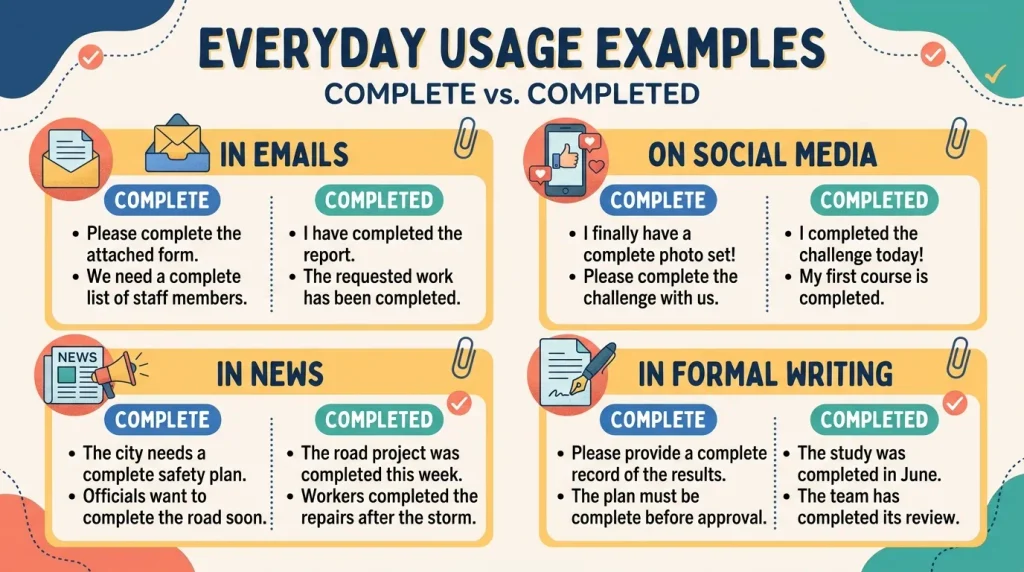
In Emails
Complete:
- Please complete the attached form.
- We need a complete list of staff members.
Completed:
- I have completed the report.
- The requested work has been completed.
On Social Media
Complete:
- I finally have a complete photo set!
- Please complete the challenge with us.
Completed:
- I completed the challenge today!
- My first course is completed.
In News
Complete:
- The city needs a complete safety plan.
- Officials want to complete the road soon.
Completed:
- The road project was completed this week.
- Workers completed the repairs after the storm.
In Formal Writing
Complete:
- Please provide a complete record of the results.
- The plan must be complete before approval.
Completed:
- The study was completed in June.
- The team has completed its review.
Usage Trends
Both are common in modern English.
People use complete in daily speech, school work, business, and online forms. It often appears in instructions, such as “Complete the form.”
People use second word when they report finished work. It is common in emails, reports, school records, and project updates.
Both words are used in British and American English. Their meaning stays the same around the world.
Metaphors and Similes
Both words can help writers talk about more than tasks. They can also describe feelings, goals, and life events.
Complete: Whole or Full
- “Her family makes her life complete.”
This means her family makes her feel happy and whole. - “The puzzle is complete, like a clear picture.”
This means every part is in place.
Completed: A Finished Journey
- “The journey is completed.”
This means the journey has reached its end. - “His dream was completed like the final piece of a puzzle.”
This means he reached his goal.
Connotative Meaning
Both words are usually neutral. Their tone depends on the sentence.
Positive Tone
They can show success, effort, and achievement.
- She completed her course with great care.
- We now have a complete plan for the future.
Negative Tone
They can appear in sentences about loss, failure, or unwanted results.
- The storm left the house with no complete roof.
- The work was completed too late to help us.
Neutral Tone
They can simply share facts.
- Please complete the form.
- The report was completed on Monday.
Idioms and Proverbs
There are no widely used idioms that depend only on the exact words. However, several common phrases share the idea of finishing something.
“Complete the picture”
Meaning: Add the missing facts or details.
Example: Her answer helped complete the picture.
“Bring something to completion”
Meaning: Finish something.
Example: The team worked hard to bring the project to completion.
“A job well done”
Meaning: Work that has been done with care and skill.
Example: You completed the task well. It was a job well done.
“All done”
Meaning: Finished.
Example: I have completed my homework. I am all done now.
Literature and Movies
Writers and filmmakers often explore the ideas of wholeness, effort, and finishing a task. These ideas connect with the meanings of both.
Literature
- The Complete Works of William Shakespeare — William Shakespeare, collected in many editions. These collections bring together his plays and poems. The word complete means the collection aims to include all his known works.
- The Complete Stories — Franz Kafka, collection published in English in 1971. The title shows that the book brings together his stories.
Movies
- The Pursuit of Happyness — United States, 2006. This drama follows a father who works hard to build a better life for his son.
- The Shawshank Redemption — United States, 1994. This drama follows a man who holds on to hope through many years of hardship.
Why This Difference Matters
Knowing the difference between both helps you write clear sentences.
It helps you give instructions, report finished work, and describe whole things. This matters at school, at work, and at home.
For example, “Complete the form” tells someone what to do. “I completed the form” tells someone what you did.
Using the wrong form can make a sentence sound unclear or incorrect. The right form helps readers understand the time and meaning.
These words are also useful in emails, reports, and online forms. Learning their roles can make your English stronger.
Usefulness in Daily Life
You can use complete and second word in many daily situations.
- At home: “Please complete your chores.”
- At school: “I completed my homework.”
- At work: “We need a complete report.”
- In emails: “The task has been completed.”
- While shopping: “I need a complete set of plates.”
- During a project: “We will complete the work by Friday.”
Situational Preference
Use complete when you give an instruction or describe something whole. It works well in forms, plans, lists, and daily talk. Use second word when you report that an action has finished. It is useful in emails, reports, school work, and project updates. In US and UK English, the rules are the same. For global readers, both words are easy to understand. Ask yourself one question: Am I talking about something whole, telling someone to finish it, or saying that it is already finished? This will help you choose the right word.
Common Questions and Answers
1. What is the main difference between complete and completed?
Complete means whole or to finish something. Completed means that an action has been finished.
2. Is completed the past tense of complete?
Yes. Completed is the simple past form and past participle of the regular verb complete.
3. Can complete be an adjective?
Yes. It can describe something that has all its parts.
Example: “We have a complete set of tools.”
4. Can completed be an adjective?
Yes. It can describe a task or item that someone has finished.
Example: “The completed form is on the desk.”
5. Should I write “I have complete” or “I have completed”?
Write “I have completed.” The word have needs the past participle completed in this sentence.
6. Is “Please complete the form” correct?
Yes. It is a correct instruction. It tells someone to fill in all the needed details.
7. Are complete and completed used differently in the US and UK?
No. Both forms follow the same basic grammar rules in British and American English.
Conclusion
The words complete or completed are closely related, but they have different jobs. Complete can mean whole or act as a verb that tells someone to finish something. Second word is the past form and past participle of the verb. It shows that an action has been finished. Use “complete” in a sentence like “Please complete your work.” Use “second word” in a sentence like “I completed my work yesterday.” You can also use “complete” as an adjective, as in “a complete set of books.” Both words are common in British and American English. Their basic rules do not change by country. This simple check will help you choose the right word. With practice, you can use both words with ease.

I’m Samia Jamshaid, an English language specialist, SEO specialist, digital publisher, and researcher. I create clear, accurate, and well-researched content on English grammar, vocabulary, word meanings, and language comparisons, helping readers understand and use English with confidence.












1 thought on “Complete or Completed: How to Use Each Word Correctly 2026”