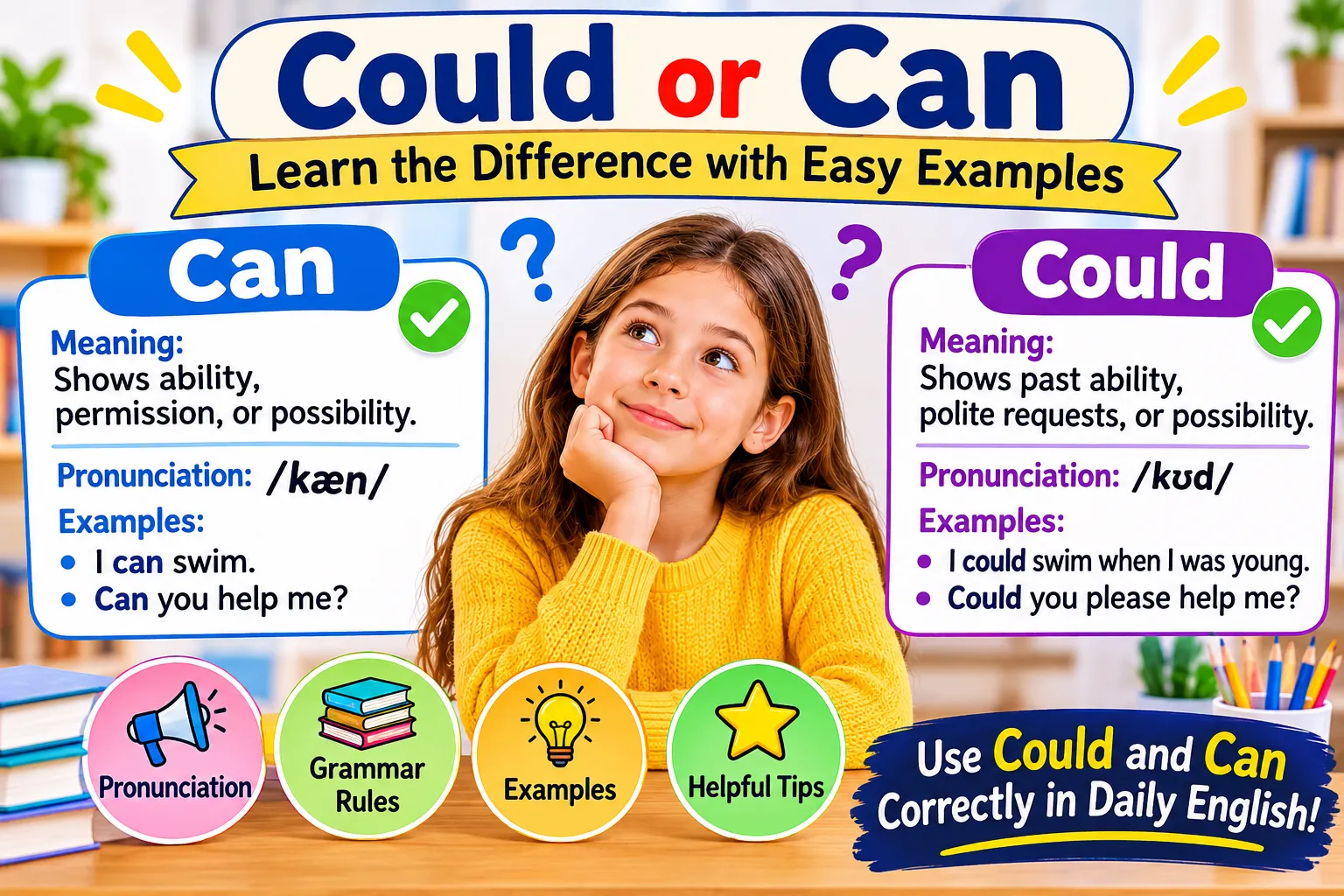
Can talks about what is possible or what someone is able to do. Could often talks about past ability, polite requests, or things that may happen.
Imagine you are at home. You ask your brother, “Can you help me?” He says, “Yes, I can.” Later, you tell a friend, “When I was young, I could run very fast.” Both words are correct, but they do not mean the same thing in every sentence.
The words could and can are modal verbs. We use them before the main verb. They help us talk about ability, permission, requests, and chances. People often search for “could or can” because both words can fit in similar sentences. This can make it hard to know which one to choose.
The good news is that the rules are easy to learn. This guide explains their meanings, uses, and differences. It also gives simple examples to help you use each word with care.
Pronunciation of Could and Can
| Word | US pronunciation | UK pronunciation |
| Can | /kæn/ | /kæn/ |
| Could | /kʊd/ | /kʊd/ |
Difference Between Could and Can
1. Present Ability vs Past Ability
Can shows that someone has an ability now. Could often shows an ability someone had in the past.
Can:
- I can swim very well.
- She can speak French.
Could:
- I could swim when I was five.
- She could read before she started school.
2. Direct Requests vs Polite Requests
We often use can for simple, direct requests. We often use could when we want to sound more polite.
Can:
- Can you open the door?
- Can you help me with this bag?
Could:
- Could you open the door, please?
- Could you help me with this task?
3. Present Permission vs Polite Permission
We use can to ask for or give permission in everyday speech. Could can make a request for permission sound more polite.
Can:
- Can I use your phone?
- You can sit here.
Could:
- Could I leave a little early?
- Could we use this room for a meeting?
4. Real Possibility vs Less Certain Possibility
Can often talks about something that is possible in general. Could often shows that something may happen, but it is not certain.
Can:
- Heavy rain can cause floods.
- Anyone can make a mistake.
Could:
- It could rain tonight.
- We could miss the bus.
5. General Facts vs Possible Results
Use can for facts that are true in many cases. Use could for a result that may happen in a certain case.
Can:
- Exercise can improve health.
- Too much sugar can harm your teeth.
Could:
- This plan could save us money.
- A small change could solve the problem.
6. Offers and Suggestions
Can can offer help or suggest an action. Could can give a softer suggestion.
Can:
- I can carry your books.
- We can meet after lunch.
Could:
- I could carry your books if you need help.
- We could meet after lunch instead.
7. Imaginary Situations
Could is common when we talk about an unreal or imagined situation. Can usually talks about a real ability or possibility.
Can:
- I can drive a car.
- We can visit the park today.
Could:
- I could buy a house if I had enough money.
- We could travel the world if we had more time.
8. Past Permission
Could can describe permission that someone had in the past. Can describes permission now.
Can:
- I can stay out until nine.
- You can use my computer.
Could:
- At school, we could play outside after lunch.
- When I lived there, I could walk to the shop.
9. Reported Speech
When we report what someone said, can often changes to could if the reporting verb is in the past.
Can:
- He says, “I can help you.”
- Sara says, “I can drive.”
Could:
- He said that he could help me.
- Sara said that she could drive.
10. Suggestions About Choices
Can can show an available choice. Could often gives one possible choice among others.
Can:
- You can take the bus.
- We can eat at home.
Could:
- You could take the bus if you want.
- We could eat at home or visit a café.
For further information https://orchoice.com/complete-or-completed/
Nature and Behaviour of Could and Can
How Can Works
Can is a modal verb. It helps us talk about ability, permission, and possibility.
It usually points to the present or to general facts.
Examples:
- I can cook dinner.
- You can ask me a question.
- This road can be busy.
How Could Works
Could is also a modal verb. It is the past form of can in some uses. It also helps us make polite requests and talk about possible or imagined events.
Examples:
- I could ride a bike when I was young.
- Could you wait for a moment?
- We could go to the beach tomorrow.
Why People Get Confused About Could and Can
People get confused because both words can talk about ability and possibility.
For example:
- I can help you.
- I could help you.
Both sentences are correct. But they sound different.
“I can help you” sounds clear and direct. It says that help is available.
“I could help you” sounds less certain. It may also suggest an offer or one possible choice.
The words also appear in questions. “Can you help me?” is common in daily speech. “Could you help me?” sounds more polite.
The best choice depends on what you want to say.
Comparison Table
| Point | Can | Could |
| Main use | Present ability | Past ability |
| Requests | Direct and common | More polite |
| Permission | Common in daily speech | Often more polite |
| Possibility | General or real possibility | Possible but less certain |
| Suggestions | Direct choice | Softer suggestion |
| Imaginary events | Less common | Very common |
| Past use | Usually not used for past ability | Used for past ability |
| Reported speech | Direct speech | Often used after past reporting verbs |
| Tone | Direct | Often softer |
| Example | I can swim. | I could swim as a child. |
The Origin of Could and Can
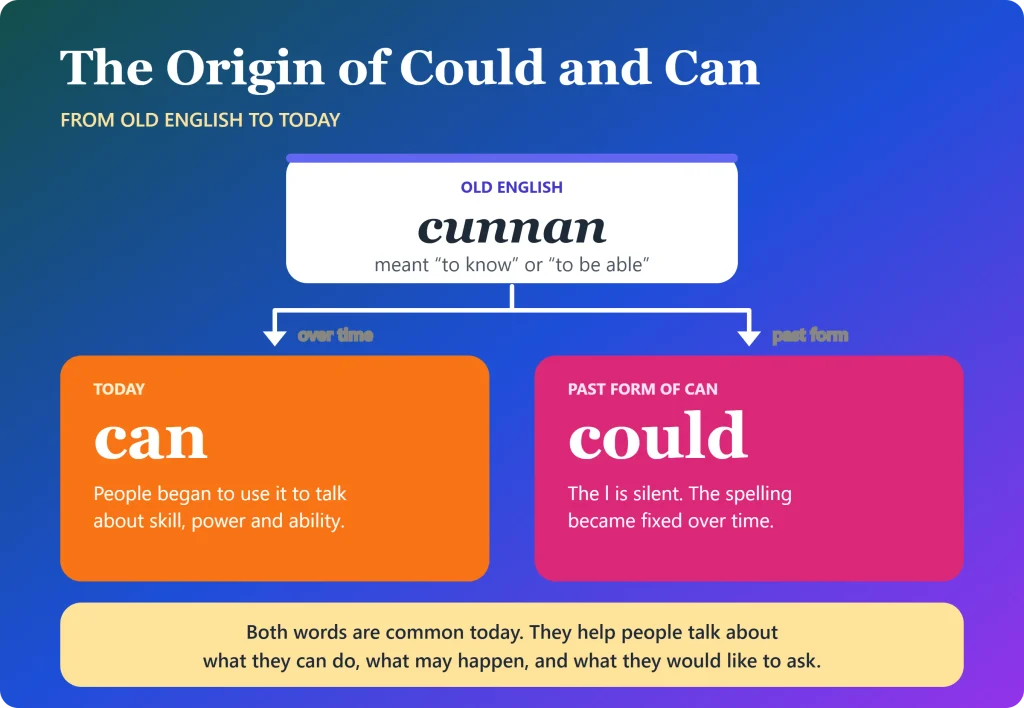
The word can comes from Old English cunnan. It meant “to know” or “to be able.”
Over time, people began to use it to talk about skill, power, and ability.
The word could developed as the past form of can. Its spelling may look unusual because the letter l is silent. The spelling became fixed over time.
Today, both words are common in English. Could or Can help people talk about what they can do, what may happen, and what they would like to ask.
British vs American English
The basic rules for can and could are the same in British and American English.
| Use | British English | American English |
| Present ability | I can swim. | I can swim. |
| Past ability | I could swim as a child. | I could swim as a child. |
| Polite request | Could you help me? | Could you help me? |
| Permission | Can I come in? | Can I come in? |
| Possibility | It could rain later. | It could rain later. |
There is no major spelling difference between Could or Can. Both countries use can and could in the same way.
Which One Should You Use?
Use can when you want to talk about a present skill, give permission, or make a direct request.
Examples:
- I can finish this work today.
- Can I borrow your pen?
Use could when you talk about past ability, make a polite request, or describe a possible event.
Examples:
- I could read when I was four.
- Could you please help me?
Common Mistakes
Here are some common mistakes and their correct forms.
| Incorrect | Correct | Why |
| I can to swim. | I can swim. | Do not add “to” after can. |
| She cans drive. | She can drive. | Do not add “s” to can. |
| He coulds help. | He could help. | Do not add “s” to could. |
| I could swim now when I was young. | I could swim when I was young. | Use could for past ability. |
| Could you to wait? | Could you wait? | Use the base verb after could. |
| I can went home. | I can go home. | Use the base verb after can. |
| I could helped him. | I could help him. | Use the base verb after could. |
| Can you helped me? | Can you help me? | Use the base verb after can. |
Easy Rule to Remember
After can and could, use the base form of the verb.
- Can + help
- Could + help
- Can + go
- Could + go
Do not add to, -s, or -ed to the main verb.
Everyday Usage Examples
In Emails
Can:
- Can you send me the report today?
- I can attend the meeting at 10 a.m.
Could:
- Could you please send me the report?
- Could we move the meeting to Friday?
On Social Media
Can:
- Can anyone suggest a good book?
- I can’t wait for the weekend!
Could:
- We could all use a little more kindness.
- Could this be the best day ever?
In News
Can:
- Strong winds can damage homes.
- A new road can reduce travel time.
Could:
- The storm could reach the coast tonight.
- The new plan could create more jobs.
In Formal Writing
Can:
- This method can improve the results.
- The rule can help protect users.
Could:
- This change could improve the results.
- The new rule could help protect users.
Usage Trends
Can or could are both used around the world. They appear in speech, books, news, emails, and online posts.
People often use can in daily talk because it is direct and simple. They use could when they want to sound polite or less certain.
Could or Can are also common in schools and workplaces. English learners meet them early because they help form many useful sentences.
Their use does not change much between British and American English. The main difference is the meaning and tone in each sentence.
Metaphors and Similes
Can and could are not usually metaphors by themselves. But writers can use them to talk about hope, choice, and new chances.
Can: Power and Ability
- “You can move mountains.”
This means you can do great things with effort. - “One small step can change your life.”
This means a small action may bring a big result.
Could: Hope and Possibility
- “The world could be your oyster.”
This means many chances may be open to you. - “A kind word could light up someone’s day.”
This means kind words may make someone feel happy.
Connotative Meaning
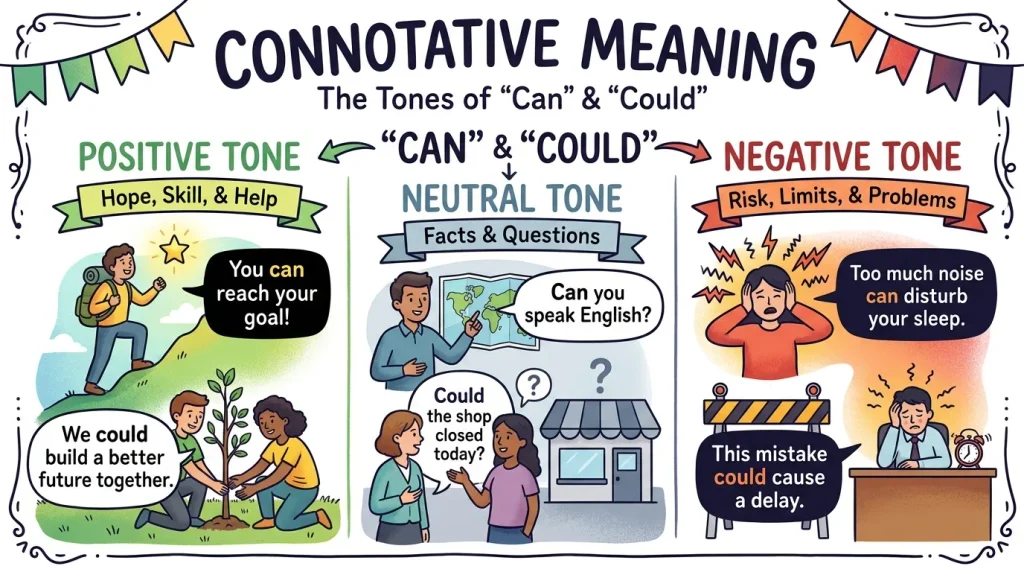
The words can and could do not have strong positive or negative meanings on their own. Their tone depends on the sentence.
Positive Tone
They can show skill, hope, help, or new chances.
- You can reach your goal with hard work.
- We could build a better future together.
Negative Tone
They can also point to risk, limits, or problems.
- Too much noise can disturb your sleep.
- This mistake could cause a delay.
Neutral Tone
They can simply share facts or ask questions.
- Can you speak English?
- Could the shop be closed today?
Idioms and Proverbs
The words can and could appear in many common sayings and phrases.
“You can lead a horse to water, but you can’t make it drink.”
Meaning: You can give someone help, but you cannot force them to use it.
Example: I gave him good advice, but he did not listen. You can lead a horse to water, but you can’t make it drink.
“If you can dream it, you can do it.”
Meaning: A clear goal and hard work can help you reach your dream.
Example: Keep working toward your goal. If you can dream it, you can do it.
“Could have been”
Meaning: Something was possible in the past, but it did not happen.
Example: We could have won the game, but we missed the last shot.
“Could not care less”
Meaning: To have no interest or concern about something.
Example: He could not care less about the gossip.
Literature and Movies
Writers use can and could in stories and dialogue. These words help show what a person can do, what they hope for, and what may happen.
Literature
- The Adventures of Tom Sawyer — Mark Twain, 1876. This adventure novel follows a boy and his friends. Ability, choices, and possible events are common parts of its story.
- The Wonderful Wizard of Oz — L. Frank Baum, 1900. This fantasy novel follows Dorothy on a strange journey. The characters face choices and talk about what they can do.
Movies
- The Wizard of Oz — United States, 1939. This fantasy film follows Dorothy and her friends as they seek help and face challenges.
- Finding Nemo — United States, 2003. This animated film follows a father searching for his son. Its story includes hope, risk, and what may be possible.
Why This Difference Matters
Knowing the difference between can and could helps you speak and write clearly.
It helps you show whether someone has a skill now or had it in the past. It also helps you make polite requests.
For example, “Can you help me?” is a direct question. “Could you help me?” sounds softer and more polite.
These small changes matter in school, work, and daily life. They can help you avoid confusion and speak with care.
Usefulness in Daily Life
You use can and could in many daily situations.
- At home: “Can you close the window?”
- At school: “I can answer this question.”
- At work: “Could you check this email?”
- With friends: “We could watch a film tonight.”
- While shopping: “Can I try this shirt?”
- While travelling: “Could you show me the way?”
Situational Preference
Use can when you talk about a real skill or ask a simple question. It works well in daily speech, school, and friendly chats. Use could when you want to sound more polite. It is useful in work emails, formal talks, and requests to people you do not know well. Choose could for past ability, too. For example, “I could ride a bike when I was six.” Use could for an unsure plan or possible result. The best word depends on your meaning, not on whether you use British or American English.
Possible Asked Question
1. What is the main difference between could and can?
Can often talks about present ability or possibility. Could often talks about past ability, polite requests, or possible events.
2. Is could the past tense of can?
Yes. Could is the past form of can when we talk about past ability.
Example: “I can swim now, but I could not swim last year.”
3. Is could more polite than can?
Yes, in many requests. “Could you help me?” often sounds more polite than “Can you help me?”
4. Can I use could for the future?
Yes. You can use could to talk about a possible future event.
Example: “We could visit the museum tomorrow.”
5. Can I say “I could help you”?
Yes. It is correct. It may sound like an offer or one possible choice.
6. Should I use can or could in a formal email?
Use could for many polite requests. Use can when you want to state a clear ability or fact.
7. Are could and can different in British and American English?
No major difference exists. Both forms follow the same basic rules in US and UK English.
Conclusion
The words Could or Can look simple, but they have different uses. Can often talks about what someone is able to do now. It also helps us ask for permission and talk about general facts. Could often talks about past ability. It also helps us make polite requests and describe possible events. Remember these easy rules: use can for present ability, direct requests, and real possibilities. Use could for past ability, polite questions, and unsure plans. Could or Can are used in British and American English. You do not need to learn two different sets of rules. With practice, you will know which word fits each situation. Soon, choosing between could and can will feel much easier.

I’m Samia Jamshaid, an English language specialist, SEO specialist, digital publisher, and researcher. I create clear, accurate, and well-researched content on English grammar, vocabulary, word meanings, and language comparisons, helping readers understand and use English with confidence.







1 thought on “Could or Can: Meaning, and Usage Guide 2026”