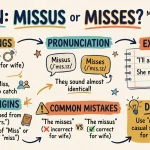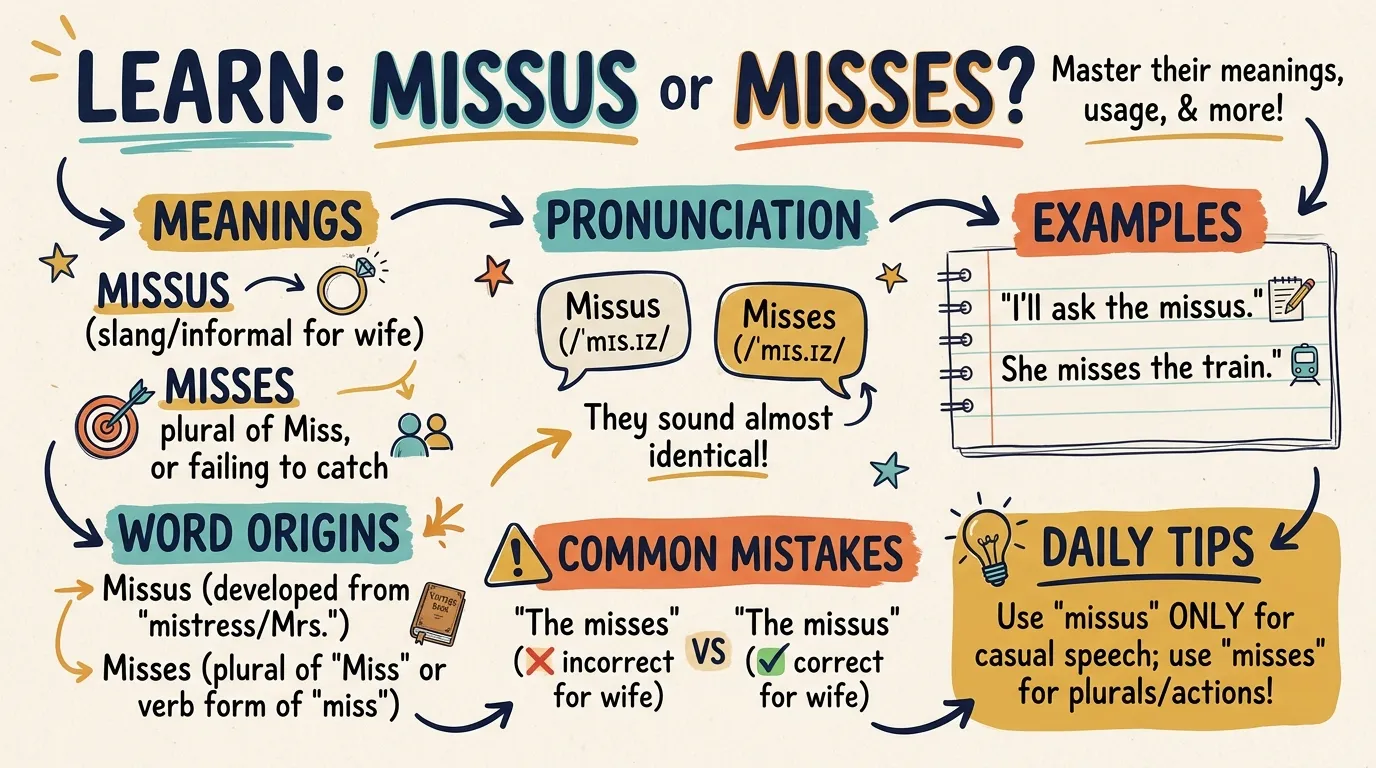
Missus is an informal word for a wife, while misses is a form of the verb miss or the plural of Miss.
Imagine someone says, “I need to ask the missus before I make plans.” They mean they need to ask their wife. Now imagine someone says, “She misses her family.” This means she feels sad because her family is away. The two words sound almost the same, but they have different meanings and uses.
Missus is a casual word. People often use it when talking about their wife. Misses has more than one use. It can mean that someone feels the absence of a person or thing. It can also refer to more than one woman called Miss.
People often search for missus or misses because the words sound alike. Their spelling makes the difference easy to miss. This guide explains their meanings, sounds, history, and use. You will also see simple examples and easy tips. These tips will help you choose the right word in daily writing and speech.
Pronunciation of Missus and Misses
Both words usually have the same pronunciation in US and UK English.
| Word | US pronunciation | UK pronunciation |
| Missus | /ˈmɪsɪz/ | /ˈmɪsɪz/ |
| Misses | /ˈmɪsɪz/ | /ˈmɪsɪz/ |
Both words have two syllables. The stress falls on the first syllable.
Difference Between Missus and Misses
1. Basic Meaning
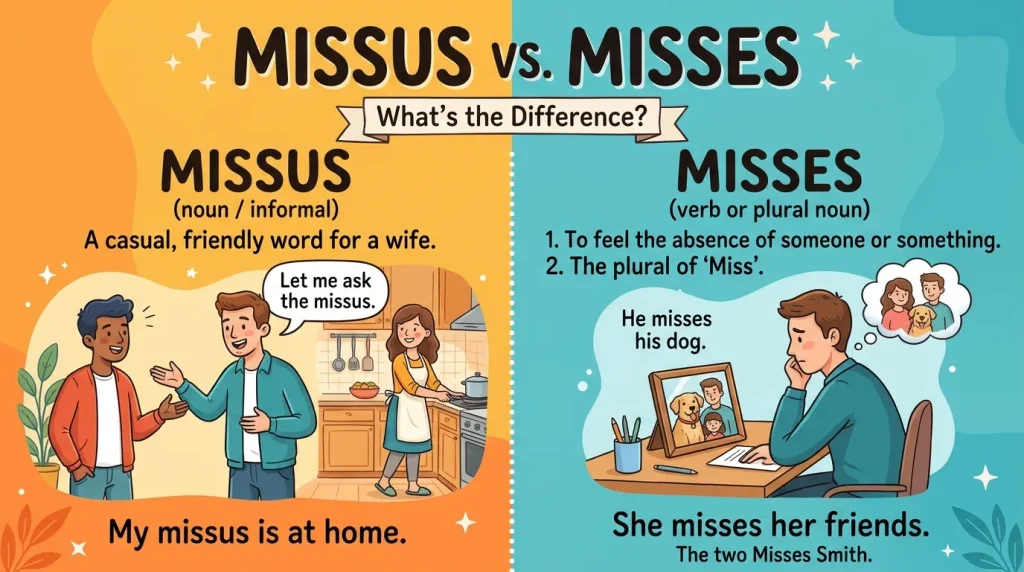
Missus is an informal word for a wife. Misses can mean that someone feels the absence of another person or thing.
- My missus made dinner.
- He misses his old home.
2. Part of Speech
Missus is a noun. It names a person. Misses is often a verb. It can also be the plural form of the title Miss.
- The missus is at work.
- She misses her friends.
3. Meaning in Family Talk
People often use missus when talking about their wife. Misses does not mean wife.
- I will ask the missus first.
- Dad misses Mom when she travels.
4. Meaning in Daily Speech
Missus sounds casual and friendly. Misses describes an action or feeling.
- The missus likes this shop.
- My brother misses his dog.
5. Use in a Sentence
Missus often comes after words such as “my” or “the.” Misses often comes after a name or a singular subject.
- My missus is a teacher.
- Sarah misses her sister.
6. Use with People
Missus can refer to someone’s wife. Misses can describe a feeling of being away from someone.
- His missus works nearby.
- He misses his parents.
7. Use with Things
Missus does not usually describe objects. Misses can describe a lost chance or something that a person wants.
- The missus bought a new bag.
- She misses her old school.
8. Use as a Plural
Missus is not the usual plural of Miss. Misses can be the plural of the title Miss.
- The missus is waiting outside.
- The two Misses Smith joined the event.
The plural form in the second example is old-fashioned and not common in everyday writing.
9. Tone
Missus is informal. It may sound warm or familiar, but it can sound too casual in formal settings. Misses is a normal verb form and can fit many types of writing.
- The missus wants to leave now.
- Our team misses its old coach.
10. Common Writing Choice
Use missus when you mean a wife. Use misses when you mean “feels the absence of” or when you need the plural of Miss.
- I am going out with the missus.
- He misses his family.
Learn more about https://orchoice.com/leapt-or-leaped/
Nature and Behaviour of Missus and Misses
Missus
Missus is a casual noun. It means a wife. People often say “the missus” or “my missus.”
For example:
- The missus is making tea.
- I bought flowers for the missus.
The word is common in casual speech. It is less common in formal writing. In a formal message, wife is often a better choice.
Misses
Misses has two main uses.
First, it is the third-person singular form of the verb miss. It tells us that someone feels the absence of a person or thing.
- He misses his home.
- She misses her best friend.
Second, misses is the plural of the title Miss. This use is less common today.
- The two Misses Brown arrived early.
Why People Get Confused About Missus and Misses
People get confused because missus and misses sound the same. Their sounds do not show their meanings.
The words also have similar spellings. Both begin with “miss.” This can make it hard to choose the right one.
The key is to look at the sentence.
If the sentence talks about someone’s wife, use missus. If it talks about missing someone or something, use misses.
Compare these sentences:
- I will ask the missus. (I will ask my wife.)
- He misses his wife. (He feels sad because she is away.)
The meaning changes when the spelling changes.
Comparison Table
| Point | Missus | Misses |
| Main meaning | An informal word for a wife | Feels the absence of someone or something |
| Part of speech | Noun | Usually a verb |
| Other use | Refers to a wife | Plural of the title Miss |
| Pronunciation | /ˈmɪsɪz/ | /ˈmɪsɪz/ |
| Syllables | Two | Two |
| Stress | First syllable | First syllable |
| Tone | Informal | Depends on the sentence |
| Formal writing | Usually avoid it | Common as a verb |
| Example | My missus is kind. | He misses his friends. |
| Easy clue | Think “wife” | Think “feels the absence” |
The Origin of Missus and Misses
Origin of Missus
Missus comes from the spoken form of Mrs. The title Mrs. comes from mistress. In older English, mistress was a polite title for a woman.
Over time, people began to say Mrs. as “missus.” The spelling missus grew from this spoken form. Today, it is an informal word for a wife.
Origin of Misses
Misses comes from the verb miss. The verb has roots in Old English. It meant to fail to reach, hit, or find something.
Over time, miss also came to mean feeling sad when someone or something is away.
The plural form of the title Miss also uses the spelling Misses. This form follows the usual English rule for making some words ending in “s” plural.
British vs American English
The main difference between missus and misses is the same in British and American English.
| Use | British English | American English |
| Informal word for a wife | Missus | Missus |
| Verb form of miss | Misses | Misses |
| Plural of Miss | Misses | Misses |
The spellings do not change between the two countries.
Examples:
- UK: He is going out with the missus.
- US: He is going out with the missus.
- UK: She misses her family.
- US: She misses her family.
In both forms of English, missus is casual. Use wife in formal writing when you want a clear and respectful tone.
Which One Should You Use?
Choose the word that matches your meaning.
- For a wife: Use missus in casual speech. Use wife in formal writing.
- For a feeling of loss: Use misses when someone feels the absence of a person or thing.
- For more than one woman called Miss: Use Misses, though this form is now uncommon.
These rules work in both US and UK English. They also work in global English. If you are unsure, read the full sentence and ask what you want to say. If you mean a wife, choose missus. Whether you mean someone feels the absence of something, choose misses.
Common Mistakes
Here are common errors and their correct forms.
| Wrong or unclear sentence | Better sentence | Why |
| I will ask the misses. | I will ask the missus. | Missus means wife. |
| He missus his wife. | He misses his wife. | Misses is the verb form. |
| My misses is at home. | My missus is at home. | Missus is the noun for a wife. |
| She miss her mother. | She misses her mother. | Use misses with she. |
| I miss the missus. | I miss the missus. | This is correct. It means I feel sad because my wife is away. |
Remember: missus means wife. Misses often means feels the absence.
Everyday Usage Examples
In Emails
Use missus only in a casual email to someone who knows you well.
- I need to check with the missus before Friday.
- My wife and I will join you on Saturday.
Use misses when you talk about someone who is away.
- Our son misses his grandparents.
- She misses her old team.
On Social Media
People may use missus in a casual post.
- A lovely day out with the missus!
- The missus picked our weekend plans.
People also use misses in posts about family and friends.
- He misses his school friends.
- She misses summer holidays.
In News Writing
News reports usually use wife instead of missus. It is clearer and more formal.
- The man and his wife attended the event.
- The child misses his family.
In Formal Writing
Use wife when you need a formal or respectful tone.
- His wife joined the meeting.
- She misses her family while working abroad.
Usage Trends
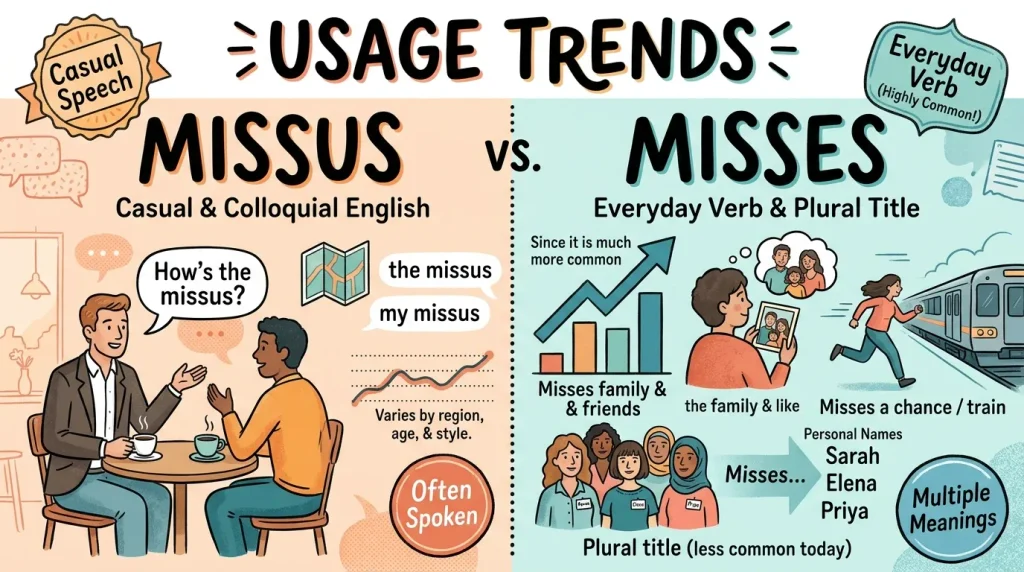
Missus is still used in casual English. It is often heard in phrases such as “the missus” and “my missus.” Its use can vary by place, age, and personal style.
Misses is much more common because it has an everyday verb use. People use it when they talk about missing family, friends, places, or chances.
The plural title Misses is less common today. Many people use women’s names instead of this older form.
Both spellings are understood in many English-speaking places. The best choice depends on the meaning of the sentence.
Metaphors and Similes
Missus does not have a common figurative meaning. It is an informal name for a wife.
Misses can appear in figurative sentences. It may describe a lost chance or a feeling of being away from something.
Examples:
- He misses home like a bird misses the sky.
- She misses her old life like a garden misses the rain.
- He misses every chance to speak up.
Connotative Meaning
Positive Tone
Missus can sound warm and loving when someone uses it with care.
- He planned a special day for the missus.
- I bought a gift for my missus.
Misses can show love and care for someone who is away.
- She misses her little brother.
- He misses his best friend.
Negative Tone
Missus can sound rude if someone uses it in a mocking way. It may also sound too casual in a serious setting.
- He spoke about the missus in a rude way.
- The word missus sounded out of place in the formal letter.
Misses can show sadness or regret.
- She misses her family every day.
- He misses the chance to say goodbye.
Neutral Tone
Missus can simply mean someone’s wife in casual speech.
- The missus is at work.
- My missus likes this café.
Misses can simply describe an action.
- He misses the bus.
- She misses her old school.
Idioms and Proverbs
There is no common English proverb that uses missus as a fixed phrase. However, misses appears in common expressions with the verb miss.
Miss the Point
This means to fail to understand the main idea.
- You miss the point if you only look at the title.
Miss the Boat
This means to lose a chance.
- He missed the boat by waiting too long.
Miss Out
This means to lose a chance to enjoy or do something.
- Do not miss out on the school trip.
Miss the Mark
This means to fail to reach the right result.
- His answer missed the mark.
These expressions use the base verb miss. They do not use missus.
Literature and Movies
The words belong to everyday English, so they may appear in stories, plays, and films about family life. However, a title or theme alone does not prove that a work uses either word.
A useful literary example is Pride and Prejudice (1813), a novel by Jane Austen from England. It explores family life, marriage, and social rules. It is a good topic for discussing how people speak about wives and women, but it should not be used as proof of the exact word missus without checking the text.
A related movie is The Shop Around the Corner (1940), made in the United States. It is a romantic comedy about work and relationships. It can help readers explore everyday talk between adults, but it is not a verified example of either spelling.
For an article that quotes a book or film, check the exact line and edition first. Do not claim that a work uses missus or misses unless the word appears in the source.
Why This Difference Matters
The difference matters because the two words have different meanings. Using the wrong one can change your message.
If you write “I will ask the misses,” readers may not know that you mean your wife. If you write “She missus her family,” the sentence is not correct.
Knowing the difference helps English learners write clear sentences. It also helps them understand casual speech, emails, and online posts.
Small spelling choices can change the meaning of a sentence. Learning these words helps you avoid simple errors and share your ideas with care.
Usefulness in Daily Life
You may hear missus in a chat with friends or family. You may also see it in a casual post.
For example:
- I am going shopping with the missus.
- The missus wants to eat out tonight.
You will see misses much more often in daily writing.
- He misses his mother.
- She misses the train every morning.
- Our dog misses its owner.
Situational Preference
Use missus when you speak casually about someone’s wife. It works well in friendly chats, jokes, and informal posts. Avoid it in formal letters or work reports. Use wife in those cases. Use misses when someone feels sad because a person or thing is away. It also works when someone fails to catch a bus or chance. In US and UK English, the rules are the same. For global readers, choose clear words that fit the sentence. If you mean a wife, write wife in formal text. If you mean a feeling or action, use misses.
Common Questions and Answers
1. What is the main difference between missus and misses?
Missus is an informal word for a wife. Misses is often a verb that means feels the absence of someone or something.
2. Are missus and misses pronounced the same?
Yes. Both are usually pronounced /ˈmɪsɪz/ in US and UK English.
3. Is missus a proper English word?
Yes. Missus is an informal English noun. It means a wife.
4. Can I use missus in formal writing?
It is better to use wife in formal writing. Missus sounds casual.
5. What does misses mean in a sentence?
It can mean that someone feels the absence of a person or thing. For example, “He misses his family.”
6. Is misses the plural of Miss?
Yes. Misses can be the plural of the title Miss. This use is less common today.
7. Are missus and misses different in British and American English?
No. Both countries use the same spellings and meanings.
Conclusion
Missus or misses sound the same, but they do not mean the same thing. Missus is an informal word for a wife. People often use it in casual speech, such as “the missus” or “my missus.” Misses is usually the verb form of miss. It means that someone feels the absence of a person or thing. It can also be the plural of the title Miss. The easiest way to choose the right word is to check the meaning. If you are talking about a wife, use missus in casual speech. If someone feels sad because a person or thing is away, use misses. In formal writing, wife is often a better choice than missus. The rules are the same in British and American English. Once you learn this simple difference, you can use both words with care and confidence.

I’m Samia Jamshaid, an English language specialist, SEO specialist, digital publisher, and researcher. I create clear, accurate, and well-researched content on English grammar, vocabulary, word meanings, and language comparisons, helping readers understand and use English with confidence.