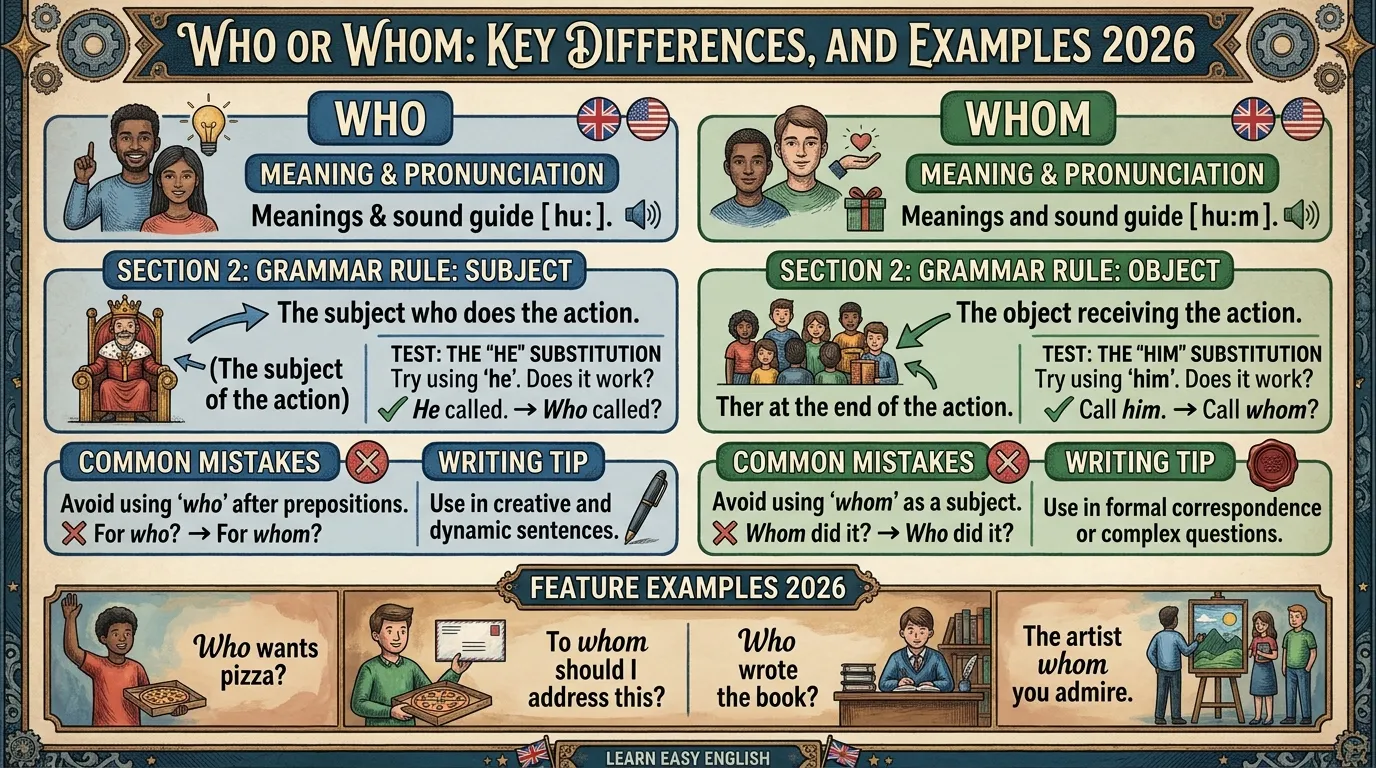
Who is used for the person doing an action. Whom is used for the person receiving an action.
Imagine you are writing a message to a friend. You want to ask about a new teacher. You write, “Who is your new teacher?” This sounds natural and correct. Later, you want to ask which person your friend met. You may write, “Whom did you meet?” This is also correct in formal English.
The words who or whom often confuse English learners. Both words ask about people. They also look and sound alike. The main difference is their job in a sentence. Who acts like he, she, or they. Whom acts like him, her, or them.
Many people search for who or whom because they want to write clear English. They may need help with schoolwork, emails, job letters, or formal writing. The good news is that a simple rule can help. Once you learn it, you can choose the right word with more confidence.
Pronunciation
| Word | US Pronunciation | UK Pronunciation |
| Who | /huː/ | /huː/ |
| Whom | /huːm/ | /huːm/ |
Difference Between Who or Whom
1. Who Does the Action
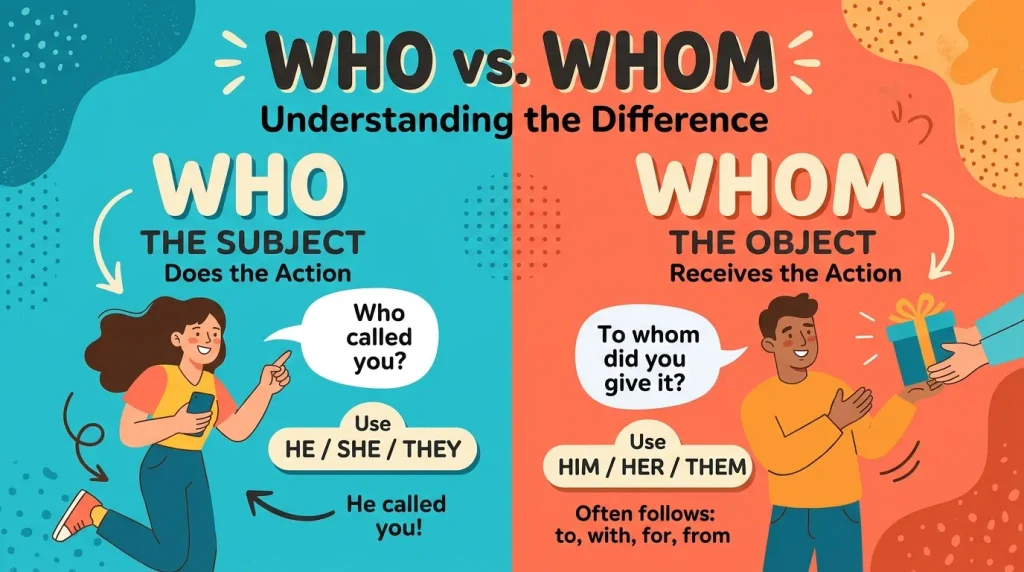
Use who when asking which person does something. It often acts as the subject of a sentence.
- Who called you last night?
- Who teaches your English class?
2. Whom Receives the Action
Use whom when asking which person receives an action. It often acts as the object.
- Whom did you call last night?
- Whom did the teacher help?
3. Who Works Like “He” or “She”
You can often use they to check who. If the sentence still makes sense, who is usually right.
- Who opened the door? He opened the door.
- Who won the game? She won the game.
4. Whom Works Like “Him” or “Her”
You can often use him or her to check whom. If the sentence works with him or her, whom may be correct.
- Whom did you invite? I invited him.
- Whom did she choose? She chose her.
5. Who Is Common in Everyday Questions
People use who in most daily conversations. It sounds natural and friendly.
- Who is coming to dinner?
- Who wants some tea?
6. Whom Is More Formal
Whom often appears in formal writing and careful speech. Some people use it in daily speech, too.
- To whom should I send the letter?
- Whom may I contact about this job?
7. Who Can Start a Question
Use who at the start of many questions about people.
- Who lives next door?
- Who broke the window?
8. Whom Often Follows a Preposition
A preposition is a word such as to, with, for, or about. In formal English, whom often follows these words.
- To whom did you give the gift?
- With whom are you traveling?
9. Who Can Join Two Parts of a Sentence
Who can add information about a person who does something.
- I know the woman who runs this shop.
- She is the student who won the prize.
10. Whom Can Join Two Parts of a Sentence
Whom can add information about a person who receives an action. This use is more formal.
- The man whom we met was kind.
- She is the friend whom I called.
For further information https://orchoice.com/led-or-lead/
Nature and Behaviour of Who or Whom
Who
Who asks about a person doing an action. It can also begin a sentence that gives more details about someone.
Examples:
- Who made this cake?
- The boy who sits here is my cousin.
Who is common in both speech and writing. It is the usual choice in most questions about people.
Whom
Whom asks about a person who receives an action. It can also follow a preposition in formal writing.
Examples:
- Whom did you see at the park?
- The woman to whom I spoke was helpful.
Whom is correct in these examples. However, many speakers choose who in casual conversation.
Why People Get Confused About Who and Whom
Who and whom ask about people, so their meanings seem close. Their grammar is what makes them different.
Many learners know that who is common. They may not know when to use whom. The difference can feel harder when a sentence has several parts.
For example:
- Who did you meet?
- Whom did you meet?
Comparison Table
| Feature | Who | Whom |
| Main job | Subject | Object |
| Simple check | He or she | Him or her |
| Used for | People doing an action | People receiving an action |
| Everyday speech | Very common | Less common |
| Formal writing | Common | Often used after prepositions |
| Example question | Who called? | Whom did you call? |
| After a preposition | Less common in formal style | Common in formal style |
| Can describe a person | Yes | Yes |
| Is it still used? | Yes | Yes |
| Easy rule | Use who for the doer | Use whom for the receiver |
The Origin of Who or Whom
Who and whom come from old forms of English. They have been used for many centuries.
Who developed from an old word used to ask about a person. Whom came from a form used for the object of a sentence. This difference remains in modern English grammar.
Over time, English speech became simpler in many settings. People began using who in places where older grammar rules called for whom. This is now common in everyday conversation.
Whom still appears in formal writing. It is especially common after words such as to, with, and for.
British vs American English
The basic grammar rule is the same in British and American English. Both use who for the subject and whom for the object in formal grammar.
| Situation | American English | British English |
| Asking who called | Who called you? | Who called you? |
| Formal question | Whom did you meet? | Whom did you meet? |
| After “to” | To whom did you speak? | To whom did you speak? |
| Casual speech | Who did you meet? | Who did you meet? |
| Formal writing | Whom is often used | Whom is often used |
Which One Should You Use?
For American English
Use who in most daily questions. Use whom in formal writing when it fits the sentence.
- Who is your manager?
- To whom should I address the letter?
For British English
Follow the same basic rule. Who is common in conversation, while whom often sounds more formal.
- Who is at the door?
- Whom did you invite?
For Global English
Use who for most everyday questions. Use whom after a preposition when you want a formal tone. If you are unsure, try replacing the word with he or him. This quick check can help you choose the correct form.
Common Mistakes
| Incorrect or less suitable | Better choice | Why |
| Whom called you? | Who called you? | Who does the action. |
| Who did you invite? (formal grammar) | Whom did you invite? | Whom receives the action in formal grammar. |
| Who should I give this to? (very formal style) | To whom should I give this? | Whom follows to in formal writing. |
| Whom is coming today? | Who is coming today? | Who is the subject. |
| The person who I met (formal style) | The person whom I met | Whom is the object in formal grammar. |
Everyday Usage Examples
In Emails
Use who for simple questions. Use whom in formal requests when needed.
- Who will attend the meeting?
- To whom should I send the report?
On Social Media
Who is usually the natural choice in short posts and messages.
- Who is joining us today?
- Who wants to watch this movie?
In News
News writing may use either word, based on the sentence.
- Who won the election?
- The official whom reporters interviewed answered questions.
In Formal Writing
Whom often appears in letters, reports, and formal requests.
- To whom it may concern.
- Whom should we contact for more details?
Usage Trends

Who is more common than whom in everyday English. Many speakers use who for both subject and object questions.
Whom has not disappeared. It remains useful in formal writing and in phrases such as “to whom it may concern.” It also appears after prepositions in careful writing.
English changes as people speak and write. Using who in casual speech is normal. Knowing when to use whom can still help you write more formally.
Metaphors and Similes
Who and whom do not have special metaphorical meanings. They are grammar words. Still, simple comparisons can help you remember their jobs.
- Who is like the person holding the pen. It points to the person doing the action.
- Whom is like the person receiving a letter. It points to the person affected by the action.
Connotative Meaning
Connotation means the feeling or tone a word may give. Who and whom have almost the same basic meaning, but they can create different tones.
Positive Tone
Whom can sound careful, formal, and respectful in the right setting.
Example: “To whom should I send my thanks?”
Negative Tone
Using whom in a casual chat may sound stiff or overly formal to some people.
Example: “Whom are you texting?” may sound less natural than “Who are you texting?”
Neutral Tone
Who is common and natural in most everyday questions.
Example: “Who is your best friend?”
The tone depends on the setting. Neither word is rude or polite by itself.
Idioms and Proverbs
Who and whom do not appear in many common idioms as a pair. However, several familiar phrases use who.
- Who knows? This means no one is sure.
- “Who knows? We may win the game.”
- Who’s who: This means a list of important or well-known people.
- “The event guide explains who’s who in the company.”
- Tell me who: This asks someone to name a person.
- “Tell me who helped you.”
A common formal phrase uses whom:
- To whom it may concern: This starts a letter when the reader’s name is unknown.
- “To whom it may concern, I am writing about my account.”
Literature and Movies
Writers use who and whom to ask about people, show relationships, and build clear sentences. These words are part of normal English grammar, not a special literary style.
Literature
In formal English books and letters, you may find phrases such as “to whom” and “the person whom.” Their use depends on the writer’s time, style, and audience.
For example, “To Whom It May Concern” is a standard phrase used in formal letters. It does not refer to one specific book.
Movies
Films often use who in natural dialogue. Whom may appear when a character speaks in a formal or old-fashioned way.
For example, a character might ask, “Who called?” in a casual scene. A formal character might say, “To whom do I owe this honor?” These are sample lines, not quotes from a named film.
Why This Difference Matters
Knowing who and whom helps you write clear English. It can make schoolwork, job letters, and reports more accurate. It also helps you understand formal writing.
Who is enough for most daily talks. Whom is useful when you need a formal tone or when it follows a preposition. Learning both gives you more choices.
You do not need to use whom in every conversation. The goal is to choose words that fit the situation. Good grammar should help people understand you, not make writing harder.
Usefulness in Daily Life
You can use who and whom in many everyday situations. Ask “Who is coming?” when planning a party. Write “To whom should I send this?” in a formal email. Use who in quick texts and social media posts. Use whom when formal grammar calls for it. These small choices can make your writing clearer. They also help you read letters, news, and books with more confidence.
Situational Preference
Choose who for most daily questions, chats, and friendly emails. It sounds natural and is easy to understand. Use whom in formal writing when the person receives an action. It often follows a preposition, as in “to whom” or “with whom.” If you are writing a job letter or formal request, whom may fit better. In casual speech, who is common even where formal grammar would use whom. Think about your reader and the setting. The best choice is the one that sounds clear and fits the level of formality.
Possible Asked Question
1. What is the main difference between who and whom?
Who is used for the person doing an action. Whom is used for the person receiving an action.
2. How can I remember when to use whom?
Try replacing the word with him or her. If that works, whom may be correct.
3. Is it wrong to use who instead of whom?
Not always. Who is common in everyday speech, even where formal grammar uses whom.
4. Should I use whom in formal emails?
Use whom when the sentence calls for it, especially after a preposition. For example, “To whom should I send the file?”
5. Do British and American English use the same rule?
Yes. The basic rule is the same in both forms of English.
6. Why does “to whom it may concern” use whom?
Whom follows the preposition to. The phrase is a formal way to start a letter when you do not know the reader’s name.
7. Can whom begin a question?
Yes. For example, “Whom did you invite?” is correct in formal grammar.
Conclusion
Who or whom both ask about people, but they do different jobs. Use who for the person doing an action and whom for the person receiving an action. A simple test can help you choose: replace who with they and whom with him or her. If the sentence works, you have a useful clue. Who or whom can be used in different situations, but who is more common in daily speech, emails, and social media. Whom is more common in formal writing, especially after words like to, with, and for. British and American English follow the same basic rule for Who or Whom. In casual conversation, many people use who in both cases, and this is normal in modern English. As you read and write, the difference will become easier. Choose the word that fits your meaning and your audience.

I’m Samia Jamshaid, an English language specialist, SEO specialist, digital publisher, and researcher. I create clear, accurate, and well-researched content on English grammar, vocabulary, word meanings, and language comparisons, helping readers understand and use English with confidence.








1 thought on “Who or Whom: Key Differences, and Examples 2026”