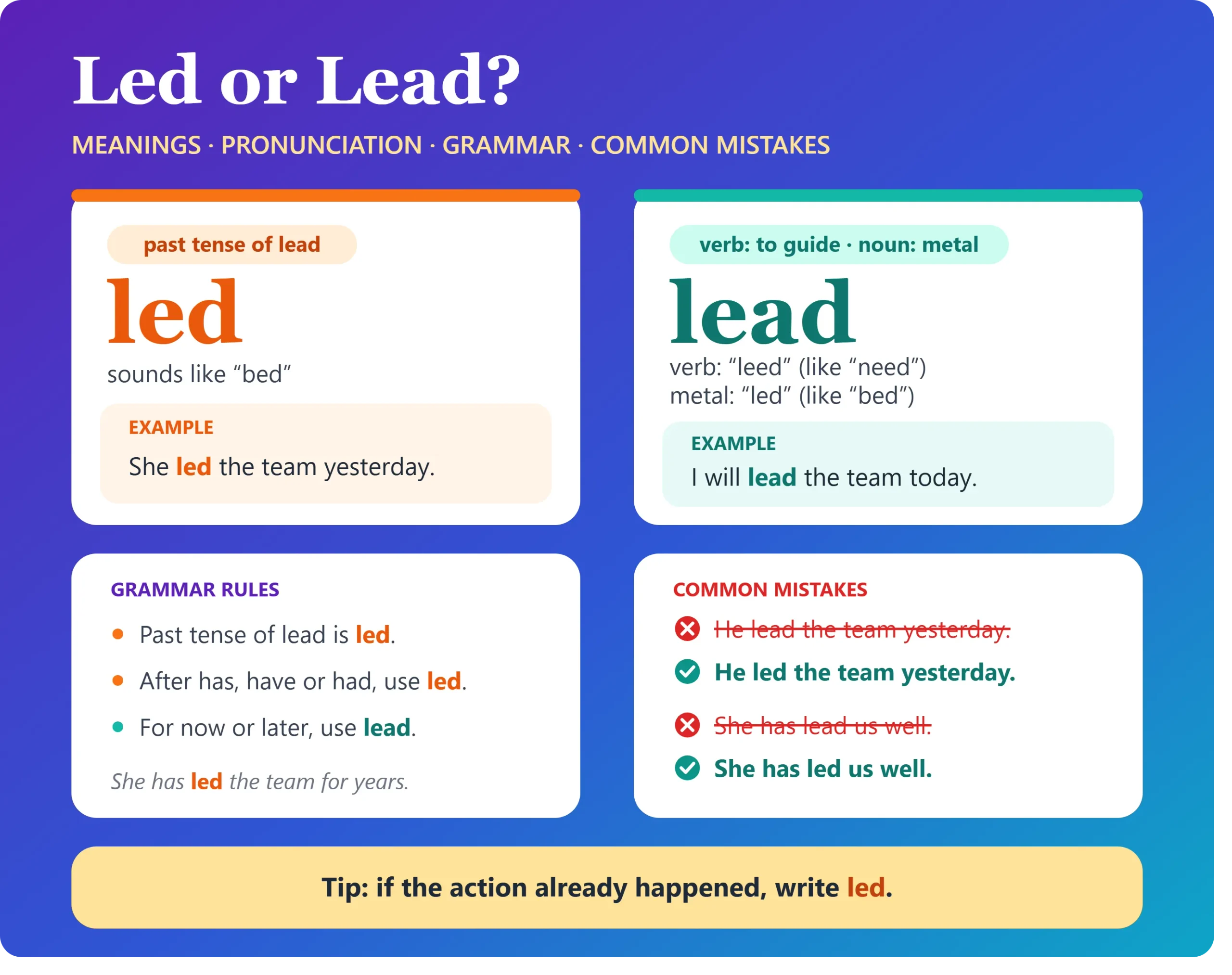
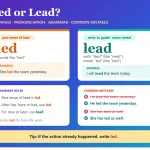
Lead can mean to guide someone or a heavy metal. Led is the past tense of the verb lead.
Imagine you are talking about a school trip. You write, “Our teacher lead the group yesterday.” Your reader may understand you, but the sentence has a spelling mistake. The correct sentence is, “Our teacher led the group yesterday.” Now think about today. You can write, “Our teacher will lead the group today.”
Both words look almost the same, so many people mix them up. However, they have different uses and sounds. Lead is usually a verb that means to guide, direct, or show the way. It can also be a noun that names a type of metal. Led is the past form of the verb lead. We use it for an action that already happened.
People search for led or lead because spell-check tools may not catch every mistake. Both are real words, but they do not fit in the same places. This guide explains their meanings, sounds, grammar, and use. It also gives simple examples to help you choose the right word.
Pronunciation of Lead and Led
The two words have different sounds when lead means “to guide.”
| Word | US pronunciation | UK pronunciation | Meaning |
| Lead (verb) | /liːd/ | /liːd/ | To guide or direct |
| Lead (metal) | /lɛd/ | /lɛd/ | A heavy metal |
| Led | /lɛd/ | /lɛd/ | Past tense of “lead” |
Remember: Lead meaning “to guide” rhymes with need. Led rhymes with bed. Lead meaning the metal has the same sound as led.
Difference Between Led and Lead
1. Meaning
Lead means to guide, direct, or show the way. Led means that someone guided or directed in the past.
Examples:
- I will lead the team.
- She led the team last year.
2. Verb Tense
Lead is the present form of the verb. Led is its simple past form.
Examples:
- They lead the class every Monday.
- They led the class last Monday.
3. Time of the Action
Use lead for actions in the present or future, depending on the sentence. Use led for actions that happened in the past.
Examples:
- He will lead the meeting tomorrow.
- He led the meeting yesterday.
4. Pronunciation
When it means “to guide,” lead has a long “ee” sound. Led has a short “e” sound.
Examples:
- I lead the group. (Sounds like “leed.”)
- I led the group. (Sounds like “led.”)
5. Use in Present Sentences
Use lead when the sentence describes a current habit or role.
Examples:
- Maya leads our school club.
- Good coaches lead by example.
Note: We add -s to lead when the subject is he, she, or it in the simple present.
6. Use in Past Sentences
Use led when the action is complete and happened before now.
Examples:
- Maya led our school club last year.
- The guide led us through the park.
7. Use With Helping Verbs
Use lead after words such as will, can, may, and should. Utilize led with forms of have to make the present perfect or past perfect.
Examples:
- We can lead the next activity.
- We have led many activities.
8. Use as a Noun
Lead can also be a noun. It may mean a type of metal or a clue in an investigation. Led is not used as a noun in these meanings.
Examples:
- Old paint may contain lead.
- The police found a new lead in the case.
9. Spelling
The past form of the verb lead is spelled led, not leaded. However, leaded is a real word in other uses, such as “leaded fuel” or “leaded glass.”
Examples:
- She led the group to the hall.
- The report says the old paint contained lead.
10. Meaning in a Sentence
The right word depends on what you want to say. Check whether you mean to guide someone now, guide someone in the past, or name the metal.
Examples:
- The coach will lead the players onto the field.
- The coach led the players onto the field yesterday.
learn more about it https://orchoice.com/its-or-its/
Nature and Behaviour of Lead and Led
How Lead Works
Lead has several uses.
- As a verb: It means to guide, direct, or be in charge.
- As a noun: It can mean a heavy metal.
- As a noun in news or investigations: It can mean a clue or a possible source of information.
Examples:
- Sara will lead the project.
- The detective followed a new lead.
The meaning depends on the sentence. The sound also changes when lead means the metal.
How Led Works
Led is the past tense and past participle of the verb lead. It tells us that the act of guiding happened earlier.
Examples:
- The captain led the team to victory.
- She has led the group for three years.
Why People Get Confused About Lead and Led
People often mix up these words for three simple reasons.
First, their spelling is similar. Both words contain the letters l and e, and both have d at the end.
Second, their sounds can be confusing. Led sounds like lead when lead means the metal. But lead meaning “to guide” has a different sound.
Third, English has many irregular verbs. Some verbs form the past tense by adding -ed, such as walk and walked. But lead changes to led.
A simple memory tip can help:
- Lead now: “I lead the team.”
- Led before: “I led the team yesterday.”
Comparison Table
| Feature | Lead (verb) | Led | Lead (metal) |
| Main meaning | To guide or direct | Guided in the past | A heavy metal |
| Part of speech | Verb | Past-tense verb or past participle | Noun |
| Time | Present or future, based on context | Past or perfect tense | Not about time |
| Pronunciation | /liːd/ | /lɛd/ | /lɛd/ |
| Example | I lead the team. | I led the team. | Lead can be toxic. |
| Common clue | Now, every day, will | Yesterday, last year, has | Metal, pipes, paint |
| Can they replace each other? | No | No | No |
The Origin of Lead
The word lead has a long history in English. As a verb, it comes from an old English word, lædan, which meant to guide or bring someone along. Over time, its spelling and uses developed into modern English.
The noun lead, meaning the metal, comes from the Old English word lēad. It has Germanic roots and is related to similar words in other languages.
The past form led developed as the past tense of the verb lead. English has many verbs that change their form instead of simply adding -ed. For example, go becomes went, and take becomes took. In the same way, lead becomes led.
These words have been used for hundreds of years. Their history helps explain why their spellings and sounds do not follow one simple rule.
British vs American English
The spelling and main rules for lead and led are the same in British and American English.
| Use | American English | British English |
| Present verb | I lead the team. | I lead the team. |
| Past verb | I led the team. | I led the team. |
| Metal | Lead can harm health. | Lead can harm health. |
| Pronunciation of verb | /liːd/ | /liːd/ |
| Pronunciation of metal | /lɛd/ | /lɛd/ |
| Past tense spelling | Led | Led |
There is no standard US-versus-UK spelling difference between these words. Both forms use lead for the present verb and led for the past form.
Examples:
- US: The guide led us to the museum.
- UK: The guide led us to the museum.
Both sentences are correct.
Which One Should You Use?
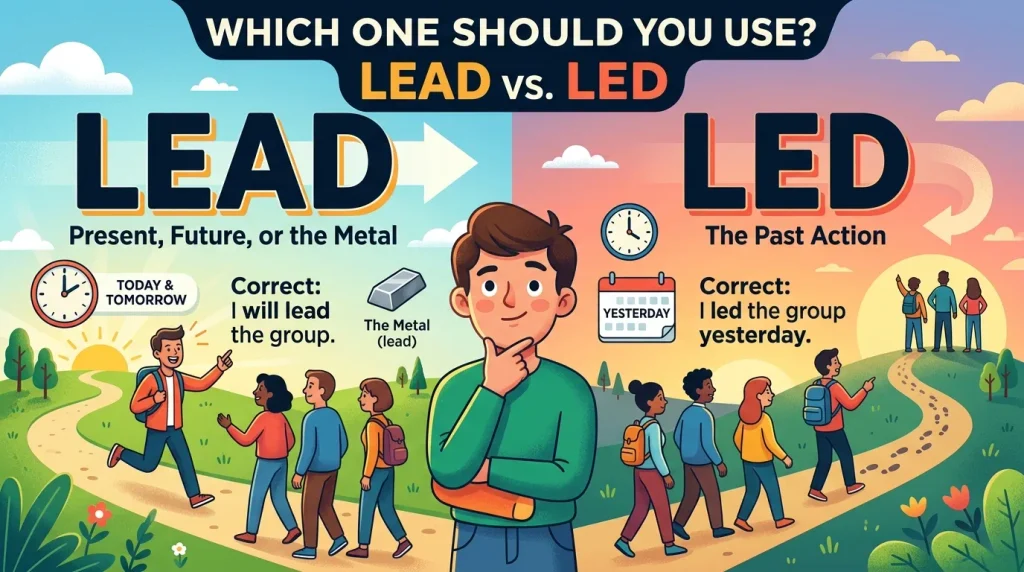
Choose the word that matches your meaning and the time of the action.
For American English
Use lead for the present verb or the metal. Use led for the past action.
- Correct: I will lead the group.
- Correct: I led the group yesterday.
For British English
Follow the same rule. The spelling does not change between the two forms of English.
- Correct: She leads the team.
- Correct: She led the team last week.
For Global English
If you write for readers around the world, use the same basic rule. Think about the sentence before choosing the word.
Ask yourself:
- Am I talking about guiding someone now or in the future? Use lead.
- Am I talking about guiding someone in the past? Use led.
- Am I talking about the metal? Use lead, pronounced like led.
Common Mistakes
Here are common errors and their corrections.
| Incorrect | Correct | Why? |
| She lead the team yesterday. | She led the team yesterday. | The action happened in the past. |
| He will led the group. | He will lead the group. | Use the base verb after “will.” |
| They have lead the project. | They have led the project. | Use the past participle after “have.” |
| The metal is called led. | The metal is called lead. | The metal is spelled “lead.” |
| I lead the team last year. | I led the team last year. | “Last year” points to the past. |
| She has lead many trips. | She has led many trips. | “Has” needs the past participle here. |
Easy tip: Words such as yesterday, last week, and in 2020 often point to the past. They can help you choose led when you mean “guided.”
Everyday Usage Examples
In Emails
- Lead: I will lead the new project next month.
- Led: Amir led the project last year.
On Social Media
- Lead: Good friends lead by example.
- Led: Our teacher led us on a fun trip today.
In News
- Lead: The new plan may lead to better roads.
- Led: The new plan led to better roads last year.
In Formal Writing
- Lead: The study will lead to more research.
- Led: The study led to more research.
When Talking About Metal
- The old pipe may contain lead.
- Children should not be exposed to lead dust.
Usage Trends
Both lead and led are common in English. They appear in books, news stories, schoolwork, websites, and daily speech.
The verb lead is used when people talk about guiding a team, running a project, or causing a result. For example, “Good habits lead to better health.”
The word led appears when writers describe something that happened in the past. For example, “The coach led the team to a win.”
The noun lead also appears in news reports. It can mean a clue in an investigation or the main story at the start of a news report. It is also the name of a metal.
Searches for led or lead often come from people checking spelling and grammar. Since both words are correct in different settings, a spelling checker may not explain which one fits. Reading the whole sentence is the best way to decide.
Metaphors and Similes
Lead often appears in figurative language. It can mean guiding people or helping them move toward a goal.
Metaphors
A metaphor compares one thing to another without using like or as.
- She is a lead light for the team. This means she guides and inspires others.
- His idea led the way. This means his idea showed others what to do.
Similes
A simile uses like or as to make a comparison.
- She led the group like a steady captain. This means she guided them with care.
- He led the team as calmly as a skilled coach. This compares his calm way of guiding to that of a coach.
The word led can describe past guidance in both literal and figurative ways.
Connotative Meaning
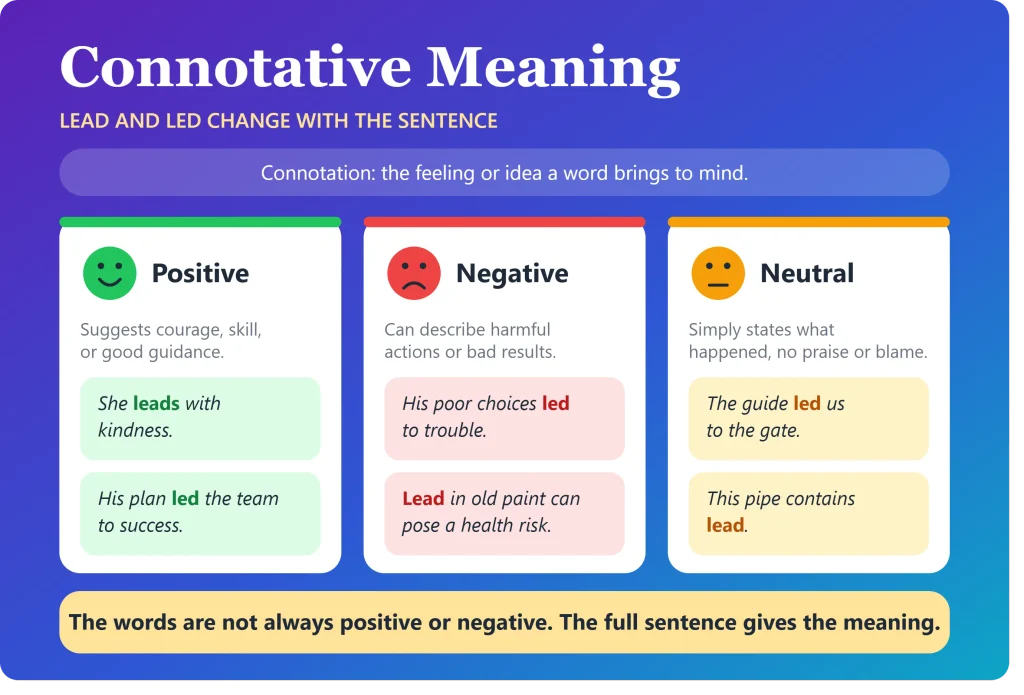
Connotation means the feeling or idea that a word brings to mind. The meaning of lead or led can change with the sentence.
Positive Meaning
Lead can suggest courage, skill, or good guidance.
Examples:
- She leads with kindness.
- His plan led the team to success.
Negative Meaning
The words can describe harmful actions or bad results.
Examples:
- His poor choices led to trouble.
- Lead in old paint can pose a health risk.
Neutral Meaning
The words can simply state what happened, without praise or blame.
Examples:
- The guide led us to the gate.
- This pipe contains lead.
The words themselves are not always positive or negative. The full sentence gives the meaning.
Idioms and Proverbs
Several common phrases use lead or led.
Lead by Example
Meaning: Show others how to act by doing it yourself.
Example: A good teacher leads by example.
Lead the Way
Meaning: Go first or show others what to do.
Example: The guide will lead the way to the hall.
All Roads Lead to Rome
Meaning: Different ways can reach the same result.
Example: We tried many plans, but all roads lead to Rome.
Lead Someone Astray
Meaning: Cause someone to make a wrong choice.
Example: Bad advice can lead a young person astray.
Be Led by the Nose
Meaning: Be controlled or easily influenced by someone.
Example: He was led by the nose and never made his own choice.
Notice that lead is used in the basic form in these phrases. When describing a past event, use led where the grammar requires it.
Literature and Movies
The words lead and led are useful in stories because they can describe who guides others and what happened in the past.
Literature
In The Lord of the Rings, a fantasy novel by J. R. R. Tolkien first published in 1954–1955, characters guide others through danger. Writers may use lead to describe a character who guides a group and led to describe a journey that already happened.
In The Adventures of Tom Sawyer, a novel by Mark Twain published in 1876, characters take part in adventures and sometimes guide one another. The words lead and led can describe those actions in a discussion of the story.
Movies
In The Lord of the Rings: The Fellowship of the Ring (2001), a fantasy film made in New Zealand and the United States, characters travel together and face difficult choices. Lead can describe guiding the group, while led can describe an action in the past.
In The King’s Speech (2010), a historical drama made in the United Kingdom and Australia, the story follows King George VI as he works to speak in public. In writing about the film, led may describe how past events guided a character’s choices.
Why This Difference Matters
Using the right word helps make your writing clear. If you write “She lead the team yesterday,” readers may understand you, but the grammar is wrong. “She led the team yesterday” is correct.
The difference also matters because lead has more than one meaning. It can mean “to guide,” or it can name a metal. The metal can be harmful if people are exposed to it in unsafe ways. Readers need the sentence to know which meaning is intended.
For English learners, this is a useful grammar lesson. It shows that some past-tense verbs do not end in -ed. It also shows why pronunciation matters. Lead meaning “guide” sounds different from led and from lead meaning the metal.
Learning this rule can improve schoolwork, emails, reports, and online posts. It can also help readers understand stories and news with less confusion.
Usefulness in Daily Life
You can use this rule in many daily situations.
- At school: “Our teacher led the class yesterday.”
- At work: “I will lead the meeting tomorrow.”
- At home: “My sister leads the family game.”
- In the news: “The new evidence led to more questions.”
- In science: “The test checked for lead in the water.”
- In writing: Check whether the sentence talks about the past or the present.
Situational Preference
Choose lead when you talk about guiding someone now or in the future. For example, “I lead the team” describes a current role, while “I will lead the team” describes a future action. Use led when the action happened in the past, such as “I led the team yesterday.” In schoolwork and formal writing, check the time of the action before choosing the word. In emails, use the form that matches the message. When talking about a type of metal, always write lead, even though it sounds like led. For readers in the US, UK, or other countries, the same spelling rule applies.
Possible Asked Question
1. What is the main difference between led and lead?
Lead is the present form of the verb meaning “to guide,” while led is its past form. Lead can also mean a type of metal.
2. Is led the past tense of lead?
Yes. The past tense of the verb lead is led.
Example: “She leads the group today.” “She led the group yesterday.”
3. How do you pronounce lead and led?
When lead means “to guide,” it sounds like “leed.” Led sounds like “led,” rhyming with bed. The metal lead also sounds like “led.”
4. Is “I lead the team yesterday” correct?
No. The correct sentence is “I led the team yesterday” because the action happened in the past.
5. Should I write “will lead” or “will led”?
Write will lead. After will, use the base form of the verb.
Example: “She will lead the meeting.”
6. Is lead a noun or a verb?
It can be both. As a verb, it means to guide. As a noun, it can mean a metal or a clue.
7. Are led and lead spelled the same in US and UK English?
Yes. American and British English use the same spellings and grammar rules for these words.
Conclusion
The difference between lead or led is easy to learn with practice. Lead means to guide someone or show the way. It can also name a type of metal. Led is the past tense of the verb lead. Use lead for present or future actions and led for actions that happened in the past. Pronunciation can help you remember the rule. Lead, meaning “to guide,” rhymes with need, while led rhymes with bed. The metal lead sounds like led. This rule is the same in American and British English. It applies to schoolwork, emails, reports, and daily speech. When unsure, check whether you mean the metal or an action that happened in the past. This simple tip can help you choose the correct word and write with confidence.

I’m Samia Jamshaid, an English language specialist, SEO specialist, digital publisher, and researcher. I create clear, accurate, and well-researched content on English grammar, vocabulary, word meanings, and language comparisons, helping readers understand and use English with confidence.








1 thought on “Led or Lead: Difference, Pronunciation, and Examples 2026”