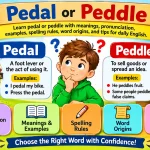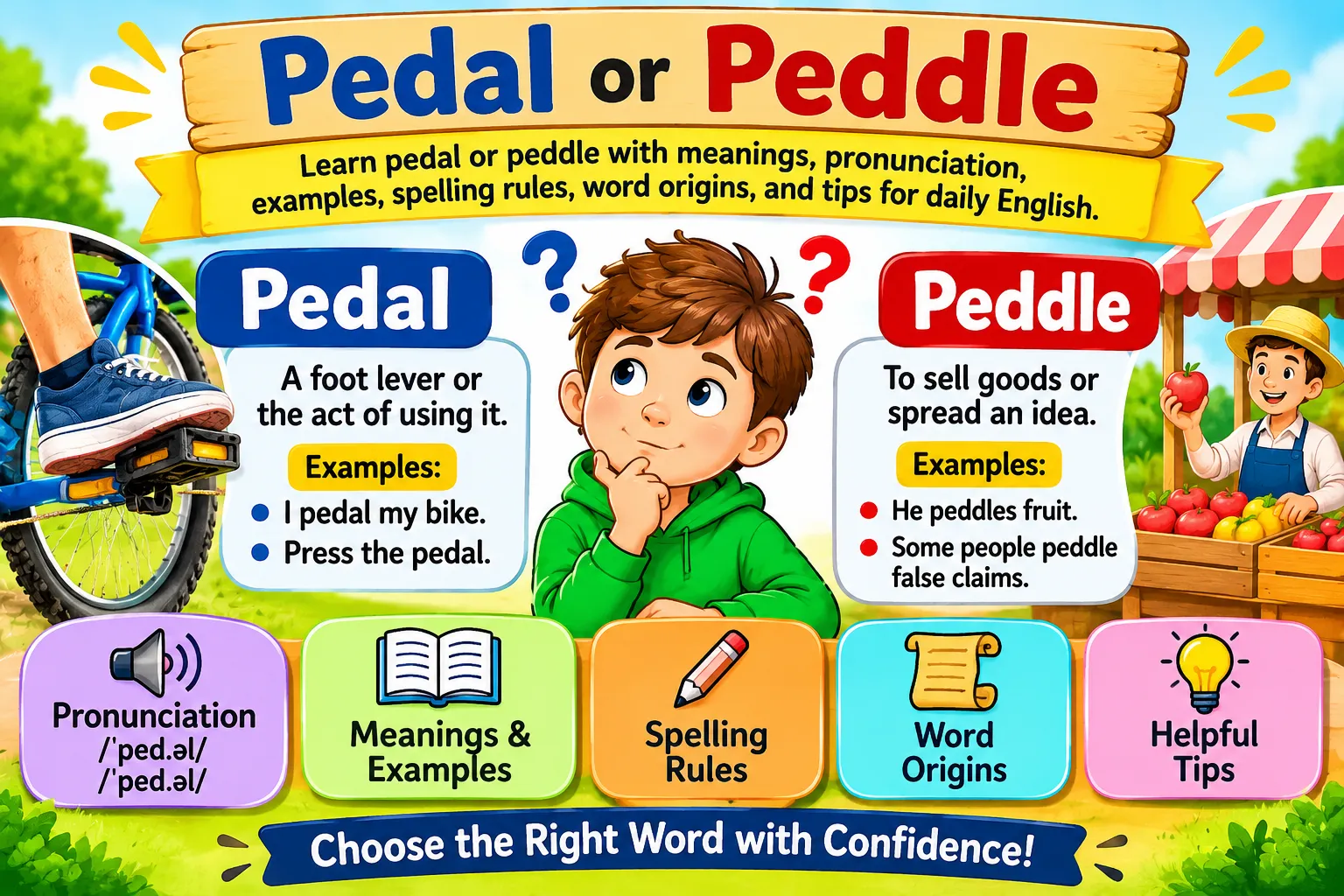
Pedal means a foot lever or the act of using it. Peddle means to sell goods or spread an idea.
Imagine riding your bike to school. You push the two foot levers to move forward. These levers are called pedals. When you push them, you pedal your bike.
Now imagine a person selling snacks from a small cart. That person may peddle snacks to people on the street. The words sound the same, but they have different meanings.
People often search for pedal or peddle because these words are easy to mix up. Both are verbs, and both can sound alike. But only one fits each meaning. Using the wrong word can change your sentence. This guide explains both words with simple rules and examples. You will learn their meanings, history, spelling, and daily use. You will also find easy ways to remember the difference.
Pronunciation of Pedal and Peddle
Both words usually have the same sound.
| Word | US Pronunciation | UK Pronunciation |
| Pedal | /ˈped.əl/ | /ˈped.əl/ |
| Peddle | /ˈped.əl/ | /ˈped.əl/ |
Both words sound like PED-uhl. The first part sounds like “bed” with a P.
Difference Between Pedal and Peddle
1. Main Meaning
Pedal means a foot lever or the act of using it. Peddle means to sell goods or spread something.
Examples:
- She pressed the brake pedal.
- He peddles fresh fruit at the market.
2. Part of Speech
Both words can work as verbs. But pedal can also be a noun.
Examples:
- The bike has two pedals.
- They peddle toys near the school.
3. Use in Cycling
Use pedal when you ride or move a bicycle by pushing its foot levers.
Examples:
- I pedal my bike every morning.
- She pedaled up the hill.
Do not use peddle for riding a bike.
4. Use in Selling
Use peddle when someone sells goods, often by going from place to place.
Examples:
- The man peddles fruit on the street.
- She peddled handmade bags at the fair.
5. Use in Machines
A pedal is a part you press with your foot. It can control a machine or vehicle.
Examples:
- Press the brake pedal slowly.
- My sewing machine has a foot pedal.
Peddle does not name a machine part.
6. Use in Music
A pedal is a foot lever on a piano or organ. A player presses it to change the sound.
Examples:
- The piano has three pedals.
- He pressed the soft pedal.
Peddle has no common meaning in this use.
7. Use with Ideas
Peddle can also mean to spread or promote an idea. It may suggest that the idea is false or harmful.
Examples:
- Some websites peddle false health claims.
- He peddles strange stories online.
Pedal does not mean to spread an idea.
8. Common Word Forms
The words change in different ways when used in the past or present.
| Form | Pedal | Peddle |
| Present | pedal | peddle |
| Past | pedaled or pedalled | peddled |
| -ing form | pedaling or pedalling | peddling |
| Person who does it | pedaler or pedaller | peddler |
Examples:
- We pedaled home after school.
- The seller peddled fresh eggs.
9. Tone and Feeling
Pedal is usually a neutral word. It simply describes a foot lever or an action.
Peddle can also be neutral when it means selling goods. But it can sound negative when it means spreading lies or false ideas.
Examples:
- The child pressed the pedal.
- The website peddles false news.
10. Easy Memory Rule
Think of the letter A in pedal as part of a bicycle or machine. Think of the double D in peddle as a word for a dealer who sells goods.
Examples:
- Use the pedal to move the bike.
- The seller will peddle fresh bread.
You May Also Like https://orchoice.com/chord-or-cord/
Nature and Behaviour of Pedal and Peddle
Pedal
Pedal is linked to feet and movement. It often names a part of a bike, car, piano, or machine. As a verb, it tells us that someone is using a foot lever.
You may pedal a bike to move forward. You may also press a brake pedal to slow a car.
Peddle
Peddle is linked to selling and spreading things. It often describes people who sell goods in small amounts. It can also describe people who try to spread ideas or claims.
Why People Get Confused About Pedal and Peddle
People mix up these words because they sound the same. Their spelling is also very close.
Both words have five letters. Both start with “ped.” The main change is in the middle. Pedal has one D, while peddle has two.
People also confuse them because both can be verbs. This makes it harder to choose the right one.
The best way to avoid mistakes is to think about the meaning. If the sentence is about a foot lever or riding a bike, use pedal. If it is about selling or spreading an idea, use peddle.
Pedal or Peddle: Comparison Table
| Feature | Pedal | Peddle |
| Main meaning | A foot lever or its use | To sell or spread something |
| Part of speech | Noun, verb, adjective | Verb |
| Main link | Feet and machines | Selling and ideas |
| Bicycle use | Yes | No |
| Car use | Yes | No |
| Piano use | Yes | No |
| Selling goods | No | Yes |
| Spreading claims | No | Yes |
| Past form | Pedaled or pedalled | Peddled |
| -ing form | Pedaling or pedalling | Peddling |
Main similarity: Both words can sound the same in speech.
Main difference: Their meanings and spellings are not the same.
The Origin of Pedal and Peddle
Origin of Pedal
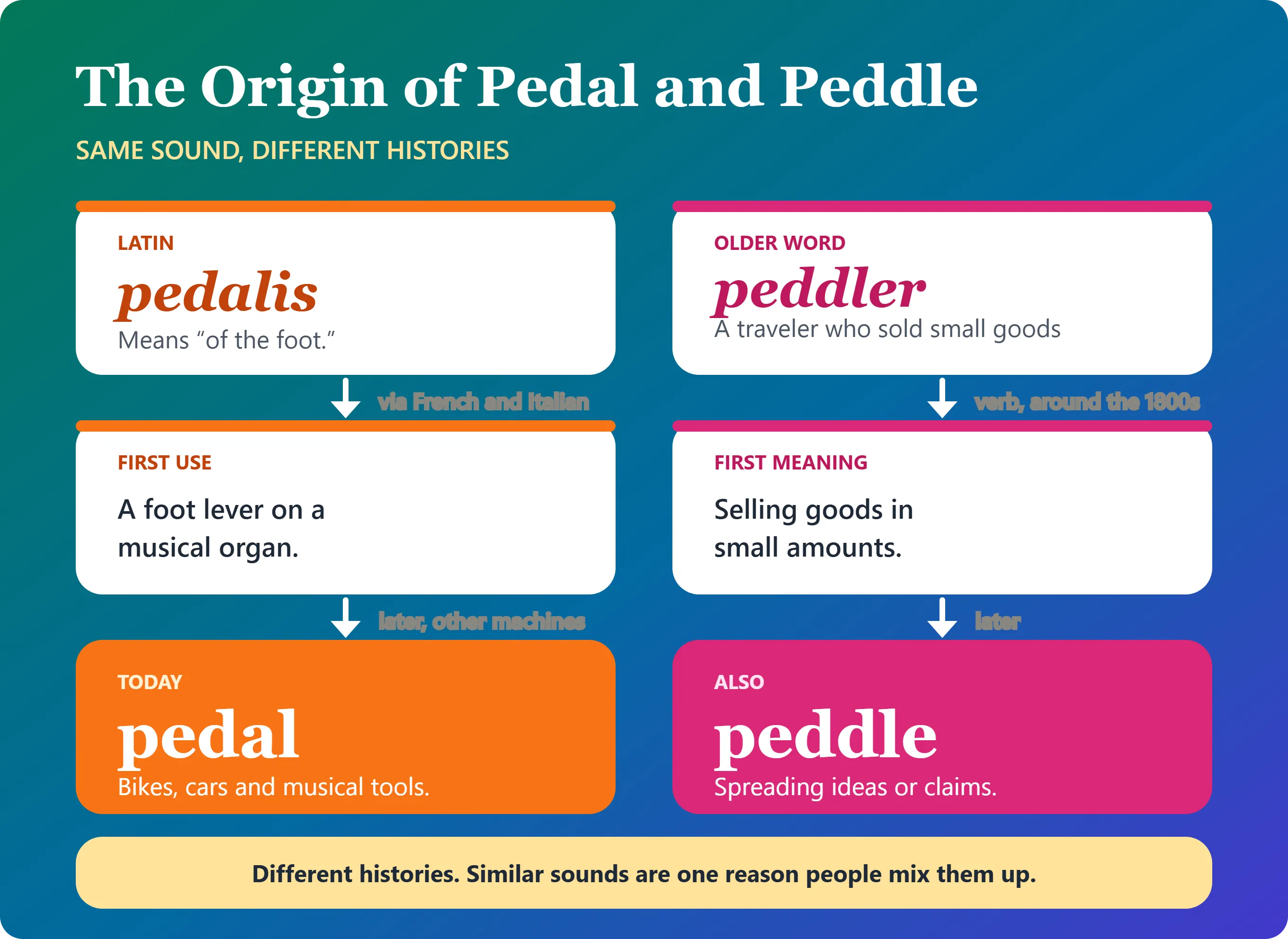
The word pedal comes from French and Italian words. These words came from the Latin word pedalis. It means “of the foot.”
The word first described a foot lever on a musical organ. Later, people used it for other machines. Today, it is common in words about bikes, cars, and musical tools.
Origin of Peddle
The word peddle came from the older word peddler. A peddler was a person who traveled from place to place selling small goods.
The verb peddle began to appear around the 1800s. It first meant selling goods in small amounts. Later, it also gained the meaning of spreading ideas or claims.
The two words have different histories. Their similar sounds are one reason people mix them up.
British vs American English
The meanings of pedal and peddle are the same in British and American English. The main spelling change appears in the past and -ing forms of pedal.
| Form | American English | British English |
| Present | pedal | pedal |
| Past | pedaled | pedalled |
| -ing form | pedaling | pedalling |
| Peddle, past | peddled | peddled |
| Peddle, -ing | peddling | peddling |
Examples:
American English:
- He pedaled his bike to work.
- She is pedaling up the road.
British English:
- He pedalled his bike to work.
- She is pedalling up the road.
Which One Should You Use?
Use pedal when you talk about a foot lever or riding a bike. Use peddle when you talk about selling goods or spreading an idea.
- For US readers: Use pedal and peddle with their normal meanings. Write pedaled and pedaling.
- For UK readers: Use the same main words. You may write pedalled and pedalling.
- For global readers: Keep the meaning clear. Use the right word for the action.
Common Mistakes
Here are some common errors and their correct forms.
| Wrong Sentence | Correct Sentence |
| I peddled my bike to school. | I pedaled my bike to school. |
| Press the peddle to stop the car. | Press the pedal to stop the car. |
| He pedals fruit at the market. | He peddles fruit at the market. |
| She is peddling her bicycle. | She is pedaling her bicycle. |
| The piano has three peddles. | The piano has three pedals. |
| They pedaled fake news online. | They peddled fake news online. |
Tip: Ask yourself what the person is doing. Are they using their foot, or are they selling something?
Everyday Usage Examples
Both words appear in daily life. You may see them in emails, news stories, social posts, and formal writing.
In Emails
- Please check the brake pedal before the trip.
- The shop will peddle its new products at the fair.
On Social Media
- I love to pedal my bike in the park.
- Some pages peddle false stories for clicks.
In News
- The driver pressed the brake pedal before the crash.
- The seller peddled goods outside the station.
In Formal Writing
- The machine uses a foot pedal to control its speed.
- The group was accused of peddling false claims.
Usage Trends
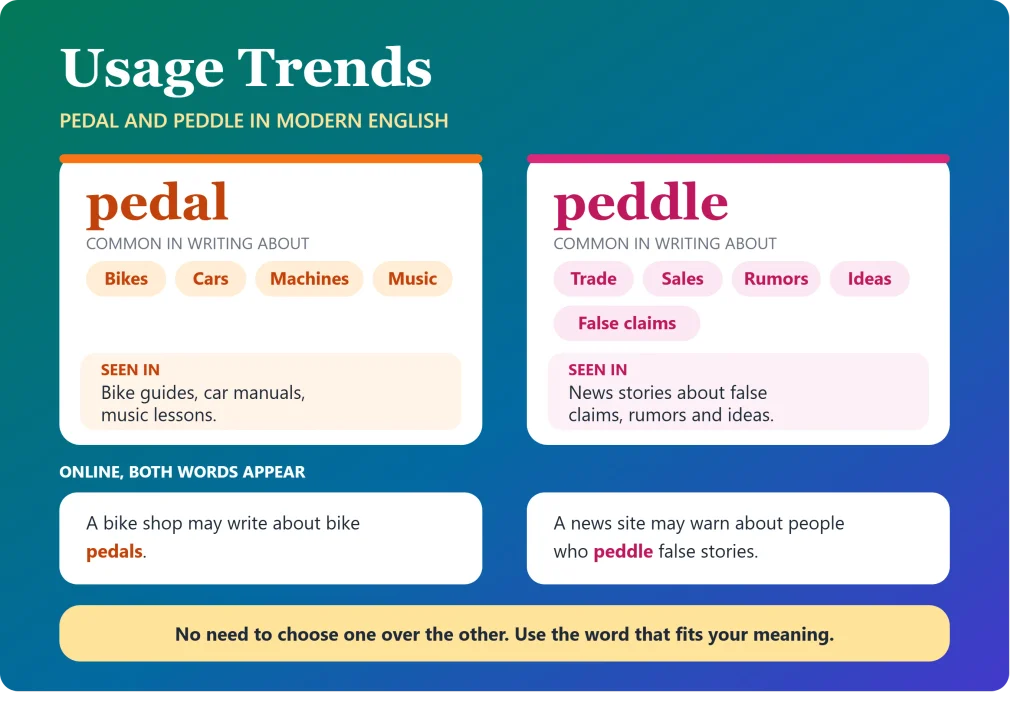
Both words are still used in modern English. Their uses are different.
Pedal is common in writing about bikes, cars, machines, and music. You may see it in bike guides, car manuals, and music lessons.
Peddle is common in writing about trade and sales. It also appears in news stories about false claims, rumors, and ideas.
Online writing uses both words. A bike shop may write about bike pedals. A news site may warn about people who peddle false stories.
There is no need to choose one word over the other. Use the word that fits your meaning.
Metaphors and Similes
A metaphor uses one thing to describe another. A simile compares two things using words such as “like” or “as.”
Pedal in Figurative Language
The word pedal can show speed, effort, or action.
- Pedal to the metal: This means to go very fast or work at full speed.
- She put the pedal to the metal to finish the job.
- He pedaled through the hard days like a strong rider.
Peddle in Figurative Language
The word peddle can mean spreading an idea or claim.
- He tried to peddle hope during a hard time.
- The website peddles rumors like a street seller.
- Some people peddle fear to control others.
Connotative Meaning
A word can carry a feeling as well as a meaning. This feeling is called its tone.
Pedal
| Tone | Meaning | Example |
| Positive | Effort, movement, and progress | She pedaled hard to reach her goal. |
| Negative | Too much effort or speed | He kept pedaling even when he felt tired. |
| Neutral | A foot lever or bike action | Press the pedal gently. |
Peddle
| Tone | Meaning | Example |
| Positive | Selling useful goods | Local farmers peddle fresh food. |
| Negative | Spreading lies or harmful ideas | The group peddles false claims. |
| Neutral | Selling goods | They peddle toys at the market. |
Idioms and Proverbs
Pedal to the Metal
This phrase means to move fast or work with full effort.
Example: We put the pedal to the metal to finish the project.
Take Your Foot Off the Gas Pedal
This phrase means to slow down or use less effort.
Example: You should take your foot off the gas pedal and rest.
Peddle Your Wares
This phrase means to sell the things you have.
Example: The sellers peddle their wares at the town market.
There is no common, well-known proverb that uses pedal or peddle as its main word.
Literature and Movies
The ideas behind these words appear in many stories and films.
Literature
Books about travel, trade, and daily life may show peddlers selling goods. Such stories can help readers picture how people sold items before large shops became common.
The word pedal also appears in writing about bicycles and music. It is often used in practical guides and stories about cycling.
Note: This article does not name a specific book or writer as a famous example of either word. A direct literary link should be checked before it is added.
Movies
Films about cycling may show people using bike pedals. A well-known example is The Bicycle Thief (1948), an Italian film directed by Vittorio De Sica. Its story follows a man whose bicycle is stolen.
The film shows how important a bicycle can be in daily life. It is not known as a film about the word peddle.
Why This Difference Matters
Using the right word helps people understand your message. A small spelling change can give a sentence a new meaning.
If you write “I peddled my bike,” readers may think you sold it. If you write “I pedaled my bike,” they know you rode it.
This difference matters in school, work, emails, and online posts. It also helps you write clear stories and reports.
Good spelling shows care for your reader. It can also help you avoid simple mistakes. Learn the meaning of each word, and you will find it easier to use them.
Usefulness in Daily Life
You may use pedal when riding a bike, driving a car, or playing the piano. It helps you talk about the foot levers used in these activities.
You may use peddle when talking about shop owners, street sellers, or online sales. You can also use it when someone spreads a claim or idea.
For example, a person may pedal a bike to work. A shop owner may peddle goods at a market. A website may peddle false news.
Knowing both words makes your speech and writing clearer.
Situational Preference
Use pedal when the topic is a bike, car, piano, or machine. It is also the right verb for moving a bicycle with your feet. Use peddle when someone sells goods, often from place to place. You can also use it for spreading claims, rumors, or ideas. At school work, choose the word that matches the action. In business writing, use peddle for selling. In travel or sports writing, use pedal for cycling. The country does not change these meanings. Only the spelling of some pedal forms changes in UK and US English.
Common Questions and Answers
1. What is the main difference between pedal and peddle?
Pedal means a foot lever or using one. Peddle means to sell goods or spread an idea.
2. Are pedal and peddle pronounced the same?
Yes. They usually sound the same in both US and UK English. Their meanings and spellings are different.
3. Is it pedal a bike or peddle a bike?
It is pedal a bike. You pedal by pushing the foot levers.
4. Is it peddle goods or pedal goods?
It is peddle goods. This means to sell goods, often by going from place to place.
5. What is the past tense of pedal?
In US English, it is usually pedaled. In UK English, pedalled is common. Both forms are correct.
6. What is the -ing form of peddle?
The -ing form is peddling. For example: “She is peddling fruit at the market.”
7. Can peddle mean to spread lies?
Yes. People use peddle to mean spreading false claims or ideas. For example: “The website peddles lies.”
Conclusion
The words pedal or peddle sound the same, but they have different meanings. Pedal is a foot lever on a bike, car, piano, or machine. It can also mean using that lever. Peddle means to sell goods or spread an idea. Remember this simple rule: you pedal a bike, but you peddle goods. You can also peddle stories, claims, or rumors. This small spelling tip can help you avoid common writing errors. Both words are useful in daily English. You may see pedal in bike guides and car books. You may see peddle in news stories and business writing. Learn their meanings, check the sentence, and choose the right spelling. Clear word choice makes your writing easier to read and understand.

I’m Samia Jamshaid, an English language specialist, SEO specialist, digital publisher, and researcher. I create clear, accurate, and well-researched content on English grammar, vocabulary, word meanings, and language comparisons, helping readers understand and use English with confidence.