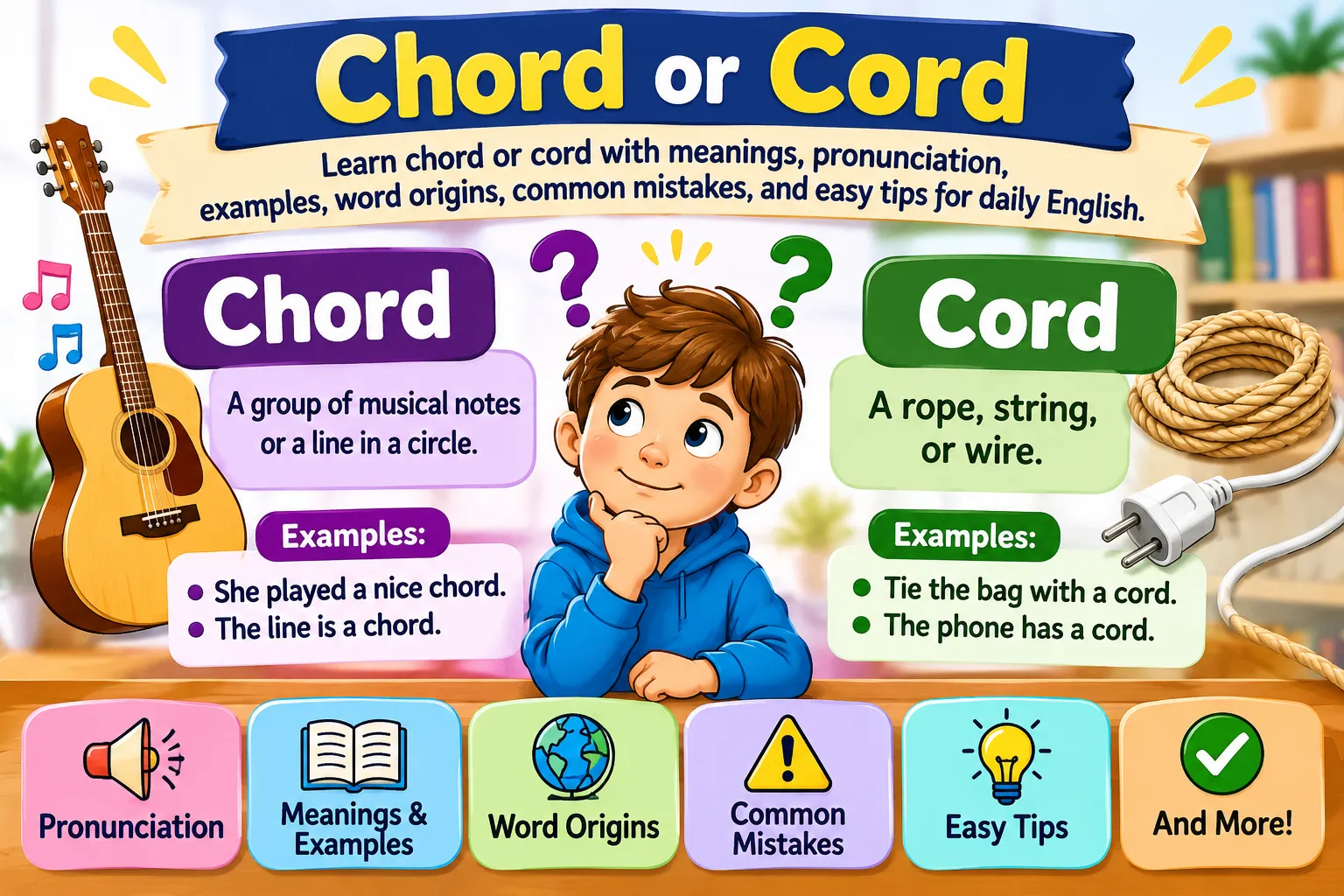
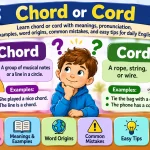
A chord is a group of musical notes. A cord is a thin rope, wire, or string.
The main difference is simple: chord is often linked to music and geometry, while cord refers to a long, thin material. Both words sound alike, so people often mix them up. The correct spelling depends on what you mean. This guide explains their meanings, uses, origins, and examples in easy English. It will also help you choose the right word in emails, schoolwork, and daily writing.
Pronunciation of Chord and Cord
Both words sound the same.
- Chord: US /kɔːrd/ | UK /kɔːd/
- Cord: US /kɔːrd/ | UK /kɔːd/
The ch in chord makes a hard k sound. It does not sound like the ch in chair.
Difference Between Chord and Cord
1. Main Meaning
Chord usually means a group of musical notes played together.
Cord means a long, thin rope, string, or wire.
Examples:
- She played a beautiful chord on the piano.
- He tied the box with a strong cord.
2. Use in Music
Chord is a common music word. It describes notes played at the same time.
Cord is not the correct word for a group of musical notes.
Examples:
- The guitar player changed the chord.
- I am learning three new chords.
3. Use for Ropes and Strings
Cord means a strong string or thin rope.
Chord does not usually mean a rope.
Examples:
- Tie the bag with a cord.
- The tent has a long safety cord.
4. Use in Mathematics
Chord has a special meaning in geometry. It is a straight line joining two points on a circle or curve.
Cord does not have this mathematical meaning.
Examples:
- The teacher drew a chord inside the circle.
- A chord connects two points on the curve.
5. Use in Electrical Items
Cord can mean an electrical cable. It carries power to a device.
Chord is not used for an electrical cable.
Examples:
- The phone charger cord is too short.
- Please unplug the power cord.
6. Use in the Human Body
Cord appears in names of body parts. These parts may look like ropes or strings.
Examples include the spinal cord and umbilical cord.
Examples:
- The spinal cord carries messages between the brain and body.
- The umbilical cord connects a baby to the placenta.
7. Use for Feelings
Chord appears in the phrase “strike a chord.” It means to cause a strong feeling or connection.
Cord does not have this common emotional meaning.
Examples:
- Her story struck a chord with the audience.
- His words touched a chord in my heart.
8. Use in Clothing
Cord can describe a type of thick, ribbed cloth. It is often used in trousers and jackets.
The word chord is not used for this fabric.
Examples:
- He bought a pair of cord trousers.
- Her cord jacket feels warm.
9. Use as a Verb
Chord can be used as a verb in music. It means to play or arrange notes as chords.
Cord can also be a verb. It can mean to bind or fasten something with a cord, though this use is less common.
Examples:
- She learned to chord a simple song on the guitar.
- The workers corded the package tightly.
10. Use in Everyday Writing
Use chord when you write about music, geometry, or emotional connection.
Utilize cord when you write about ropes, cables, or body parts.
Examples:
- The song begins with a soft chord.
- The lamp has a damaged cord.
You May Also Like https://orchoice.com/except-or-accept/
Nature and Behaviour of Chord and Cord
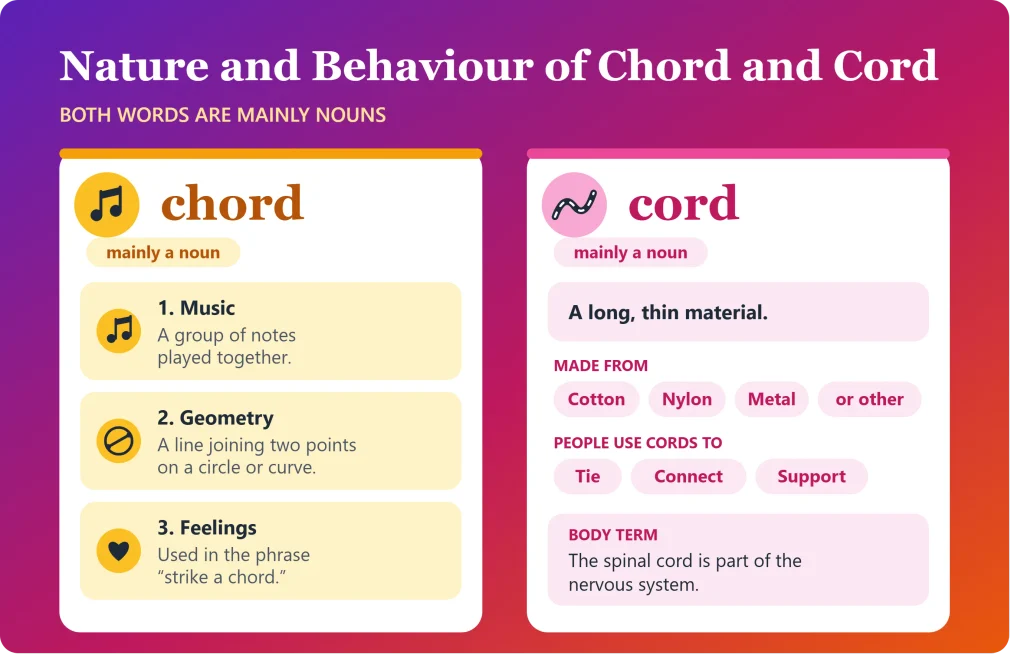
Nature and Behaviour of Chord
Chord is mainly a noun. It has several uses.
- Music: A group of notes played together.
- Geometry: A line joining two points on a circle or curve.
- Feelings: A word used in the phrase “strike a chord.”
Nature and Behaviour of Cord
Cord is mainly a noun. It describes a long, thin material. It can be made from cotton, nylon, metal, or other materials. People use cords to tie, connect, or support things. The word also appears in body terms. For example, the spinal cord is part of the nervous system.
Why People Get Confused About Chord and Cord
People confuse these words because they sound exactly alike. This makes them homophones.
They also differ by only one letter. The h in chord does not change its sound.
Both words have links to strings and musical instruments. In the past, musical strings were made from animal gut. This shared history adds to the confusion.
The easiest way to remember them is:
- Chord: Think of music and harmony.
- Cord: Think of a rope, cable, or string.
Comparison Table
| Feature | Chord | Cord |
| Main meaning | A group of musical notes | A rope, string, or wire |
| Pronunciation | /kɔːrd/ US; /kɔːd/ UK | /kɔːrd/ US; /kɔːd/ UK |
| Music | Common | Older or rare use |
| Geometry | A line joining two points on a curve | Not used in this sense |
| Electrical items | Incorrect for a cable | Power cord, charger cord |
| Body terms | Used in some older or less common forms | Standard in medical terms |
| Feelings | “Strike a chord” | Not used in this phrase |
| Clothing | Not used for this fabric | Cord fabric |
| Word type | Mainly a noun; also a verb | Mainly a noun; also a verb |
| Example | Play a chord | Tie with a cord |
Similarity: Both words sound the same. Both have a long history linked to strings.
The Origin of Chord and Cord
The two words have a shared history, but their meanings later became different.
Cord came into English around the 1300s. It came through Old French corde from Latin chorda. The Latin word came from Greek khordē. It referred to a string or gut used in musical instruments.
Chord has more than one history. The music word developed from accord, which meant agreement or harmony. Its spelling later changed under the influence of the Greek and Latin word for a string.
The mathematical meaning of chord also developed from the older word cord. It became a special term for a line joining two points on a curve.
The emotional meaning came later. A musical chord can affect the listener. This led to the phrase “strike a chord,” meaning to create a strong feeling.
British vs American English
There is no major spelling difference between British and American English.
Both use chord for music and geometry. Both use cord for ropes, wires, and standard body terms.
The main difference is pronunciation.
| Word | American English | British English |
| Chord | /kɔːrd/ | /kɔːd/ |
| Cord | /kɔːrd/ | /kɔːd/ |
The American sound usually includes a clear r. In many British accents, the r is not spoken at the end.
Examples:
- US: The power cord is on the floor.
- UK: The power cord is on the floor.
- US: He played a C major chord.
- UK: He played a C major chord.
Which One Should You Use?
Choose the word by its meaning.
- For music: Use chord. Example: She played a soft chord.
- For ropes and wires: Use cord. Example: The cord holds the tent in place.
- For geometry: Use chord. Example: Draw a chord across the circle.
- For body parts: Use cord in standard medical terms. Example: The spinal cord is important.
Common Mistakes
Here are common errors and their correct forms.
- Wrong: She played a beautiful cord.
Right: She played a beautiful chord. - Wrong: My phone charger chord is broken.
Right: My phone charger cord is broken. - Wrong: The doctor checked his spinal chord.
Right: The doctor checked his spinal cord. - Wrong: The song starts with a soft cord.
Right: The song starts with a soft chord. - Wrong: Tie the box with a strong chord.
Right: Tie the box with a strong cord. - Wrong: The power chord needs repair.
Right: The power cord needs repair. - Wrong: The line across the circle is a cord.
Right: The line across the circle is a chord. - Wrong: Her story touched a cord with me.
Right: Her story touched a chord with me. - Wrong: He bought cord trousers made from soft chord fabric.
Right: He bought cord trousers made from soft cord fabric. - Wrong: The guitar player changed the cord.
Right: The guitar player changed the chord.
Everyday Usage Examples
In Emails
- Please bring an extra power cord for the meeting.
- I enjoyed the music and the final chord of your song.
- Could you check the cord before using the machine?
On Social Media
- I finally learned my first guitar chord!
- This song really strikes a chord with me.
- Does anyone know where I can buy a strong phone cord?
In News
- The storm damaged power cords across the area.
- The singer ended the show with a powerful chord.
- A new study explains how the spinal cord sends signals.
In Formal Writing
- The report explains the role of the spinal cord.
- The musician used a minor chord in the final section.
- The device must be connected with a safe electrical cord.
Usage Trends
Both words are used around the world. Their use depends on the topic.
Chord is common in music lessons, song reviews, and music guides. It also appears in maths and geometry lessons. The phrase “strike a chord” is common in everyday writing.
Cord is common in home guides, product descriptions, health writing, and safety advice. People often search for terms such as power cord, phone cord, and spinal cord.
The words are not new. Both have been used in English for centuries. Their meanings are now clear, even though their sounds are the same.
Metaphors and Similes
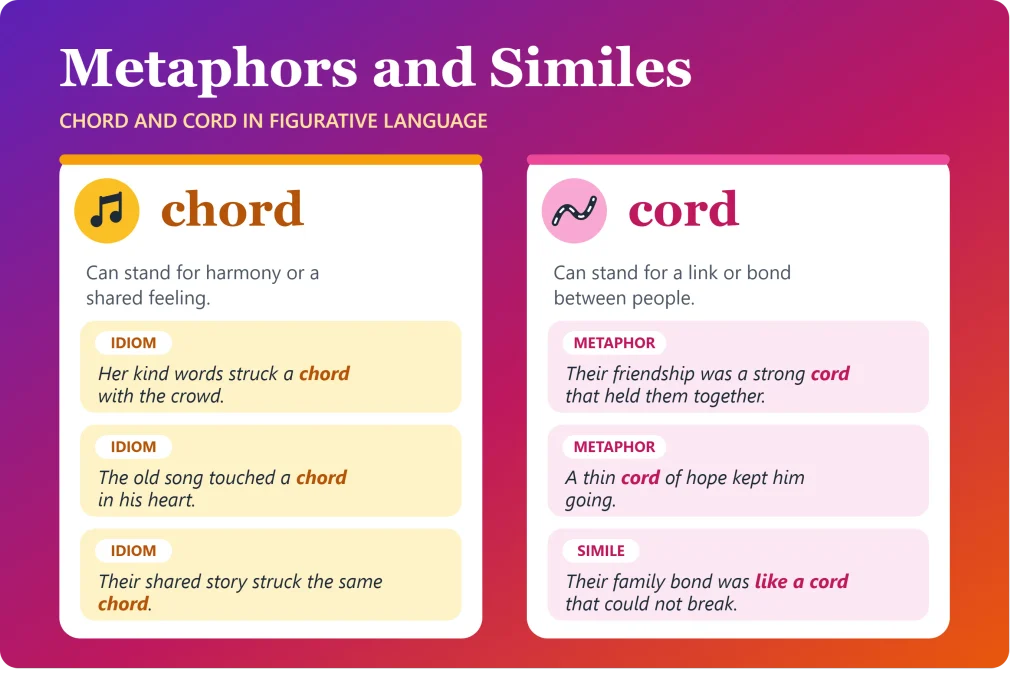
Both words can appear in figurative language.
Chord
A chord can stand for harmony or a shared feeling.
Examples:
- Her kind words struck a chord with the crowd.
- The old song touched a chord in his heart.
- Their shared story struck the same chord.
Cord
A cord can stand for a link or bond between people.
Examples:
- Their friendship was a strong cord that held them together.
- A thin cord of hope kept him going.
- Their family bond was like a cord that could not break.
Connotative Meaning
The words have different feelings and ideas linked to them.
Chord
Positive tone: It can suggest harmony, joy, and connection.
Example: The final chord filled the room with joy.
Negative tone: It can suggest sadness or tension in music.
Example: The dark chord made the scene feel sad.
Neutral tone: It can simply name a group of musical notes.
Example: The song begins with a C major chord.
Cord
Positive tone: It can suggest strength, support, and safety.
Example: The strong cord held the tent in place.
Negative tone: It can suggest a limit or something that holds a person back.
Example: Fear felt like a cord around his plans.
Neutral tone: It can simply name a rope, string, or cable.
Example: The lamp has a long cord.
Idioms and Proverbs
Strike a Chord
This means to create a strong feeling or connection.
Example: Her speech struck a chord with many parents.
Touch a Chord
This means to bring out a feeling in someone.
Example: The old song touched a chord in his heart.
Cord of Love
This is a creative phrase for a strong bond between people.
Example: The cord of love kept the family close.
Note: “Strike a chord” and “touch a chord” are common English idioms. “Cord of love” is a creative phrase, not a fixed idiom.
Literature and Movies
Music, sound, and strong feelings often appear in books and films. These themes can help explain the word chord.
Literature
Poetry often uses music to show love, sadness, and hope. William Shakespeare’s Sonnets (1609) explore love, time, and human feelings. These themes connect well with the figurative idea of a chord that touches the heart.
Books about nature and daily life may use the word cord for ropes, ties, and other objects. Such uses are common in adventure stories and historical fiction.
Movies
Music is central to many films. For example, The Piano (1993) is a drama directed by Jane Campion. It is a New Zealand, Australian, and French co-production. Its music helps express the feelings of its characters.
Adventure and survival films often show ropes and cables. These objects are examples of a cord in action.
These are examples of themes and settings. They are not claims that the titles contain a specific use of either word.
Why This Difference Matters
Using the right word makes your message clear.
If you write cord when you mean chord, readers may think you mean a rope or cable. If you write chord when you mean cord, readers may think you mean music.
This can cause problems in schoolwork, emails, reports, and online posts. It can also change the meaning of health or safety information.
For example, spinal cord is the standard medical spelling. Writing “spinal chord” is a common mistake.
Learning this difference helps English learners write with care. It also helps readers understand messages without guessing.
Usefulness in Daily Life
You may use these words more often than you think.
Use chord when talking about:
- Playing the guitar or piano.
- Learning music.
- Reading a song guide.
- Studying circles in geometry.
- Describing a strong emotional response.
Use cord when talking about:
- Phone and charger cables.
- Electrical items.
- Ropes and strings.
- Clothing made from cord fabric.
- Body parts such as the spinal cord.
Situational Preference
Use chord when you write about music, harmony, or a line in geometry. It is also the correct spelling in “strike a chord.” Use cord for a rope, string, cable, or standard body term. In school, choose the word that matches the subject. At work emails, use cord for electrical cables and chord for music. In medical writing, use terms such as spinal cord and vocal cords. These rules apply in both the US and the UK. The meaning, not the accent, decides the spelling.
Common Questions and Answers
1. What is the main difference between chord and cord?
A chord is usually a group of musical notes. A cord is a rope, string, or wire.
2. Are chord and cord pronounced the same way?
Yes. Both words sound the same in common US and UK English accents.
3. Is it guitar chord or guitar cord?
The correct term is guitar chord. It means a group of notes played together.
4. Is it power chord or power cord?
The correct term for an electrical cable is power cord. A power chord is a type of musical chord.
5. Is it spinal cord or spinal chord?
The standard medical term is spinal cord. It is part of the body’s nervous system.
6. What does “strike a chord” mean?
It means to cause a strong feeling or connection. For example, her story struck a chord with the audience.
7. How can I remember chord and cord?
Think of the h in chord as a reminder of harmony. Think of cord as a rope or cable.
Conclusion
The words chord or cord sound the same. But they have different meanings and spellings. A chord is usually a group of musical notes played together. It can also mean a line joining two points on a curve. The phrase “strike a chord” means to create a strong feeling. A cord is a long, thin rope, string, or wire. It can also mean an electrical cable. The word appears in body terms such as spinal cord and umbilical cord. The easiest way to remember the difference is to connect chord with music and harmony. Connect cord with ropes, strings, and cables. These rules work in both British and American English. Before you write either word, think about what you mean. A quick check can prevent a spelling mistake. With practice, you will choose the right word with ease.

I’m Samia Jamshaid, an English language specialist, SEO specialist, digital publisher, and researcher. I create clear, accurate, and well-researched content on English grammar, vocabulary, word meanings, and language comparisons, helping readers understand and use English with confidence.






1 thought on “Chord or Cord: Difference With Explanation and Examples”