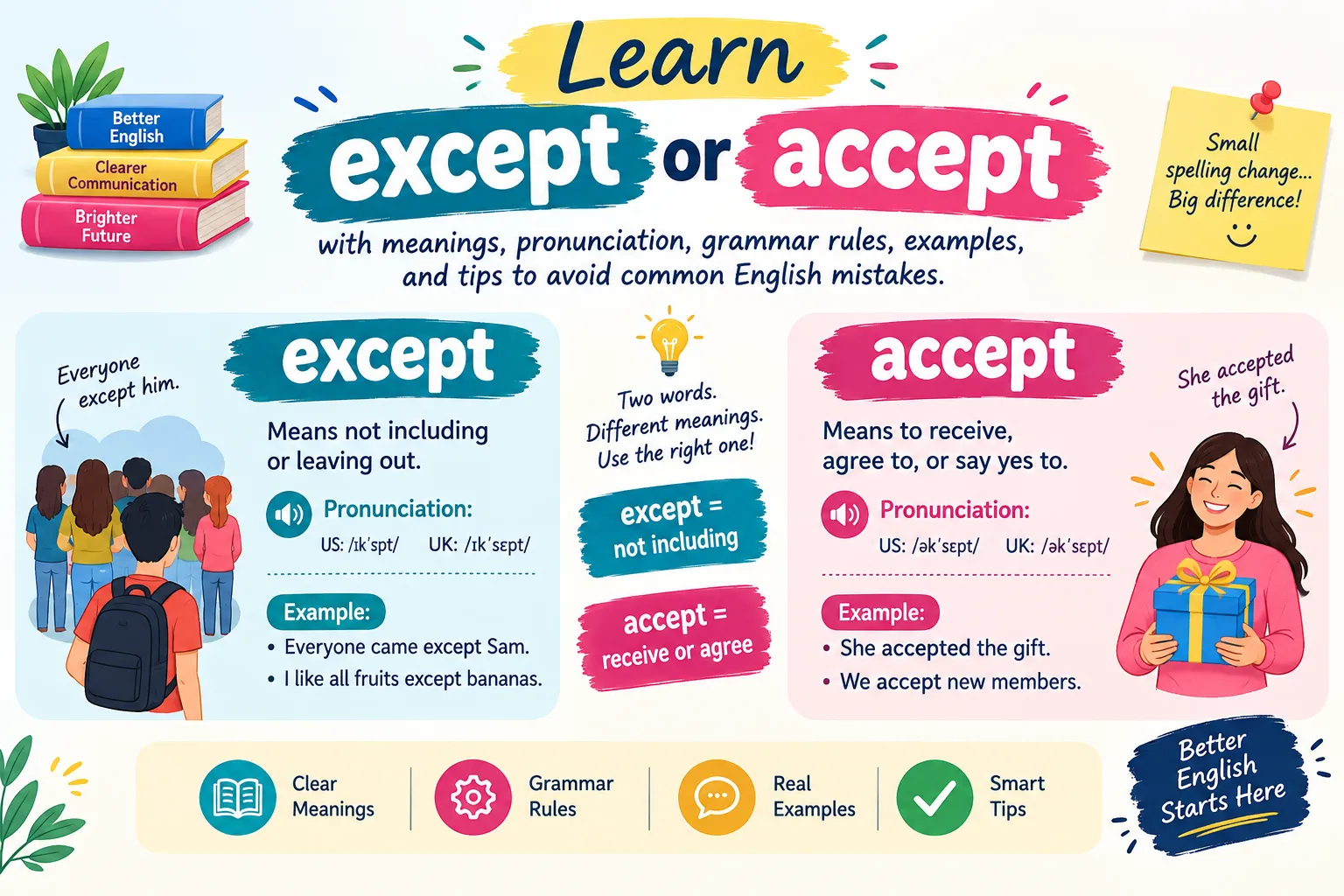
Except means “not including,” while accept means “to receive or agree to something.”
Imagine your teacher gives homework to every student except Ali. Ali does not need to do it. Now imagine Ali accepts an award at school. He receives the award with thanks.
The words except and accept look and sound quite similar. However, they have very different meanings. Except shows that someone or something is left out. Accept means to receive, agree to, or say yes to something.
People often search for “except or accept” because they mix up these two words. This can lead to mistakes in emails, schoolwork, and daily messages. The first letters may look different, but the sounds are close. Learning their meanings makes the choice much easier.
In this guide, you will learn their meanings, grammar rules, and pronunciation. You will also see simple examples, common mistakes, and daily uses. By the end, you will know when to use each word.
Pronunciation of Except and Accept
Both words have two syllables. Their stress falls on the second syllable.
| Word | US pronunciation | UK pronunciation | Easy sound guide |
| Except | /ɪkˈsɛpt/ | /ɪkˈsɛpt/ | ik-SEPT |
| Accept | /əkˈsɛpt/ | /əkˈsɛpt/ | uhk-SEPT |
The main sound difference is at the start. Except begins with a short “ih” sound. Accept begins with a soft “uh” sound.
Difference Between Except and Accept
1. Meaning
Except means not including someone or something. Accept means to receive or agree to something.
Examples with except:
- Everyone came except Sara.
- I like all fruits except papaya.
Examples with accept:
- I accept your gift.
- She will accept the offer.
2. Part of Speech
Except is often a preposition or conjunction. It can also be used as a verb. Accept is mainly a verb.
Examples with except:
- We work every day except Sunday.
- I would go, except I am busy.
Examples with accept:
- They accept new members.
- He accepted the job.
3. Main Purpose
Except shows what is left out. Accept shows that something is received or agreed to.
Examples with except:
- All rooms are open except Room 4.
- Everyone passed except Tom.
Examples with accept:
- Please accept my thanks.
- The school accepts new students.
4. Use in Positive Sentences
Except can name one person or thing that does not belong to a group. Accept can show a yes or a warm response.
Examples with except:
- All children played except Ben.
- I eat every vegetable except onions.
Examples with accept:
- I accept your kind words.
- She accepts help from her friends.
5. Use in Negative Sentences
Except can still show what is left out. Accept can appear in a negative sentence when someone refuses to receive or agree to something.
Examples with except:
- No one called except my brother.
- Nothing was ready except the food.
Examples with accept:
- He did not accept the payment.
- They cannot accept late work.
6. Use in Questions
Use except when asking about something that is not included. Utilize accept when asking if someone will receive or agree to something.
Examples with except:
- Is everyone here except Mark?
- Did you invite anyone except your friends?
Examples with accept:
- Will you accept this gift?
- Do they accept cash?
7. Common Word Partners
Except often follows words such as all, everyone, and everything. Accept often goes with words such as offer, gift, help, and apology.
Examples with except:
- Everyone except Jack is ready.
- I packed everything except my shoes.
Examples with accept:
- Please accept my apology.
- She accepted the job offer.
8. Past Tense
The past form of except is excepted. The past form of accept is accepted.
Examples with except:
- The rule excepted one small group.
- The old plan excepted no one.
Examples with accept:
- She accepted the prize yesterday.
- We accepted their invitation.
9. Use in Formal Writing
Except helps make limits clear. Accept helps explain a choice or agreement.
Examples with except:
- All staff must attend except those on leave.
- The price includes all fees except delivery.
Examples with accept:
- We accept applications until Friday.
- Please accept our sincere thanks.
10. Effect on the Sentence
Except removes something from a group. Accept describes an action by a person or group.
Examples with except:
- All shops are open except this one.
- Everyone agreed except Maya.
Examples with accept:
- The shop accepts card payments.
- Maya accepted the invitation.
More about https://orchoice.com/bearing-or-baring/
Nature and Behaviour of Except and Accept
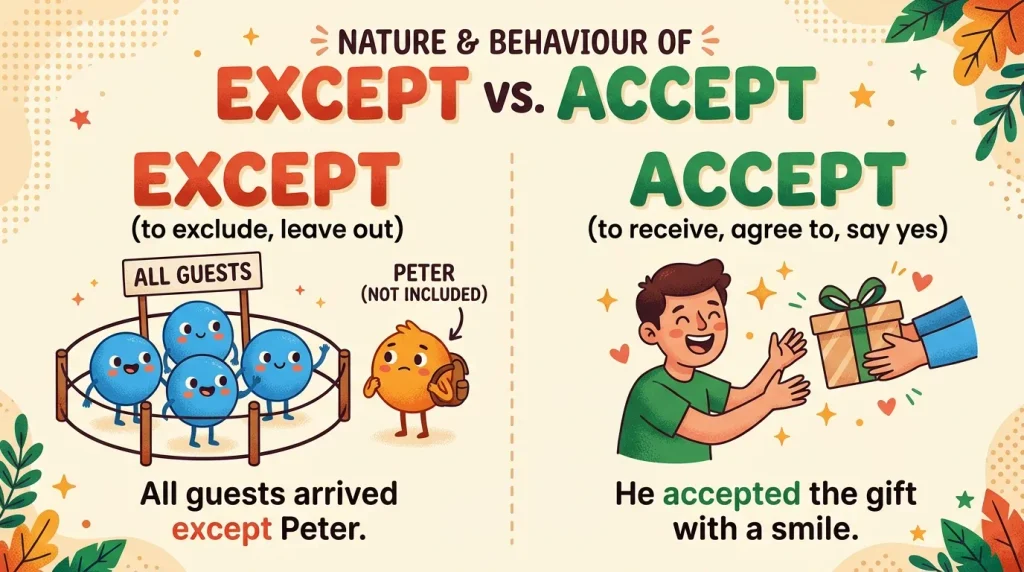
Nature of Except
Except points to a person or thing that is not included. It sets a limit in a group or list. It often follows words such as all, everyone, and everything.
Examples:
- I like every subject except maths.
- All guests arrived except Peter.
It can also join ideas in a sentence.
Example:
- I would help, except I have no time.
Nature of Accept
Accept describes an action. It means to receive, agree to, or say yes to something. It often needs an object, such as a gift, offer, or idea.
Examples:
- She accepts every challenge.
- He accepted the gift with a smile.
The word can also mean to believe something as true.
Example:
- We must accept the facts.
Why People Get Confused About Except and Accept
People confuse these words because they look alike. They also share many of the same sounds. Both have two syllables and end with “cept.”
Their meanings are the main problem. One word leaves something out. The other means to receive or agree.
A small spelling change can also change the whole sentence.
- Correct: Everyone came except Sam.
- Correct: Everyone accepted the invitation.
A useful way to remember them is simple. Except means “not included.” Accept means “say yes.”
Comparison Table
| Feature | Except | Accept |
| Main meaning | Not including | Receive or agree |
| Main use | Shows something left out | Shows receiving or agreement |
| Part of speech | Preposition, conjunction, or verb | Mainly a verb |
| Present form | Except | Accept |
| Past form | Excepted | Accepted |
| Common partners | All, everyone, everything | Gift, offer, help, apology |
| Sentence role | Shows a limit or exception | Shows an action |
| Example | Everyone came except Mia. | Mia accepted the gift. |
| Opposite idea | Including | Reject or refuse |
| Main question | Who or what is left out? | Who receives or agrees? |
The Origin of Except and Accept
Both words have roots in Latin. They entered English through French forms.
Origin of Except
Except comes from the Latin word excipere. It means to take out or leave out. The word passed through Old French before entering English.
It has long been used to show that something is not included. Today, it is common in speech and writing.
Origin of Accept
Accept comes from the Latin word accipere. It means to receive or take. It also passed through Old French before becoming part of English.
Its meaning grew to include agreeing to an offer or idea. Today, people use it in daily talk, work, school, and formal writing.
The words share a Latin link, but their meanings are different.
British vs American English
There is no major spelling difference between British and American English for these words. Both forms use except and accept.
| Use | British English | American English |
| Spelling | Except / Accept | Except / Accept |
| Meaning of except | Not including | Not including |
| Meaning of accept | Receive or agree | Receive or agree |
| Past form | Excepted / Accepted | Excepted / Accepted |
| Main grammar rules | Same | Same |
Examples in British English:
- Everyone is invited except John.
- I accept your offer.
Examples in American English:
- All stores are open except this one.
- We accept credit cards.
The pronunciation may vary slightly between speakers. However, the spelling and basic rules stay the same.
Which One Should You Use?
Use except when you want to leave someone or something out. Use accept when you mean to receive or agree.
For US English, UK English, and global writing, the rule is the same. Do not change the spelling based on the country.
Ask yourself one simple question:
- Are you leaving something out? Use except.
- Are you saying yes or receiving something? Use accept.
Examples:
- Everyone except Ali is ready.
- Ali will accept the prize.
This quick test works in schoolwork, emails, and daily messages.
Common Mistakes
| Wrong sentence | Correct sentence | Reason |
| I except your gift. | I accept your gift. | You receive the gift. |
| Everyone came accept Tom. | Everyone came except Tom. | Tom was left out. |
| She will except the offer. | She will accept the offer. | She agrees to the offer. |
| All passed accept Ben. | All passed except Ben. | Ben did not pass. |
| Please except my apology. | Please accept my apology. | You are asking someone to receive it. |
| We accept Sunday. | We work every day except Sunday. | Sunday is not included. |
Easy Tips to Avoid Mistakes
- Remember that except means “not including.”
- Remember that accept means “receive or agree.”
- Read the whole sentence before choosing.
- Check the first vowel sound.
- Replace except with “not including” to test it.
- Replace accept with “receive” or “agree” to test it.
Everyday Usage Examples
These words appear in emails, social media, news, and formal writing.
In Emails
- Everyone is invited except the new staff members.
- Please accept my apology for the delay.
- We accept your request and will reply soon.
On Social Media
- I love all music except heavy metal.
- I accept myself just as I am.
- Everyone joined the game except me.
In News
- All roads are open except the main road.
- The company accepted the new deal.
- The school will accept new students next month.
In Formal Writing
- All workers must attend except those on leave.
- The office does not accept forms after Friday.
- Please accept this letter as proof of payment.
Usage Trends
Both words are common in modern English. People use except to explain rules, limits, and lists. They use accept to talk about gifts, offers, choices, and ideas.
You may see except in school rules, news reports, and work notes. You may see accept in emails, job offers, and daily talks.
Neither word is limited to British or American English. Both are used around the world.
Their use depends on the meaning of the sentence. The best choice is the one that says what you mean.
Metaphors and Similes
Except and accept are not usually used as figures of speech by themselves. Still, they can help express ideas in a more colorful way.
Except in Figurative Language
- Like a gate with one person left outside: Everyone joined the team except Ben.
- Like a list with one name crossed out: I enjoy every sport except boxing.
Accept in Figurative Language
- Like opening a door to a new chance: She accepted the chance to study abroad.
- Like opening your hands to a gift: He accepted help from his friends.
Connotative Meaning
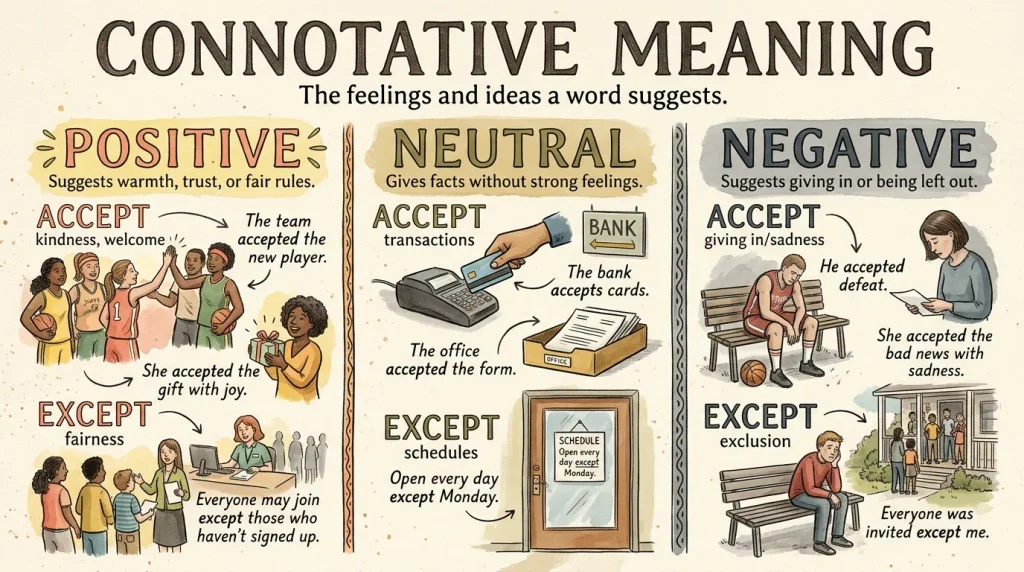
A word’s connotation is the feeling or idea it may suggest. The meaning can change with the sentence.
Positive Meaning
Accept can suggest kindness, trust, and welcome.
Examples:
- The team accepted the new player.
- She accepted the gift with joy.
Except can help make a clear and fair rule.
Examples:
- Everyone may join except those who have not signed up.
- All students can enter except those without tickets.
Negative Meaning
Accept can suggest giving in to something unwanted.
Examples:
- He accepted defeat after the match.
- She accepted the bad news with sadness.
Except can sound unfair when someone is left out.
Examples:
- Everyone was invited except me.
- All children played except the new student.
Neutral Meaning
Both words can give facts without showing strong feelings.
Examples with except:
- The shop is open every day except Monday.
- All rooms are clean except Room 2.
Examples with accept:
- The bank accepts cash and cards.
- The office accepted the form.
Idioms and Proverbs
There are no widely used fixed idioms built only around except. However, both words appear in common phrases and sayings.
Common Phrases with Except
Except for: This means “not including” or “apart from.”
- Except for one mistake, the work was perfect.
- The road was clear except for a small block.
With the exception of: This is a more formal way to say “except.”
- With the exception of Mia, everyone arrived.
- The store is open daily, with the exception of Sunday.
Common Phrases with Accept
Accept responsibility: To agree that something is your duty or fault.
- He accepted responsibility for the mistake.
- We must accept responsibility for our choices.
An offer: To agree to something offered.
- She accepted the job offer.
- They accepted our offer to help.
Accept the fact: To agree that something is true.
- We must accept the fact that plans can change.
- He accepted the fact that he was wrong.
Literature and Movies
The ideas behind these words appear in many books and films. Stories often show people making choices, receiving help, or being left out.
Literature
Pride and Prejudice — Jane Austen, 1813
This classic novel explores love, marriage, class, and social choices. Its characters must decide whether to accept or refuse offers and beliefs. The word except can also be used to show limits or differences in descriptions.
Genre: Classic romance and social novel.
Movies
The Pursuit of Happyness — 2006, United States
This film follows a father who faces hard times while seeking a better life. Its story touches on accepting help, facing facts, and making choices.
Genre: Biographical drama.
These are examples of themes linked to the words. They are not claims about exact lines from the books or films.
Why This Difference Matters
Using the right word helps people understand your message. A wrong word can change the meaning of a whole sentence.
Imagine writing, “I except your offer.” The reader may stop and wonder what you mean. The correct sentence is, “I accept your offer.”
The difference also matters in school, work, and public writing. Clear words help avoid confusion. They make emails, forms, reports, and messages easier to read.
For English learners, this pair is a useful lesson. It shows how a small spelling change can create a new meaning. Learning the rule helps you write with care and speak with confidence.
Usefulness in Daily Life
You can use except and accept in many daily situations.
- At school: Everyone passed except one student.
- At work: We accept new job applications.
- At home: I eat all fruits except grapes.
- With friends: I accept your invitation.
- While shopping: This store accepts card payments.
- In travel: All flights are on time except one.
Situational Preference
Choose except when you talk about a group with one person or thing left out. It works well in lists, rules, and daily plans. Choose accept when you receive a gift, agree to an offer, or welcome an idea. It is useful in emails, job talks, and friendly messages. In US and UK English, both words follow the same rules. The choice does not depend on the country. It depends on your meaning. If you can replace the word with “not including,” use except. If you can replace it with “receive” or “agree,” use accept.
Possible Asked Question
1. What is the main difference between except and accept?
Except means “not including.” Accept means “to receive or agree to something.”
2. How can I remember except and accept?
Remember this simple rule: except leaves something out, while accept means yes or receive.
3. Are except and accept pronounced the same?
No. They sound close, but their first vowel sounds differ. Both words stress the second syllable.
4. Is except a verb or a preposition?
Except is often a preposition or conjunction. It can also be used as a verb in some sentences.
5. Is accept a verb?
Yes. Accept is mainly a verb. It means to receive, agree to, or say yes to something.
6. Do British and American English use the same spelling?
Yes. Both use except and accept. Their meanings and basic grammar rules are also the same.
7. What is the past tense of accept?
The past tense is accepted. For example: “She accepted the gift yesterday.”
Conclusion
The difference between except or accept is simple once you know their meanings. Except means “not including.” Accept means “to receive or agree.” Use except when one person or thing is left out of a group. Use accept when someone receives a gift, agrees to an offer, or welcomes an idea. Both words are used in British and American English. Their spelling rules do not change by country. Remember the easy test: replace except with “not including.” Replace accept with “receive” or “agree.” This small tip can help you choose the right word. It can also make your emails, schoolwork, and daily messages clear. Keep practicing with simple examples. Soon, you will use both words with ease.

I’m Samia Jamshaid, an English language specialist, SEO specialist, digital publisher, and researcher. I create clear, accurate, and well-researched content on English grammar, vocabulary, word meanings, and language comparisons, helping readers understand and use English with confidence.







1 thought on “Except or Accept: Meaning, Pronunciation, and Examples”