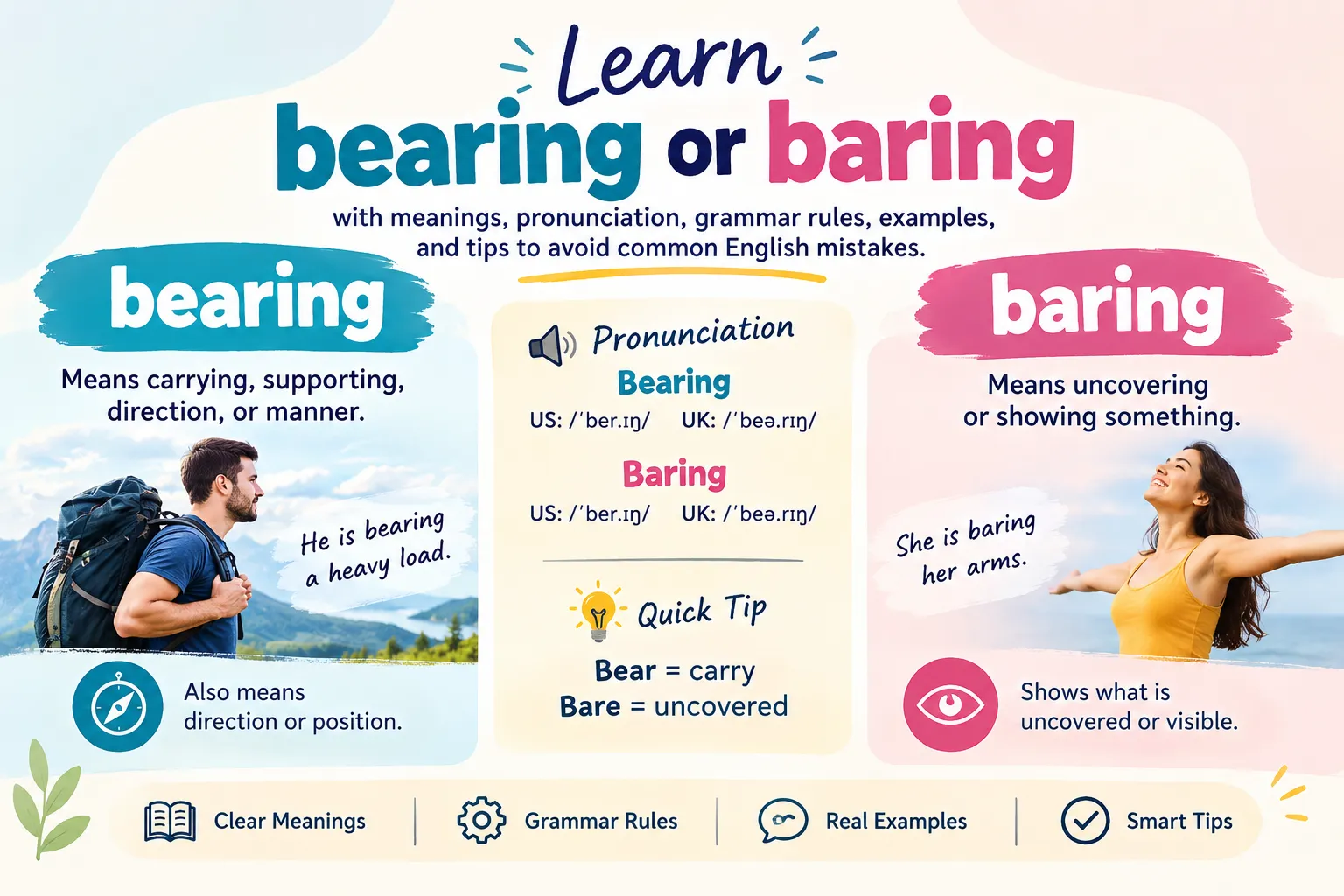
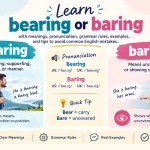
Bearing means carrying, direction, or manner, while baring means uncovering or showing something.
Imagine you are reading a story about a brave man. He is bearing a heavy load on his back. Later, he is baring his arms to show his strength. Both words look and sound alike. But they have different meanings.
Bearing comes from the verb bear. It can mean carrying, having, or showing a certain manner. It can also mean direction or position. Baring comes from the verb bare. It means making something uncovered or visible.
People often search for “bearing or baring” because these words are easy to mix up. Their sounds are almost the same. Their spellings differ by only one letter. Yet using the wrong word can change the whole meaning of a sentence.
This guide explains both words in simple English. You will learn their meanings, grammar rules, and common uses. You will also see examples that help you choose the right word with confidence.
Pronunciation of Bearing and Baring
In most common US and UK accents, bearing and baring sound the same. Both have two syllables. The stress falls on the first syllable.
| Word | US pronunciation | UK pronunciation | Easy sound guide |
| Bearing | /ˈber.ɪŋ/ | /ˈbeə.rɪŋ/ | BAIR-ing |
| Baring | /ˈber.ɪŋ/ | /ˈbeə.rɪŋ/ | BAIR-ing |
The exact vowel sound can vary by accent. In many US accents, the first part sounds like “bear.” In many UK accents, it has a slightly different vowel sound.
Difference Between Bearing and Baring
1. Meaning
Bearing can mean carrying, direction, or manner. Baring means making something uncovered or visible.
Examples with bearing:
- She is bearing a heavy bag.
- His calm bearing impressed the guests.
Examples with baring:
- He is baring his arms.
- The storm is baring the tree roots.
2. Word Origin
Bearing comes from the verb bear. It can describe carrying or supporting something. Baring comes from the verb bare. It means making something uncovered.
Examples with bearing:
- The bridge is bearing the weight of the cars.
- She is bearing the cost of the trip.
Examples with baring:
- The boy is baring his feet.
- The wind is baring the rocks.
3. Main Purpose
Bearing often describes what someone carries or how someone acts. Baring describes the act of removing a cover.
Examples with bearing:
- The worker is bearing a box.
- Her proud bearing caught our attention.
Examples with baring:
- She is baring her shoulders.
- The flood is baring the riverbed.
4. Use in Grammar
Bearing is the -ing form of bear. Baring is the -ing form of bare.
Examples with bearing:
- He is bearing the pain.
- They are bearing the cost.
Examples with baring:
- She is baring her teeth.
- He is baring his chest.
5. Use in Daily Life
Bearing appears when people talk about duties, weight, direction, or behavior. Baring appears when something is uncovered.
Examples with bearing:
- The road has a northward bearing.
- Her friendly bearing made us feel welcome.
Examples with baring:
- The child is baring his knees.
- The artist is baring the wood beneath the paint.
6. Use in Formal Writing
Bearing is common in reports, instructions, and formal talks. Baring can appear in reports about land, clothing, or actions.
Examples with bearing:
- The new rule has no bearing on this case.
- The ship changed its bearing.
Examples with baring:
- The work involves baring the metal frame.
- The process includes baring the soil.
7. Use in Emotional Situations
Bearing can describe handling pain or stress. Baring can describe showing feelings or secrets.
Examples with bearing:
- She is bearing the loss with courage.
- He is bearing a great deal of stress.
Examples with baring:
- He is baring his feelings.
- She is baring her fears to a friend.
8. Use in Science and Nature
Bearing can describe support, weight, or direction. Baring can describe something becoming exposed.
Examples with bearing:
- The beam is bearing the roof’s weight.
- The compass shows our bearing.
Examples with baring:
- The river is baring the stones.
- Erosion is baring the roots.
9. Past and Future Forms
The past form of bear is bore. Its past participle is borne or born, depending on the meaning. The past form of bare is bared.
Examples with bearing:
- She bore the burden with care.
- He has borne the cost for years.
Examples with baring:
- He bared his arms.
- The wind bared the tree roots.
10. Effect on the Sentence
Bearing can show support, direction, or influence. Baring shows that something is being uncovered.
Examples with bearing:
- This choice has no bearing on my plans.
- The tower is bearing the weight of the roof.
Examples with baring:
- She is baring her hands.
- The workers are baring the old stone wall.
For further information https://orchoice.com/who-or-whom/
Nature and Behaviour of Bearing and Baring
Nature of Bearing
Bearing is the -ing form of bear. Its meaning depends on the sentence.
It can mean carrying or supporting something.
- He is bearing a heavy load.
- The wall is bearing the roof’s weight.
Bearing can also mean a person’s way of acting or standing.
- Her calm bearing helped the team.
- He has a proud and kind bearing.
It may also mean direction or connection.
- The ship changed its bearing.
- This rule has no bearing on our plan.
Nature of Baring
Baring is the -ing form of bare. It means making something uncovered or easy to see.
It often describes removing clothes or a cover.
- He is baring his arms.
- She is baring her feet.
Baring can also describe showing feelings or facts.
- He is baring his fears.
- The report is baring the truth.
Why People Get Confused About Bearing and Baring
People mix up these words because they sound alike. Both have two syllables. Both end with the same sound.
Their spellings are also close. The main difference is the extra letter e in bearing.
Their base words help explain the difference:
- Bear → Bearing: carrying or supporting.
- Bare → Baring: uncovering or showing.
For example:
- The worker is bearing a box. He is carrying it.
- The worker is baring his arms. He is uncovering them.
Comparison Table
| Feature | Bearing | Baring |
| Base word | Bear | Bare |
| Main meaning | Carrying, support, direction, or manner | Uncovering or showing |
| Part of speech | -ing verb form; also a noun | -ing verb form |
| Main action | Carrying or supporting | Removing a cover |
| Common phrase | Bearing a burden | Baring one’s arms |
| Formal use | Has no bearing on the case | Baring the surface |
| Emotional use | Bearing pain | Baring feelings |
| Example | She is bearing the cost. | She is baring her feet. |
| Past form | Bore; borne or born | Bared |
| Pronunciation | Usually /ˈber.ɪŋ/ | Usually /ˈber.ɪŋ/ |
The Origin of Bearing and Baring
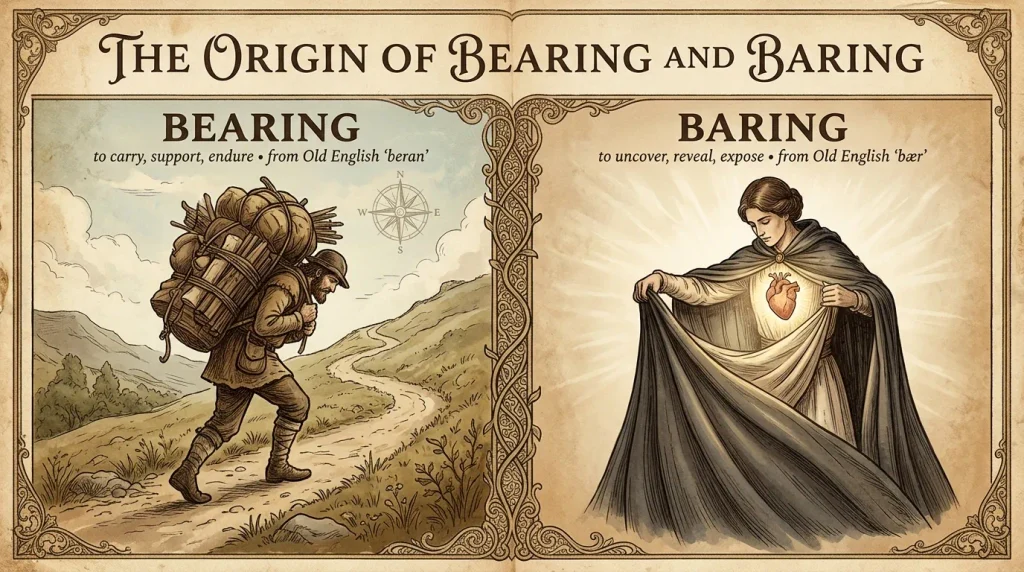
Origin of Bearing
Bearing comes from the Old English verb beran. It meant to carry, bring, or support. The word later developed many uses.
Today, bearing can describe carrying a load. It can also describe direction, behavior, or a link between things.
For example:
- She is bearing the cost.
- This fact has no bearing on the case.
Origin of Baring
Baring comes from the Old English word bær. It meant uncovered or open. The verb bare later came to mean making something uncovered.
Today, baring can describe showing skin, a surface, or hidden feelings.
For example:
- He is baring his chest.
- She is baring her thoughts.
British vs American English
British and American English use the same spellings for bearing and baring. Their meanings and grammar rules are also the same.
| Feature | British English | American English |
| Spelling | Bearing / Baring | Bearing / Baring |
| Meaning of bearing | Carrying, direction, or manner | Carrying, direction, or manner |
| Meaning of baring | Uncovering or showing | Uncovering or showing |
| Grammar | Same basic rules | Same basic rules |
| Pronunciation | May vary by accent | May vary by accent |
Examples in British English:
- The ship is changing its bearing.
- He is baring his arms.
Examples in American English:
- The rule has no bearing on the case.
- She is baring her feet.
Which One Should You Use?
Use bearing when you mean carrying, supporting, direction, or manner. Use baring when you mean uncovering or showing something.
This rule is the same in US and UK English. It also applies to global English.
Ask yourself what action you want to describe:
- Is someone carrying or supporting something? Use bearing.
- Is someone uncovering or showing something? Use baring.
- Are you talking about direction or influence? Use bearing.
Examples:
- He is bearing the weight of the box.
- He is baring his arms.
Common Mistakes
| Wrong sentence | Correct sentence | Reason |
| She is baring the cost. | She is bearing the cost. | She is paying or carrying the cost. |
| He is bearing his arms. | He is baring his arms. | He is uncovering his arms. |
| This has no baring on the case. | This has no bearing on the case. | The phrase means it has no connection. |
| The wall is baring the roof. | The wall is bearing the roof. | The wall supports the roof. |
| She is bearing her feelings. | She is baring her feelings. | She is showing her feelings. |
| He is baring a heavy load. | He is bearing a heavy load. | He is carrying the load. |
Easy Tips to Avoid Mistakes
- Remember bear = carry.
- Remember bare = uncovered.
- Use bearing for weight, direction, or influence.
- Use baring for showing or uncovering.
- Read the full sentence before choosing.
- Check the base word if you are unsure.
Everyday Usage Examples
Both words appear in daily talks, emails, reports, and news stories.
In Emails
- The new rule has no bearing on your request.
- We are bearing the cost of the repair.
- The report is baring the facts about the issue.
On Social Media
- She is bearing a lot of stress this week.
- He is baring his feelings in his post.
- This choice has no bearing on my life.
In News
- The bridge is bearing more weight than before.
- The storm is baring the roots of old trees.
- The new report may have a bearing on the case.
In Formal Writing
- The team is bearing the cost of the work.
- The study has no bearing on the final result.
- The process includes baring the metal surface.
Usage Trends
Both words remain useful in modern English. They appear in different types of writing.
Bearing has several common uses. People use it to talk about weight, duty, direction, and influence. The phrase “has no bearing on” is common in formal writing.
Baring is more specific. It often describes uncovering skin, land, or a surface. It can also describe showing feelings or facts.
You may see bearing in news, reports, and daily talk. You may see baring in stories, reports, and descriptions.
The words are not different by country. Their correct use depends on the meaning.
Metaphors and Similes
A metaphor compares one idea to another without using “like” or “as.” A simile makes a comparison using words such as “like” or “as.”
Bearing in Figurative Language
Bearing can describe carrying a duty or handling a hard time.
- Bearing a burden: She is bearing the burden of family duties.
- Bearing the weight of the world: He feels like he is bearing the weight of the world.
- Having a bearing on life: Good choices can have a bearing on your future.
Baring in Figurative Language
Baring can describe showing feelings or hidden facts.
- Baring one’s soul: She is baring her soul in her letter.
- Baring the truth: The report is baring the truth about the problem.
- Baring one’s heart: He is baring his heart to his friend.
Connotative Meaning
Connotation means the feeling or idea linked to a word. The feeling can change with the sentence.
Positive Meaning
Bearing can suggest strength, care, and courage.
Examples:
- She is bearing her duties with care.
- His kind bearing made everyone feel welcome.
Baring can suggest honesty and openness.
Examples:
- He is baring his heart to his friend.
- She is baring the facts to help others.
Negative Meaning
Bearing can suggest pain, stress, or a heavy duty.
Examples:
- He is bearing a great deal of pain.
- She is bearing the cost of the mistake.
Baring can suggest exposure or a loss of privacy.
Examples:
- He felt uneasy about baring his secrets.
- The storm is baring the roots of the trees.
Neutral Meaning
Both words can describe facts without strong feelings.
Examples with bearing:
- The ship changed its bearing.
- This detail has no bearing on the plan.
Examples with baring:
- The worker is baring the metal frame.
- The wind is baring the soil.
Idioms and Proverbs
Both words appear in common English phrases. Some are used in a figurative way.
Phrases with Bearing
Have a bearing on: To affect or relate to something.
- The new rule has a bearing on our work.
- Your choice may have a bearing on the result.
Bear the burden: To carry a duty or problem.
- She must bear the burden of the mistake.
- The team bears the burden of the extra work.
Bear in mind: To remember or think about something.
- Bear in mind that the shop closes early.
- Please bear in mind that plans can change.
Phrases with Baring
Baring one’s soul: Showing deep thoughts or feelings.
- He was baring his soul in the letter.
- She felt safe while baring her soul to her friend.
Baring one’s teeth: Showing teeth, often as a sign of anger or warning.
- The dog was baring its teeth.
- The angry animal stood still, baring its teeth.
Literature and Movies
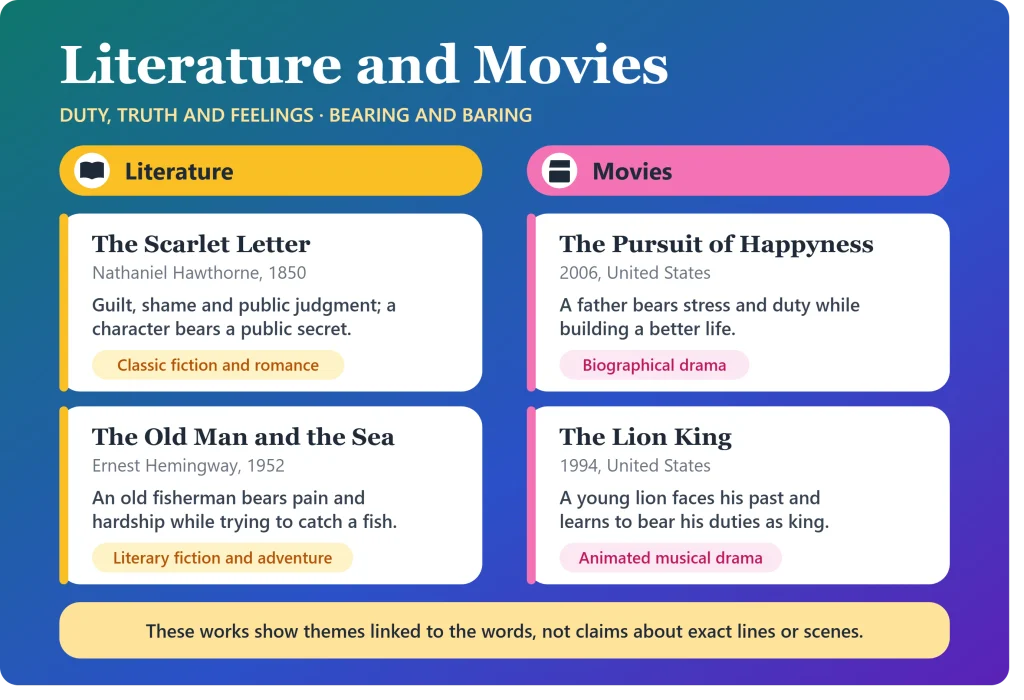
Writers and filmmakers often explore ideas such as duty, truth, and personal feelings. These ideas connect with the meanings of bearing and baring.
Literature
The Scarlet Letter — Nathaniel Hawthorne, 1850
This classic novel explores guilt, shame, and public judgment. Its main character must bear the weight of a public secret. The story also deals with hidden feelings and truth.
Genre: Classic fiction and romance.
The Old Man and the Sea — Ernest Hemingway, 1952
This short novel follows an old fisherman’s struggle at sea. He bears pain and hardship while trying to catch a large fish.
Genre: Literary fiction and adventure.
Movies
The Pursuit of Happyness — 2006, United States
This film follows a father facing many hard times. He bears stress and duty while trying to build a better life.
Genre: Biographical drama.
The Lion King — 1994, United States
This animated film follows a young lion who must face his past. He learns to bear his duties as a future king.
Genre: Animated musical drama.
These works show themes linked to the words. They are not claims about exact lines or scenes.
Why This Difference Matters
Using the right word helps readers understand your message. A wrong word can make a sentence confusing.
For example, “She is bearing her arms” means she is carrying or supporting them. “She is baring her arms” means she is uncovering them. One letter changes the meaning.
The difference also matters in schoolwork, emails, reports, and daily talks. Clear spelling helps people trust what they read. It also makes your writing easier to follow.
For English learners, these words offer a useful lesson. They show why you should check both spelling and meaning. Learning the base words can help you remember the rule.
Use bearing when you mean carrying, support, direction, or influence. Use baring when you mean uncovering or showing. This simple rule will help you write with care.
Usefulness in Daily Life
You may use these words in many daily situations.
- At work: The manager is bearing the cost of the repair.
- At home: The wall is bearing the weight of the shelf.
- In travel: The boat changed its bearing.
- With friends: She is baring her feelings in a message.
- In nature: The storm is baring the tree roots.
- In school: This fact has no bearing on the answer.
Situational Preference
Choose bearing when you talk about weight, duty, direction, or influence. It is common in work reports, news, and daily speech. Choose baring when something is uncovered or shown. It works well in stories and descriptions. In US and UK English, both words use the same spelling rules. Their sounds may be very close. So, do not depend only on pronunciation. Think about the meaning first. If the sentence means carrying or support, choose bearing. If it means uncovering or showing, choose baring.
Common Questions and Answers
1. What is the main difference between bearing and baring?
Bearing means carrying, supporting, direction, or manner. Baring means uncovering or showing something.
2. How can I remember bearing and baring?
Remember that bear means to carry. Bare means uncovered. This makes the difference easier to recall.
3. Are bearing and baring pronounced the same?
In many US and UK accents, they sound the same. Both have two syllables and stress the first syllable.
4. Is bearing a verb or a noun?
Bearing can be a verb form or a noun. It can mean carrying, direction, or manner.
5. Is baring a verb?
Yes. Baring is the -ing form of bare. It means making something uncovered or visible.
6. Do British and American English use the same spelling?
Yes. Both use bearing and baring. Their basic meanings and grammar rules are the same.
7. What is the past tense of bear and bare?
The past tense of bear is bore. Its past participle is borne or born, depending on the meaning. The past tense of bare is bared.
Conclusion
The difference between bearing or baring is easy to learn. Bearing comes from bear. It can mean carrying, supporting, direction, or manner. Baring comes from bare. It means uncovering or showing something. The two words often sound alike. So, spelling and meaning are the best clues. Use bearing when someone carries a load or handles a duty. It also works when you talk about direction or influence. Use baring when someone uncovers skin, shows feelings, or reveals a surface. British and American English follow the same rules. Keep the base words in mind when you write. Bear means carry, while bare means uncovered. With a little practice, you can choose the right word. This will make your emails, schoolwork, and daily messages clear and easy to read.

I’m Samia Jamshaid, an English language specialist, SEO specialist, digital publisher, and researcher. I create clear, accurate, and well-researched content on English grammar, vocabulary, word meanings, and language comparisons, helping readers understand and use English with confidence.






1 thought on “Bearing or Baring: Difference, Pronunciation, and Examples”