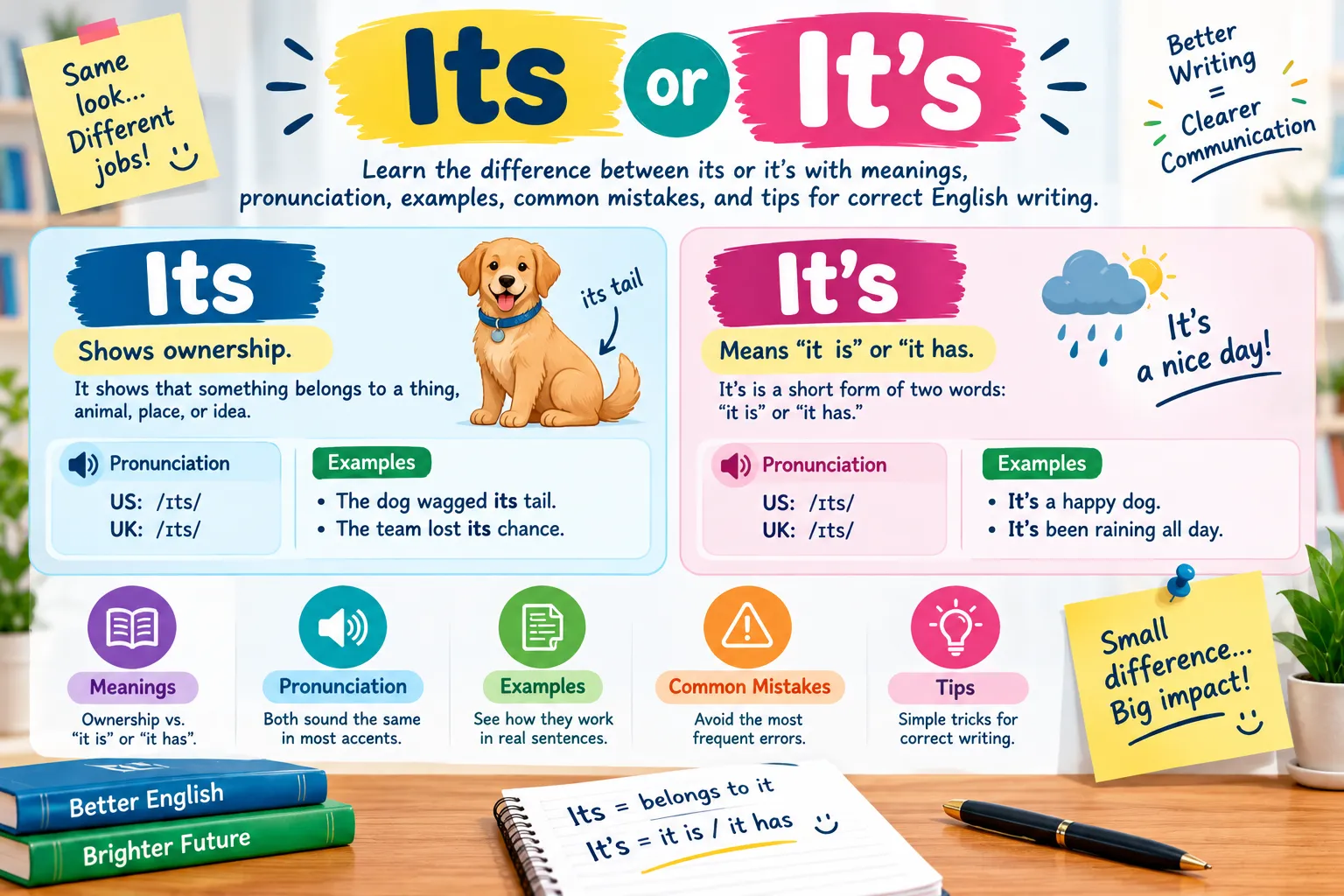
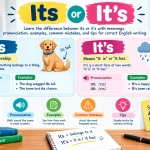
Use its to show that something belongs to it. Use it’s as a short form of “it is” or “it has.”
Imagine you are writing about your pet cat. You want to say that the cat has a long tail. You write, “The cat wagged its tail.” Here, its shows that the tail belongs to the cat.
Now, imagine you want to say that the cat is sleepy. You write, “It’s sleepy.” Here, it’s means “it is.”
The words its or it’s often confuse students and English learners. They look almost the same. They also sound the same in most accents. But they have different meanings and uses.
Its is a possessive word. It shows who or what owns something. It’s is a contraction. A contraction joins two words into one shorter word.
Knowing the difference helps you write better emails, schoolwork, messages, and reports. It also helps you avoid common grammar mistakes. The good news is that one simple test can help you choose the right word every time.
Pronunciation
Both words usually sound the same in American and British English.
- Its
- US: /ɪts/
- UK: /ɪts/
- It’s
- US: /ɪts/
- UK: /ɪts/
Both words sound like “its.” The apostrophe in it’s does not change the sound.
Difference Between Its and It’s
1. Possession vs. contraction
Its shows that something belongs to an animal, object, place, or thing. It’s is short for “it is” or “it has.”
Examples:
- The dog hurt its paw.
- It’s a friendly dog.
2. Showing ownership
Use its when you talk about something that belongs to something else.
Examples:
- The bird cleaned its wings.
- The school changed its rules.
3. Meaning “it is”
Use it’s when you can replace it with “it is.”
Examples:
- It’s cold outside.
- It’s a sunny day.
4. Meaning “it has”
Use it’s when it means “it has” in a sentence.
Examples:
- It’s been a long day.
- It’s already started.
5. Using an apostrophe
Its has no apostrophe when it shows ownership. It’s needs an apostrophe because it joins two words.
Examples:
- The tree lost its leaves.
- It’s losing its leaves.
6. Talking about animals
Use its to show that something belongs to an animal. Use it’s when you mean “it is” or “it has.”
Examples:
- The rabbit moved its ears.
- It’s hiding under the chair.
7. Talking about objects
Use its for an object’s parts or features. Use Second word for a statement about the object.
Examples:
- The phone lost its charge.
- It’s out of power.
8. Talking about time and weather
Use it’s to describe time, weather, or a situation when it means “it is.”
Examples:
- It’s late.
- It’s raining now.
9. Using the replacement test
Try replacing it’s with “it is” or “it has.” If the sentence still makes sense, it’s may be correct. If not, use its when showing ownership.
Examples:
- It’s easy to learn. (“It is easy to learn.”)
- The toy lost its wheel. (“The toy lost it is wheel” does not make sense.)
10. Using both words together
You can use its and it’s in the same sentence because they have different jobs.
Examples:
- It’s a dog, and its name is Max.
- It’s a tree, and its leaves are green.
More about https://orchoice.com/affect-or-effect/
Nature and Behaviour
Its
Its is a possessive word. It tells us that something belongs to or is linked to a thing, animal, place, or idea.
It works much like “his” or “her,” but we often use it for things and animals.
Examples:
- The baby bird opened its beak.
- The car needs its tires checked.
Its does not take an apostrophe when it shows possession.
It’s
It’s is a contraction. It joins “it is” or “it has” into one word.
Examples:
- It’s a good book. (“It is a good book.”)
- It’s been raining all day. (“It has been raining all day.”)
Why People Get Confused
People often mix up these words because they look almost the same. The only visible difference is the apostrophe.
Many English possessive words use an apostrophe. For example, “the girl’s bag” shows that the bag belongs to the girl. But its is different. It already shows possession without an apostrophe.
It’s causes confusion because the apostrophe has a different job. It joins “it” and “is” or “it” and “has.”
The two words also sound the same in most accents. This means you cannot always hear which word is correct.
A simple test can help:
- If you mean “it is” or “it has,” use it’s.
- If you mean something belongs to it, use its.
Comparison Table
| Feature | Its | It’s |
| Meaning | Belonging to it | It is or it has |
| Word type | Possessive word | Contraction |
| Apostrophe | No | Yes |
| Shows ownership | Yes | No |
| Can mean “it is” | No | Yes |
| Can mean “it has” | No | Yes |
| Example | The cat licked its paw. | It’s hungry. |
| Example with both | The car lost its mirror. | It’s a new car. |
| Memory tip | No apostrophe for ownership | Apostrophe for missing letters |
| Common mistake | Writing “it’s tail” | Writing “its raining” |
The Origin of Its and It’s
The words have a long history in English.
Its became common as a possessive form of “it.” Earlier English often used other forms to show possession. Over time, its became the usual form.
Second word developed as a short form of “it is” and later also came to stand for “it has.” The apostrophe shows that letters have been left out.
The apostrophe is a mark used in English writing. It can show missing letters in contractions. It can also show ownership in many nouns, such as “the boy’s hat.”
But possessive its is an exception. It does not use an apostrophe. This is why its and second word are easy to mix up.
You do not need to learn their full history to use them well. Just remember what each word means.
British vs. American English
There is no spelling difference between British and American English for these words. Both use its and second word in the same way.
| Situation | American English | British English |
| Showing ownership | The dog wagged its tail. | The dog wagged its tail. |
| Meaning “it is” | It’s a nice day. | It’s a lovely day. |
| Meaning “it has” | It’s been a busy week. | It’s been a busy week. |
| Talking about an object | The phone lost its signal. | The phone lost its signal. |
Which One Should You Use?
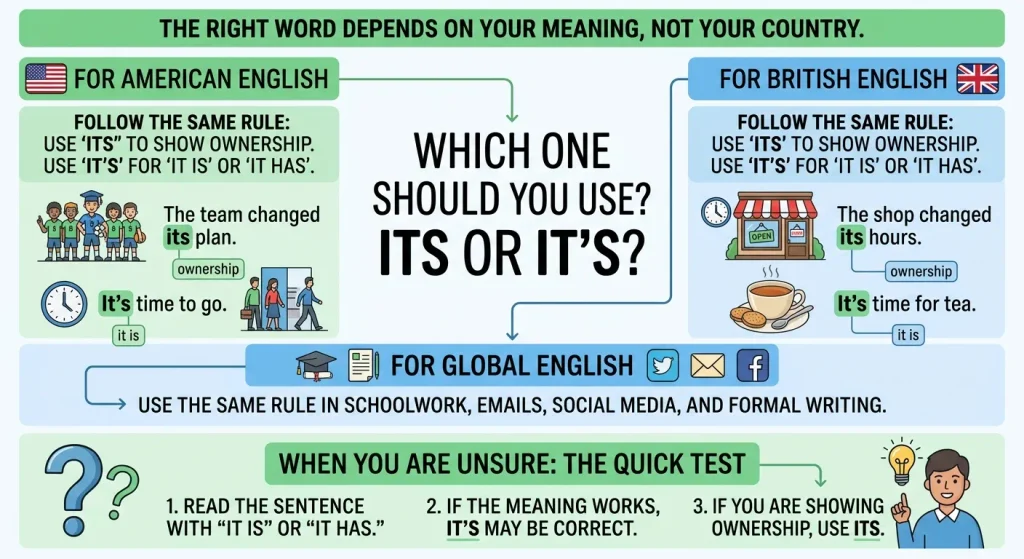
The right word depends on your meaning, not your country.
For American English
Use its to show ownership. Use second word for “it is” or “it has.”
- The team changed its plan.
- It’s time to go.
For British English
Follow the same rule.
- The shop changed its hours.
- It’s time for tea.
For global English
Use the same rule in schoolwork, emails, social media, and formal writing.
When you are unsure, read the sentence with “it is” or “it has.” If the meaning works, second word may be correct. If you are showing ownership, use its.
Common Mistakes
Here are some common errors and their corrections.
| Incorrect | Correct |
| The cat licked it’s paw. | The cat licked its paw. |
| Its raining outside. | It’s raining outside. |
| The phone lost it’s signal. | The phone lost its signal. |
| Its a nice day. | It’s a nice day. |
| The dog wagged it’s tail. | The dog wagged its tail. |
| Its been a long day. | It’s been a long day. |
| The tree lost it’s leaves. | The tree lost its leaves. |
| I think its ready. | I think it’s ready. |
How to avoid these mistakes
- Ask if you mean “it is” or “it has.”
- If yes, use second word.
- If you mean something belongs to it, use its.
- Do not add an apostrophe to its when showing ownership.
- Check your sentence before sending it.
Everyday Usage Examples
In emails
- The company changed its meeting time.
- It’s important to send the report today.
On social media
- My phone lost its charge again.
- It’s finally the weekend!
In news
- The city changed its safety rules.
- It’s a major change for local schools.
In formal writing
- The report lists its main findings.
- It’s clear that the plan needs more work.
At schoolwork
- The plant needs its roots to stay healthy.
- It’s easy to see the difference.
These examples show how both words work in daily writing.
Usage Trends
Its and second word are both common in modern English. People use them in books, emails, schoolwork, websites, and online posts.
The main problem is not how often people use them. It is choosing the correct form. Since both words sound alike, spelling mistakes can happen even when a person knows the rule.
Some people leave out the apostrophe when they mean it’s. Others add one when they mean its. These mistakes are common in quick messages and social media posts.
The same grammar rule applies across English-speaking countries. Readers expect its to show ownership and second word to mean “it is” or “it has.”
Metaphors and Similes
A metaphor says one thing is another. A simile compares things using words such as “like” or “as.”
Its and second word do not have special figurative meanings on their own. But they can appear in sentences that use metaphors and similes.
Metaphor examples
- The city opened its heart to new visitors.
- It’s a sea of lights at night.
Simile examples
- The flower spread its petals like a fan.
- It’s as bright as the morning sun.
Connotative Meaning
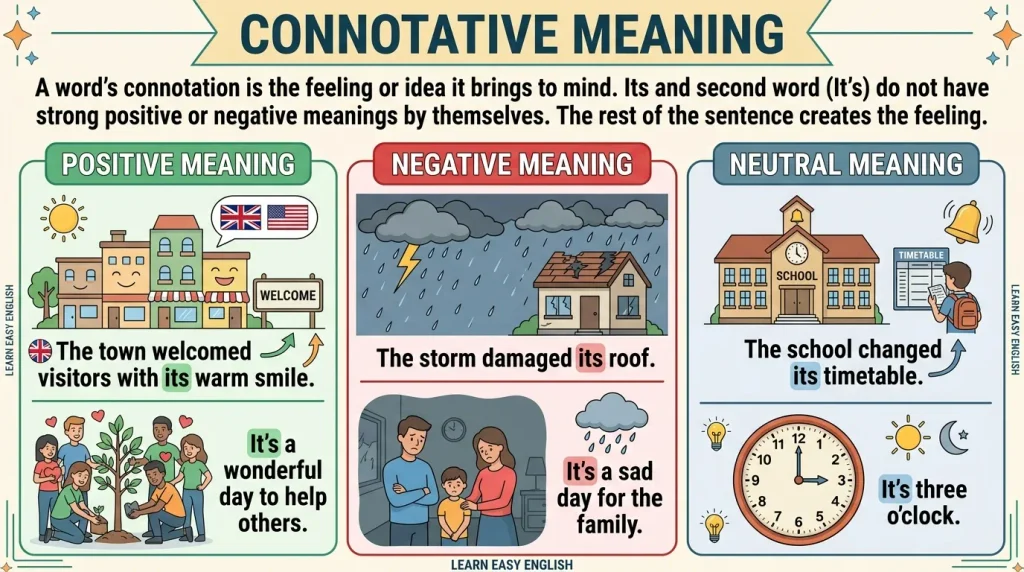
A word’s connotation is the feeling or idea it brings to mind. Its and second word do not have strong positive or negative meanings by themselves. The rest of the sentence creates the feeling.
Positive meaning
- The town welcomed visitors with its warm smile.
- It’s a wonderful day to help others.
Negative meaning
- The storm damaged its roof.
- It’s a sad day for the family.
Neutral meaning
- The school changed its timetable.
- It’s three o’clock.
Idioms and Proverbs
There are no common idioms or proverbs built around the grammar difference between its and it’s. However, both forms can appear in phrases that people use every day.
It’s up to you
This means that you can make the choice.
Example: It’s up to you to choose the book.
It’s no use
This means that something will not help.
Example: It’s no use waiting if the shop is closed.
In its own way
This means that something happens or works in a special manner.
Example: The old house is beautiful in its own way.
At its best
This means that something is showing its finest quality.
Example: The garden looks at its best in spring.
Literature and Movies
Writers and filmmakers use both words in stories, titles, and dialogue. They help show ownership, time, and what is happening.
Literature
In Charlotte’s Web, a children’s novel by E. B. White published in 1952, animals and objects are described in clear, simple language. Sentences about an animal’s body or home may use its to show ownership.
In many novels, writers use second word in dialogue. Characters may say “It’s time to go” instead of “It is time to go.” This makes speech sound natural.
Movies
In the 1999 American science-fiction film The Iron Giant, the story follows a giant robot and a young boy. A writer discussing the robot might use its to describe the robot’s body or actions.
A character might also say “It’s here!” in a moment of surprise. Here, second word means “it is.”
These are examples of how the words can be used in stories. Their grammar rules stay the same in books and movies.
Why This Difference Matters
Using its and second word correctly makes your writing easier to read. It also helps you share your meaning clearly.
Students need these words for homework, essays, and tests. Workers use them in emails and reports. People use them in messages and social media posts every day.
A small apostrophe mistake can change how a sentence reads. For example, “The dog hurt its leg” is correct. “The dog hurt it’s leg” is wrong because second word cannot show ownership.
The difference also helps readers trust your writing. Correct grammar shows care and makes your message look neat.
You do not need a long grammar lesson to remember the rule. Just check whether the word means “it is,” “it has,” or “belonging to it.”
Usefulness in Daily Life
You can use its and it’s in many daily situations.
- At home: The baby dropped its toy.
- At school: It’s time for class.
- At work: The team changed its plan.
- In emails: It’s good to hear from you.
- On social media: My phone lost its signal.
- In the news: The town changed its rules.
- In reports: The plan has its own goals.
Situational Preference
Use its when you talk about something that belongs to a thing, animal, place, or idea. For example, “The bird built its nest.” Use second word when you mean “it is” or “it has.” For example, “It’s getting dark” means “It is getting dark.” This rule works in schoolwork, emails, social media, and formal writing. It is the same in American and British English. When you are unsure, replace second word with “it is” or “it has.” If the sentence still makes sense, it’s is likely correct. If you mean ownership, choose its.
Common Questions and Answers
1. What is the difference between its and it’s?
Its shows ownership. It’s means “it is” or “it has.”
2. Does its need an apostrophe?
No. Its does not need an apostrophe when it shows ownership.
3. When should I use it’s?
Use it’s when you mean “it is” or “it has.”
4. Are its and it’s pronounced the same?
Yes. They usually sound the same in both American and British English.
5. Is “its raining” correct?
No. The correct sentence is “It’s raining.” It means “It is raining.”
6. Is “the dog wagged its tail” correct?
Yes. Its shows that the tail belongs to the dog.
7. How can I remember the rule?
Try replacing it’s with “it is” or “it has.” If that does not work and you mean ownership, use its.
Conclusion
Its or it’s look almost the same, but they have different jobs. Its shows that something belongs to a thing, animal, place, or idea. Second word is a short form of “it is” or “it has.” For example, “The dog wagged its tail” shows ownership. “It’s a happy dog” means “It is a happy dog.” . It does not belong in its when the word shows ownership. This rule is the same in American English, British English, and other forms of English. You can use it in schoolwork, emails, reports, and online messages. When you are unsure, try replacing second word with “it is” or “it has.” If the sentence makes sense, second word may be the right choice. If you mean something belongs to it, use its. With a little practice, you will soon choose the right word with ease.

I’m Samia Jamshaid, an English language specialist, SEO specialist, digital publisher, and researcher. I create clear, accurate, and well-researched content on English grammar, vocabulary, word meanings, and language comparisons, helping readers understand and use English with confidence.

1 thought on “Its or It’s: Meaning, Difference, and Examples 2026”