Aesthetics and esthetics mean the same thing. They both relate to beauty and art.
Think about your bedroom. You choose nice colors, clean your desk, and put up pictures. You want the room to look good. These choices are part of its look and style.
The word aesthetics describes ideas about beauty. It can also mean the look of something. For example, people may like the aesthetics of a garden, a painting, or a website.
But why do we have two spellings? British English often uses aesthetics. American English also uses aesthetics, but esthetics is an accepted shorter spelling. Both are correct.
People search for aesthetics or esthetics because they want to know which spelling to use. They may see both words in books, online posts, or beauty shops.
This guide explains both words in easy English. You will learn their meaning, spelling, and use. You will also see simple examples from daily life.
Pronunciation of Aesthetics and Esthetics
Both words have the same basic meaning. Their sounds may change a little by accent.
- Aesthetics (US): /ɛsˈθɛtɪks/
- Aesthetics (UK): /iːsˈθetɪks/
- Esthetics (US): /ɛsˈθɛtɪks/
- Esthetics (UK): /esˈθetɪks/
The first sound may change by accent. The main difference you see is the letter a at the start of aesthetics.
Simple meaning: Aesthetics means the look or beauty of something.
Examples:
- I like the aesthetics of this room.
- I like the esthetics of this room.
Difference Between Aesthetics and Esthetics
1. Spelling
Aesthetics starts with ae. Esthetics starts with e.
Examples:
- The aesthetics of the room are lovely.
- The esthetics of the room are lovely.
2. Country and Style
Aesthetics is used in both British and American English. Esthetics is an accepted shorter spelling, mainly used in North America.
Examples:
- The book explains the aesthetics of art.
- The book explains the esthetics of art.
3. Meaning
Both words can mean the study of beauty or the look of something.
Examples:
- The aesthetics of the garden are pleasing.
- The esthetics of the garden are pleasing.
4. Word Type
Both words are nouns. They name an idea or the look of something.
Examples:
- The aesthetics of the shop matter.
- The esthetics of the shop matter.
5. Use in Art
Both words can describe beauty in paintings, music, and other art.
Examples:
- We studied the aesthetics of the painting.
- We studied the esthetics of the painting.
6. Use in Design
Both words can describe how a room, website, or product looks.
Examples:
- The website has a clean aesthetic style.
- The website’s esthetics are simple.
7. Use in Beauty Care
In North America, esthetics may also relate to skin care and beauty work.
Examples:
- She studies esthetics at a beauty school.
- The course teaches esthetics and skin care.
8. Use in School
Both spellings may appear in lessons about art and beauty.
Examples:
- Our class learned about aesthetics.
- Our class learned about esthetics.
9. Use in Writing
Both spellings can be correct. The choice depends on the book, school, or style guide.
Examples:
- This book uses aesthetics.
- This book uses esthetics.
10. Correctness
Neither spelling is always wrong. Aesthetics is the more common choice in many kinds of writing.
Examples:
- The aesthetics of the park are beautiful.
- The esthetics of the park are beautiful.
For further information https://orchoice.com/discretely-or-discreetly/
Nature and Behaviour of Aesthetics and Esthetics
Aesthetics
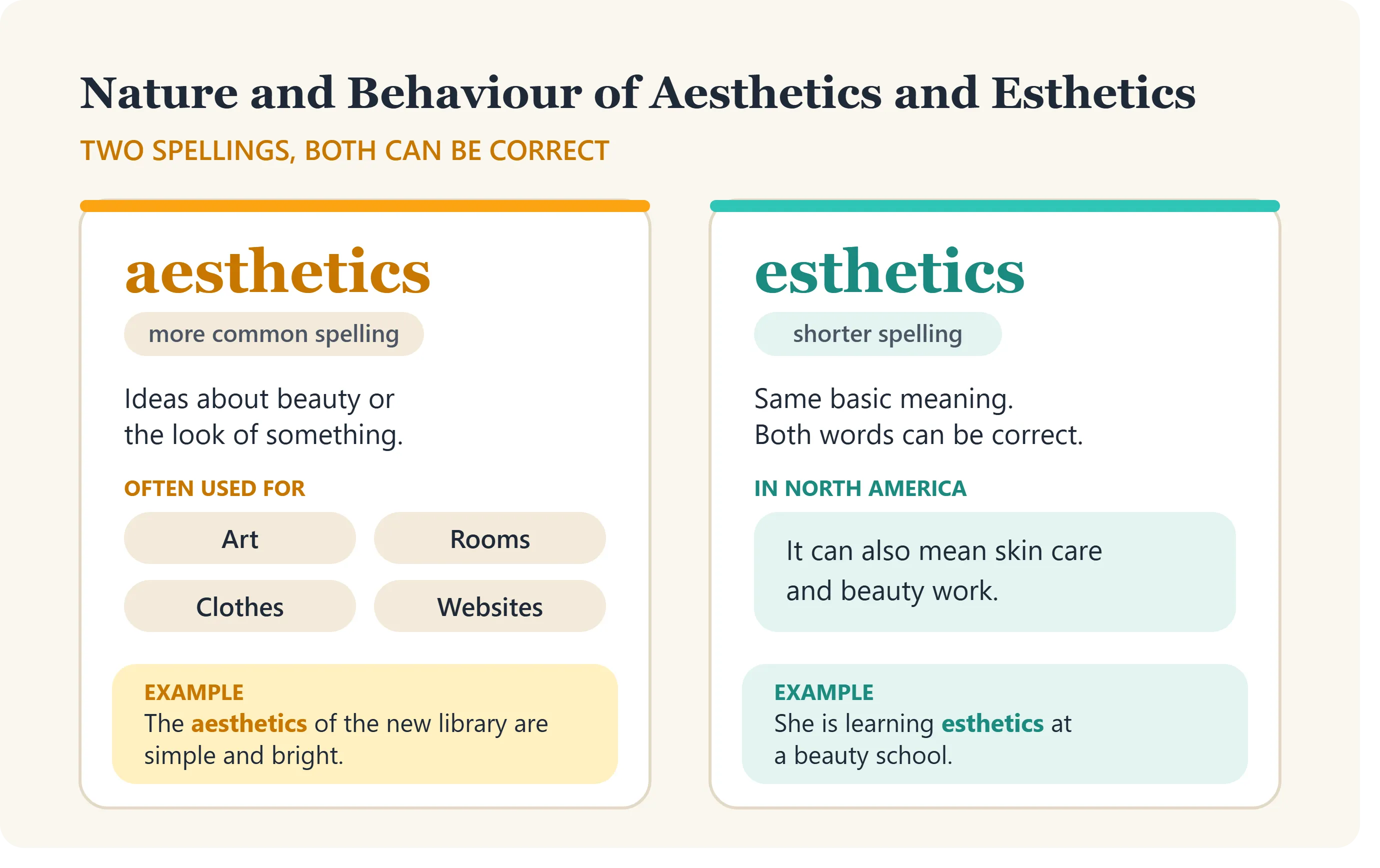
Aesthetics is the more common spelling in many English texts. It can mean ideas about beauty or the look of something.
Example: The aesthetics of the new library are simple and bright.
It is often used when people talk about art, rooms, clothes, and websites.
Esthetics
Esthetics is a shorter spelling of aesthetics. It has the same basic meaning.
In North America, it can also refer to skin care and beauty work.
Example: She is learning esthetics at a beauty school.
The meaning depends on the sentence. Both words can be correct.
Why People Get Confused About Aesthetics or Esthetics
People get confused because the words look almost the same. One starts with ae, and the other starts with e.
Both spellings are accepted. This is not a case where one word is simply a mistake.
People may also think the words have different meanings. Most of the time, they do not.
For example, both words can describe the look of a room or a painting.
The main tip is simple: use aesthetics if you are unsure. It is widely understood and used in many kinds of writing.
Comparison Table
| Feature | Aesthetics | Esthetics |
| First letters | Ae | E |
| Meaning | Beauty or the look of something | Beauty or the look of something |
| Word type | Noun | Noun |
| Use in art | Yes | Yes |
| Use in design | Yes | Yes |
| Use in North America | Common | Also used |
| Skin care meaning | Possible by context | Common in North American beauty care |
| Correct spelling | Yes | Yes |
The Origin of Aesthetics and Esthetics
The word aesthetics comes from an old Greek word linked to feeling and the senses. It later became linked to beauty and art.
The word entered English around the late 1700s and early 1800s. People used it when talking about beauty, art, and taste.
The shorter spelling esthetics leaves out the first a. It became an accepted form, especially in North America.
Today, both words are used. People may use them when talking about art, home design, fashion, and beauty care.
British vs American English
Both British and American English use aesthetics. The shorter spelling esthetics is also used, especially in North America.
| British English | American English |
| Aesthetics | Aesthetics |
| Aesthetic | Aesthetic |
| Esthetics | Also accepted |
| Esthetic | Also accepted |
Examples:
- British: I like the aesthetics of this garden.
- American: I like the aesthetics of this garden.
- North American beauty school: She studies esthetics.
Which One Should You Use?
For US Readers
Aesthetics is a safe choice. Use esthetics when it fits the subject or style.
Example: The aesthetics of the room are beautiful.
For UK Readers
Use aesthetics. It is the usual spelling in many British texts.
Example: The aesthetics of the museum are simple.
For Global Readers
Use aesthetics if you are unsure. Most readers will know what it means.
For a beauty school or skin care job in North America, esthetics may be the word you need.
Common Mistakes
| Mistake | Better Form | Why? |
| Saying esthetics is always wrong | Both are accepted | Esthetics is a real spelling |
| Saying the words always mean different things | They often mean the same thing | Both relate to beauty |
| Using the wrong word for a beauty course | Check the course name | Esthetics often means skin care |
| Thinking aesthetics only means art | It can mean a look or style | It is used in daily life too |
| Changing spelling without a reason | Keep one form | This keeps writing clear |
Everyday Usage Examples
In Emails
- The new design improves the aesthetics of our website.
- The beauty school offers a course in esthetics.
On Social Media
- I love the aesthetics of this room!
- These colors match my style and aesthetics.
In News
- The new park has a simple and clean look.
- The school opened a new esthetics course.
In Formal Writing
- The report studies the aesthetics of modern art.
- The course teaches esthetics and skin care.
Usage Trends
Aesthetics is widely used in books, art, design, and online posts. People often use it to talk about the look of a room, outfit, or website.
Esthetics is also used. In North America, it is common in the name of skin care work and training.
You may see both spellings online. This does not mean one is wrong.
If you are writing about art or design, aesthetics is a good choice. If you are writing about a beauty course, check which spelling the school uses.
Metaphors and Similes
A metaphor compares two things. A simile compares things using words like like or as.
Metaphor
“Good aesthetics are the heart of the design.”
This means the look is an important part of the design.
Simile
“The room’s aesthetics are like a fresh spring day.”
This means the room feels bright and pleasant.
These are creative examples. They are not fixed meanings of the words.
Connotative Meaning
A word can give a good, bad, or neutral feeling.
Positive Meaning
Aesthetics can suggest beauty and care.
Example: The clean design gives the shop a lovely look.
Negative Meaning
Aesthetics can suggest that someone cares too much about looks.
Example: He cared only about the room’s looks and ignored its comfort.
Neutral Meaning
The word can simply describe how something looks.
Example: The class studied the aesthetics of the painting.
Idioms and Proverbs
There are no common idioms made with these exact words. But these phrases relate to beauty and looks.
Beauty Is in the Eye of the Beholder
This means people do not all like the same things.
Example: I love the old chair, but my friend does not. Beauty is in the eye of the beholder.
Don’t Judge a Book by Its Cover
This means looks do not tell us everything.
Example: The shop looks plain, but its food is great. Don’t judge a book by its cover.
Looks Can Be Deceiving
This means something may not be as it seems.
Example: The room looks large, but it is small inside. Looks can be deceiving.
Literature and Movies
Aesthetics is a common topic in books about art, beauty, and design.
In Literature
The book Aesthetics and the Philosophy of Art by Peter Lamarque (2009) discusses art and beauty. It is a book for readers who want to learn about these ideas.
In Movies
The film The Grand Budapest Hotel (2014), made in the United States and Germany, is known for its careful use of colors and design. It gives a clear example of how a film’s look can shape the viewer’s experience.
Why This Difference Matters
Knowing both spellings helps you read and write with care. It can help with schoolwork, websites, and work emails.
If you write about art or design, aesthetics is a safe choice. If you write about skin care in North America, esthetics may fit better.
Both words are accepted. The key is to use the right word for your topic and readers.
Usefulness in Daily Life
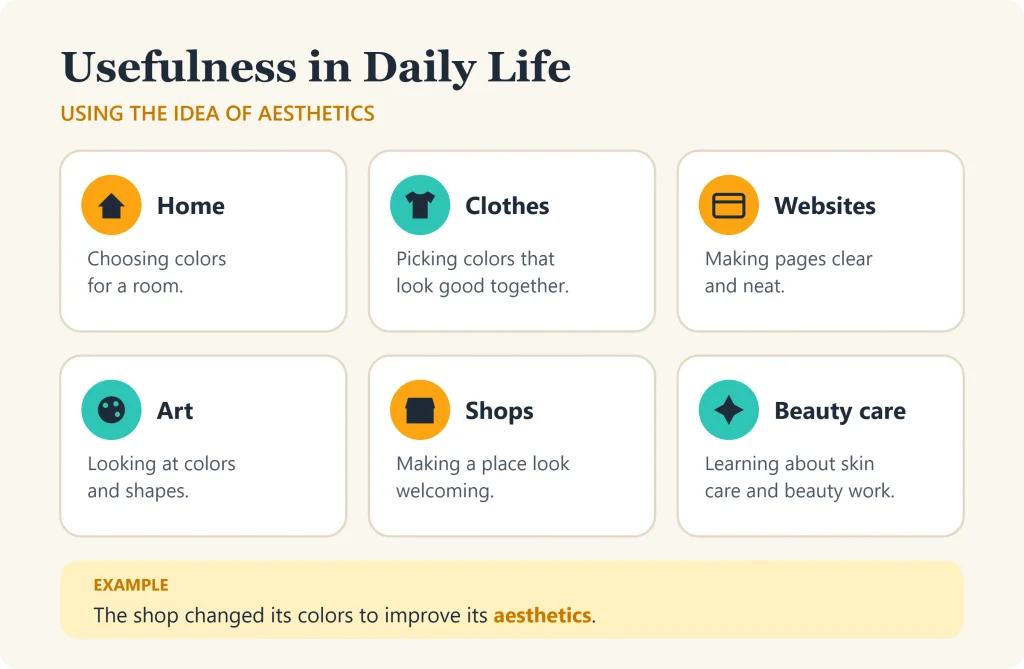
You can use the idea of aesthetics in many parts of life.
- Home: Choosing colors for a room.
- Clothes: Picking colors that look good together.
- Websites: Making pages clear and neat.
- Art: Looking at colors and shapes.
- Shops: Making a place look welcoming.
- Beauty care: Learning about skin care and beauty work.
Example: The shop changed its colors to improve its aesthetics.
Situational Preference
Use aesthetics when writing about art, design, clothes, rooms, or websites. It is a safe choice for both British and American readers. Use esthetics if your school, workplace, or beauty course uses that spelling. In North America, esthetics often relates to skin care. For a general article, choose aesthetics. Keep the spelling the same throughout your work. This helps readers follow your ideas without confusion.
Queries
1. What is the difference between aesthetics and esthetics?
They often mean the same thing. The main difference is spelling.
2. Is esthetics a real word?
Yes. It is an accepted spelling of aesthetics.
3. What does aesthetics mean?
It means ideas about beauty or the look of something.
4. Which spelling is more common?
Aesthetics is widely used in many kinds of writing.
5. What does esthetics mean in beauty care?
In North America, it often means skin care and beauty work.
6. Which spelling should I use?
Use aesthetics if you are unsure. Use esthetics when it fits your topic or style.
7. Can I use both words in one article?
Yes, but use each spelling for a clear reason. Keep your writing easy to follow.
Conclusion
Aesthetics or esthetics are both correct words with almost the same meaning. They relate to beauty, art, and the way things look. Aesthetics is widely used in British and American English, while esthetics is a shorter spelling often seen in North America. It can also refer to skin care and beauty work. You may see both words in books, websites, art lessons, and beauty schools. Their meaning depends on the sentence. For most writing, aesthetics is a safe choice. If you are writing about a beauty course, check which spelling the school uses. Remember, both words are correct, so choose the one that best fits your topic and readers.

I’m Samia Jamshaid, an English language specialist, SEO specialist, digital publisher, and researcher. I create clear, accurate, and well-researched content on English grammar, vocabulary, word meanings, and language comparisons, helping readers understand and use English with confidence.









1 thought on “Aesthetics or Esthetics: Meaning, Spelling, and Examples”