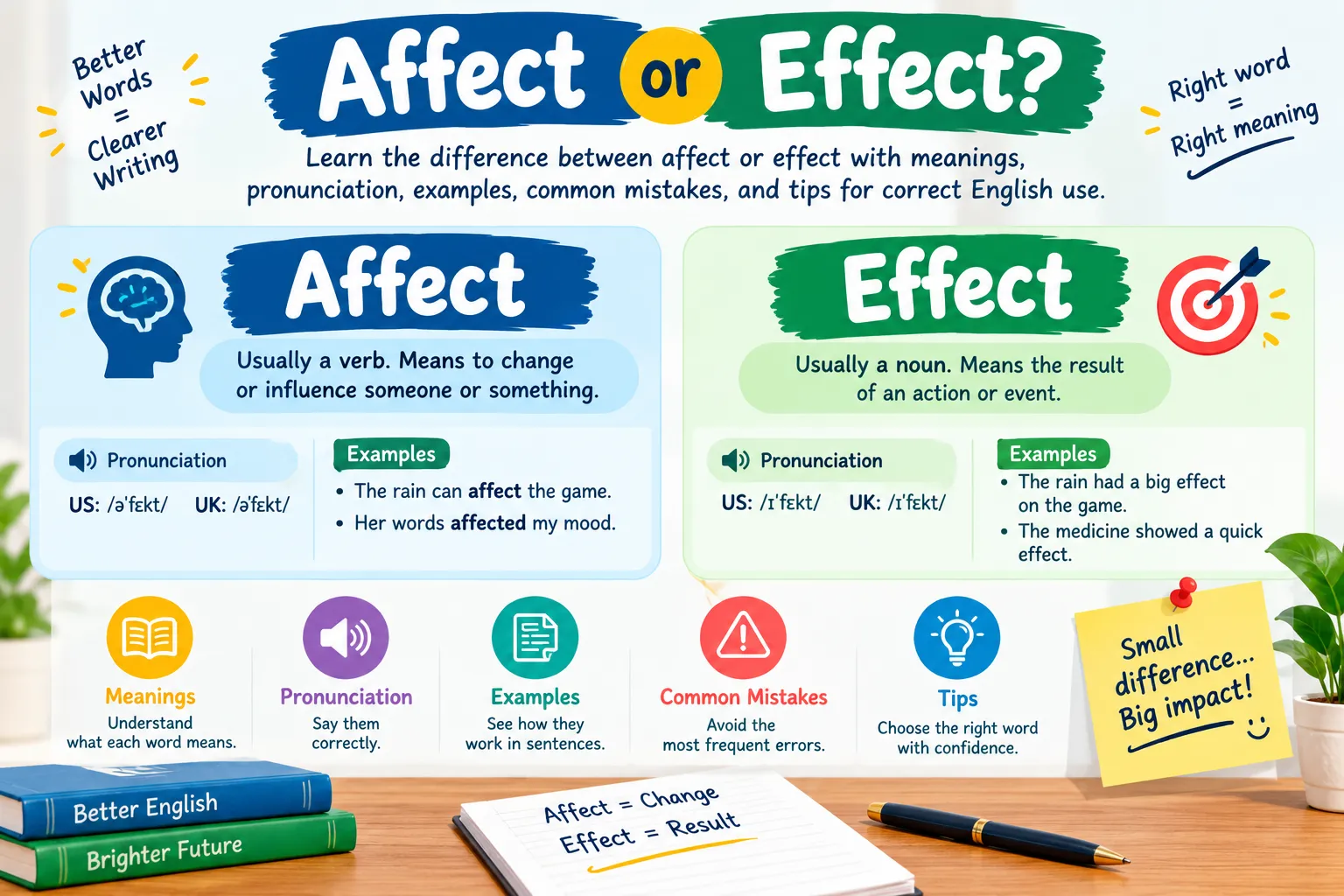
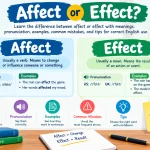
Affect is usually a verb that means “to change.” Effect is usually a noun that means “a result.”
Imagine you have a test tomorrow. You stay up late playing games. The lack of sleep may affect your focus. The effect may be a lower test score.
Both words sound alike, but they have different jobs. Affect or effect is a common problem for students, writers, and English learners. Many people know both words but still mix them up when writing.
Affect means to change or influence someone or something. Effect means the result of a change or action. These words often appear in schoolwork, emails, news, and daily talks.
Knowing the difference helps you write clear and correct sentences. It also helps readers understand your message without guessing. In this guide, you will learn how to use each word, avoid common mistakes, and remember the rules with easy examples.
Pronunciation
| Word | US Pronunciation | UK Pronunciation |
|---|---|---|
| Affect | /əˈfɛkt/ | /əˈfɛkt/ |
| Effect | /ɪˈfɛkt/ | /ɪˈfɛkt/ |
Both words have stress on the second part. Their main sound difference is at the start. Affect usually begins with a short “uh” sound. Effect begins with a short “ih” sound.
Difference Between Affect and Effect
1. Verb vs. noun
Affect is usually a verb. It tells us that something changes or influences something else.
Effect is usually a noun. It names the result of a change.
Examples:
- The rain may affect our trip.
- The rain had a big effect on our trip.
2. Action vs. result
Affect often shows an action or change. Effect often shows what happens because of that action.
Examples:
- Lack of sleep can affect your mood.
- Lack of sleep can have a bad effect on your mood.
3. How to use them
Use affect when you want to say that one thing changes another. Use effect when you want to name the result.
Examples:
- Noise can affect my work.
- The noise had an effect on my work.
4. How they fit in a sentence
Affect often comes before the thing that changes. Effect often follows words like “an,” “the,” or “a.”
Examples:
- The heat affects my sleep.
- The heat has an effect on my sleep.
5. School examples
Students often use both words when they write about learning and grades.
Examples:
- Stress can affect your grades.
- Stress can have an effect on your grades.
6. Health examples
Affect can describe how a health issue changes a person. Effect can name the result of a treatment or problem.
Examples:
- The illness may affect his daily life.
- The medicine had a strong effect.
7. Work examples
Affect can describe a change in work. Effect can describe the result of that change.
Examples:
- A new rule may affect our team.
- The new rule had a good effect on our team.
8. Weather examples
Weather can affect people, plans, and travel. Its effects are the results people notice.
Examples:
- Heavy rain can affect traffic.
- Heavy rain can have a serious effect on traffic.
9. News examples
News reports often use affect to describe who or what is changed. They use effect to describe the result.
Examples:
- The storm may affect many homes.
- The storm had a major effect on the town.
10. Easy memory rule
Remember this simple rule: Affect = action. Effect = end result. This rule works for most everyday sentences.
Examples:
- The loud music can affect my sleep.
- The effect of loud music was poor sleep.
Explore more about https://orchoice.com/customisation-or-customization/
Nature and Behaviour of Affect and Effect
Affect
Affect is usually a verb. It means to change, influence, or make a difference to someone or something.
It often tells us what causes a change.
Examples:
- Cold weather affects my hands.
- Your words can affect how people feel.
Affect can also describe feelings in psychology. For example, a report may discuss a person’s “flat affect.” In this use, affect is a noun and refers to the way feelings are shown.
Effect
Effect is usually a noun. It means the result of an action, event, or change.
It often tells us what happens after something else.
Examples:
- The new plan had a good effect.
- The effect of the storm lasted for days.
Effect can also be a verb in formal writing. “To effect change” means to bring change about.
Example: The group worked to effect change in the town.
Why People Get Confused About Affect and Effect
People get confused because the words sound very much alike. They also share the same letters, but their meanings are different.
Another reason is that both words can appear in the same sentence.
For example:
- The heat can affect your sleep.
- The effect may be tiredness the next day.
The first word shows a change. The second word names the result.
There are also a few less common uses. Affect can be a noun in psychology. Effect can be a verb that means to bring something about. These uses may confuse learners.
For most daily writing, remember this rule:
- Affect is usually an action word.
- Effect is usually a result word.
Comparison Table
| Feature | Affect | Effect |
| Usual word type | Verb | Noun |
| Main meaning | To change or influence | A result |
| Main job | Shows an action | Names an outcome |
| Common pattern | Affect something | Have an effect |
| School example | Stress affects grades | Stress has an effect on grades |
| Health example | Pain affects sleep | Pain has an effect on sleep |
| Work example | Rules affect staff | Rules have an effect on staff |
| Memory tip | Think “action” | Think “end result” |
| Less common use | A noun for shown feelings | A verb meaning to bring about |
| Common mistake | Using affect as a noun | Using effect as a verb when affect is needed |
The Origin of Affect and Effect
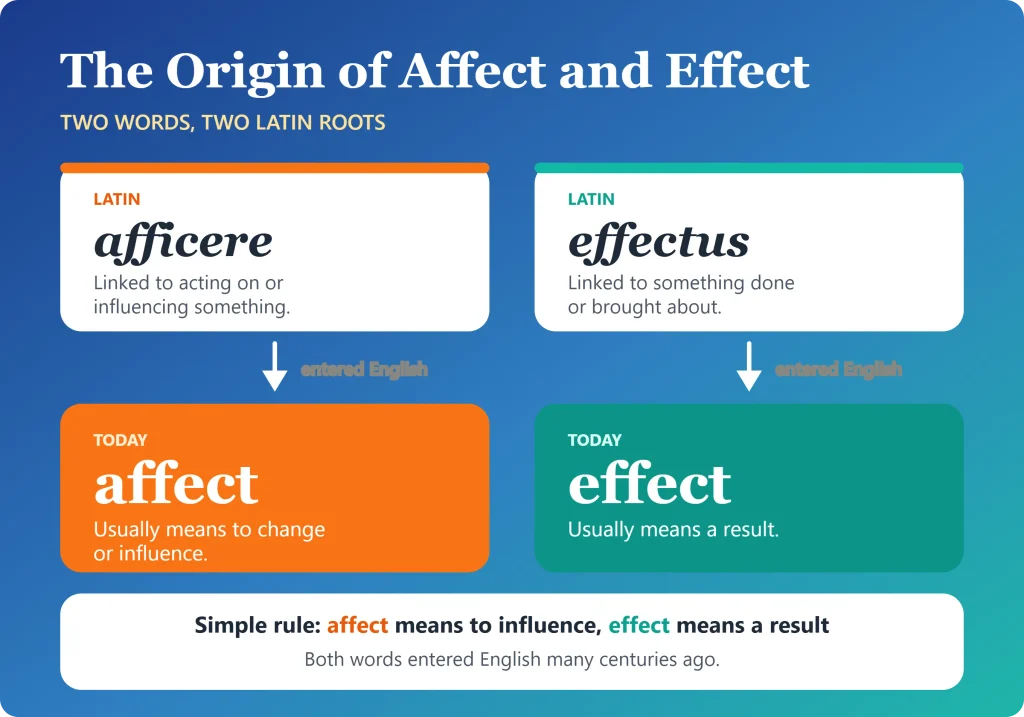
Affect and effect come from Latin words. Their long history helps explain why they look and sound alike.
Affect came through Latin afficere. It is linked to acting on or influencing something. Today, affect usually means to change or influence.
Effect came through Latin effectus. It is linked to something done or brought about. Today, effect usually means a result.
Both words entered English many centuries ago. Over time, their meanings became more set in common use.
You do not need to learn Latin to use them well. The simple rule is enough for most writing: affect means to influence, while effect means a result.
British vs. American English
There is no major spelling difference between British and American English for these words. Both forms use affect and effect.
The main difference is in how people use them, not how they spell them.
| Use | American English | British English |
| Verb meaning “to change” | Affect | Affect |
| Noun meaning “result” | Effect | Effect |
| Example | The rain affected the game. | The rain affected the match. |
| Example | The effect was clear. | The effect was clear. |
Which One Should You Use?
Your choice depends on what you want to say.
For US English
Use affect as a verb when something changes or influences something. Use effect as a noun when you mean the result.
- The new law may affect workers.
- The law had an effect on workers.
For UK English
Follow the same rule. The spelling and basic meaning are the same.
- The cold weather affected travel.
- The effect of the cold weather was clear.
For global English
Use the same simple rule in schoolwork, emails, reports, and online posts. It is widely understood across English-speaking regions.
When you are unsure, check the sentence. If you mean “change,” try affect. If you mean “result,” try effect.
Common Mistakes
Here are common errors and their correct forms.
| Incorrect sentence | Correct sentence |
| The rain had a bad affect on the game. | The rain had a bad effect on the game. |
| The noise had an effect my sleep. | The noise affected my sleep. |
| This will effect my mood. | This will affect my mood. |
| The medicine had a good affect. | The medicine had a good effect. |
| The new rule will effect many people. | The new rule will affect many people. |
| The effect of the news affected her. | The news affected her. |
| This change had a strong affect. | This change had a strong effect. |
| The cold effected my hands. | The cold affected my hands. |
Easy ways to avoid these mistakes
- Ask yourself whether you mean an action or a result.
- Use “affect” when you mean “change.”
- Use “effect” when you mean “result.”
- Read the sentence aloud to check that it makes sense.
- Look up the word if the sentence uses a less common meaning.
Everyday Usage Examples
In emails
Affect and effect often appear in work and school emails.
- The meeting time may affect my plans.
- The delay had an effect on our work.
On social media
People use these words when they talk about daily life.
- Lack of sleep affects my mood.
- That kind message had a good effect on my day.
In news reports
News stories often describe changes and their results.
- The storm may affect local roads.
- The storm had a serious effect on homes.
In formal writing
Reports and school essays use both words to explain causes and results.
- The new plan may affect school attendance.
- The plan had a positive effect on attendance.
Usage Trends
Affect and effect are both common in written English. You may see them in news, school books, work reports, and online posts.
Affect often appears when writers explain how one thing changes another. For example, they may write about how weather affects travel.
Effect often appears when writers talk about results. For example, they may explain the effect of a new rule.
The words are used in many English-speaking countries. Their basic meanings remain the same in American and British English.
There is no need to follow a special trend to choose between them. Focus on the meaning of your sentence and the role of the word.
Metaphors and Similes
A metaphor says one thing is another to make an idea clear. A simile compares two things using words such as “like” or “as.”
Affect and effect can help describe these ideas.
Affect in a metaphor
- His words changed the mood of the room.
- The news shook her world.
These sentences show how words or events can affect people.
Effect in a metaphor
- The new rule was a ray of hope.
- The speech left a mark on the team.
These phrases describe the result or impact of an action.
Affect in a simile
- The news affected him like a sudden storm.
- Her kind words affected me like warm sunshine.
Effect in a simile
- The effect of the speech was like a spark.
- The change had an effect as strong as a wave.
Connotative Meaning
A word’s connotation is the feeling or idea it brings to mind. Affect and effect do not always have a good or bad meaning. Their tone depends on the sentence.
Positive meaning
Affect can describe a helpful change.
- Her advice affected me in a good way.
Effect can describe a good result.
- The new plan had a positive effect.
Negative meaning
Affect can describe a harmful change.
- The storm affected many homes.
Effect can describe a bad result.
- The storm had a harmful effect on the town.
Neutral meaning
Affect can describe a change without saying if it is good or bad.
- The new time may affect the meeting.
Effect can name a result without judging it.
- The effect of the new time is still unknown.
Idioms and Proverbs
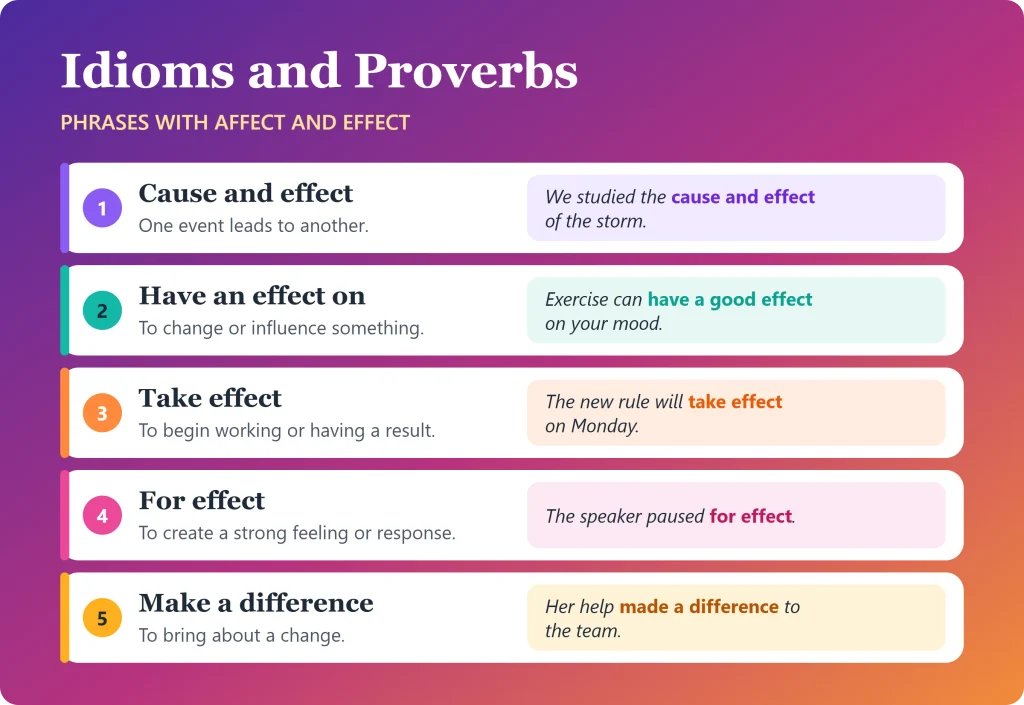
There are few common idioms that use affect and effect directly. However, both words fit well with phrases about change and results.
Cause and effect
This phrase means that one event leads to another.
Example: We studied the cause and effect of the storm.
Have an effect on
This means to change or influence something.
Example: Exercise can have a good effect on your mood.
Take effect
This means to begin working or having a result.
Example: The new rule will take effect on Monday.
For effect
This means doing something to create a strong feeling or response.
Example: The speaker paused for effect.
Make a difference
This phrase means to bring about a change.
Example: Her help made a difference to the team.
These phrases can help you talk about change and results in a natural way.
Literature and Movies
Affect and effect appear in books, plays, and films because stories often show how actions change people and what results follow.
Literature
The Effect of Gamma Rays on Man-in-the-Moon Marigolds is a play by American writer Paul Zindel. It was first produced in 1964. The story explores family life and the effects of difficult experiences.
The word “effect” in the title points to results. It shows how events can shape people’s lives.
Writers also use affect when they describe how a person, event, or choice changes a character.
Movies
The Butterfly Effect is an American science-fiction thriller released in 2004. It follows a young man who finds that changing past events can affect the present.
The title uses “effect” as a noun. It refers to the results that may follow from small changes.
Stories like these show why the two words matter. One action can affect a person or event. The effect is what happens as a result.
Why This Difference Matters
Using affect and effect correctly helps readers understand your meaning. A small word mistake can make a sentence confusing.
Students need these words for essays, homework, and tests. Workers use them in emails, reports, and meetings. News writers use them to explain changes and results.
The difference also helps people think clearly. Many events have causes and effects. Knowing how to describe them makes it easier to explain what happened and why.
For example:
- The storm affected the town.
- The effect was damage to roads and homes.
The first sentence tells us what changed. The second tells us the result.
Learning this rule can improve both your writing and your reading. It is a small lesson that helps in many parts of daily life.
Usefulness in Daily Life
You can use affect and effect in many daily situations.
- At school: Stress can affect your grades.
- At work: A late delivery may affect the plan.
- At home: Loud noise can affect your sleep.
- In health talks: A lack of sleep can affect your mood.
- In the news: The storm had an effect on traffic.
- In emails: The change may affect our meeting.
- In reports: The new plan had a clear effect.
Situational Preference
Choose affect when you want to show that something changes or influences another thing. It works well when you talk about weather, health, school, work, or feelings. Choose effect when you want to name the result of an action or event. This rule works in American English, British English, and most global English writing. In formal reports, you may also see “effect change,” which means to bring about change. This is a less common use. For everyday writing, remember: affect is usually a verb, and effect is usually a noun.
Common Questions and Answers
1. What is the main difference between affect and effect?
Affect is usually a verb that means to change or influence. Effect is usually a noun that means a result.
2. How can I remember affect and effect?
Remember “A” for action: affect often shows an action. “E” for end result: effect often names the result.
3. Is affect a verb or a noun?
Affect is usually a verb. In psychology, it can also be a noun for the way feelings are shown.
4. Is effect a verb or a noun?
Effect is usually a noun. It can also be a verb meaning to bring something about, as in “effect change.”
5. Are affect and effect spelled differently in the US and UK?
No. Both American and British English use the same spellings and basic rules.
6. Can affect and effect appear in one sentence?
Yes. For example: “The rain may affect the game, and the effect could be a delay.”
7. Which word should I use in an essay?
Use affect when you mean “change” or “influence.” Use effect when you mean “result.” Check the role of the word in your sentence.
Conclusion
Affect or effect sound alike, but they usually do different jobs. Affect is usually a verb that means to change or influence someone or something. Effect is usually a noun that means the result of an action or event. For example, rain can affect a game, and the effect may be a delay. This simple rule works in American English, British English, and most global English writing. Both words are useful in schoolwork, emails, news, and daily talks. Affect can be a noun in psychology, while effect can be a verb meaning to bring about change. When you are unsure, ask yourself one question: Do I mean a change or a result? If you mean a change, use affect. If you mean a result, use effect. With practice, you will learn to choose the right word with ease.

I’m Samia Jamshaid, an English language specialist, SEO specialist, digital publisher, and researcher. I create clear, accurate, and well-researched content on English grammar, vocabulary, word meanings, and language comparisons, helping readers understand and use English with confidence.






1 thought on “Affect or Effect: Ways to Remember the Difference”