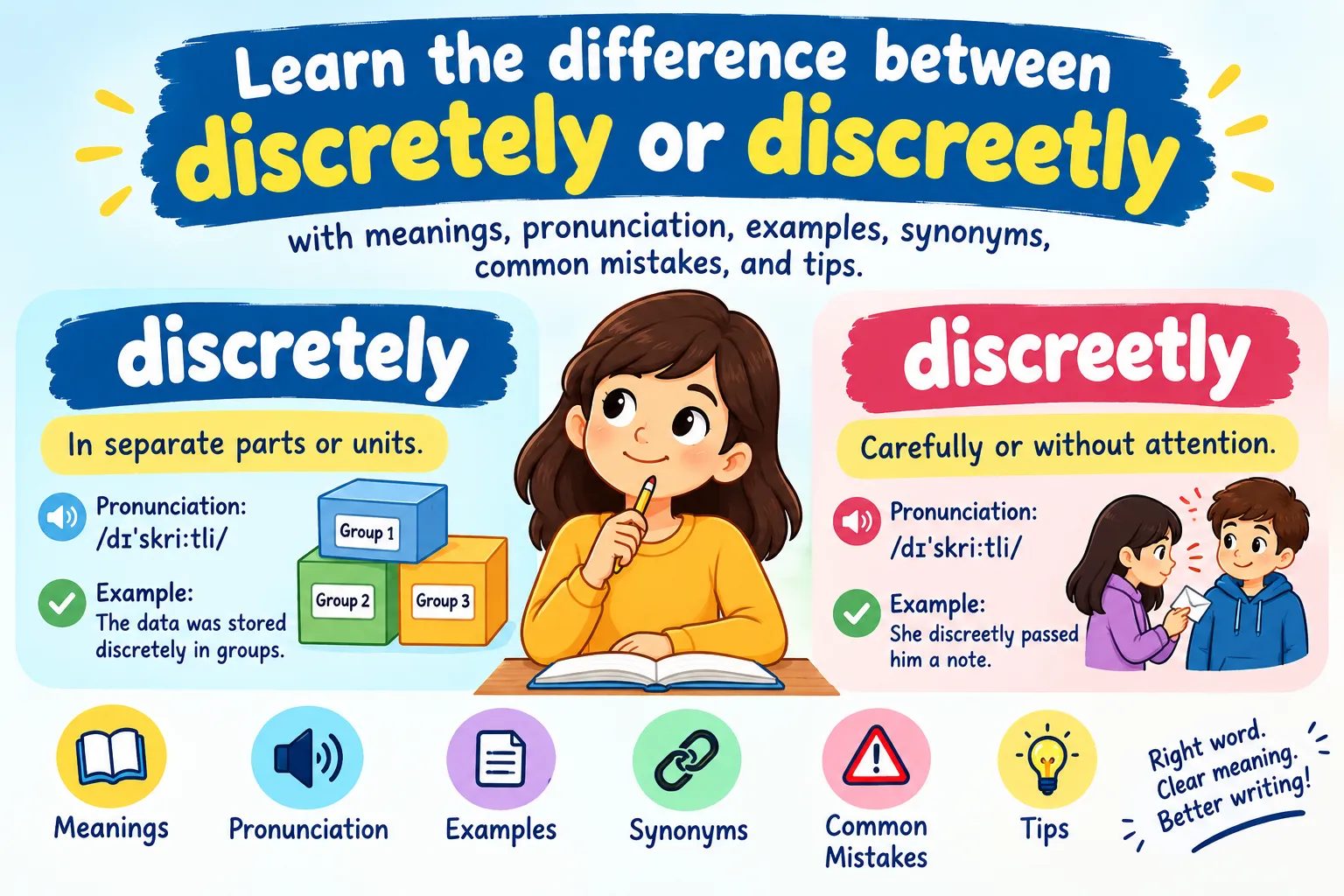
Discreetly means doing something carefully without getting attention. Discretely means treating things as separate parts or units.
Imagine you need to share a private message with a friend in class. You speak quietly so others cannot hear. You act discreetly. Now imagine a teacher checks each student’s work as a separate task. The teacher checks the work discretely.
These words look almost the same. They also sound the same in many English accents. But they have different meanings. Using the wrong word can change your message.
Many people mix up discretely and discreetly because their spellings are very close. Their base words also look alike. However, discreet means careful or private, while discrete means separate or distinct.
In this guide, you will learn the meanings, pronunciation, differences, synonyms, and examples of both words. You will also learn common mistakes and simple ways to remember them. These tips will help you write clearly at school, at work, and online.
Pronunciation of Discretely and Discreetly
Both words usually sound the same.
- US pronunciation: /dɪˈskriːtli/
- UK pronunciation: /dɪˈskriːtli/
Meaning of Discreetly
Discreetly (adverb): In a careful way that avoids attention or keeps private information safe.
Use discreetly when someone wants to act quietly or avoid making others notice something.
Examples:
- She discreetly passed him a note during the meeting.
- The manager discreetly asked the worker to stay after work.
Meaning of Discretely
Discretely (adverb): In separate parts or units, rather than as one whole.
Use discretely when things are separate or are treated as individual units.
This word often appears in science, math, computing, and other technical subjects.
Examples:
- The data was stored discretely in separate files.
- The scientist studied each sample discretely.
Difference Between Discretely and Discreetly: 10 Key Differences
1. Main Meaning
Discreetly means acting carefully and avoiding attention. Discretely means keeping things in separate parts or units.
- She discreetly asked about the private matter.
- The system processed the values discretely.
2. Focus
Discreetly focuses on how a person acts. Discretely focuses on how things are kept separate.
- He discreetly left the room.
- The items were counted discretely.
3. Privacy
Discreetly can mean keeping something private. Discretely does not mean secret.
- They discreetly discussed the problem.
- The machine measured each part discretely.
4. Separation
Discretely relates to separate parts or units. Discreetly does not have this meaning.
- The figures were recorded discretely.
- She discreetly changed the subject.
5. Common Use
People often use discreetly in daily life. Discretely is more common in science and technical writing.
- He discreetly gave her the key.
- The computer handled the data discretely.
6. People and Things
Discreetly often describes what people do. Discretely often describes data, values, objects, or tasks.
- The nurse discreetly spoke to the patient.
- The results were stored discretely.
7. Attention
Discreetly often means doing something without being noticed. Discretely does not have this meaning.
- She discreetly took a photo.
- The program handled each number discretely.
8. Grammar
Both words are adverbs. They tell us how an action happens. But they do not mean the same thing.
- He discreetly answered the question.
- The system treated the values discretely.
9. Related Words
Discreetly comes from discreet. Discretely comes from discrete.
- Discreet: Careful and private.
- Discrete: Separate and distinct.
10. Simple Replacement
You can often replace discreetly with “quietly” or “privately.” You can often replace discretely with “separately.”
- She discreetly spoke to the manager.
- The team reviewed each section separately.
More About https://orchoice.com/ridiculous-or-rediculous/
Nature and Behaviour
The word discreetly often describes how a person behaves. It can show care, good judgment, and respect for privacy.
For example, a friend may discreetly tell you that your shirt is inside out. They help you without embarrassing you in front of others.
The word discretely describes separate parts, steps, or values. It does not usually describe polite or private behaviour.
For example, a computer may store each number discretely. Each number stays as a separate unit.
The main difference is simple: discreetly is about careful behaviour, while discretely is about separate parts.
Why People Get Confused
People often mix up these words for three reasons.
First, their spellings are almost the same. Both begin with “discre-” and end with “-ly.”
Second, they sound the same in many English accents. You may not know which word is being used just by hearing it.
Third, their base words look alike. Discreet means careful or private. Discrete means separate or distinct.
Here is an easy way to remember them:
- Discreetly: Think about being careful and private.
- Discretely: Think about separate pieces.
Comparison Table
| Feature | Discreetly | Discretely |
| Base word | Discreet | Discrete |
| Main meaning | Carefully and without attention | In separate units |
| Main focus | Behaviour and privacy | Separation |
| Common setting | Daily life and conversations | Science and technical writing |
| Simple synonym | Quietly | Separately |
| Example | She discreetly left. | The data was stored discretely. |
Origin of the Words
Both words have roots linked to ideas about judging and telling things apart. Over time, their meanings became different.
Discreet came through Old French and Middle English. It developed the meaning of being wise, careful, and good at keeping private matters private.
Discrete came through French and Latin forms. It developed the meaning of being separate or distinct.
Adding “-ly” turns each adjective into an adverb.
- Discreet → Discreetly
- Discrete → Discretely
British vs. American English
The spelling and meaning of both words are the same in British and American English.
Both use discreetly for careful or private behaviour. Both use discretely for separate parts or units.
The words also have the same usual pronunciation in both types of English. Small changes may happen because of local accents.
Examples:
- British English: She discreetly spoke to the headteacher.
- American English: She discreetly spoke to the principal.
- Technical use: The values were stored discretely.
Which One Should You Use?
Ask yourself what you want to say.
Use discreetly when someone acts carefully, quietly, or privately.
Use discretely when things are kept separate or treated as individual units.
Ask yourself these two questions:
- Does the sentence involve privacy or avoiding attention? Use discreetly.
- Does the sentence involve separate parts or units? Use discretely.
For example, “She discreetly asked for help” is correct because she wants to avoid attention.
“The data was divided discretely” may be correct if the data was divided into separate units.
Common Mistakes
Mistake 1: Using Discretely for Privacy
Incorrect: She discretely told me the secret.
Better: She discreetly told me the secret.
The sentence is about keeping something private. So, discreetly is the right word.
Mistake 2: Using Discreetly for Separate Units
Incorrect: The program stored the values discreetly.
Better: The program stored the values discretely.
Use discretely when you mean that the values were kept as separate units.
Mistake 3: Choosing by Sound
Both words sound alike in many accents. Do not choose the spelling by sound alone.
Read the sentence and ask what you want the word to mean.
Mistake 4: Thinking One Word Is Always Correct
Neither word is always correct. Both are right when used with the proper meaning.
Everyday Usage Examples
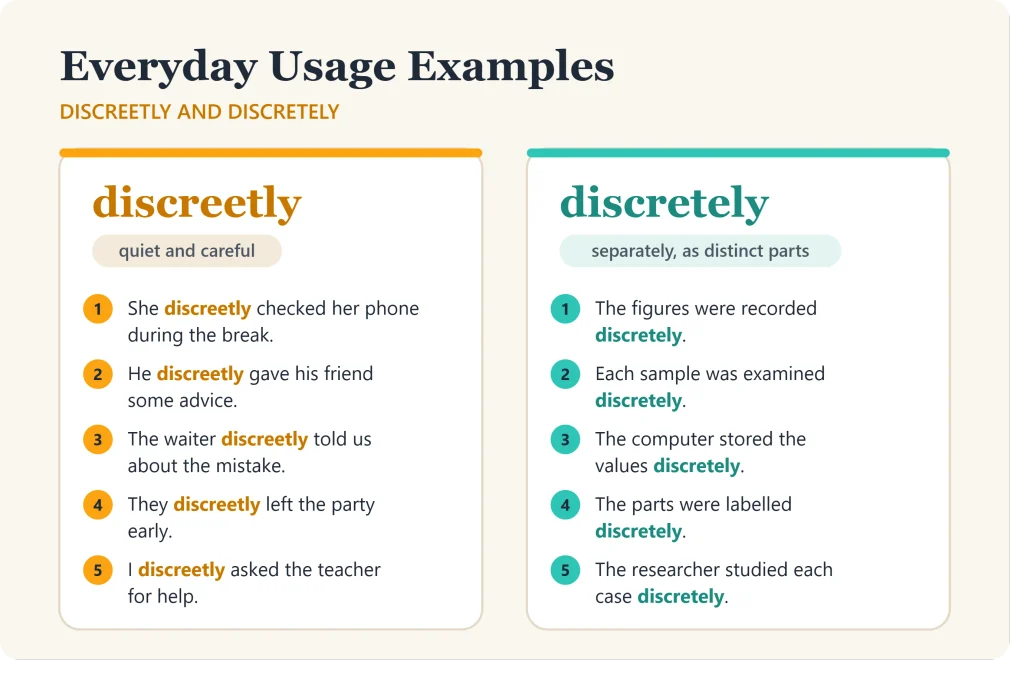
These examples show how to use both words in daily life.
Discreetly:
- She discreetly checked her phone during the break.
- He discreetly gave his friend some advice.
- The waiter discreetly told us about the mistake.
- They discreetly left the party early.
- I discreetly asked the teacher for help.
Discretely:
- The figures were recorded discretely.
- Each sample was examined discretely.
- The computer stored the values discretely.
- The parts were labelled discretely.
- The researcher studied each case discretely.
Synonyms of Discreetly
Discreetly means acting carefully without attracting attention or sharing private information. The best synonym depends on the meaning you want to show.
| Synonym | Meaning | Example |
| Quietly | Without much noise or attention | She quietly left the room. |
| Privately | Away from other people | He spoke privately with his teacher. |
| Carefully | With care and thought | She carefully shared the news. |
| Secretly | Without letting others know | They secretly planned a party. |
| Tactfully | In a kind and careful way | He tactfully explained the mistake. |
| Subtly | In a way that is hard to notice | She subtly changed the subject. |
| Silently | Without speaking or making noise | He silently gave her the note. |
| Cautiously | With care to avoid trouble or danger | She cautiously asked about the issue. |
| Diplomatically | In a way that helps avoid conflict | He diplomatically handled the complaint. |
| Inconspicuously | Without attracting notice | The guest inconspicuously left the event. |
How to Choose the Right Synonym
These words have close meanings, but they are not always the same.
- Quietly focuses on noise or attention.
- Privately means away from other people.
- Carefully means using care and thought.
- Tactfully means avoiding hurt feelings.
- Secretly means hiding something from others.
- Subtly means doing something in a way that is hard to notice.
For example, “She discreetly spoke to the manager” could become “She privately spoke to the manager” if privacy is the main idea.
Synonyms of Discretely
Discretely means in separate parts or units. It is often used in science, math, computing, and formal writing.
| Synonym or Alternative | Meaning | Example |
| Separately | Apart from other things | The teacher checked each answer separately. |
| Individually | As one person or thing at a time | Each student was tested individually. |
| Independently | Without relying on something else | Each team worked independently. |
| Distinctly | In a way that is clear or different | The two groups were distinctly different. |
| Apart | Away from other things | Keep the parts apart. |
| One by one | Each item in turn | The worker checked the items one by one. |
| In separate groups | Divided into different groups | The cards were placed in separate groups. |
| As separate units | Treated as individual parts | The system handled the parts as separate units. |
| Individually considered | Looked at one item at a time | Each case was considered individually. |
| In isolation | Away from other things for study | The problem was studied in isolation. |
How to Choose the Right Synonym
The best choice depends on your sentence.
- Separately means keeping things apart.
- Individually means looking at each person or item on its own.
- Independently means not depending on something else.
- One by one means doing each item in turn.
- In isolation means studying something away from other things.
For example, “The team reviewed each section discretely” could become “The team reviewed each section separately.”
Usage Trends
Discreetly is often used in daily writing. People use it when they talk about privacy, manners, or careful actions.
Discretely is more common in writing about separate values or units. You may see it in math, science, data work, and computing.
The words have different jobs. Do not replace one with the other just because it seems more common. Choose the word that fits your meaning.
Metaphors and Similes
Writers sometimes use comparisons to explain discreetly.
- She moved discreetly, like a shadow in the night.
- He handled the problem as carefully as someone carrying glass.
These comparisons show quiet and careful behaviour.
For discretely, imagine objects kept in separate boxes. Each object can be counted or checked on its own.
Connotative Meaning
Discreetly
Positive tone: It can show good judgment, care, and respect for privacy.
Example: She discreetly helped her colleague fix the error.
Negative tone: Sometimes, it can suggest hiding something wrong.
Example: They discreetly removed the damaged items before the inspection.
Neutral tone: It can simply describe an action that avoids attention.
Example: He discreetly closed the door.
Discretely
Positive tone: It can show that things are clearly arranged into separate units.
Example: The information was stored discretely for easy review.
Negative tone: It may suggest that things are being studied separately when they should be studied together.
Example: The team examined the problems discretely and missed their link.
Neutral tone: It usually describes separate parts, values, or objects.
Example: Each value was recorded discretely.
Idioms and Proverbs
There are no common idioms that use discreetly or discretely as their main words. However, some related sayings can help explain their meanings.
For discreet behaviour:
- Keep something under wraps: Keep information secret.
- Keep a low profile: Avoid getting attention.
- Let sleeping dogs lie: Do not bring up an issue that may cause trouble.
For separate items:
- Divide and conquer: Break a large task into smaller parts.
- Take things one at a time: Deal with each issue in order.
Literature and Movies
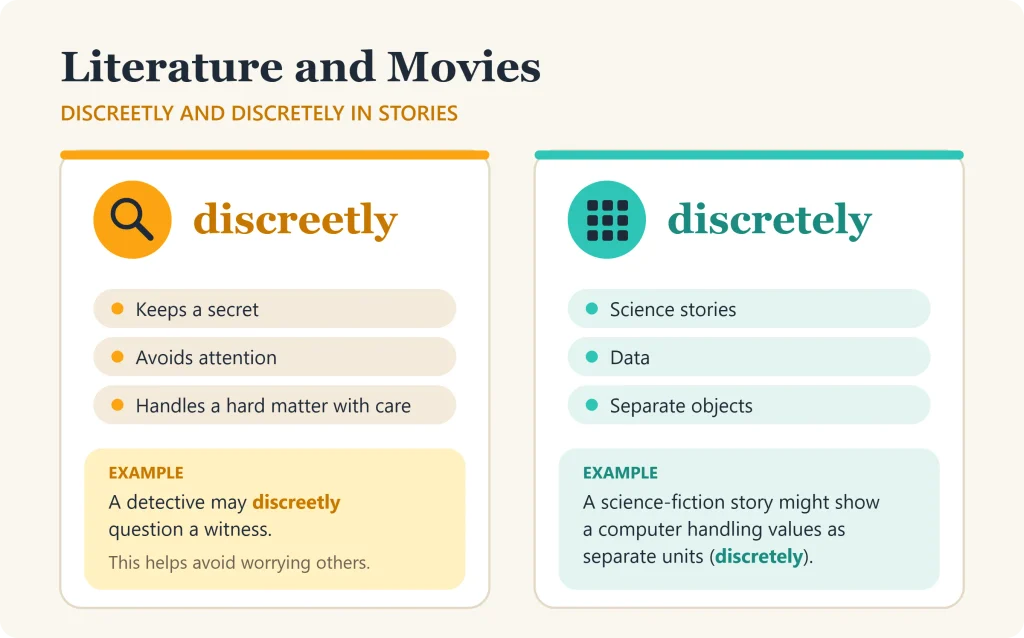
Books and movies often show people acting discreetly. A character may keep a secret, avoid attention, or handle a difficult matter with care.
For example, a detective may discreetly question a witness. This can help the detective avoid worrying other people.
The word discretely is more likely to appear in stories about science, data, or separate objects. A science-fiction story might show a computer handling values as separate units.
Why the Difference Matters
Using the wrong word can make your meaning unclear.
If you write, “She discretely shared the news,” readers may not know if you mean she shared it privately or in separate parts. If you mean she avoided attention, discreetly is clearer.
Now consider a computer that stores information discreetly. This may sound like the computer is acting carefully or privately. If the computer stores separate values, discretely is the better word.
Choosing the right word helps readers understand you. It is useful in schoolwork, reports, emails, and work messages.
Usefulness in Daily Life
You may use discreetly when talking about private talks, sensitive questions, or polite actions.
For example, you might discreetly tell a friend about a mistake. This lets you help without embarrassing them.
You may use discretely when talking about separate items, measurements, or values. It can be useful in science or formal reports.
If you are writing for a general audience, use simple words when they give the same meaning. “Privately” may be clearer than “discreetly.” “Separately” may be clearer than “discretely.”
Situational Preference
Use discreetly when privacy or avoiding attention is important. For example, a teacher may discreetly talk to a student about a problem. This keeps the talk private and respectful.
Use discretely when you need to show that parts or values are separate. For example, a researcher may record each measurement discretely. This shows that each measurement is treated as its own unit.
In daily conversation, discreetly is likely to be more useful. In technical writing, discretely may be needed. Always choose the word that matches your meaning.
More About Discretely or Discreetly
1. What is the main difference between discretely and discreetly?
Discreetly means acting carefully without attracting attention. Discretely means treating things as separate parts or units.
2. Do discretely and discreetly sound the same?
Yes. They usually have the same pronunciation: /dɪˈskriːtli/. Some accents may sound a little different.
3. Is discretely a real word?
Yes. Discretely is a correct word. It comes from discrete and means in separate parts or units.
4. Is discreetly the same as secretly?
Not always. Discreetly often means acting carefully to avoid attention. Secretly means keeping something hidden from others.
5. What is a simple synonym for discretely?
“Separately” is often a simple choice. The best word still depends on the sentence.
6. Can I use discreetly in academic writing?
Yes. Use it when you mean careful or private behaviour. Use discretely when you mean separate values or units.
7. How can I remember which word to use?
Remember that discreetly means careful or private. Discretely means separate. Check the meaning before you choose the spelling.
Conclusion
Discretely or discreetly look and sound almost the same, but they have different meanings. Discreetly means acting carefully, privately, or without attracting attention, while discretely means treating things as separate parts or units. Use discreetly when someone handles private information, speaks carefully, or avoids making a scene. Use discretely when talking about separate values, objects, or parts of a task. Their synonyms can help you remember the difference. Words like quietly, privately, and tactfully relate to discreetly, while separately, individually, and one by one relate to discretely. Do not choose between these words by sound alone. Check the meaning of your sentence. If you mean privacy, choose discreetly. If you mean separate parts, choose discretely. By following this simple rule, you can use both words with confidence and make your writing clearer at school, at work, and in daily life.

I’m Samia Jamshaid, an English language specialist, SEO specialist, digital publisher, and researcher. I create clear, accurate, and well-researched content on English grammar, vocabulary, word meanings, and language comparisons, helping readers understand and use English with confidence.





1 thought on “Discretely or Discreetly: Meaning, Differences, and Examples”