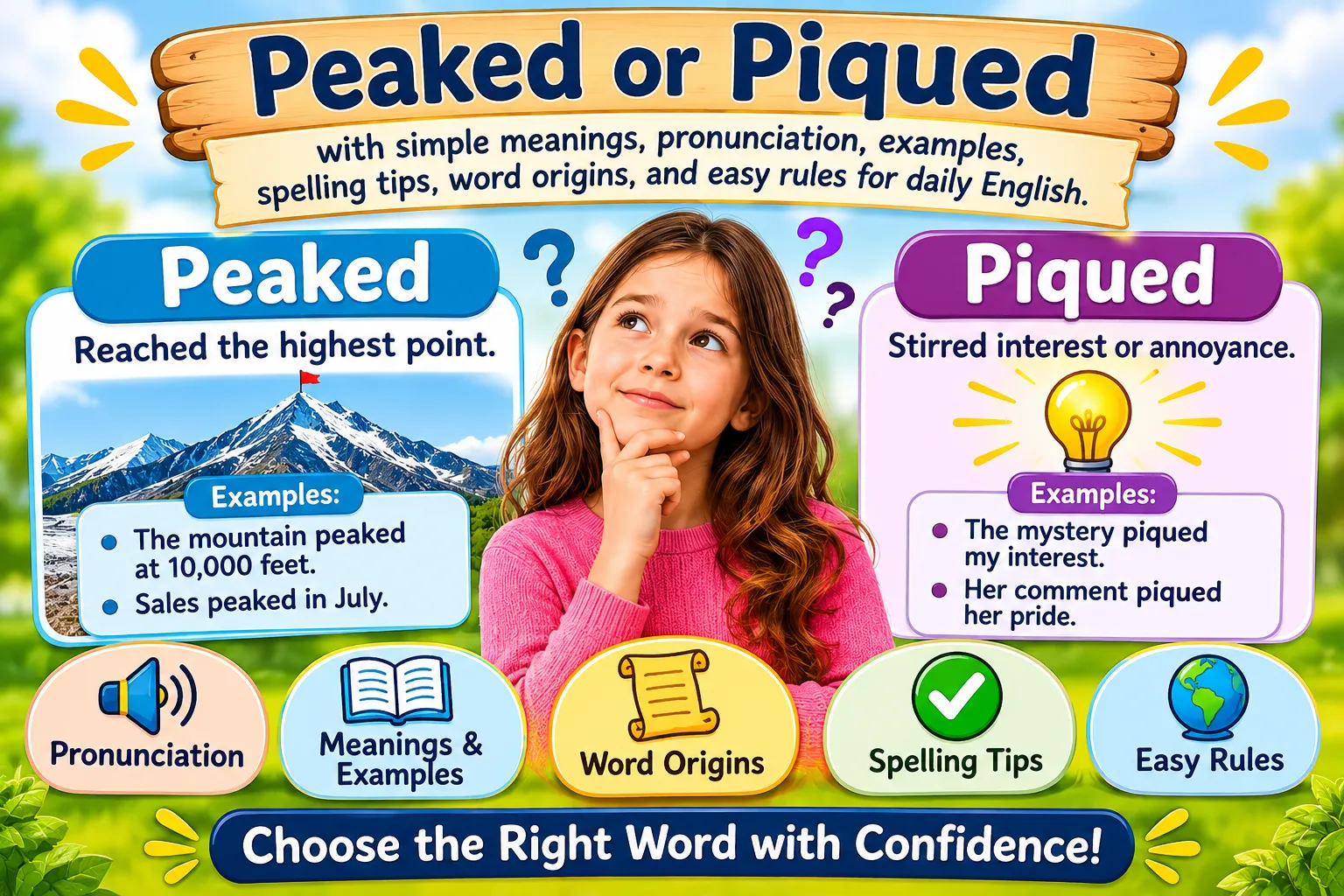
Peaked means reached the highest point, while piqued means sparked interest or caused annoyance.
Imagine reading an exciting story. One line makes you want to know more. You might say, “That line piqued my interest.” Now imagine a singer whose fame reaches its highest point. You could say, “Her career peaked last year.”
These words sound the same, but they have different meanings. This makes them easy to mix up. Many people search for peaked or piqued because both words are pronounced alike. They also appear in similar sentence patterns.
The word peaked comes from peak, which means the top or highest level. The word piqued comes from pique, which means to stir interest or annoyance. Knowing this small difference can help you write clear emails, posts, stories, and reports.
In this guide, you will learn their meanings, spelling, pronunciation, history, and common uses. You will also see simple examples to help you choose the right word.
Pronunciation of Peaked and Piqued
Both words have the same pronunciation.
| Word | US pronunciation | UK pronunciation |
| Peaked | /piːkt/ | /piːkt/ |
| Piqued | /piːkt/ | /piːkt/ |
Both sound like “peeked.” The spelling and meaning are different, but the sound is the same.
Transition: Let’s look at the main differences and see when to use each word.
Difference Between Peaked and Piqued
1. Main Meaning
Peaked means reached the highest point or level.
Piqued means stirred interest or caused annoyance.
Examples:
- Sales peaked during the holiday season.
- The news piqued my interest.
2. Word Form
Peaked is the past form and past participle of the verb peak.
Piqued is the past form and past participle of the verb pique.
Examples:
- The team peaked at the right time.
- Her question piqued his curiosity.
3. Main Idea
Peaked is about a high point or top level.
Piqued is about a feeling or reaction.
Examples:
- The heat peaked at noon.
- The strange sound piqued my curiosity.
4. Use with Interest
Peaked is not the correct word when you mean “made someone interested.”
Piqued is common in the phrase “piqued my interest.”
Examples:
- Correct: The book piqued my interest.
- Incorrect: The book peaked my interest.
5. Use with Curiosity
Peaked does not mean that someone became curious.
Piqued can mean that something made a person curious.
Examples:
- The old map piqued her curiosity.
- His strange reply piqued my curiosity.
6. Use with Annoyance
Peaked does not usually describe annoyance.
Piqued can mean that someone felt annoyed or offended.
Examples:
- His rude words piqued her pride.
- She looked piqued by the remark.
7. Use with Numbers
Peaked often describes numbers that reach their highest level.
Piqued does not describe a rise in numbers.
Examples:
- The price peaked in July.
- The report piqued the reader’s interest.
8. Use with Careers and Success
Peaked can describe the highest point in a career or period of success.
Piqued can describe interest in a person’s work or success.
Examples:
- His music career peaked in the 1990s.
- Her success piqued the interest of reporters.
9. Common Sentence Patterns
Peaked often appears with words such as at, during, and in.
Piqued often appears with words such as interest, curiosity, and pride.
Examples:
- The crowd peaked at 10,000 people.
- The offer piqued his interest.
10. Memory Tip
Think of a mountain peak when you use peaked. It means a top or highest point.
Think of interest or feelings when you use piqued.
Examples:
- The river level peaked after the storm.
- The mystery piqued the child’s curiosity.
Learn more about https://orchoice.com/dissatisfied-or-unsatisfied/
Nature and Behaviour of Peaked and Piqued
Peaked
Peaked comes from the word peak. A peak is the top of a mountain or the highest point of something.
The word can describe a number, level, event, or period. It often shows that something reached its highest point. After that, it may stay level or begin to fall.
Examples:
- The shop’s sales peaked in December.
- Her fame peaked after the film came out.
Another meaning: In some English use, especially British English, peaked can mean pale or unwell.
Example:
- You look a little peaked today.
Piqued
Piqued comes from the verb pique. It means to stir a feeling in someone.
Piqued often appears with interest or curiosity. It can also describe hurt pride or annoyance.
Examples:
- The story piqued my interest.
- His comment piqued her pride.
Why People Get Confused About Peaked and Piqued
People mix up these words because they sound exactly alike. This is called a homophone pair. Homophones have the same sound but different meanings or spellings.
Both words also end in -ed. This makes them look alike in writing. But their base words are different:
- Peak: a top or highest point.
- Pique: to stir interest or annoyance.
The phrase “piqued my interest” causes many spelling errors. Some people write “peaked my interest” because they know the word peak. But the correct phrase is “piqued my interest.”
Comparison Table
| Point | Peaked | Piqued |
| Base word | Peak | Pique |
| Main meaning | Reached the highest point | Stirred a feeling |
| Pronunciation | /piːkt/ | /piːkt/ |
| Word form | Past tense and past participle | Past tense and past participle |
| Common use | Sales, prices, heat, success | Interest, curiosity, pride |
| Shows | A high point or level | A feeling or reaction |
| Example phrase | Peaked at a record level | Piqued my interest |
| Common mistake | Using it for interest | Using it for a high point |
| US spelling | Peaked | Piqued |
| UK spelling | Peaked | Piqued |
Similarities: Both words sound alike. Both end in -ed. Both can describe something that happened in the past.
The Origin of Peaked and Piqued
Origin of Peak and Peaked
The word peak came into English through French. It was used for a pointed top or summit. Over time, it also gained the meaning of the highest level.
The verb peak grew from this noun. It means to reach a top point. Peaked is its past form.
Today, people use it for mountains, sales, health, fame, and many other things.
Origin of Pique and Piqued
The word pique came into English from French. It is linked to a French word meaning to prick or sting.
Its meaning later grew to include stirring a feeling. This can be interest, curiosity, pride, or annoyance.
Piqued is the past form of pique. It is often used when something makes a person curious.
British vs American English
There is no spelling difference between US and UK English for these two words. Both regions use peaked and piqued.
| Use | American English | British English |
| Reached the highest point | Peaked | Peaked |
| Stirred interest | Piqued | Piqued |
| Made someone curious | Piqued curiosity | Piqued curiosity |
| Reached the highest sales level | Sales peaked | Sales peaked |
Examples:
- US: The team’s performance peaked in June.
- UK: The team’s performance peaked in June.
- US: The news piqued my interest.
- UK: The news piqued my interest.
Which One Should You Use?
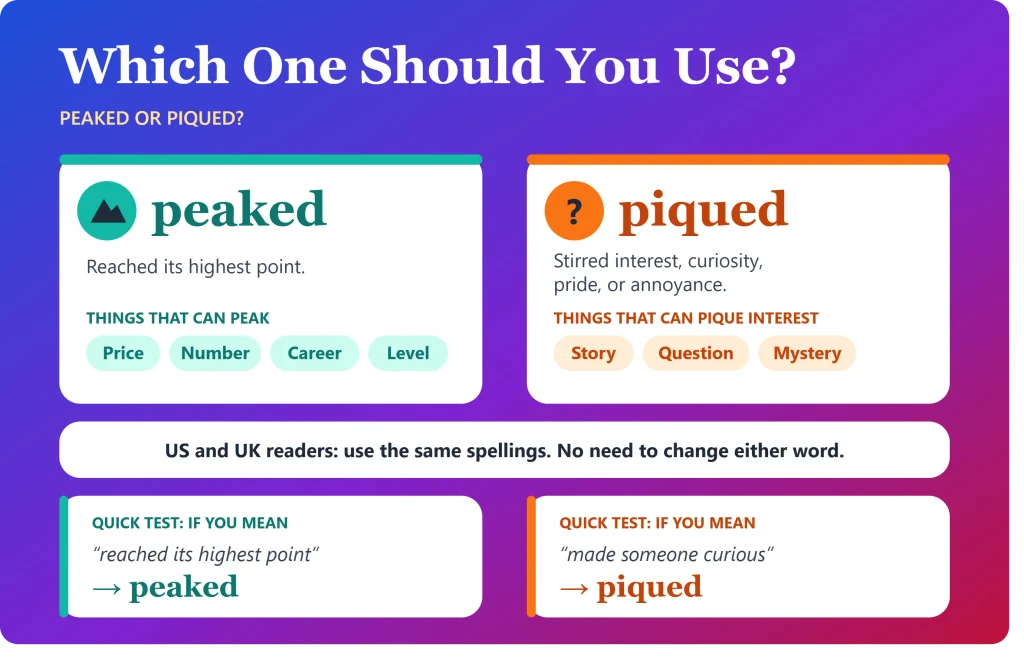
Use peaked when you mean that something reached its highest point.
Use piqued when you mean that something stirred interest, curiosity, pride, or annoyance.
For US readers, use the same spellings shown here. The same rule applies to UK readers. There is no need to change the spelling for either region.
For global writing, remember these two simple rules:
- A price, number, career, or level can peak.
- A story, question, or mystery can pique someone’s interest.
If you are unsure, replace the word with a simple phrase. If you mean “reached its highest point,” choose peaked. Whether you mean “made someone curious,” choose piqued.
Common Mistakes
Here are common errors and their correct forms.
| Incorrect | Correct | Why? |
| The story peaked my interest. | The story piqued my interest. | It made me interested. |
| Sales piqued in May. | Sales peaked in May. | Sales reached their highest point. |
| The news peaked her curiosity. | The news piqued her curiosity. | The news made her curious. |
| The heat piqued at noon. | The heat peaked at noon. | The heat reached its highest level. |
| His question peaked my interest. | His question piqued my interest. | The question caught my attention. |
| Her fame piqued in 2020. | Her fame peaked in 2020. | Her fame reached its highest point. |
Easy tip: Ask yourself what the sentence means. A high point needs peaked. A stirred feeling needs piqued.
Everyday Usage Examples
In Emails
- The new plan piqued my interest. I would like to learn more.
- Our website visits peaked last month.
On Social Media
- This new book has piqued my curiosity.
- The singer’s popularity peaked after the concert.
In News Reports
- The number of visitors peaked during the summer.
- The new study piqued public interest.
In Formal Writing
- Demand for the product peaked in the final quarter.
- The results piqued the research team’s interest.
Usage Trends
Both words appear in modern English. Their uses are not the same.
Peaked is common in news, business, sports, health, and reports. Writers use it to show that a number or level reached its highest point.
Piqued often appears in books, articles, reviews, and formal writing. It is common in phrases such as “piqued interest” and “piqued curiosity.”
Both words are used in American and British English. Their spelling stays the same around the world.
Metaphors and Similes
Peaked
Peaked can help describe the highest point of an event or a period.
Examples:
- Her career peaked like a mountain reaching the sky.
- The team’s success peaked at the perfect time.
Piqued
Piqued can describe a feeling that starts after a question or event.
Examples:
- The clue piqued his curiosity like a spark.
- Her words piqued my interest like a door opening to a new world.
Connotative Meaning
Positive Tone
Peaked can suggest success or a high level.
Example: The team peaked during the final match.
Piqued can suggest curiosity and a desire to learn.
Example: The lesson piqued the students’ interest.
Negative Tone
Peaked can describe a high point that has passed. This may suggest that success is now falling.
Example: The band’s fame peaked years ago.
Piqued can suggest hurt pride or annoyance.
Example: His rude reply left her piqued.
Neutral Tone
Peaked can simply report the highest level of something.
Example: The temperature peaked at 30°C.
Piqued can simply show that something caused interest.
Example: The question piqued the reader’s curiosity.
Idioms and Proverbs
These words appear in useful phrases. Some are common expressions rather than old proverbs.
Peak Performance
This means doing something at your best level.
Example: The player reached peak performance during the final game.
Peak Season
This means the busiest or most popular time of the year.
Example: Hotels are full during peak season.
Pique Someone’s Interest
This means to make someone interested.
Example: The first page piqued my interest.
Pique Someone’s Curiosity
This means to make someone want to know more.
Example: The strange photo piqued her curiosity.
In a Fit of Pique
This means doing something because you feel annoyed or offended.
Example: He left the room in a fit of pique.
Literature and Movies
Literature
The idea of a peak appears in adventure, travel, and nature writing. Writers often describe mountain tops, high points, and moments of great success.
A useful example is Into Thin Air (1997), a nonfiction book by Jon Krakauer. It tells the story of a deadly climb on Mount Everest. The book explores the risks of reaching a mountain peak.
The word pique also fits stories about mystery and discovery. A clue may pique a character’s curiosity and move the story forward.
Movies
The film Everest (2015) is a survival drama made through a US and UK film partnership. It follows climbers who face danger on Mount Everest.
The film shows the idea of a mountain peak. It also shows how a mystery or warning can pique a person’s interest.
These are examples of the words’ ideas and uses. They are not claims that either word appears in a specific line of the works.
Why This Difference Matters
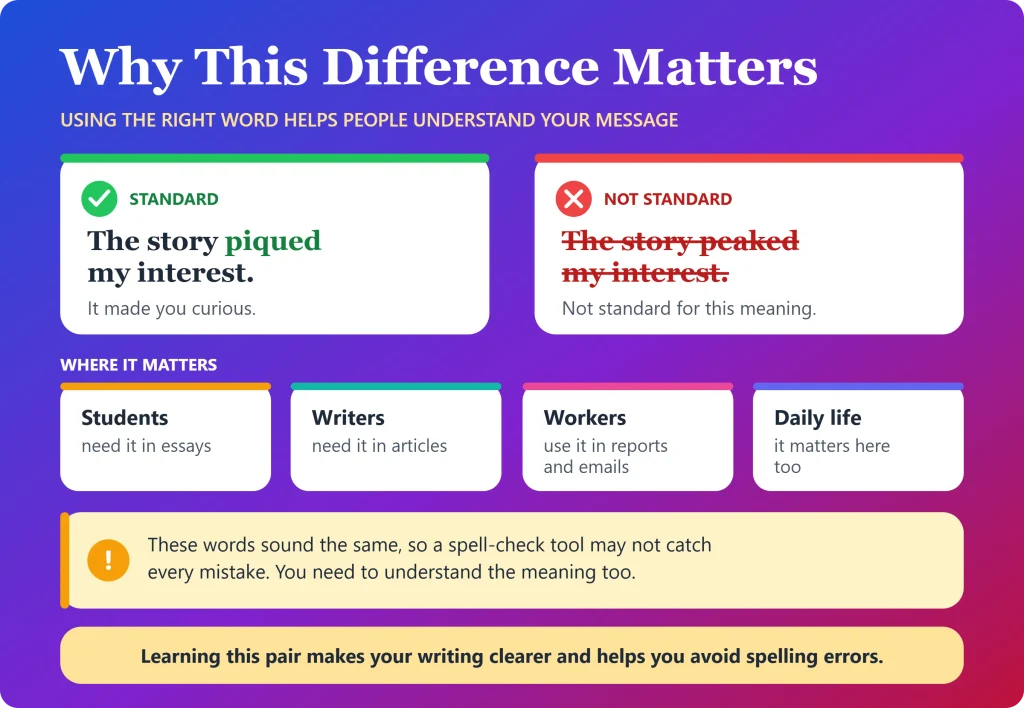
Using the right word helps people understand your message. The wrong spelling can change the meaning of a sentence.
For example, “The story piqued my interest” means the story made you curious. “The story peaked my interest” is not the standard form for this meaning.
The difference also matters in school, work, and daily life. Students need the right word in essays. Writers need it in articles. Workers may use it in reports and emails.
These words sound the same, so a spell-check tool may not catch every mistake. You need to understand the meaning too.
Learning this pair can make your writing clearer. It can also help you avoid common spelling errors.
Usefulness in Daily Life
You can use these words in many daily situations.
- At work: Say that sales peaked when they reached their highest level.
- At school: Say that a topic piqued your interest when it made you curious.
- In emails: Use “piqued my interest” when you want to learn more.
- In reports: Use “peaked” to explain when a number reached its top level.
- In talks: Use piqued to describe interest or annoyance.
Situational Preference
Choose peaked when you discuss a high point. It works for sales, prices, heat, fame, and success. Choose piqued when something starts a feeling. It works with interest, curiosity, pride, and annoyance. At school essay, write “The topic piqued my interest.” In a business report, write “Sales peaked in July.” In a news story, use the word that matches the facts. Do not choose by sound alone. Both words sound the same, so check the meaning before you write.
Common Questions and Answers
1. What is the main difference between peaked and piqued?
Peaked means reached the highest point. Piqued means stirred interest or caused annoyance.
2. Is it peaked my interest or piqued my interest?
The correct phrase is “piqued my interest.” It means something made you curious or interested.
3. Do peaked and piqued sound the same?
Yes. Both are pronounced /piːkt/ in standard US and UK English.
4. Can peaked mean pale or unwell?
Yes. In some English use, especially British English, peaked can mean pale or unwell.
5. Is piqued a past-tense verb?
Yes. Piqued is the past tense and past participle of pique.
6. Can I use peaked for sales and prices?
Yes. Use peaked when sales, prices, or numbers reach their highest point.
7. Does British English use different spellings?
No. British and American English both use peaked and piqued.
Conclusion
The words peaked or piqued sound the same, but they have different meanings. Peaked comes from peak. It means reaching the highest point or level. You can use it for sales, prices, heat, fame, and success. Piqued comes from pique. It means stirring interest, curiosity, pride, or annoyance. The phrase “piqued my interest” is a common use. It means something made you want to know more. Do not write “peaked my interest” when you mean this. Use peaked for a high point and piqued for a feeling. Both spellings are correct in US and UK English. The key is to choose the word that matches your meaning. Think about the sentence before you write it. With this simple rule, you can use both words with care and confidence.

I’m Samia Jamshaid, an English language specialist, SEO specialist, digital publisher, and researcher. I create clear, accurate, and well-researched content on English grammar, vocabulary, word meanings, and language comparisons, helping readers understand and use English with confidence.