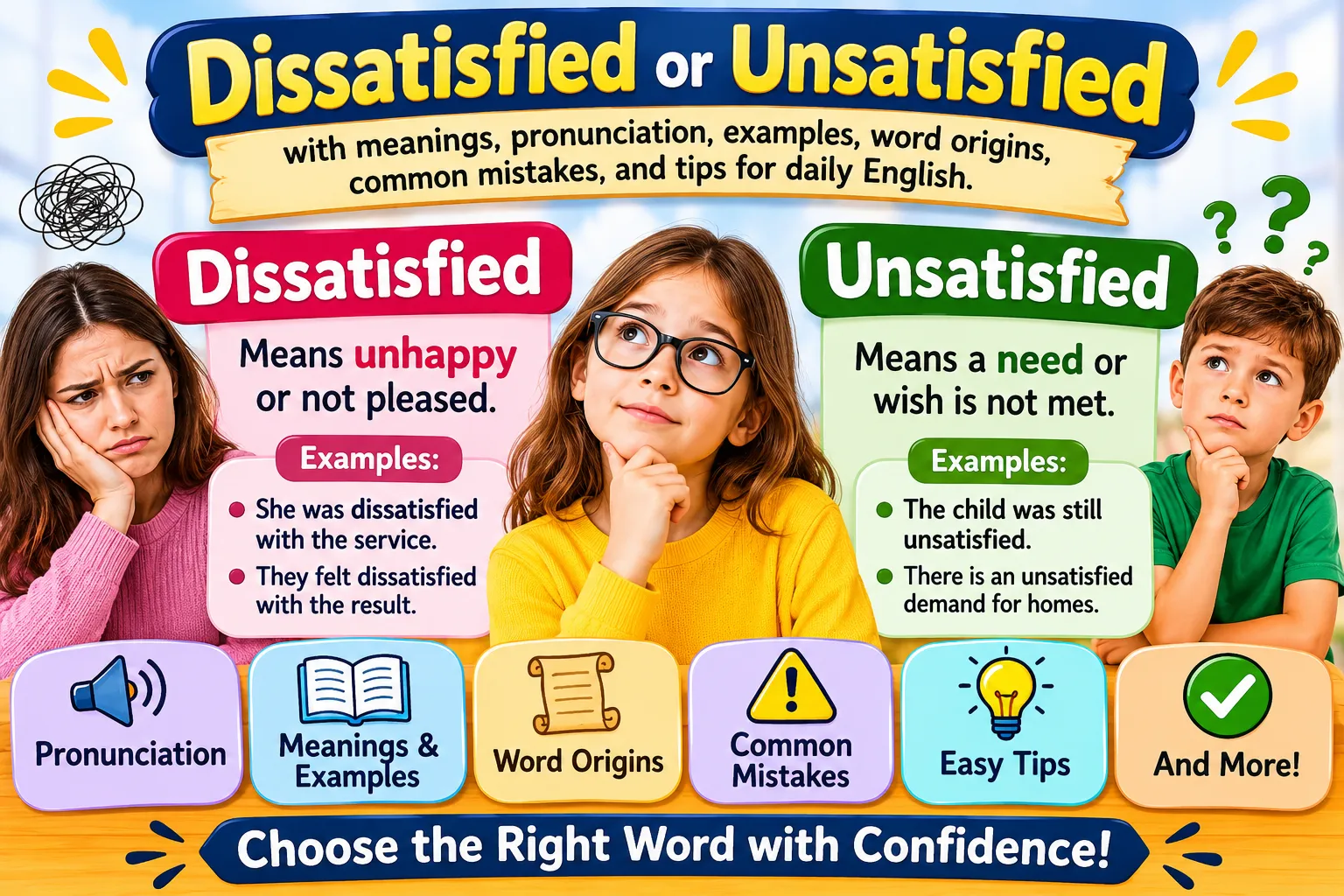
Dissatisfied means unhappy with something. Unsatisfied often means a need or wish has not been met.
Imagine you visit a café and order a meal. The food is cold, and the service is poor. You feel unhappy with your visit. You are dissatisfied with the service. Now imagine you eat a small meal but still feel hungry. Your hunger is unsatisfied.
These words have close meanings. Both can show that something is not right or enough. But they are often used in different ways. Dissatisfied usually talks about an unhappy feeling. Unsatisfied often talks about a need, wish, or desire that is still not met.
Many people search for dissatisfied or unsatisfied because the words seem almost the same. They want to know which word fits each sentence. Both words are correct, and both can describe people. The right choice depends on what you want to say.In this guide, you will learn their meanings, sounds, spelling, and uses.
Pronunciation of Dissatisfied and Unsatisfied
| Word | US pronunciation | UK pronunciation |
| Dissatisfied | /dɪˈsæt̬ɪsˌfaɪd/ | /dɪsˈsætɪsfaɪd/ |
| Unsatisfied | /ʌnˈsæt̬ɪsˌfaɪd/ | /ʌnˈsætɪsfaɪd/ |
The words do not sound the same. Dissatisfied starts with a “dis” sound. Unsatisfied starts with an “un” sound. The rest of each word sounds very similar.
Difference Between Dissatisfied and Unsatisfied
1. Main Meaning
Dissatisfied means unhappy or not pleased with something.
Unsatisfied means that a need or wish has not been met.
Examples:
- The customer was dissatisfied with the service.
- The child was still unsatisfied after lunch.
2. Main Focus
Dissatisfied often focuses on how a person feels.
Unsatisfied often focuses on what is missing.
Examples:
- The workers were dissatisfied with their pay.
- The town had many unsatisfied needs.
3. Use with People
Dissatisfied is often used for people who are unhappy with something.
Unsatisfied can describe people who did not get what they wanted.
Examples:
- She was dissatisfied with her new phone.
- He felt unsatisfied after the short meal.
4. Use with Needs
Dissatisfied can describe a person who is unhappy about a need.
Unsatisfied can describe a need that has not been met.
Examples:
- Parents were dissatisfied with the school.
- The area had an unsatisfied need for clean water.
5. Use with Customers
Dissatisfied is common when customers are unhappy with a shop or service.
Unsatisfied can describe customers who feel they did not get enough.
Examples:
- The shop called its dissatisfied customers.
- The small meal left some guests unsatisfied.
6. Use with Wishes
Dissatisfied shows that someone is unhappy about not getting what they want.
Unsatisfied can show that a wish is still not fulfilled.
Examples:
- He was dissatisfied with his test result.
- Her wish to travel remained unsatisfied.
7. Use with Feelings
Dissatisfied often shows sadness, anger, or disappointment.
Unsatisfied can show that a feeling or need is not fully met.
Examples:
- I was dissatisfied with the final answer.
- The story left me feeling unsatisfied.
8. Use with Work and Success
Dissatisfied can describe people who are unhappy with their work or results.
Unsatisfied can describe a wish or need that is still not met.
Examples:
- The staff were dissatisfied with the new rules.
- Her wish for a better job remained unsatisfied.
9. Common Word Partners
Dissatisfied often appears with words such as customers, workers, users, and service.
Unsatisfied often appears with words such as needs, demand, curiosity, and desire.
Examples:
- Dissatisfied customers asked for their money back.
- The book left her curiosity unsatisfied.
10. Easy Memory Tip
Use dissatisfied when someone feels unhappy.
Use unsatisfied when a need or wish is still not met.
Examples:
- I was dissatisfied with the poor service.
- The child’s hunger was unsatisfied.
Remember: Both words can describe people. Their meanings can sometimes be very close.
Learn more about https://orchoice.com/pedal-or-peddle/
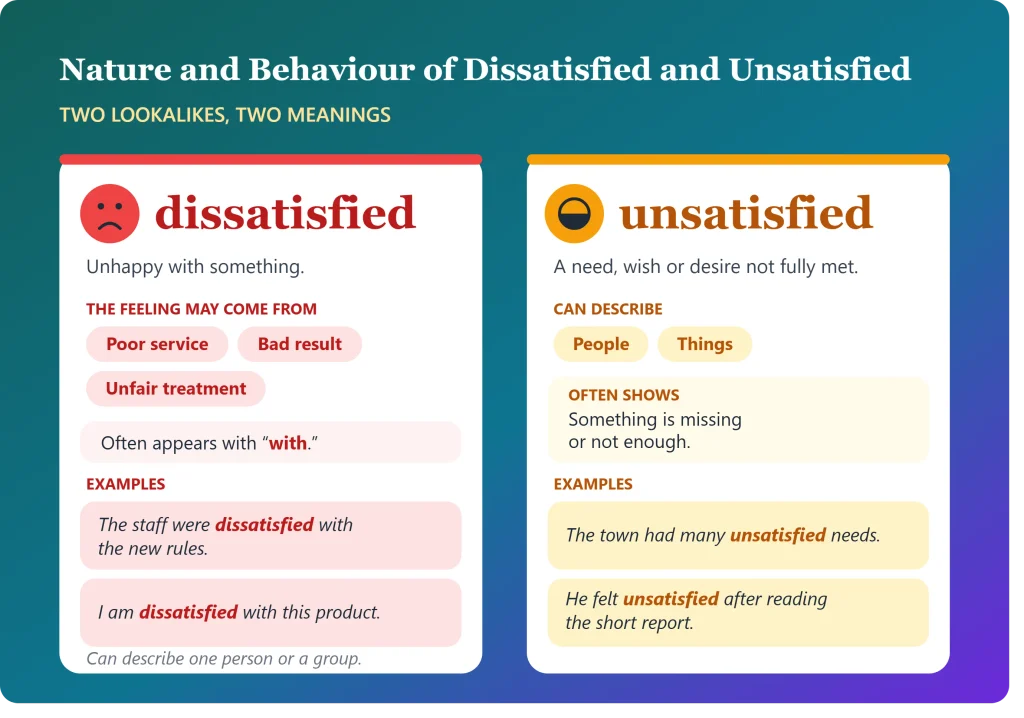
Nature and Behaviour of Dissatisfied and Unsatisfied
Dissatisfied
Dissatisfied describes a person who is unhappy with something. This feeling may come from poor service, a bad result, or unfair treatment.
It often appears with the word with.
Examples:
- The staff were dissatisfied with the new rules.
- I am dissatisfied with this product.
It can describe one person or a group.
Unsatisfied
Unsatisfied means that a need, wish, or desire has not been fully met. It can describe people and things.
Examples:
- The town had many unsatisfied needs.
- He felt unsatisfied after reading the short report.
It often shows that something is missing or not enough.
Why People Get Confused About Dissatisfied and Unsatisfied
People mix up these words because they have close meanings. Both can mean that someone is not happy or does not have enough.
Both words also have a short part at the start:
- Dis- changes the meaning of satisfied.
- Un- means “not.”
The words can also describe the same person.
For example, a customer may be dissatisfied with poor service. The same customer may feel unsatisfied because the problem was not fixed.
Comparison Table
| Point | Dissatisfied | Unsatisfied |
| Main meaning | Unhappy or not pleased | Not fully met |
| Main focus | A person’s feelings | A need or wish |
| Common use | People and groups | Needs, wishes, and people |
| Customers | Dissatisfied customers | Unsatisfied customers |
| Needs | A person is unhappy about a need | A need is not met |
| Curiosity | A person is unhappy with an answer | Curiosity is not fulfilled |
| Common phrase | Dissatisfied with the service | Unsatisfied demand |
| Feeling | Often shows unhappiness | Often shows a lack |
| US spelling | Dissatisfied | Unsatisfied |
| UK spelling | Dissatisfied | Unsatisfied |
Similarities: Both words mean that satisfaction is missing. Both can describe people. Both can be used with with. Their meanings can overlap.
The Origin of Dissatisfied and Unsatisfied
Origin of Dissatisfied
The word dissatisfied comes from the word satisfy. It uses the prefix dis- to give a negative meaning.
The word dissatisfy was used in English by the 1660s. It means to make someone unhappy or to fail to meet their wishes.
Origin of Unsatisfied
The word unsatisfied also comes from satisfy. It uses the prefix un-, which means “not.”
The word has been used in English since the late 1400s. It means not satisfied or not fully fulfilled.
Both words come from the same base word. Their first parts help explain their meanings.
British vs American English
There is no spelling difference between British and American English. Both use dissatisfied and unsatisfied.
| Use | American English | British English |
| Unhappy with a service | Dissatisfied | Dissatisfied |
| A need that is not met | Unsatisfied | Unsatisfied |
| A wish not fulfilled | Unsatisfied | Unsatisfied |
| Unhappy customers | Dissatisfied customers | Dissatisfied customers |
Examples:
- US: I am dissatisfied with the hotel service.
- UK: I am dissatisfied with the hotel service.
- US: There is unsatisfied demand for homes.
- UK: There is unsatisfied demand for homes.
The spelling stays the same. The main difference is the meaning you want to share.
Which One Should You Use?
Use dissatisfied when you want to show that someone is unhappy or not pleased.
Use unsatisfied when you want to show that a need or wish has not been met.
For American readers, both words are correct. The same is true for British readers. You do not need to change their spelling.
For clear writing, follow these simple tips:
- A person who is unhappy with a service is often dissatisfied.
- A need that has not been met is unsatisfied.
- A person who did not get enough may feel unsatisfied.
- A group that dislikes a new rule may be dissatisfied.
Common Mistakes
| Incorrect or less clear | Better choice | Reason |
| The customers were unsatisfied with the rude staff. | The customers were dissatisfied with the rude staff. | Shows that they were unhappy. |
| The town had many dissatisfied needs. | The town had many unsatisfied needs. | The needs were not met. |
| I was dissatisfied because I still wanted more food. | I was unsatisfied because I still wanted more food. | Shows that there was not enough food. |
| Her demand was dissatisfied. | Her demand was unsatisfied. | The demand was not met. |
| He was unsatisfied with the unfair treatment. | He was dissatisfied with the unfair treatment. | Shows that he was unhappy. |
Easy tip: Ask yourself: Is someone unhappy, or is something still missing?
Everyday Usage Examples
In Emails
- I am dissatisfied with the service I received.
- My request is still unsatisfied because I have not received a reply.
On Social Media
- Many users are dissatisfied with the new update.
- My curiosity is still unsatisfied after watching the short video.
In News
- Dissatisfied workers asked for better pay.
- The report found an unsatisfied demand for low-cost homes.
In Formal Writing
- Many customers were dissatisfied with the service.
- The study found that some basic needs remained unsatisfied.
Usage Trends
Both words are used in modern English. You can find them in books, news, business reports, and daily talks.
Dissatisfied is common in customer reviews and surveys. It often describes people who are unhappy with a service, plan, or result.
Unsatisfied is often used with needs, wishes, and demands. It can also describe a person who did not get enough.
The words sometimes have the same meaning. A person can feel both dissatisfied and unsatisfied at the same time.
Metaphors and Similes
Writers can use these words to show deeper feelings.
Dissatisfied
Dissatisfied can show that someone feels unhappy with life or a situation.
Examples:
- He felt dissatisfied, like a bird in a small cage.
- She looked dissatisfied, as if a dark cloud followed her.
Unsatisfied
Unsatisfied can show that a need or wish is still open.
Examples:
- His hunger was like an empty cup that stayed unsatisfied.
- Her curiosity was like a door left open.
Connotative Meaning
Positive Tone
Neither word is usually positive by itself. But an unhappy feeling can lead to good change.
Dissatisfied: A person may speak up and ask for better service.
Example: Dissatisfied workers asked for safer work areas.
Unsatisfied: A wish to learn more may help someone grow.
Example: Her unsatisfied curiosity led her to read more books.
Negative Tone
Dissatisfied: This word can show anger or disappointment.
Example: The dissatisfied guests left the hotel early.
Unsatisfied: This word can show that something is missing.
Example: The unsatisfied demand caused a shortage of homes.
Neutral Tone
Dissatisfied: It can simply report that someone is not pleased.
Example: The survey found that some users were dissatisfied.
Unsatisfied: It can simply report that a need has not been met.
Example: The town still had unsatisfied needs for clean water.
Idioms and Proverbs
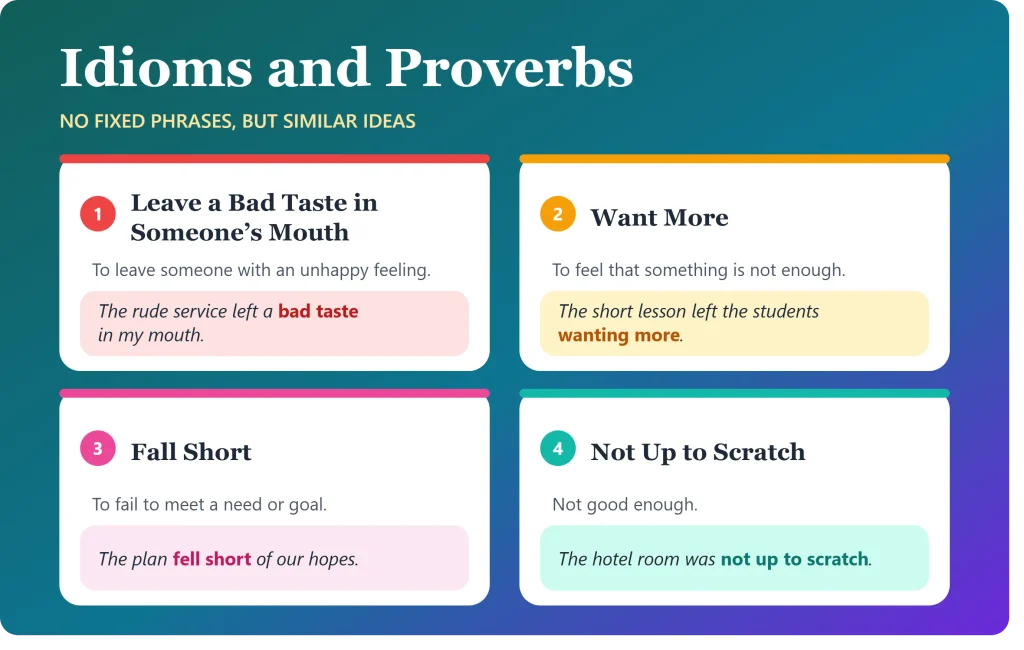
There are no common idioms that use dissatisfied or unsatisfied as fixed phrases. But these expressions share similar ideas.
Leave a Bad Taste in Someone’s Mouth
This means to leave someone with an unhappy feeling.
Example: The rude service left a bad taste in my mouth.
Want More
This means to feel that something is not enough.
Example: The short lesson left the students wanting more.
Fall Short
This means to fail to meet a need or goal.
Example: The plan fell short of our hopes.
Not Up to Scratch
This means not good enough.
Example: The hotel room was not up to scratch.
Literature and Movies
Literature
The book Poor White (1920) by Sherwood Anderson is a work of American fiction. It includes the phrase “unsatisfied curiosity.” This shows how unsatisfied can describe a feeling that has not been fulfilled.
Movies
The film The Pursuit of Happyness (2006) is an American drama based on Chris Gardner’s life. It shows his struggle to meet basic needs and build a better life.
The story helps viewers think about needs, hopes, and hard times. It also shows why people may feel unhappy when life does not meet their hopes.
These examples show ideas linked to the words. They do not claim that the words appear in a famous line from the works.
Why This Difference Matters
Using the right word helps people understand your message.
If you write “dissatisfied customers,” readers know that the customers are unhappy. If you write “unsatisfied demand,” readers know that people want something but cannot get enough.
This difference matters at school, at work, and in daily life. Students need clear words in essays. Workers need them in reports. Shops use them to explain why customers are unhappy. When you know this small difference, you can write more clearly. You can also avoid common spelling mistakes.
Usefulness in Daily Life
You can use both words in many daily situations.
- At work: Use dissatisfied for workers who dislike a new rule.
- In business: Use dissatisfied customers when people are unhappy with a service.
- At school: Use unsatisfied curiosity when a student still wants answers.
- In reports: Use unsatisfied demand when people need more of a product.
- In daily talks: Use unsatisfied when you did not get enough food or rest.
Situational Preference
Choose dissatisfied when you want to show that a person or group is unhappy. It works well in customer reviews, work reports, and complaints. Choose unsatisfied when you want to show that a need or wish is still not met. It works well in news, school work, and reports. For example, a customer may be dissatisfied with poor service. A town may have unsatisfied needs for clean water. In some cases, both words can work. Think about whether you mean an unhappy feeling or something still missing.
Common Questions and Answers
1. What is the main difference between dissatisfied and unsatisfied?
Dissatisfied often means unhappy or not pleased. Unsatisfied often means that a need or wish has not been met.
2. Are dissatisfied and unsatisfied both correct?
Yes. Both are correct English words. Their meanings can be close, but they often have different uses.
3. Can I say I am unsatisfied with my meal?
Yes. It means the meal did not give you what you wanted. You can also say you are dissatisfied with the meal if you are unhappy with it.
4. Is dissatisfied common with customers?
Yes. The phrase dissatisfied customers is very common. It often means people are unhappy with a product or service.
5. Can a need be dissatisfied?
No. A need cannot feel unhappy. Use unsatisfied need because the need has not been met.
6. Are the spellings different in British and American English?
No. Both regions use dissatisfied and unsatisfied in the same way.
7. Which word should I use in formal writing?
Use dissatisfied for unhappy people or groups. Use unsatisfied for needs, wishes, and demands that are not met. Always check the full meaning of your sentence.
Conclusion
The words dissatisfied or unsatisfied both show that satisfaction is missing. But they often focus on different things. Dissatisfied usually means that a person or group is unhappy with something. Unsatisfied often means that a need, wish, or demand has not been met. For example, a customer may be dissatisfied with poor service. A town may have unsatisfied needs for clean water. A person may also feel unsatisfied after a small meal. Both words can describe people, so their uses can sometimes overlap.
There is no spelling change between British and American English. Both forms are correct around the world. Think about the meaning before you choose. Ask yourself: Is someone unhappy, or is something still missing? This simple question can help you choose the right word. With practice, you can use both words with care and confidence.

I’m Samia Jamshaid, an English language specialist, SEO specialist, digital publisher, and researcher. I create clear, accurate, and well-researched content on English grammar, vocabulary, word meanings, and language comparisons, helping readers understand and use English with confidence.





1 thought on “Dissatisfied or Unsatisfied Spelling, Meaning, and Usage 2026”