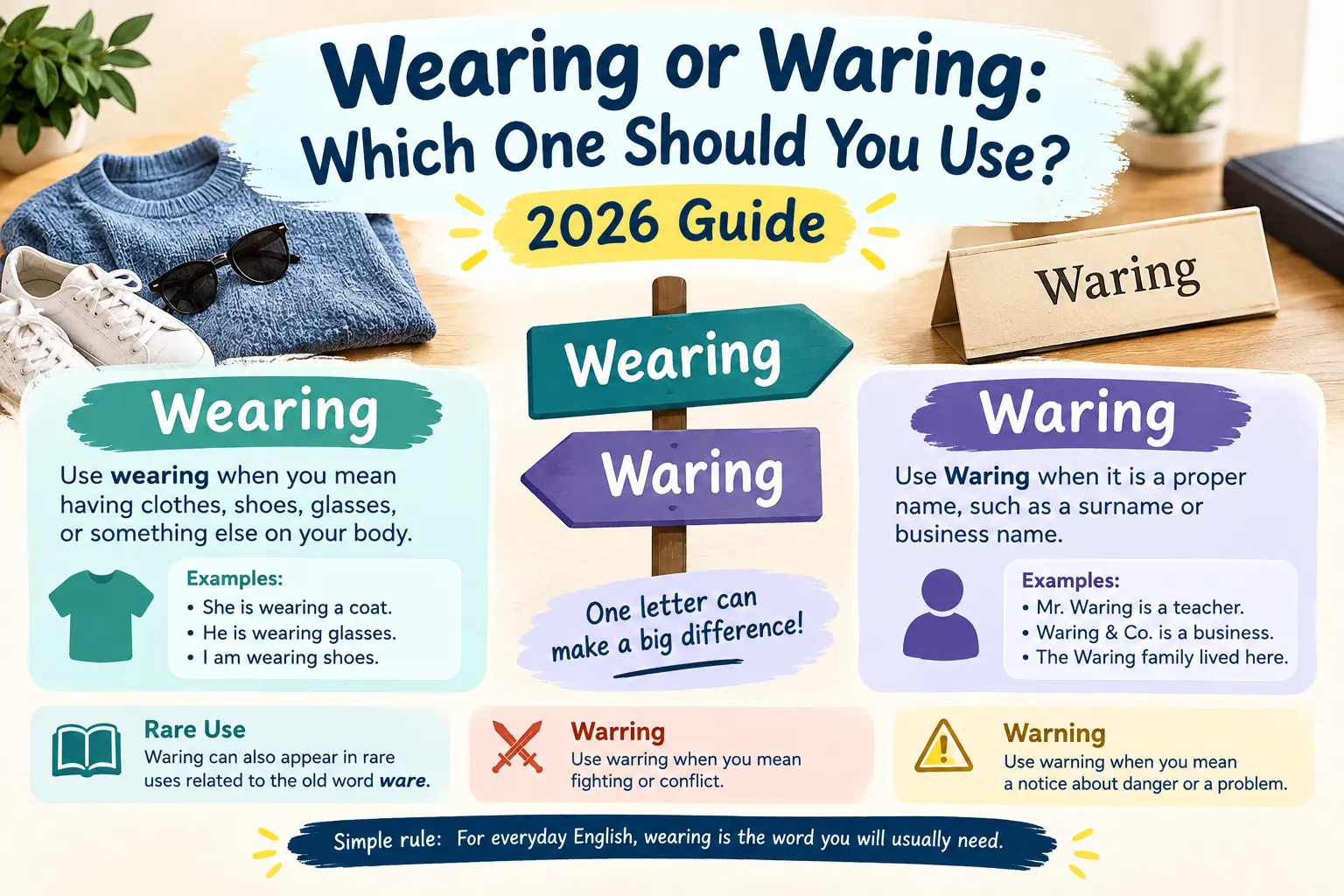
If you are talking about clothes, shoes, glasses, or something you have on your body, wearing is the normal word. Waring is a very rare word and is also used as a name. The two spellings look close and can sound the same, so many people type the wrong one. This can happen when writing fast, using autocorrect, or learning English. For example, you may wonder if you should write, “She is wearing a red dress” or “She is waring a red dress.” The answer is wearing. It comes from the verb wear. Wearing can also talk about damage from use, such as a carpet wearing thin. It can even describe something that makes you tired, such as a wearing day. Waring has rare uses linked to the old verb ware, and it can also be a surname or name. That means it is not simply a “bad word.” It is just not the normal spelling for the common verb wear. Learning this small difference can help you avoid spelling and grammar mistakes in school, work, emails, and daily writing.
Pronunciation of Wearing and Waring
| Word | US pronunciation | UK pronunciation |
| Wearing | /ˈwer.ɪŋ/ | /ˈweə.rɪŋ/ |
| Waring | No single standard pronunciation | No single standard pronunciation |
Wearing has a clear standard pronunciation in both US and UK English. Waring may be pronounced similarly when it is the rare word or a surname, but names can have their own pronunciation.
Difference Between Wearing and Waring
1. Wearing is the normal spelling
Wearing is the normal modern spelling when wear becomes an -ing form.
Examples:
She is wearing a blue shirt.
He is wearing new shoes.
2. Wearing talks about clothes and things on your body
We use wearing for clothes, shoes, glasses, jewelry, makeup, uniforms, and other things we have on our bodies.
Examples:
Mia is wearing a red dress.
Tom is wearing glasses.
3. Wearing Comes from the Verb Wear
The word wearing comes from the verb wear.
Here are the main forms:
| Form | Example |
| wear | I wear a hat. |
| wears | She wears a hat. |
| wore | She wore a hat yesterday. |
| worn | She has worn that hat before. |
| wearing | She is wearing that hat now. |
4. Waring is not the normal -ing form of wear
A common mistake is to remove the final e from wear and write waring.
That does not work here.
The correct form is:
wear → wearing
Not:
wear → waring
Examples:
Incorrect: She is waring a coat.
Correct: She is wearing a coat.
Incorrect: He is waring glasses.
Correct: He is wearing glasses.
5. Wearing can describe damage
Wearing does not only relate to clothes.
It can also describe something becoming thinner, weaker, or damaged because of use.
Examples:
The carpet is wearing thin.
The steps are wearing down.
6. Wearing can mean tiring
Wearing can also be an adjective.
It means something makes you feel tired or annoyed.
Examples:
It was a very wearing day.
Caring for the children all day can be wearing.
7. Waring can be a rare word
Waring is not always a spelling mistake.
It can be the -ing form of the rare verb ware. Some dictionaries list ware with old or regional meanings, including “to beware of” and, in some uses, “to spend.”
However, this use is rare.
Examples:
You may see waring in old or regional writing.
8. Waring can be a name
Waring is also an English surname.
So, a sentence may contain Waring because it refers to a person, family, place, company, or other proper name.
Examples:
Mr. Waring spoke at the meeting.
The Waring family lived in the area.
9. Wearing and warring have different meanings
Do not confuse wearing with warring.
Wearing comes from wear.
Warring comes from war and relates to fighting or conflict.
Examples:
The child is wearing a helmet.
The two countries were warring for years.
A simple memory rule is:
wear → wearing
war → warring
10. Wearing and warning are different too
Another common mistake is waring instead of warning.
Warning comes from warn.
It means telling someone about danger or a problem.
Examples:
The sign is a warning about the wet floor.
The teacher gave us a warning.
So remember:
wear → wearing
war → warring
warn → warning
ware → waring in rare uses
Explore related topics https://grammaryx.com/wearing-or-waring/
Nature and Behaviour of Wearing and Waring
Wearing is a normal and useful English word. You can see it in daily speech, school writing, emails, news, books, and conversations. It can describe clothes, accessories, damage, expressions, and tiring situations.
Waring is much less common. It may appear as a rare form of ware or as a proper name. It is not the normal form of wear.
This is why the best choice in normal writing is usually simple:
Use wearing when you mean the -ing form of wear.
Why People Get Confused About Wearing and Waring
There are several reasons.
They look almost the same
The words differ by only one letter:
wearing
waring
That makes typing mistakes easy.
They can sound similar
In many accents, wearing and Waring can sound alike or very close.
People confuse wear and war
Wear and war sound different in meaning but can cause spelling problems.
Remember:
wear = have something on
war = fighting between groups or countries
Spellcheck may not always help
A rare word can sometimes be accepted by a dictionary or word tool. Waring accepted does not mean it is the right word for your sentence.
Comparison Table
| Point | Wearing | Waring |
| Common in modern English | Yes | Very rare |
| Normal form of wear | Yes | No |
| Used for clothes | Yes | No |
| Can describe damage from use | Yes | No, not in this sense |
| Can mean tiring | Yes | No |
| Rare word | No | Yes |
| Can be a surname | Sometimes | Yes |
| Related base word | wear | ware in rare use |
| Common in daily writing | Yes | Very rare |
| Best choice for “have on” | Yes | No |
Origin of Wearing and Waring
Origin of Wearing
The word wear has a long history.
The old word had the idea of having or carrying something on the body. Over time, the modern verb developed many uses.
The word wearing is the -ing form of wear.
Over time, the meaning grew beyond clothes. Wear can also describe damage caused by use, such as a floor becoming worn.
Origin of Waring
Waring has more than one possible background.
As a word, it can come from the rare verb ware, which has old or regional uses. Some dictionary sources list waring as a form of that verb.
As a name, Waring has a separate surname history.
For example, family-name sources connect Waring with older personal names such as Warin.
British vs. American English
There is no normal US-versus-UK spelling difference for wearing.
Both use:
wearing
Examples:
US: She is wearing a jacket.
UK: She is wearing a jacket.
Which One Should You Use?
For normal English, use wearing when you mean:
- having clothes on
- having shoes on
- having glasses on
- having jewelry on
- using makeup
- having a uniform or badge on
- showing an expression
- becoming damaged through use
- Use Waring when it is a proper name, such as a surname or business name.
- Use waring only in a rare or special use related to the old word ware.
- Use warring when you mean fighting or conflict.Use warning when you mean a notice about danger or a problem.
Common Mistakes
Mistake 1: Using “waring” for clothes
Incorrect: She is waring a dress.
Correct: She is wearing a dress.
Mistake 2: Using “waring” for shoes
Incorrect: He is waring black shoes.
Correct: He is wearing black shoes.
Mistake 3: Using “waring” in “wearing me out”
Incorrect: The long trip is waring me out.
Correct: The long trip is wearing me out.
Mistake 4: Using “wearing” for a finished past action
Incorrect: He is wearing that jacket yesterday.
Correct: He wore that jacket yesterday.
Mistake 5: Using “waring” instead of “warning”
Incorrect: The sign gave a waring.
Correct: The sign gave a warning.
Mistake 6: Using “waring” instead of “warring”
Incorrect: The two groups were waring.
Correct: The two groups were warring.
Mistake 7: Forgetting the base word
Incorrect: wear → waring
Correct: wear → wearing
Remember:
wear → wearing
war → warring
warn → warning
Everyday Usage Examples
In emails
I am wearing the company uniform today.
Please tell me what we should be wearing for the event.
On social media
I am wearing my favorite jacket today.
What are you wearing tonight?
In news
The players were wearing their team colors.
The workers were wearing safety helmets.
In school writing
The girl was wearing a blue dress.
The old road showed signs of wearing.
In formal writing
All staff must be wearing an identification badge.
The floor is showing signs of heavy wear.
Usage Trends
Wearing is a normal everyday English word. It appears often because people talk about clothes, uniforms, shoes, glasses, and many other things they have on their bodies.
It also appears in phrases about damage and tiredness.
Waring is far less common. It may appear as a surname, name, or rare word connected with ware.
Because of this, learners are much more likely to need wearing than waring in normal writing.
Do not choose a spelling only because a spellchecker accepts it. Look at the meaning first.
Metaphors and Similes
The word wear is also used in many figurative ways.
Wearing a smile
Someone can “wear a smile.” This means they have a smile on their face.
Example:
She was wearing a bright smile.
Wear your heart on your sleeve
This means to show your feelings openly.
Example:
He wears his heart on his sleeve.
Wear many hats
This means to have many roles or jobs.
Example:
At work, she wears many hats.
Wear thin
This means something becomes less acceptable after repeated use.
Example:
His excuses are wearing thin.
These uses show that wear is not only about clothes.
Connotative Meaning
The word wearing can give different feelings depending on how it is used.
| Use | Tone | Example |
| Wearing clothes | Neutral | She is wearing a blue coat. |
| Wearing a uniform | Neutral/Positive | He is wearing his work uniform. |
| Wearing a smile | Positive | She was wearing a warm smile. |
| Wearing someone down | Negative | The long delay was wearing him down. |
| Wearing = tiring | Negative | It was a wearing day. |
Idioms and Proverbs
The word wear appears in many common English expressions.
Wear your heart on your sleeve
Show your feelings openly.
Wear many hats
Have many roles or jobs.
Wear thin
Become less acceptable over time.
Wear someone down
Make someone weaker or more tired over time.
Wear someone out
Make someone very tired.
Wear and tear
Normal damage caused by use.
Example:
The sofa has some wear and tear after years of use.
These expressions are useful in everyday English.
Wearing in Literature and Movies
Literature
“You Were Wearing” — Kenneth Koch, 1962
This is a free-verse lyric poem by American poet Kenneth Koch. It was first published in his collection Thank You and Other Poems in 1962. The title uses wearing in its normal sense of having clothes on.
Traditional ballad
“The Wearing of the Green” — Irish street ballad, associated with 1798
This traditional Irish ballad uses wearing to talk about wearing green. Many versions exist, and the best-known later version is linked with Dion Boucicault.
Movie
The Wearing of the Grin — 1951, United States
This is a Warner Bros. animated comedy short directed by Chuck Jones and written by Michael Maltese. Its title uses “wearing” and plays on the older Irish song title.
These examples show that wearing is a normal English word used in many types of writing and entertainment.
Why the Difference Matters
A small spelling change can change the meaning of a sentence.
Compare:
She is wearing a hat.
The two groups are warring.
The sign gives a warning.
Waring is the man’s surname.
Each word has a different job.
Using the wrong spelling can make your writing unclear. It can also make schoolwork, emails, reports, and website content look less polished.
The good news is that the difference is easy to remember.
Start with the base word:
wear → wearing
war → warring
warn → warning
ware → waring in rare uses.
Connotative Meaning
The word wearing can give different feelings depending on how it is used.
| Use | Tone | Example |
| Wearing clothes | Neutral | She is wearing a blue coat. |
| Wearing a uniform | Neutral/Positive | He is wearing his work uniform. |
| Wearing a smile | Positive | She was wearing a warm smile. |
| Wearing someone down | Negative | The long delay was wearing him down. |
| Wearing = tiring | Negative | It was a wearing day. |
Situational Preference
In almost every normal situation about clothes or things on the body, choose wearing. Use it in schoolwork, emails, social posts, news writing, work documents, and everyday speech. If the sentence is about fighting or conflict, use warring. In case it is about danger or advice, use warning. If Waring is a person’s name, place, brand, or another proper name, keep the capital letter. The rare word waring should only be used when the sentence clearly calls for the old or regional verb ware. When in doubt, check the base word and the meaning.
Wearing or Waring: Common Questions
1. Is wearing the correct spelling?
Yes. Wearing is the normal spelling of the -ing form of wear.
2. Is waring a word?
Yes, but it is very rare. It can be linked to the old or regional verb ware. Waring is also used as a surname. It is not the normal form of wear.
3. Is “waring clothes” correct?
No, not in normal modern English.
Write:
She is wearing clothes.
4. What is the difference between wearing and warring?
Wearing comes from wear and can relate to clothes or use over time.
Warring comes from war and means fighting or being in conflict.
5. What is the difference between wearing and warning?
Wearing comes from wear.
Warning comes from warn and means a notice about danger or a problem.
6. Can Waring be a name?
Yes. Waring is an English surname. It can also appear in the name of a place or business.
7. How can I remember wearing?
Use the base-word test:
wear → wearing
If the word fits the wear word family, such as wear, wears, wore, or worn, use we
Conclusion
Wearing or Waring have a simple difference: wearing is the normal spelling, while waring is very rare. Wearing is the normal modern English word. It is the -ing form of wear, and we use it when someone has clothes, shoes, glasses, jewelry, makeup, or another item on the body. It can also describe damage from use and something that makes you tired. Waring is much rarer. It can appear as a form of the old or regional verb ware, and Waring is also used as a surname or name. So, if you are writing about clothes, do not use waring. Use wearing. Also remember the nearby words warring and warning. Warring relates to war, while warning relates to danger or advice. The easiest memory rule is wear → wearing, war → warring, warn → warning. Once you learn these base words, this spelling problem becomes much easier.

I’m Samia Jamshaid, an English language specialist, SEO specialist, digital publisher, and researcher. I create clear, accurate, and well-researched content on English grammar, vocabulary, word meanings, and language comparisons, helping readers understand and use English with confidence.












1 thought on “Wearing or Waring: Which One Should You Use? 2026 Guide”