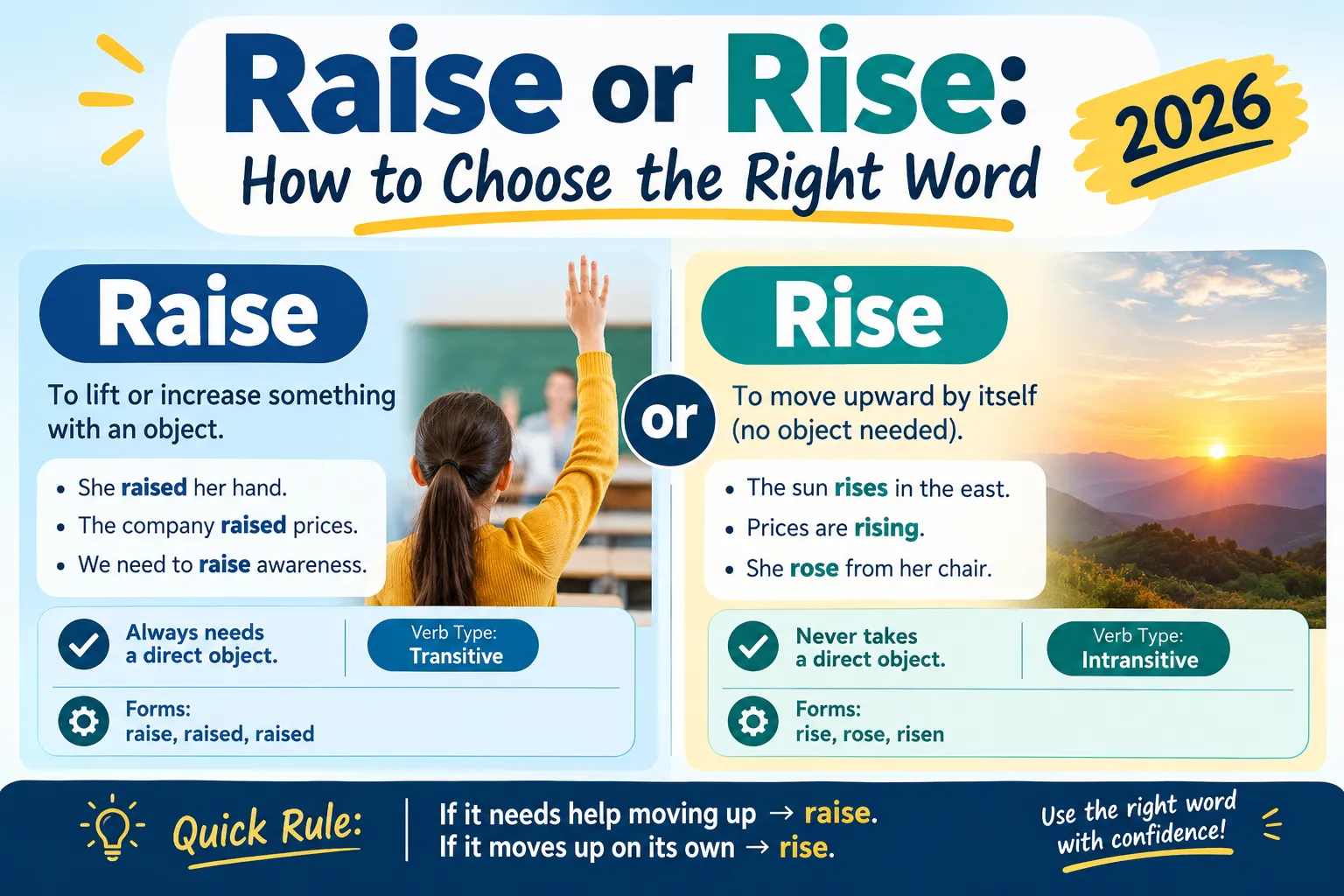
People often confuse raise or rise because both words describe something going up. The good news is that the main difference is simple. Raise means to move something up or cause an increase, while rise means to go up or increase without a direct object. For example, you raise your hand, but your hand rises when it moves upward. You can also raise prices, while prices rise. This difference matters in everyday English, school writing, work emails, and news reports. The two words also have different past forms: raise → raised → raised, while rise → rose → risen. People often search for raise or rise because the words look and sound similar, but they follow different grammar rules. Once you understand the role of the direct object, choosing between raise or rise becomes much easier.
Pronunciation
| Word | US Pronunciation | UK Pronunciation |
| Raise | /reɪz/ | /reɪz/ |
| Rise | /raɪz/ | /raɪz/ |
Difference Between Raise or Rise
1. Direct Object
The clearest difference is grammar.
Raise is a transitive verb. It normally takes a direct object.
Rise is an intransitive verb. It does not take a direct object.
- Please raise your hand.
- The teacher raised the window.
- The sun rose early.
- Smoke rose from the chimney.
A useful question is:
Raise what? If you can answer that question, raise may be the right word.
2. Causing Something to Move Up
Raise shows that someone or something causes another thing to move higher.
Rise describes the thing that moves higher.
- The worker raised the flag.
- The crane raised the heavy beam.
- The balloon rose into the sky.
- Hot air rises toward the ceiling.
Think of it this way:
Raise = cause something to go up.
Rise = go up.
3. Increasing Prices, Costs, or Rates
Both words can describe increases, but the grammar changes.
Use raise when someone actively increases something.
Use rise when the price, cost, rate, or amount increases.
- The company raised its prices.
- The bank raised interest rates.
- Food prices rose last month.
- Interest rates rose again.
So:
Someone raises prices. Prices rise.
4. Past Tense
The two verbs have different past forms.
Raise is regular:
raise → raised → raised
Rise is irregular:
rise → rose → risen
Examples:
- The company raised its prices yesterday.
- She raised her hand.
- The sun rose at 6:00.
- Prices rose sharply last year.
5. Past Participle
The past participles are also different.
- Raise → raised
- Rise → risen
Examples:
- They have raised three children.
- The company has raised its standards.
- Prices have risen this year.
- The water level has risen quickly.
Incorrect: Prices have rose.
Correct: Prices have risen.
6. Children and Animals
Raise can mean to care for and bring up children or animals.
Rise does not have this meaning.
- Her grandparents raised her.
- The farmer raised chickens.
- They want to raise their children in a quiet town.
- The family raised cattle on their farm.
Do not say:
Incorrect: They rose three children.
Correct: They raised three children.
However, rise can describe a person getting up.
- The children rose early.
- He rose from his chair.
7. Money, Funds, and Awareness
Raise can mean to collect or create something, especially money, support, or awareness.
- The group will raise funds for the shelter.
- We need to raise money for the project.
- The campaign hopes to raise awareness.
- The charity raised thousands of dollars.
Rise is not used for collecting money or awareness.
Incorrect: We will rise money for charity.
Correct: We will raise money for charity.
8. Getting Up
Rise can mean to get up from a bed, chair, or other position.
- I rise early every morning.
- She rose from her chair.
- He rose at seven yesterday.
Raise can be used when someone or something lifts another person or thing.
- The nurse raised the patient to a sitting position.
- The machine raised the platform.
9. Pay Increase
The nouns raise and rise are used differently in American and British English.
In American English, raise is common for an increase in salary.
- I got a raise at work.
- She asked for a pay raise.
In British English, rise is common for an increase in salary.
- I got a pay rise.
- He asked for a salary rise.
The verb rules do not change:
- The company raised my salary.
- My salary rose this year.
10. Higher Position, Level, or Success
Raise can describe actively moving someone or something to a higher level.
Rise can describe someone or something reaching a higher level.
- The promotion raised her position in the company.
- The new policy raised the standard.
- He rose to a senior position.
- She rose to the top of her field.
Explore related topics https://orchoice.com/wearing-or-waring/
Nature and Behaviour of Raise and Rise
Nature of Raise
Raise usually shows an action that affects another person or thing. The subject causes something else to move, increase, improve, or appear.
You can raise:
- a hand
- a flag
- a question
- a concern
- money
- awareness
- prices
- standards
- children
- animals
Examples:
- She raised a question during the meeting.
- The company raised its prices.
Nature of Rise
Rise describes upward movement or an increase without a direct object.
Things can rise in many ways:
- The sun rises.
- Smoke rises.
- Prices rise.
- Temperatures rise.
- Water levels rise.
- People rise from their seats.
- Someone can rise to a higher position.
Examples:
- The temperature rose during the afternoon.
- The athlete rose to the challenge.
Why People Get Confused About Raise or Rise
The words are easy to confuse because they share similar sounds and meanings. Both can describe something becoming higher.
For example:
- The company raised prices.
- Prices rose.
Both sentences are about higher prices, but the grammar is different.
In the first sentence, the company causes the increase.
In the second sentence, prices are the subject and no direct object follows rose.
The past forms also cause confusion:
- raise → raised
- rise → rose → risen
Comparison Table
| Feature | Raise | Rise |
| Basic idea | Cause something to go up | Go up or increase |
| Verb type | Transitive | Intransitive |
| Direct object | Yes | No |
| Past tense | Raised | Rose |
| Past participle | Raised | Risen |
| Children/animals | Raise children or animals | Not used for this meaning |
| Money collection | Raise money | Not used |
| Awareness | Raise awareness | Not used |
| Price increase | Raise prices | Prices rise |
| Salary noun in US English | Raise | Less common |
| Salary noun in UK English | Less common | Rise |
| Getting up | Raise someone/something | Rise yourself |
Origin of Raise and Rise
Rise comes from Old English rīsan, meaning to get up, stand up, or move upward.
Raise is related to Old Norse reisa, meaning to raise, lift, or cause to stand.
English kept both words, and they developed into useful verbs with different grammatical roles.
Raise commonly describes an action that causes something to move or increase, while rise describes upward movement or an increase without a direct object.
British vs American English
The main verb difference is the same in both American and British English.
Both varieties use:
- raise your hand
- raise prices
- the sun rises
- prices rise
American English
Raise is common for a salary increase.
- I got a raise.
- She received a pay raise.
British English
Rise is common for a salary increase.
- I got a pay rise.
- She received a salary rise.
Which One Should You Use?
Use raise when a direct object receives the action.
- Raise your hand.
- Raise the price.
- Raise a question.
Use rise when the subject goes up or increases without a direct object.
- The sun rises.
- Prices rise.
- Temperatures rise.
For salary increases, remember the regional difference:
US: raise
UK: rise
A simple memory rule is:
Raise something. Something rises.
Common Mistakes
Mistake 1: Using Raise for the Sun
Incorrect: The sun will raise tomorrow morning.
Correct: The sun will rise tomorrow morning.
The sun rises; it does not take a direct object.
Mistake 2: Using Rise for Your Hand
Incorrect: Please rise your hand.
Correct: Please raise your hand.
You raise something, such as your hand.
Mistake 3: Using Raised for Prices
Incorrect: Prices raised last month.
Correct: Prices rose last month.
However, this is correct:
The company raised its prices last month.
Mistake 4: Using Rose After “Have”
Incorrect: Prices have rose.
Correct: Prices have risen.
Remember:
rise → rose → risen
Mistake 5: Using Rise for Children
Incorrect: She rose three children.
Correct: She raised three children.
Raise can mean to bring up children.
Mistake 6: Using Rise for Money
Incorrect: We need to rise money for the charity.
Correct: We need to raise money for the charity.
Mistake 7: Confusing Raise and Rise in Salary Sentences
US: I got a raise.
UK: I got a pay rise.
Everyday Usage Examples
In Emails
- We plan to raise our service standards.
- Please note that prices will rise next month.
- We hope to raise awareness about the issue.
- Costs may rise during the busy season.
On Social Media
- We are proud to raise funds for the local shelter.
- Watching the sun rise over the ocean was beautiful.
- It feels great to raise money for a good cause.
- Food prices continue to rise.
In News
- The central bank raised interest rates.
- Interest rates rose again this month.
- The government plans to raise the minimum wage.
- Global temperatures continue to rise.
In Formal Writing
- Researchers want to raise public awareness.
- Average temperatures rose during the study.
- The company raised its safety standards.
- The number of cases rose during the winter.
Usage Trends
Both raise and rise are common English words, but they appear in different patterns.
Raise often appears with an object:
- raise prices
- raise money
- raise awareness
- raise a question
- raise standards
- raise a child
Rise often appears as the subject of an increase or upward movement:
- prices rise
- temperatures rise
- water rises
- demand rises
- the sun rises
- smoke rises
Metaphors and Similes
Both words are also common in figurative English.
Raise
Raise the bar means to set a higher standard.
- Her excellent work raised the bar for the whole team.
- Please do not raise your voice during the meeting.
Rise
Rise to the occasion means to deal successfully with a difficult situation.
- She rose to the occasion and solved the problem.
- The team rose to the challenge.
Connotative Meaning
| Use | Word | Tone |
| Raise a child | Raise | Neutral/positive |
| Raise money for charity | Raise | Positive |
| Raise awareness | Raise | Positive |
| Raise your voice in anger | Raise | Negative |
| Raise prices | Raise | Neutral/negative depending on context |
| Sun rises | Rise | Neutral |
| Rise to a challenge | Rise | Positive |
| Rising floodwater | Rise | Negative |
| Rising costs | Rise | Negative or neutral |
| Rising temperatures | Rise | Negative or neutral |
Idioms and Proverbs
Rise and Shine
Rise and shine is a friendly way to tell someone to wake up and get ready for the day.
- Rise and shine! It is time for school.
Raise the Roof
Raise the roof can mean making a lot of noise or celebrating with great energy.
- The fans raised the roof after the team won.
Rise to the Occasion
Rise to the occasion means responding successfully to a difficult situation.
- She rose to the occasion when the project became difficult.
Raise the Bar
Raise the bar means to set a higher standard.
- The new product raised the bar for quality.
Literature and Movies
The difference between raise and rise also appears in titles and common cultural expressions.
Literature
The Sun Also Rises is a 1926 novel by Ernest Hemingway. The title uses rises because the sun goes upward; it does not take a direct object.
Movies
The Dark Knight Rises is a 2012 American superhero film. The title uses rises to describe the subject moving upward or returning to a position of strength.
Why This Difference Matters
Using raise and rise correctly makes your English clearer.
The difference is especially useful in:
- school assignments
- work emails
- business writing
- news writing
- everyday conversation
- English exams
- professional communication
Compare:
The company raised prices.
and:
Prices rose.
The first sentence tells us who caused the increase. The second simply reports the increase.
Usefulness in Daily Life
You can use these words in many everyday situations.
Talk about a salary and you may need raise or rise.
Explain about weather and you may say temperatures rise.
Talk about shopping and you may say a store raised its prices.
Tell about charity and you may raise money.
Discuss about a meeting and you may raise a question.
Talk about the morning and you may watch the sun rise.
Situational Preference
Choose raise when someone actively changes, lifts, collects, or brings up something. For example, a company can raise prices, a charity can raise money, and parents can raise children. Choose rise when something moves upward or increases without a direct object. For example, prices rise, temperatures rise, and the sun rises. In American English, use raise as a common noun for a salary increase. In British English, rise is common for the same meaning. When you are unsure, look for the direct object first.
Common Questions About Raise or Rise
1. Do you raise or rise your hand?
You raise your hand because your hand is the direct object of the verb.
2. Does the sun raise or rise?
The sun rises.
3. Is it pay raise or pay rise?
Pay raise is common in American English. Pay rise is common in British English.
4. What is the past tense of rise?
The past tense of rise is rose.
- The sun rose early.
5. What is the past participle of rise?
The past participle is risen.
- Prices have risen.
6. What is the past tense of raise?
The past tense of raise is raised.
- She raised her hand.
7. Can you raise a question?
Yes. Raise a question or raise a concern is a common expression.
- He raised a question during the meeting.
Conclusion
Raise or rise becomes much easier when you focus on grammar. Raise normally takes a direct object, while rise does not. You raise your hand, raise prices, raise money, and raise children. In contrast, the sun rises, prices rise, temperatures rise, and people rise from their seats. Their verb forms are also different: raise → raised → raised, while rise → rose → risen. Salary language has one important regional difference: raise is common in American English, while rise is common in British English when talking about a pay increase. The easiest memory rule is simple: raise something; something rises. When you are unsure, look for the direct object and ask what is receiving the action. With this simple habit, you can use raise and rise clearly in everyday speech, schoolwork, emails, business writing, and professional communication.

I’m Samia Jamshaid, an English language specialist, SEO specialist, digital publisher, and researcher. I create clear, accurate, and well-researched content on English grammar, vocabulary, word meanings, and language comparisons, helping readers understand and use English with confidence.











1 thought on “Raise or Rise: How to Choose the Right Word 2026”