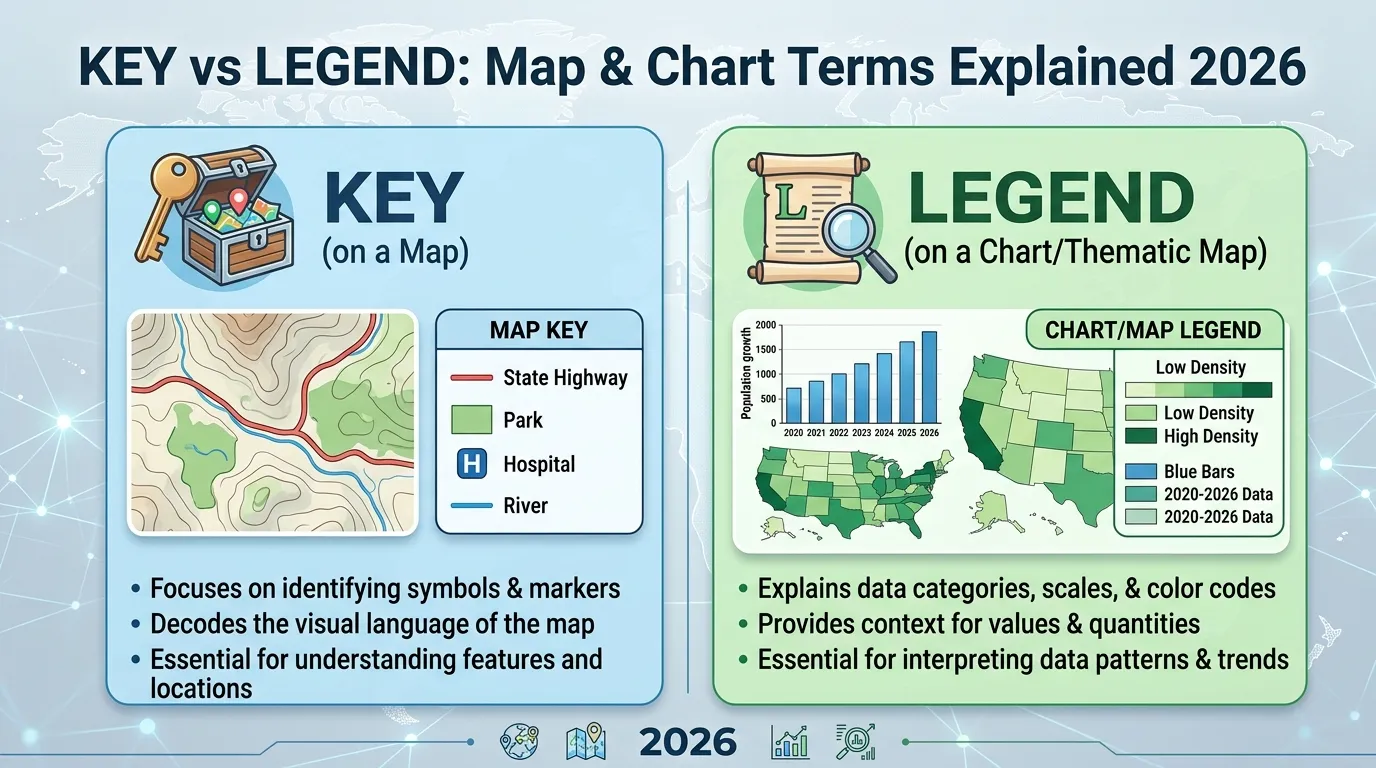
On a map or chart, key and legend often mean the same thing. Both can explain what symbols, colors, lines, and other marks mean. The box can be at the top, bottom, side, or corner. Its position does not decide whether it is called a key or a legend.
Imagine a family planning a road trip. They spread a map across the kitchen table. The map has blue lines, red roads, green areas, and small symbols. A box on the map explains what these marks mean. One person calls the box a key. Another calls it a legend. In many cases, both are correct.
The words can be confusing because key and legend also have other meanings. A key can open a door, mean something important, or describe a musical key. A legend can mean an old story or a very famous person. This guide explains the difference between key and legend, their meanings, origins, examples, and common uses in simple English.
Pronunciation
| Word | US Pronunciation | UK Pronunciation |
| Key | /kiː/ | /kiː/ |
| Legend | /ˈledʒənd/ | /ˈledʒənd/ |
Difference Between Key and Legend
1. Meaning on a Map
On a map, key and legend can both mean a guide that explains symbols.
Key example:
Check the map key to find the hospital symbol.
Legend example:
Check the map legend to find the hospital symbol.
2. Meaning on a Chart
Both words can also be used for visual information on charts and diagrams.
Key example:
The key shows that blue means sales.
Legend example:
The legend shows that blue means sales.
3. Key Has Many Other Meanings
Outside maps and charts, key has many meanings.
It can mean a tool used to open a lock.
Example:
I lost my house key.
It can also mean something very important.
Example:
Trust is a key part of a good team.
It can also describe a set of musical notes.
Example:
The song is in the key of C.
4. Legend Can Mean an Old Story
Legend can mean a story from the past that may or may not be true.
Example:
The legend tells of a hidden castle.
Example:
The village has an old legend about the lake.
5. Legend Can Mean a Famous Person
Legend can also describe a very famous person who is admired by others.
Example:
The football player became a legend.
Example:
She is a legend in the world of music.
6. Key Can Be an Adjective
Key is often used as an adjective to mean very important.
Example:
This is a key point in the report.
Example:
Good planning is a key part of the project.
7. Key and Legend Can Overlap
A major point to remember is that key and legend are not always separate terms.
For map use, authoritative sources show the overlap clearly. Esri defines a legend as a description of what map symbols represent and says that a legend is sometimes called a key.
8. Position Does Not Decide the Word
A common question is:
Is it still a legend if it is at the top of a map or chart?
Yes.
A legend can be placed:
- at the top
- at the bottom
- on the left
- on the right
- inside or beside the visual
9. Some Fields May Prefer One Term
A school, company, software program, mapmaker, or publisher may have its own preferred term.
For example, Esri discusses using “Key” or “Legend” as a title for a map’s explanation of symbols.
10. Outside Maps and Charts, the Words Are Different
The biggest difference appears outside visual guides.
Use key for meanings such as:
- a door key
- an important point
- a musical key
- an answer key
Use legend for meanings such as:
- an old story
- a famous person
- a map or diagram explanation
Discover more related topics https://orchoice.com/antipasta-or-antipasto/
Nature and Behaviour of Key and Legend
Nature of Key
Key is a flexible word. It has many meanings.
It can talk about:
- locks
- answers
- importance
- music
- maps
- charts
- diagrams
The meaning comes from the sentence.
For example:
I need my key.
Here, key probably means a tool for a lock.
Look at the key on the map.
Here, key means a guide to symbols.
This is a key reason.
Here, key means important.
Nature of Legend
Legend has several clear meanings too.
It can mean:
- an old story
- a famous person
- a map or diagram guide
- a short written label in some uses
Why People Get Confused About Key and Legend
People get confused because both words can describe the same type of map or chart guide.
A student may learn map key at school. Another student may learn map legend.
Both terms can be found in real mapping materials. Ordnance Survey uses both “key” and “legend,” while its map materials also use the term “legend.”
For example:
- house key has nothing to do with a map.
- music key has nothing to do with a map.
- old legend has nothing to do with a chart.
- sports legend describes a person.
Comparison Table: Key vs Legend
| Feature | Key | Legend |
| Map meaning | Guide to symbols and colors | Guide to symbols and colors |
| Chart meaning | Can explain visual marks | Commonly explains visual marks |
| Position | Can be anywhere | Can be anywhere |
| Lock meaning | Yes | No |
| Important meaning | Yes | No |
| Music meaning | Yes | No |
| Old story meaning | No | Yes |
| Famous person meaning | No | Yes |
| Adjective use | Yes, as in “key point” | Usually a noun |
| Can they overlap? | Yes | Yes |
The Origin of Key and Legend
Origin of Key
The word key comes from Old English cǣg or cǣge. Oxford notes that its earlier origin is unknown. The original word was connected with a key used to open something.
Over time, key gained wider meanings. It came to describe something that helps a person understand or unlock something. This helps explain why we use key for a guide to map symbols.
Origin of Legend
Legend comes from Medieval Latin legenda, meaning “things to be read.” It passed through Old French into English.
The word first had a strong link to written stories, especially stories about saints. Later, legend developed other meanings, including traditional stories, famous people, and the explanation of symbols on maps or diagrams.
British vs American English
There is no simple British-versus-American rule that says one variety must use key and the other must use legend.
Both British and American English use both words.
For example:
US:
Check the map key.
UK:
Check the map legend.
Which One Should You Use?
For maps and charts, follow the style of the source you are using.
Use “key” when:
- your textbook calls it a key
- your map calls it a key
- you are writing a simple guide
- your audience already uses the word key
Use “legend” when:
- your software uses the word legend
- your field normally uses legend
- your map or chart already labels it as a legend
- you want to match the terminology of a source
If there is no fixed style
Either word may work when you mean a guide to symbols on a map or chart.
There is no need to think that key is always informal or legend is always formal. Usage can vary by context.
Common Mistakes with Key and Legend
Mistake 1
Incorrect: I lost my house legend.
Correct: I lost my house key.
A house is opened with a key, not a legend.
Mistake 2
Incorrect: The old key tells a story about a dragon.
Correct: The old legend tells a story about a dragon.
An old traditional story can be called a legend.
Mistake 3
Incorrect: The song is in the legend of C.
Correct: The song is in the key of C.
Music uses key to describe the group of notes used in a song.
Mistake 4
Incorrect: He is a key in the world of tennis.
Correct: He is a legend in the world of tennis.
A very famous and admired person can be called a legend.
Mistake 5
Incorrect: The map must use a legend because the box is at the bottom.
Correct: The map can use a key or legend.
Everyday Usage Examples
Maps
Check the map key for the hospital symbol.
Check the map legend for the railway symbol.
Charts
The chart legend shows which line represents sales.
Look at the key to see what each color means.
Emails
Please check the key at the bottom of the map.
Social Media
Check the legend on the map to find our hiking route.
News
The weather map legend shows the colors used for rain and snow.
Formal Writing
The map includes a legend explaining the symbols used for roads and public buildings.
Usage Trends and Context
There is no need to force a simple rule such as “key is casual and legend is formal.”
Real usage is more flexible.
For example, Ordnance Survey uses key or legend when teaching map reading, while its map resources also use legend for detailed map symbols.
In mapping software, legend is also a common term. Esri uses “map legend” for the section that explains map symbols and colors.
The safest approach is to follow the terminology used by the map, chart, software, textbook, or organization in front of you.
Metaphors and Similes
Key metaphor
The key to success is hard work.
Here, key means an important factor.
Key simile
The answer was like a key that opened a locked door.
The key represents the solution.
Legend metaphor
Her final performance became the stuff of legend.
This means the performance became famous and memorable.
Legend simile
He played like a legend.
This compares his skill or fame with that of a great person.
Connotative Meaning
Key
Positive: helpful, important, useful
The key made the chart easy to understand.
Neutral: factual and instructional
Check the key for the meaning of each symbol.
Legend
Positive: famous, admired, memorable
She became a legend in the sport.
Neutral: factual and explanatory
The map legend lists the symbols used for roads.
Storytelling: old, traditional, or mysterious
The legend says a hidden treasure lies nearby.
Idioms and Common Expressions
“The key to something”
This means an important part of reaching a result.
Example:
Good communication is the key to a strong friendship.
“Hold the key to something”
This means to have an important answer or solution.
Example:
The new evidence may hold the key to the mystery.
“A living legend”
This describes a famous person who is still alive.
Example:
The singer is a living legend.
“The stuff of legend”
This describes something so remarkable that people may tell stories about it.
Example:
His final match became the stuff of legend.
Literature and Movies
Literature
The Legend of Sleepy Hollow was written by Washington Irving and first published in 1820. The title uses legend in the sense of a traditional or famous story.
Another useful example is the general phrase “a legend” in literature, where it can refer to a story passed down over time.
Movies
I Am Legend — 2007, United States
The title uses legend in a broader way connected with the story and the main character.
The Skeleton Key — 2005, United States
The title uses key in its normal object sense, while also giving the word a symbolic role in the story.
Why This Difference Matters
Knowing the difference between key and legend helps you understand maps, charts, books, and everyday English.
It also helps you avoid simple mistakes.
If you see key on a map, it may mean the guide to the map’s symbols.
If you see legend, it may have the same map meaning.
But if someone says house key, they mean the object used to open a lock.
If someone says sports legend, they mean a very famous and admired person.
Understanding the context helps you choose the right meaning.
Usefulness in Daily Life
You may meet a key or legend when you:
- read a road map
- follow a hiking trail
- use a subway map
- check a weather map
- read a business chart
- study a school diagram
- look at a science graph
- follow a floor plan
- read a data report
Situational Preference
If your map, chart, textbook, or software already uses key, follow that wording.
When it uses legend, follow that wording.
If you are writing your own material, either word may work for a guide to map or chart symbols. The best choice is often the one that matches your audience and field.
For example, a school worksheet may call the box a key, while mapping software may call it a legend.
Key vs Legend: Common Questions
1. What is the difference between a key and a legend?
On maps and charts, key and legend often mean the same thing: a guide that explains symbols, colors, lines, or other visual marks. Outside this use, the words have different meanings.
2. Is a map key the same as a map legend?
Often, yes. A map key and map legend can both explain the symbols used on a map. Esri says a legend is sometimes called a key.
3. Does the position of a legend matter?
No. A legend can be at the top, bottom, left, right, or inside a visual. Its position does not decide whether it is called a legend.
4. Which is more formal: key or legend?
There is no universal rule. Legend may be the usual term in some fields or software, while key may be preferred in others. Follow the style used by your source or field.
5. Is there a British vs American difference?
Not a simple one. Both British and American English use key and legend for map and chart explanations.
6. Can key and legend be used interchangeably?
Often, yes, when talking about the explanatory part of a map or chart. However, a particular organization, software program, or publication may prefer one term.
7. Can a key mean something other than a map guide?
Yes. Key can mean a tool for opening a lock, an important factor, a musical key, or a set of answers.
8. Can legend mean something other than a map guide?
Yes. Legend can mean an old story or a very famous and admired person. Oxford lists all of these meanings.
Conclusion
Key or legend often mean the same thing when they are used on maps, charts, and diagrams. Both can explain symbols, colors, lines, and other marks so readers can understand the information. The position of the box does not decide whether it is called a key or a legend, and there is no simple rule that one word is always more formal or correct than the other. Outside maps and charts, the words have different meanings: a key can mean something important, a solution, or a part of a keyboard, while a legend can mean an old story or a very famous person. When choosing between them, follow the wording used by the map, chart, software, or source you are working with.

I’m Samia Jamshaid, an English language specialist, SEO specialist, digital publisher, and researcher. I create clear, accurate, and well-researched content on English grammar, vocabulary, word meanings, and language comparisons, helping readers understand and use English with confidence.