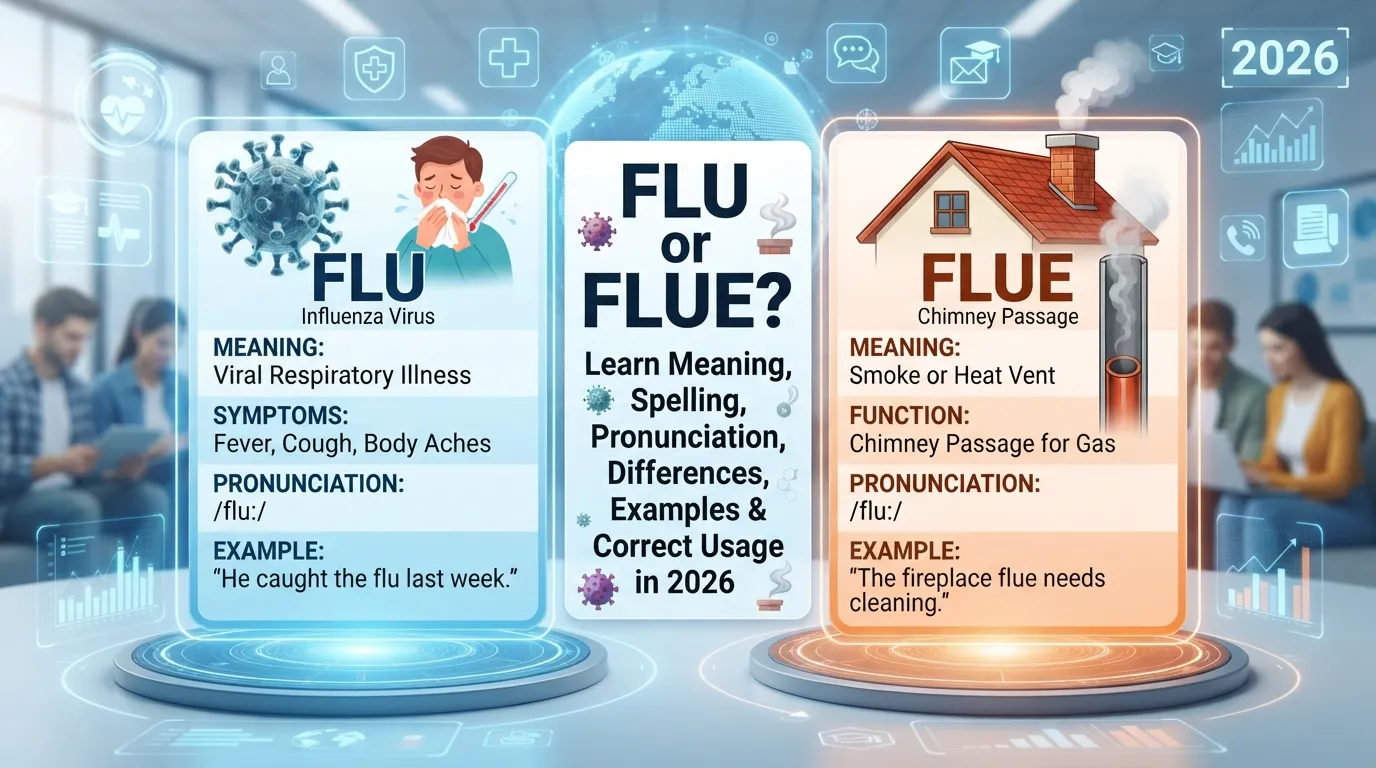
Flu means an illness, while flue means a pipe or passage that carries smoke or gases.
Imagine someone says, “I have the flue.” You may understand what they mean, but the spelling is wrong if they are talking about an illness. The correct word is flu. Now imagine a worker cleaning a chimney. He may need to check the flue because it carries smoke out of the building.
This is why flu or flue can be confusing. Both words sound the same, but they have different meanings and spellings. Flu is the short and standard form of influenza, a viral illness. Flue is a duct, channel, tube, or pipe used to carry smoke, gases, heat, or exhaust.
There is also a third word to know: flew. It is the past tense of fly, as in “The bird flew away.”
So, when choosing flu or flue, think about the meaning first. Are you talking about sickness or a smoke passage? This simple difference will help you choose the right word every time.
Flu or Flue: Difference
| Word | Meaning | Part of Speech | Example |
| Flu | A viral illness; short for influenza | Noun | I have the flu. |
| Flue | A pipe, duct, or passage for smoke or gases | Noun | The chimney flue needs cleaning. |
| Flew | Past tense of fly | Verb | The bird flew away. |
Pronunciation of Flu and Flue
Flu and flue are pronounced the same way.
| Word | US Pronunciation | UK Pronunciation | Syllables |
| Flu | /fluː/ | /fluː/ | 1 |
| Flue | /fluː/ | /fluː/ | 1 |
| Flew | /fluː/ | /fluː/ | 1 |
The sound is like “floo.”
This makes flu, flue, and flew homophones. Homophones are words that sound alike but have different meanings and spellings. Oxford also lists these three words as homophones.
What Does Flu Mean?
Flu is the short form of influenza. It is a viral respiratory illness.
For example:
- I have the flu.
- She stayed home because of the flu.
- He got a flu vaccine.
- The whole family has the flu.
The spelling flu is now standard. You do not need an apostrophe before it. So, write flu, not ’flu.
Flu in Simple Words
Think:
Flu = illness
If the sentence is about being sick, fever, a virus, a vaccine, or influenza, flu is usually the word you need.
What Does Flue Mean?
A flue is a duct, channel, tube, or pipe. It carries smoke, gases, heat, or exhaust away from a fire, stove, furnace, or similar source.
For example:
- The chimney flue needs cleaning.
- Smoke escaped through the flue.
- The worker checked the stove flue.
- A bird was stuck in the flue of the wood stove.
Flue in Simple Words
Think:
Flue = smoke or exhaust passage
If the sentence is about a chimney, stove, furnace, smoke, or gases, flue is usually the correct word.
What Does Flew Mean?
Flew is the past tense of fly.
For example:
- The bird flew away.
- We flew to New York.
- The plane flew over the city.
- Time flew by.
Flew is not a spelling of flu or flue. It has a different meaning.
Easy Memory Rule
Flu = illness
Flue = smoke passage
Flew = past of fly
Difference Between Flu and Flue
1. Meaning
Flu means a viral illness.
Flue means a pipe, duct, or passage that carries smoke or gases.
Examples:
- She has the flu.
- The chimney flue is blocked.
2. Spelling
The words have different spellings.
Flu has three letters.
Flue has four letters and ends in -ue.
Examples:
- The doctor said I have the flu.
- The worker cleaned the flue.
3. Part of Speech
Both flu and flue are nouns.
Flu names an illness.
Flue names a physical passage or pipe.
Examples:
- The flu kept him home.
- The flue carries smoke outside.
4. Health vs. Home Equipment
Use flu when talking about health.
Use flue when talking about a chimney, stove, furnace, or smoke system.
Examples:
- She missed school because of the flu.
- The stove flue needs repair.
5. Medical Use
Flu is common in medical and everyday health talk.
You may see phrases such as:
- flu vaccine
- flu symptoms
- flu season
- flu outbreak
- flu shot
Examples:
- I got my flu shot.
- He has flu symptoms.
6. Chimney and Heating Use
Flue is used when talking about systems that move smoke or gases.
Examples:
- The chimney flue is dirty.
- The furnace flue carries gases outside.
7. Everyday Conversation
Flu is common in everyday conversation because people often talk about being sick.
Examples:
- I think I have the flu.
- She is home with the flu.
Flue is more likely to appear when discussing buildings, heating, chimneys, or repairs.
Examples:
- The flue needs cleaning.
- Check the flue before using the stove.
8. Related Words
Words related to flu include:
- influenza
- flu vaccine
- flu shot
- flu symptoms
- flu season
Words related to flue include:
- chimney
- stove
- furnace
- smoke
- exhaust
9. The Extra Letter
The extra e in flue can help you remember that it relates to a tube or passage.
This is only a memory trick, not a rule about how the word was formed.
Examples:
- Flu → illness
- Flue → pipe or passage
10. Flew Is Different
Do not forget flew.
Flew is the past tense of fly.
Examples:
- The plane flew across the country.
- The bird flew into the tree.
You may also like https://orchoice.com/knelt-or-kneeled/
Nature and Behaviour of the Words
| Word | Nature | Main Context |
| Flu | Illness | Health and medicine |
| Flue | Physical passage | Chimneys, stoves, furnaces |
| Flew | Past-tense verb | Flying or moving quickly |
Why Are Flu and Flue Confused?
The main reason is pronunciation.
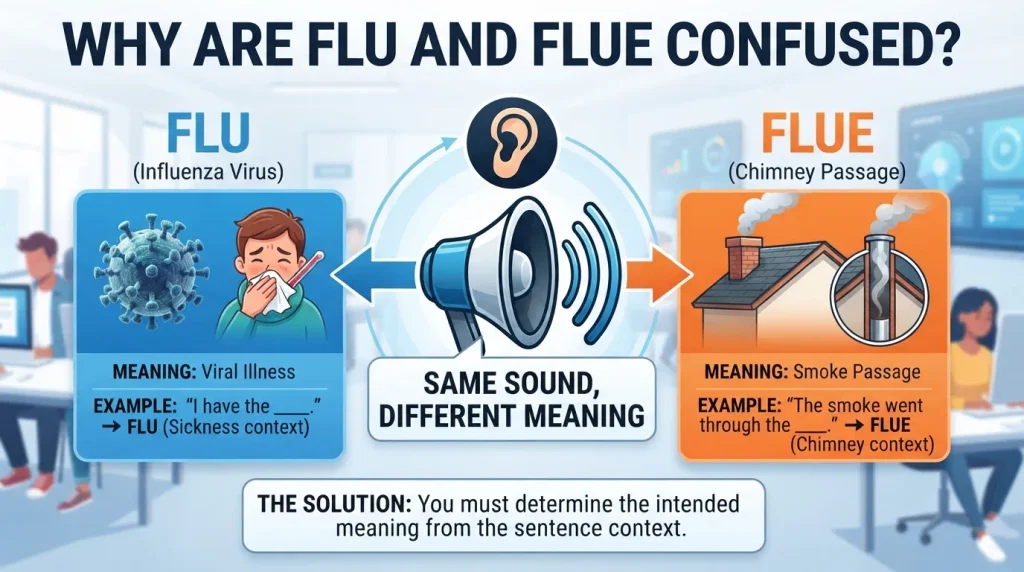
Flu and flue sound exactly alike in standard English. Flew also has the same sound.
When people hear the word, they cannot tell which spelling is meant from the sound alone. They need to use the meaning and the sentence.
For example:
I have the ___.
The correct answer is flu because the sentence is about illness.
But:
The smoke went through the ___.
The correct answer is flue because the sentence is about a smoke passage.
Comparison Table
| Feature | Flu | Flue | Flew |
| Meaning | Viral illness | Smoke/gas passage | Past tense of fly |
| Word type | Noun | Noun | Verb |
| Spelling | Flu | Flue | Flew |
| Sound | /fluː/ | /fluː/ | /fluː/ |
| Syllables | 1 | 1 | 1 |
| Main use | Health | Chimneys and heating | Flying |
| Related word | Influenza | Chimney | Fly |
| Example | I have the flu. | Clean the flue. | The bird flew away. |
Origin of Flu
Flu is short for influenza.
The longer word influenza came into English from Italian and has a history connected with the idea of “influence.” The short form flu later became a standard everyday word.
Today, flu is widely used instead of the longer word influenza in ordinary speech and writing.
Origin of Flue
The history of flue is different from the history of flu. The word has been used for a passage or duct, especially one connected with smoke or air.
Its exact word history is not as simple as saying that it definitely comes from one specific old English word. So it is better to focus on its modern meaning:
Flue = a duct, channel, tube, or pipe.
British vs. American English
There is no major British-American spelling difference between flu and flue.
Both forms are used in British and American English.
| Word | American English | British English |
| Flu | Flu | Flu |
| Flue | Flue | Flue |
| Flew | Flew | Flew |
One small usage difference can appear with flu.
British English commonly uses:
She has flu.
American English often uses:
She has the flu.
Which One Should You Use?
Use flu when you mean the illness.
Utilize flue when you mean a pipe, duct, or passage for smoke or gases.
Use flew when you mean the past tense of fly.
A simple rule is:
Flu = sick
Flue = smoke
Flew = fly
Common Mistakes
Mistake 1
Incorrect: I have the flue.
Correct: I have the flu.
Mistake 2
Incorrect: The smoke went through the flu.
Correct: The smoke went through the flue.
Mistake 3
Incorrect: The bird flu away.
Correct: The bird flew away.
Mistake 4
Incorrect: I have ’flu.
Correct: I have flu / I have the flu.
The short form flu is now standard without an apostrophe.
Mistake 5
Incorrect: The flue vaccine can help prevent illness.
Correct: The flu vaccine can help prevent illness.
Everyday Usage Examples
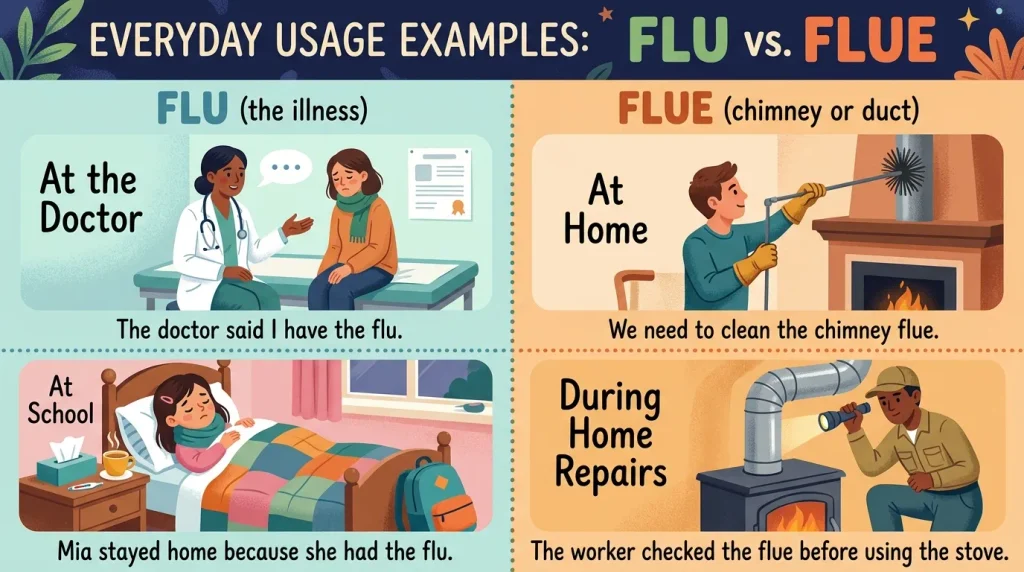
At Home
We need to clean the chimney flue.
At the Doctor
The doctor said I have the flu.
At School
Mia stayed home because she had the flu.
During Home Repairs
The worker checked the flue before using the stove.
Talking About Travel
We flew to Chicago last weekend.
Talking About a Bird
The bird flew out of the window.
Flu in Formal and Informal Writing
Flu is normal in both everyday and general formal writing.
For example:
The patient was treated for flu.
In medical writing, influenza may be used when a more formal or exact term is needed.
For example:
The patient was diagnosed with influenza.
In everyday writing, however, flu is much more natural.
Flue in Everyday and Technical Writing
Flue is used when talking about a physical system that moves smoke, gases, or exhaust.
You may see it in:
- home repair guides
- chimney instructions
- heating information
- building work
- safety information
- appliance manuals
For example:
The flue should be checked before the fireplace is used.
Metaphors and Similes
Flu is sometimes used in expressions that describe illness or a strong wave of sickness.
Examples include:
The flu knocked him out for a week.
A wave of flu went through the school.
These are informal ways to describe how strongly an illness affects people.
Flue is usually used in its literal sense because it names a physical part of a heating or smoke system.
Connotative Meaning
Flu usually has a negative feeling because it is linked with sickness, weakness, fever, and being unwell.
Flue is mostly neutral. It is simply the name of a part of a building or heating system.
Flew is also usually neutral, but it can suggest speed or movement.
For example:
The car flew past us.
Here, flew does not mean that the car could actually fly. It means the car moved very quickly.
Idioms and Common Expressions
Have the flu
This means to be sick with influenza.
I can’t come to work because I have the flu.
Flu season
This refers to the time when flu is common in a particular place.
Many people get flu vaccines before flu season.
Time flew
This means time passed very quickly.
Time flew during our vacation.
Flew by
This means something passed quickly.
The weekend flew by.
Literature and Movies
The word flu appears often in writing about illness, outbreaks, families, schools, and public health.
Flew is also common in stories because flying and movement are common actions.
Flue is more likely to appear in writing about homes, fires, chimneys, heating systems, and repairs.
The different uses make context very important when you read these words.
Why Does the Difference Matter?
Choosing the correct word makes your meaning clear.
If you write flue when you mean the illness, readers may think you are talking about a chimney or pipe.
If you write flu when you mean a smoke passage, readers may think you are talking about a sickness.
The same problem can happen with flew.
Knowing the three spellings helps you write clearly and avoid simple mistakes.
Usefulness in Daily Life
You may see flu in:
- doctor visits
- health articles
- school notices
- news reports
- vaccine information
- everyday conversations
People may see flue in:
- chimney guides
- home repair
- stove instructions
- furnace information
- building work
- safety advice
You may see flew in:
- stories
- travel writing
- news
- conversations
- descriptions of movement
Situational Preference
Choose flu when the topic is health or influenza. For example, say, “I have the flu” or “She received a flu vaccine.” Choose flue when the topic is a chimney, stove, furnace, smoke, or exhaust system. For example, say, “The flue needs cleaning.” Choose flew when talking about the past action of flying or moving quickly. For example, say, “The plane flew over the city.” If you are unsure, look at the words around the blank. The context usually tells you which spelling you need.
Frequently Asked Questions
1. Is flu or flue correct?
Both are correct words, but they have different meanings. Flu means an illness. Flue means a pipe, duct, or passage for smoke or gases.
2. Is flu short for influenza?
Yes. Flu is the standard short form of influenza.
3. Is flue related to the flu?
No. Flue and flu are different words with different meanings. They only sound the same.
4. What is the difference between flu and flue?
Flu is an illness. Flue is a pipe, duct, or passage that carries smoke or gases.
5. What does flew mean?
Flew is the past tense of fly.
Example:
The plane flew over the mountains.
6. Should I write ’flu or flu?
Use flu. The apostrophe is not needed in the standard modern spelling.
7. Is “the flu” correct?
Yes. The flu is very common, especially in American English. British English also uses flu without the in some contexts, such as “She has flu.”
Conclusion
Flu or flue is a common spelling question because both words sound the same. However, their meanings are easy to separate once you know the rule. Flu is the short form of influenza and means a viral illness. Flue is a duct, channel, tube, or pipe that carries smoke, gases, heat, or exhaust. Flew is another homophone and is the past tense of fly. Remember the simple rule: flu = illness, flue = smoke passage, and flew = past of fly. You do not need an apostrophe in flu, and there is no major British-American spelling difference for flu or flue. When you focus on the meaning of the sentence, choosing the correct spelling becomes much easier.

I’m Samia Jamshaid, an English language specialist, SEO specialist, digital publisher, and researcher. I create clear, accurate, and well-researched content on English grammar, vocabulary, word meanings, and language comparisons, helping readers understand and use English with confidence.












1 thought on “Flu or Flue: Definitions, Differences & Real-Life Examples 2026”