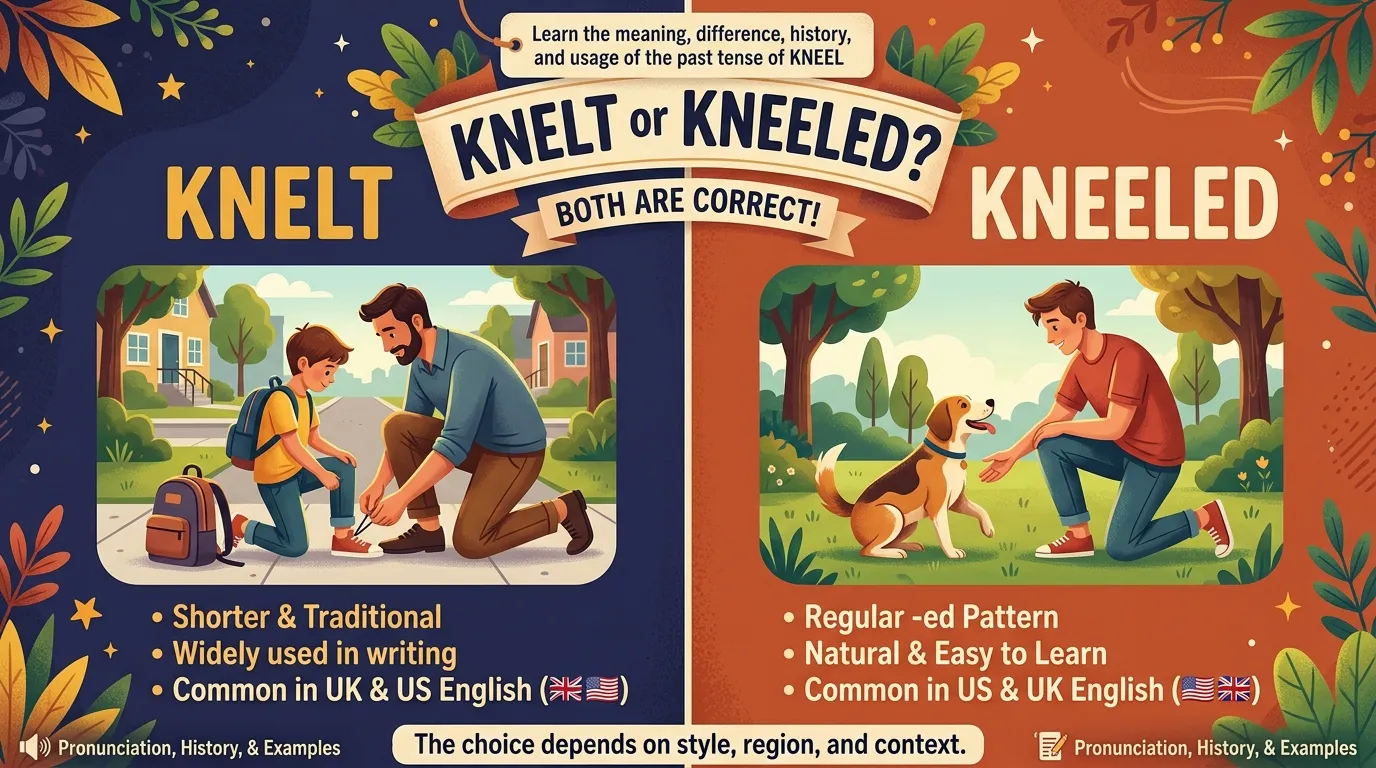
Knelt and kneeled are both correct past forms of the verb kneel.
Imagine you are helping a child tie their shoe. You go down on one knee to help. Later, you tell a friend what happened. You might say, “I knelt beside her.” You could also say, “I kneeled beside her.”
This is why many people search for knelt or kneeled. They want to know which form is correct. They may also wonder if one form belongs to British English and the other to American English.
The verb kneel means to put one or both knees on the ground. Knelt and kneeled are both past tense and past participle forms of kneel.
Knelt is the shorter and older-looking form. It is very common in English writing. Kneeled follows a regular verb pattern and is also correct. It is often seen in American English.
So, when choosing between knelt or kneeled, you do not need to worry about a basic grammar error. Both forms can be used. The choice often depends on style, region, and context.
Pronunciation
| Word | US Pronunciation | UK Pronunciation | Syllables |
| Knelt | /nelt/ | /nelt/ | 1 |
| Kneeled | /niːld/ | /niːld/ | 1 |
The k in knelt is silent. The word begins with the same sound as N.
The -ed in kneeled sounds like d.
Difference Between Knelt and Kneeled
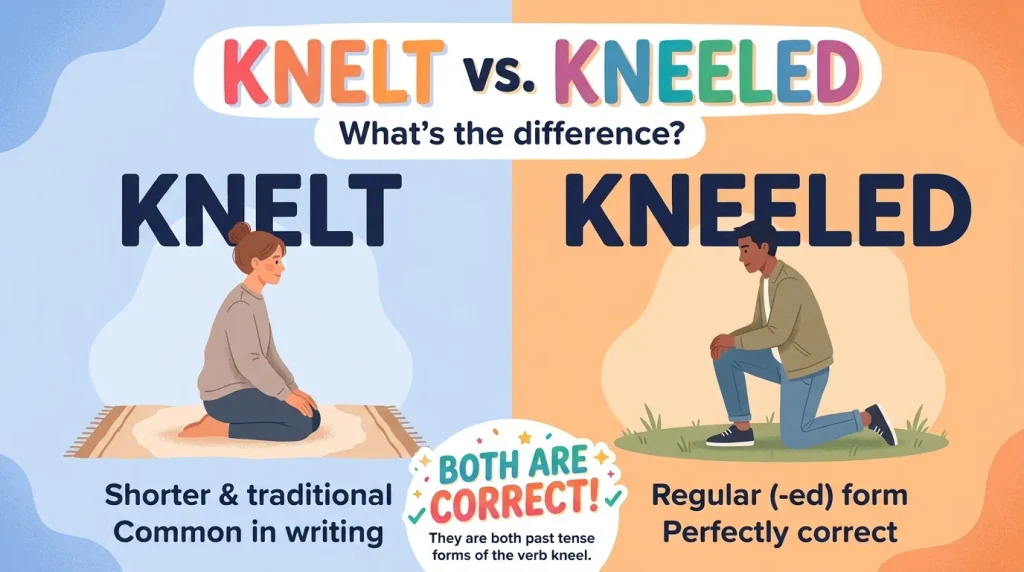
1. Both are past forms of kneel
The biggest point is simple. Both words are past forms of kneel.
Examples:
- She knelt beside the child.
- She kneeled beside the child.
2. Knelt is the shorter form
Knelt is short and simple. It has only five letters.
It is often the first form people learn.
Examples:
- He knelt on the floor.
- She knelt beside the bed.
3. Kneeled is a regular-looking form
Kneeled follows a common pattern. It adds -ed to the verb kneel.
This makes it easy for learners to understand.
Examples:
- He kneeled near the chair.
- They kneeled before the altar.
4. Knelt is very common in writing
Knelt is widely used in books, news, and general writing.
It often sounds natural in a sentence.
Examples:
- The man knelt in the snow.
- She knelt beside her mother.
5. Kneeled is also correct
You do not need to change kneeled to knelt every time.
Kneeled is a valid form of kneel.
Examples:
- He kneeled to pick up the toy.
- The player kneeled near the goal.
6. Knelt often sounds more traditional
Knelt has a long history in English. It can sound more traditional or literary.
Examples:
- The knight knelt before the king.
- The worshipper knelt to pray.
7. Kneeled can sound more regular
Some speakers prefer kneeled because it follows the simple -ed pattern.
Examples:
- The player kneeled before the game.
- She kneeled to speak to the child.
8. Both can describe the same action
There is no basic difference in the action.
Both words can describe going down onto one or both knees.
Examples:
- He knelt on the floor.
- He kneeled on the floor.
9. Both can work as past participles
Both forms can appear after have, has, or had.
Examples:
- She has knelt beside the bed.
- She has kneeled beside the bed.
10. Your style may decide the choice
If you want a short, traditional form, knelt is a good choice.
If you prefer the regular -ed form, kneeled is also correct.
Examples:
- The old man knelt before the altar.
- The player kneeled during the ceremony.
You may also like https://orchoice.com/tubbing-or-tubing/
Nature and Behaviour of Knelt and Kneeled
Knelt
Knelt is the past tense and past participle of kneel. It describes an action that already happened.
It is common in general English and often appears in stories, news, and formal writing.
Kneeled
Kneeled is also a past tense and past participle form of kneel.
It has the same basic meaning as knelt. It can sound more regular because it uses the normal -ed ending.
Why People Get Confused About Knelt and Kneeled
People get confused because English has two accepted past forms for kneel.
Many learners expect one verb to have only one past form. But English has many verbs with more than one accepted form.
For example:
- dreamed / dreamt
- learned / learnt
- burned / burnt
- kneeled / knelt
There is also a spelling clue. Kneeled looks like a normal -ed verb, while knelt looks like an irregular past form.
This makes knelt or kneeled a common search question.
Comparison Table
| Feature | Knelt | Kneeled |
| Base verb | Kneel | Kneel |
| Word type | Past tense / past participle | Past tense / past participle |
| Meaning | Went or stayed on the knees | Went or stayed on the knees |
| Pronunciation | /nelt/ | /niːld/ |
| Syllables | 1 | 1 |
| Spelling | Short form | Regular -ed form |
| Correct? | Yes | Yes |
| British English | Used | Used |
| American English | Used | Used |
| Tone | Often traditional | Often regular |
| Best choice | Natural and widely used | Also correct |
The Origin of Knelt and Kneeled
The verb kneel has a very old history.
It comes from Old English cneowlian, meaning “to kneel” or “fall on the knees.” It is linked to old Germanic words and to an older root connected with the word knee.
The form knelt developed later as a past form. Etymonline dates this form to the 19th century and connects its pattern with verbs such as feel → felt.
Kneeled follows the more regular pattern:
kneel + ed = kneeled
So English kept two forms:
kneel → knelt
kneel → kneeled
British vs American English
Both knelt and kneeled can be found in British and American English.
There is no simple rule that says:
knelt = British
or
kneeled = American
That would be too simple.
British English
British writers commonly use knelt.
Example:
- She knelt beside the child.
But kneeled can also be used.
American English
American English uses both forms.
Examples:
- He knelt beside the bed.
- He kneeled beside the bed.
For global writing, knelt is a safe and very familiar choice. But kneeled is not wrong.
Which One Should You Use?
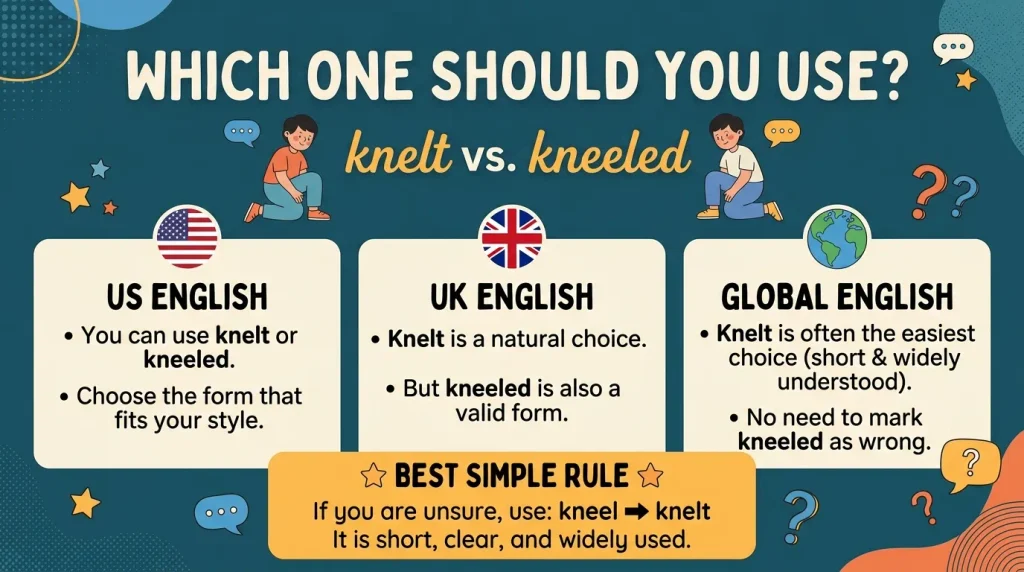
For US English
You can use knelt or kneeled.
Choose the form that fits your style.
For UK English
Knelt is a natural choice.
But kneeled is also a valid form.
For global English
Knelt is often the easiest choice because it is short and widely understood.
Still, there is no need to mark kneeled as wrong.
Best simple rule
If you are unsure, use:
kneel → knelt
It is short, clear, and widely used.
Common Mistakes
Mistake 1: Calling kneeled wrong
Incorrect: “Kneeled is always wrong.”
Correct: “Kneeled is an accepted past form of kneel.”
Mistake 2: Calling knelt wrong
Incorrect: “Knelt is not a real word.”
Correct: “Knelt is a correct past form of kneel.”
Mistake 3: Using kneel for a past action
Incorrect: Yesterday, she kneel beside me.
Correct: Yesterday, she knelt beside me.
Mistake 4: Using the wrong present form
Incorrect: Yesterday, he kneeling beside the chair.
Correct: Yesterday, he knelt beside the chair.
Mistake 5: Adding an extra form
Incorrect: He kneeleded beside the bed.
Correct: He kneeled beside the bed.
Mistake 6: Using knelt after a present-time action
Incorrect: Every morning, she knelt to pray.
Better: Every morning, she kneels to pray.
Everyday Usage Examples
In Emails
- “I knelt beside the box to check the label.”
- “He kneeled to speak with the child.”
On Social Media
- “I knelt down to take this photo.”
- “He kneeled beside his dog for the picture.”
In News
- “The player kneeled during the ceremony.”
- “The group knelt in silence.”
In Formal Writing
- “The witness knelt before the memorial.”
- “The player kneeled before the ceremony.”
With Daily Conversation
- “I knelt down to tie my shoe.”
- “She kneeled beside the child.”
Usage Trends
Both forms are still used.
Knelt remains a common form in general English. It is especially familiar in stories and formal writing.
Kneeled is also used, including in American English. There is no need to treat this as a strict US-versus-UK spelling issue.
The main trend is simple:
Knelt is shorter and traditional.
Kneeled is regular and clear.
Metaphors and Similes
Knelt and kneeled are mainly literal words. But the action of kneeling can carry a deeper meaning.
It may suggest respect, prayer, fear, love, or surrender.
Examples
- He knelt like a soldier before his leader.
- She knelt as if asking the world for peace.
- He kneeled beside her like a caring father.
Connotative Meaning
Positive Meaning
Kneeling can show respect, care, love, or prayer.
Example:
- He knelt beside his sick mother.
Here, the action can suggest care.
Negative Meaning
Kneeling can sometimes suggest fear, defeat, or forced control.
Example:
- The defeated soldier knelt before the king.
Neutral Meaning
The word can also describe a simple body movement.
Example:
- She knelt to pick up the book.
In this sentence, there is no special emotion.
Idioms and Proverbs
There are no major English idioms that depend on knelt or kneeled as their exact form.
However, the related word knee appears in many common expressions.
Knee-high to a grasshopper
This means very young or very small.
Example:
- I knew him when he was knee-high to a grasshopper.
Bring someone to their knees
This means to defeat or greatly weaken someone.
Example:
- The long war brought the country to its knees.
On bended knee
This means kneeling, often to ask for something or show strong feeling.
Example:
- He asked her to marry him on bended knee.
Literature and Movies
Kneeling is common in literature because it can show prayer, respect, love, fear, or surrender.
Literature
In Charles Dickens’s Great Expectations, first published in serial form in 1860–1861, Pip kneels in an emotional scene with Miss Havisham.
Older literature also uses both forms. For example, Project Gutenberg texts include examples of knelt and kneeled, showing that both forms have appeared in published English.
Movies
The 2014 American film Selma includes scenes based on Martin Luther King Jr.’s civil rights marches and his act of kneeling in prayer.
This is a good example of how the action of kneeling can show prayer, protest, and respect.
Why This Difference Matters
Knowing the difference helps English learners write with confidence.
You may see knelt in a book and kneeled in another text. You do not need to think that one must be a spelling mistake.
Both forms come from kneel.
This also matters when reading older books. Writers have used different forms over time.
Understanding both forms helps you read news, books, stories, and online writing more easily.
Most importantly, it prevents a common mistake: thinking that kneeled is always wrong.
Usefulness in Daily Life
You may use these words when talking about:
- prayer
- sports
- children
- helping someone
- proposals
- ceremonies
- stories
- history
- protests
- everyday movement
Simple examples
- I knelt to tie my shoe.
- She knelt beside the child.
- He kneeled during the ceremony.
- They knelt in prayer.
- The player kneeled on the field.
Situational Preference
Knelt is a strong choice for most situations. It is short, clear, and widely used. It also fits well in stories, news, and formal writing. Kneeled is also correct and may feel more natural when you want the regular -ed form. In American English, both forms can be found. British English also uses both. If you are writing for a global audience, knelt is often the safest simple choice. But do not mark kneeled as wrong. The meaning does not change. The main difference is style and word form, not the action itself.
What People Ask About Knelt or Kneeled
1. Is knelt or kneeled correct?
Both are correct. They are past tense and past participle forms of kneel.
2. Is knelt more common than kneeled?
Knelt is a very common form and is widely used. Kneeled is also accepted.
3. Is kneeled an American word?
Not only American. Kneeled is used in both British and American English. However, American English sources clearly list it as an accepted form.
4. What is the past tense of kneel?
You can use knelt or kneeled.
Example:
- She knelt beside me.
- She kneeled beside me.
5. Is knelt an irregular verb form?
Yes. Knelt does not use the normal -ed ending. It is an older-style past form of kneel. Its history is linked to patterns such as feel → felt.
6. Which is better for formal writing?
Knelt is often a good choice because it is short and widely used. But kneeled is not grammatically wrong.
7. Can I use knelt and kneeled in the same article?
Yes. Both can be used when they fit your chosen style. For a clean article, however, using one form consistently can make the writing feel smoother.
Conclusion
Knelt or kneeled are both correct forms of the verb kneel. They describe the same basic action: going down onto one or both knees. Knelt is the shorter and more traditional form, and it is very common in books, news, stories, and formal writing. Kneeled follows the regular -ed pattern and is also accepted in both British and American English. The word kneel has a very old history. It comes from Old English and is linked to old words for the knee. The past form knelt developed as a shorter past form, while kneeled developed as the regular -ed form. If you are unsure which one to use, knelt is a simple and widely understood choice. But remember that kneeled is not wrong. For English learners, the key lesson is simple: both forms are correct, and the meaning stays the same.

I’m Samia Jamshaid, an English language specialist, SEO specialist, digital publisher, and researcher. I create clear, accurate, and well-researched content on English grammar, vocabulary, word meanings, and language comparisons, helping readers understand and use English with confidence.







1 thought on “Knelt or Kneeled: Which Is Right? Examples & Usage 2026”