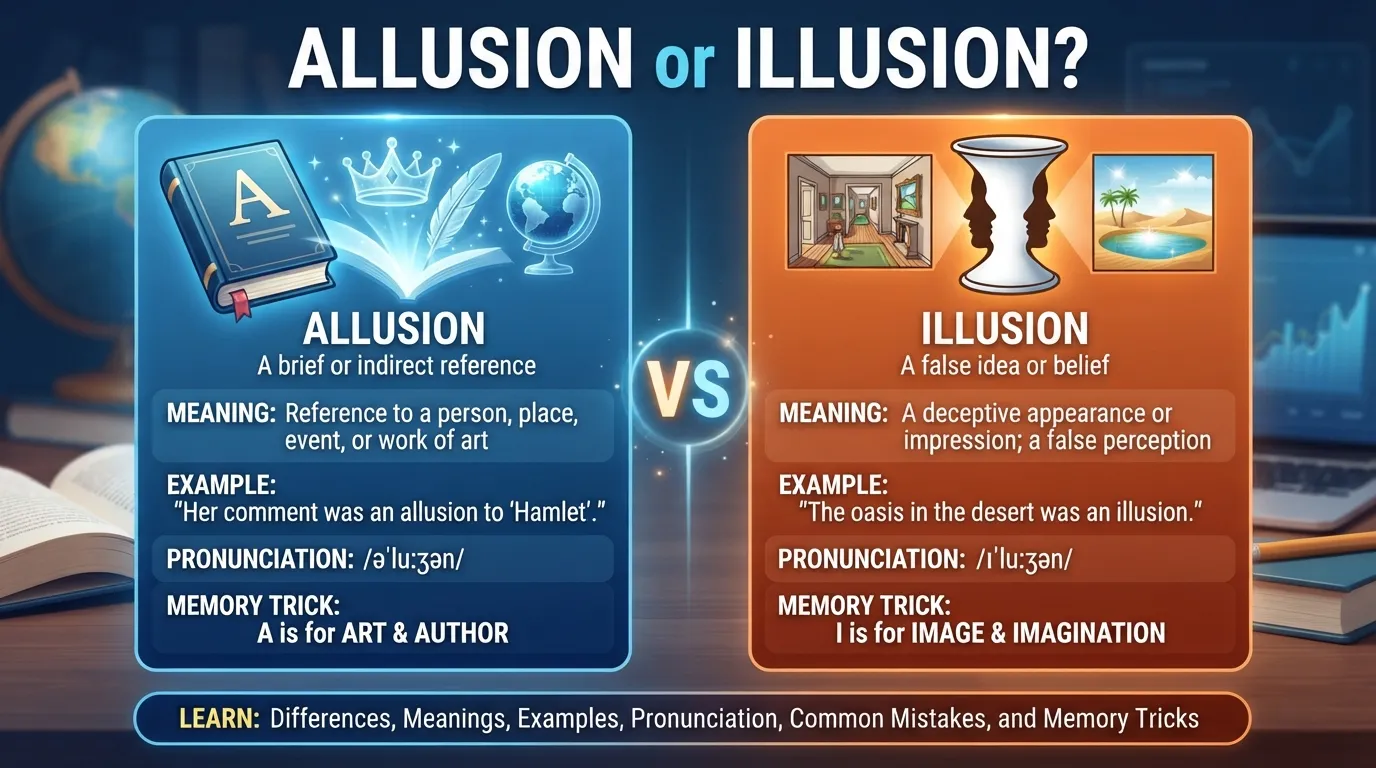
Allusion means an indirect reference, while illusion means a false appearance, impression, or belief.
Imagine you are reading a novel and see a line that reminds you of Shakespeare. The writer does not name the play, but you understand the hidden reference. That is an allusion. Now imagine a magician making a coin seem to disappear. The coin has not really vanished. It is an illusion. These two words look and sound very similar, so many people confuse allusion or illusion when writing or speaking. However, their meanings are very different.
Allusion is about pointing to another person, story, event, place, or idea. Illusion is about something that seems real or true but is not. Writers often use allusions to add meaning without giving a long explanation. Illusions can appear in magic, art, science, everyday life, and even our beliefs. Once you learn the simple difference between allusion or illusion, choosing the right word becomes much easier.
Allusion and Illusion: Pronunciation
Both words have three syllables, and their pronunciation is very close. The main difference is the first vowel sound.
| Word | US Pronunciation | UK Pronunciation | Syllables | Part of Speech |
| Allusion | /əˈluːʒən/ | /əˈluːʒən/ | 3 | Noun |
| Illusion | /ɪˈluːʒən/ | /ɪˈluːʒən/ | 3 | Noun |
Simple pronunciation:
- Allusion: uh-LOO-zhun
- Illusion: ih-LOO-zhun
The words are sometimes called homophones in informal explanations because they sound very close, but in standard pronunciation they are not exact homophones because the first vowel differs.
Now let us look at the main differences.
Difference Between Allusion and Illusion
1. Basic Meaning
Allusion means an indirect reference to something.
Illusion means a false appearance, impression, or belief.
Examples:
- The poem contains an allusion to Greek mythology.
- The magician created an illusion of a disappearing coin.
2. Main Idea
An allusion points to something else.
An illusion makes something seem different from reality.
Examples:
- “He is no Einstein” is an allusion to Albert Einstein.
- The mirror creates the illusion of a larger room.
3. Purpose
An allusion can add meaning or depth to writing or speech.
An illusion can describe something that tricks the senses or creates a mistaken idea.
Examples:
- The author used an allusion to make the scene more meaningful.
- The stage lights created the illusion of a sunset.
4. Common Areas of Use
Allusion is common in books, poems, films, speeches, songs, and everyday conversation.
Illusion is common when talking about magic, art, vision, perception, and false beliefs.
Examples:
- The film contains several allusions to famous stories.
- The magician performed a clever illusion.
5. Connection to Other Things
An allusion needs another person, place, event, story, work, or idea as its reference.
An illusion does not point to another work. Instead, it creates a false impression.
Examples:
- Her speech made an allusion to a famous historical event.
- The hot road created an illusion of water.
6. Reality
An allusion does not mean something is false. It simply refers to something indirectly.
An illusion suggests that what you see, think, or believe is not the same as reality.
Examples:
- The title is an allusion to an old poem.
- The shining object in the distance was an illusion.
7. Related Verb
The common verb related to allusion is allude.
Illusion is normally used as a noun. The rare verb illude exists, but it is not common in everyday English.
Examples:
- The writer alluded to Shakespeare.
- The magician created an illusion on stage.
8. Common Expressions
Allusion is often used with phrases such as:
- an allusion to
- a literary allusion
- a historical allusion
- a biblical allusion
Illusion is often used with:
- an illusion of
- create an illusion
- the illusion of
- under the illusion
- under no illusion
Examples:
- The book contains an allusion to Greek mythology.
- The mirrors create the illusion of more space.
9. What the Reader or Listener Does
With an allusion, the reader or listener may need to recognize the reference.
With an illusion, the person may be tricked or given a false impression.
Examples:
- The author made an allusion to Romeo and Juliet.
- The magic trick gave the audience the illusion that the box was empty.
10. Easy Memory Meaning
Think:
Allusion = reference
Illusion = false appearance
Examples:
- The speech made an allusion to the past.
- The picture created an illusion of movement.
Learn more about https://orchoice.com/flu-or-flue/
Nature and Behaviour
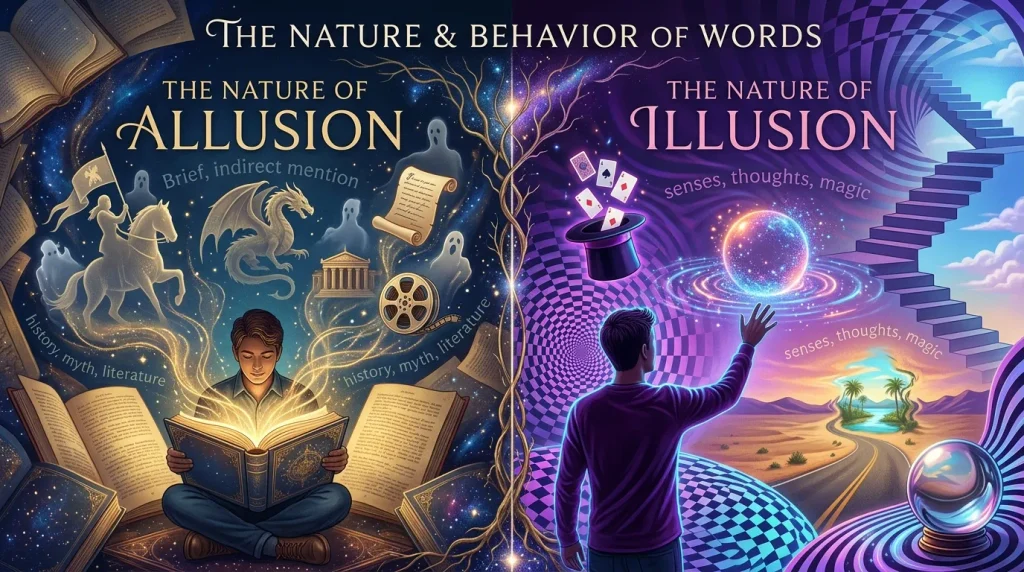
Nature of Allusion
An allusion is a noun. It refers to a brief, indirect mention of something.
It may refer to:
- a famous person
- a book
- a poem
- a movie
- a historical event
- a myth
- a religious story
- a place
- a cultural idea
An allusion often works best when the reader already knows the reference.
Example:
Her courage was an allusion to the strength of Joan of Arc.
The sentence connects her courage with Joan of Arc without explaining the whole story.
Nature of Illusion
An illusion is also a noun. It describes something that seems real or true but is different from reality.
An illusion can involve:
- sight
- sound
- other senses
- thoughts
- beliefs
- expectations
Examples:
- The magician created an illusion of a floating ball.
- The road looked wet, but it was an illusion caused by heat.
- He lived under the illusion that he would win easily.
Why People Get Confused
People often confuse allusion or illusion for several reasons.
First, the words look almost the same. They both contain -lusion.
Second, they sound very similar. Their first vowel sound is different in standard pronunciation, but the rest of the word sounds almost the same.
Third, both words can appear in writing about ideas, stories, art, and perception.
Finally, both words are nouns ending in -sion, which makes them easy to mix up.
The best way to remember them is simple:
Allusion = a reference.
Illusion = something that is not what it seems.
Comparison Table
| Feature | Allusion | Illusion |
| Meaning | An indirect reference | A false appearance, impression, or belief |
| Part of speech | Noun | Noun |
| Related verb | Allude | Illude, but rare |
| Main idea | Refers to something | Seems different from reality |
| Common use | Writing, speech, literature, films | Magic, art, perception, beliefs |
| Needs a reference? | Usually yes | No |
| Can involve literature? | Very common | Sometimes |
| Can involve the senses? | Not normally | Often |
| Simple memory | Reference | False appearance |
| Example | An allusion to Shakespeare | An illusion of space |
The Origin of Allusion and Illusion
Allusion and illusion have related Latin roots. Both are connected with the Latin word ludere, meaning “to play.”
The history of the two words then developed in different directions.
Allusion is connected with Latin alludere, which carries the idea of referring to or hinting at something.
Illusion is connected with Latin forms related to illudere, which carried ideas of mocking, deceiving, or misleading.
This shared history helps explain why the words look so similar today. But their meanings became different.
For English learners, the history is less important than the simple rule:
Allusion points to something. Illusion makes something seem different from reality.
British vs. American English
There is no major spelling difference between British and American English for allusion and illusion.
Both forms are used in the UK and US:
- allusion
- illusion
| Word | American English | British English |
| Allusion | allusion | allusion |
| Illusion | illusion | illusion |
Which One Should You Use?
Use allusion when you mean a reference or hint.
The writer made an allusion to Shakespeare.
Use illusion when you mean a false appearance, impression, or belief.
The magician created an illusion.
Ask yourself:
Am I referring to something?
If yes, use allusion.
Does something only seem real or true?
If yes, use illusion.
Common Mistakes
Mistake 1: Using illusion for a reference
Incorrect:
The book contains several illusions to Greek mythology.
Correct:
The book contains several allusions to Greek mythology.
The word is allusions because the writer is referring to Greek mythology.
Mistake 2: Using allusion for a magic trick
Incorrect:
The magician performed an amazing allusion.
Correct:
The magician performed an amazing illusion.
A magic trick that creates a false appearance is an illusion.
Mistake 3: Saying “under the allusion”
Incorrect:
She was under the allusion that everything was safe.
Correct:
She was under the illusion that everything was safe.
Here, the person has a mistaken belief, so illusion is correct.
Mistake 4: Using allusion as a verb
Incorrect:
The writer allusioned to the event.
Correct:
The writer alluded to the event.
Allusion is a noun. Allude is the common verb. Cambridge defines allude to as mentioning someone or something without talking about it directly.
Mistake 5: Confusing allude and elude
Incorrect:
The thief managed to allude the police.
Correct:
The thief managed to elude the police.
Elude means to escape or avoid.
Allude means to refer to something indirectly.
Everyday Usage Examples
Allusion in Everyday Speech
People use allusions when they mention something without explaining the full story.
He called himself an Einstein.
This is an allusion to Albert Einstein and his intelligence.
She said the project was her Everest.
This is an allusion to Mount Everest and the idea of a great challenge.
Allusion in Writing
The novel contains an allusion to Greek mythology.
The poem makes an allusion to a famous historical event.
The film title is an allusion to an older work.
Illusion in Everyday Speech
The mirror creates an illusion of extra space.
The bright lights created an illusion of movement.
The road looked wet, but it was only an illusion.
Illusion in Beliefs
Illusion can also describe a false idea or belief.
He was under the illusion that the meeting was canceled.
She had no illusion that the job would be easy.
They lost the illusion that everything would change quickly.
Usage Trends
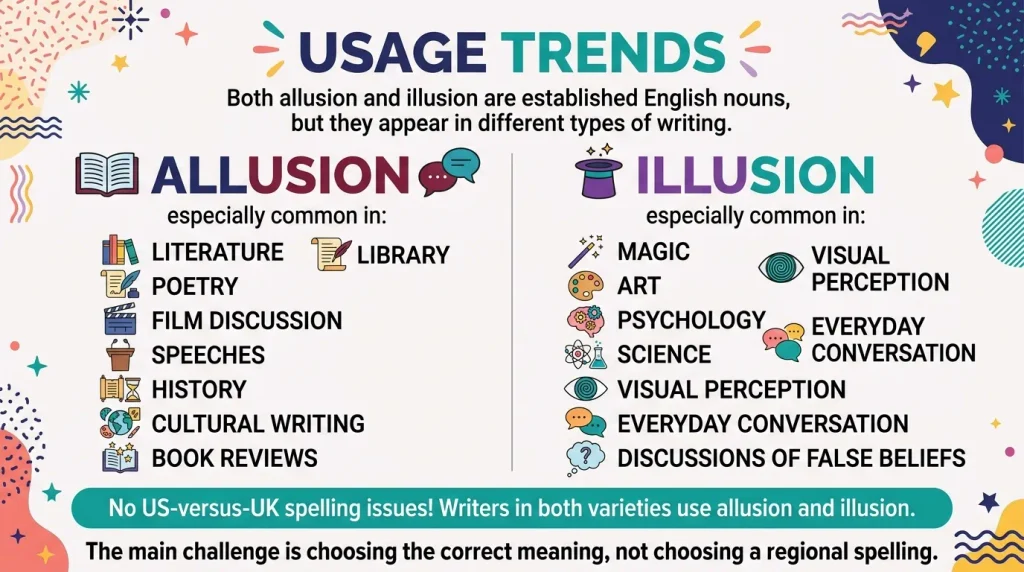
Both allusion and illusion are established English nouns, but they appear in different types of writing.
Allusion is especially common in:
- literature
- poetry
- film discussion
- speeches
- history
- cultural writing
- book reviews
Illusion is common in:
- magic
- art
- psychology
- science
- visual perception
- everyday conversation
- discussions of false beliefs
There is no US-versus-UK spelling issue with these words. Writers in both varieties use allusion and illusion.
The main challenge is choosing the correct meaning, not choosing a regional spelling.
Metaphors and Similes
Allusion and illusion can also appear in figurative language.
Allusion
An allusion can make a comparison without saying everything directly.
Calling a brave person “a real Hercules” is an allusion to the Greek hero Hercules.
The speaker uses a known figure to suggest strength.
Illusion
Illusion can be used to describe something that seems true but is not.
The calm office was an illusion; everyone was worried inside.
Here, the calm appearance hides the real situation.
Simple Simile
The empty promise was like an illusion.
This suggests that the promise looked real or hopeful but was not what it seemed.
Connotative Meaning
Allusion usually has a neutral or positive meaning.
It can suggest:
- knowledge
- creativity
- deeper meaning
- clever writing
- shared culture
For example:
The poem is full of clever allusions.
Illusion can have a neutral, positive, or negative meaning depending on the situation.
A magic illusion can be entertaining.
The show included a wonderful illusion.
But a false belief can have a negative meaning.
He was under the illusion that everything was perfect.
Idioms and Common Expressions
Under the Illusion
Under the illusion means believing something that is not true.
She was under the illusion that the work was finished.
Under No Illusion
Under no illusion means fully aware of the real situation.
I am under no illusion that this will be easy.
It can also be written:
I am under no illusions about the risks.
Do not write “under no allusion.”
Allude To
Allude to means to mention something indirectly.
The speaker alluded to the problem without naming it.
This is one of the most useful patterns to remember:
allude to something
Literature and Movies
Allusions are very common in literature.
A writer may mention a famous person, story, myth, historical event, or earlier book without explaining the whole reference. Readers who recognize the allusion can understand an extra layer of meaning.
For example:
The author makes an allusion to Romeo and Juliet.
The writer expects readers to connect the reference with Shakespeare’s famous story.
Another example is a title that points to an older work. A famous example discussed in writing guides is Brave New World, whose title alludes to Shakespeare’s The Tempest.
Illusions are also common in stories and movies. Magic scenes, special effects, mirrors, false images, and mistaken beliefs can all involve illusions.
A movie may use an illusion to make viewers believe something is real when it is not.
Allusion vs. Illusion vs. Elusion vs. Delusion
These four words can cause confusion, but their meanings are different.
| Word | Simple Meaning | Example |
| Allusion | An indirect reference | The poem has an allusion to the Bible. |
| Illusion | A false appearance or belief | The magician created an illusion. |
| Elusion | The act of escaping or avoiding | His elusion of the guards was successful. |
| Delusion | A false belief | He lived under a delusion. |
For everyday English, allusion, illusion, allude, elude, and delusion are more useful than trying to remember the rare verb illude.
Remember Them This Way
Allusion → allude → refer
Illusion → seems real but is not
Elusion → elude → escape
Delusion → false belief
Why This Difference Matters
Choosing the wrong word can change the meaning of a sentence.
If you write:
The writer made an illusion to Shakespeare.
Readers may understand that you mean a reference, but the word is wrong.
The correct sentence is:
The writer made an allusion to Shakespeare.
If you write:
The magician created an allusion.
You are also using the wrong word.
The correct sentence is:
The magician created an illusion.
Knowing the difference helps you write clearly in school, work, emails, stories, reviews, and everyday conversations.
Usefulness in Daily Life
You may see allusion when reading:
- books
- poems
- news articles
- movie reviews
- speeches
- essays
- history texts
You may see illusion when reading about:
- magic
- art
- optical tricks
- perception
- false beliefs
- special effects
- everyday mistakes in judgment
The words may look almost the same, but they do different jobs.
A simple rule can help:
If it refers, use allusion. If it deceives or seems real when it is not, use illusion.
Situational Preference
Use allusion when you are talking about a reference or hint. It is especially useful when discussing books, poems, movies, speeches, history, or culture. Use illusion when something looks, feels, or seems real but is not what it appears to be. This includes magic tricks, optical effects, false impressions, and mistaken beliefs. In formal or academic writing, choosing the right word is important because the two terms have different meanings. If you are unsure, replace allusion with reference and see if the sentence still makes sense. For illusion, try false appearance or false belief. This simple test can help you choose the right word.
Common Questions and Answers
1. What is the difference between allusion and illusion?
Allusion means an indirect reference. Illusion means a false appearance, impression, or belief.
2. Is allusion a noun or a verb?
Allusion is a noun.
The related verb is allude.
The writer made an allusion to history.
The writer alluded to history.
3. Is illusion a noun or a verb?
Illusion is a noun.
The rare verb illude exists, but it is uncommon in everyday English. It is better for learners to use phrases such as create an illusion or give the illusion of.
4. Are allusion and illusion homophones?
They are very similar in sound, but they are not exact homophones in standard US and UK pronunciation. The first vowel is different:
- Allusion: /əˈluːʒən/
- Illusion: /ɪˈluːʒən/
5. What is an example of an allusion?
The writer called the young scientist “an Einstein.”
This is an allusion to Albert Einstein because it indirectly refers to his intelligence.
6. What is an example of an illusion?
The magician created the illusion that the coin had disappeared.
The coin did not really disappear. The trick created a false appearance.
7. What does “under no illusion” mean?
Under no illusion means being fully aware of the truth or real situation.
I am under no illusion that this task will be easy.
8. What is the difference between allude and elude?
Allude means to refer to something indirectly.
Elude means to escape or avoid something.
She alluded to the problem.
The suspect eluded the police.
Conclusion
Allusion or illusion are easy to confuse because they look and sound very similar, but they have completely different meanings. An allusion is an indirect reference to a person, place, event, book, story, or idea. It often gives writing or speech extra meaning without explaining everything. An illusion is a false appearance, impression, or belief. It can trick the eyes, other senses, or the mind. Remember the easiest rule: allusion = reference, illusion = false appearance or belief. Also remember that the common verb for allusion is allude, while elude means to escape. The rare word illude is not needed in normal everyday writing. Once you connect each word with its meaning, choosing between allusion or illusion becomes much easier. Whether you are writing an essay, reading a novel, watching a movie, or having a daily conversation, using the right word will make your meaning clear.

I’m Samia Jamshaid, an English language specialist, SEO specialist, digital publisher, and researcher. I create clear, accurate, and well-researched content on English grammar, vocabulary, word meanings, and language comparisons, helping readers understand and use English with confidence.



1 thought on “Allusion or Illusion: Correct Word, & Everyday Usage 2026”