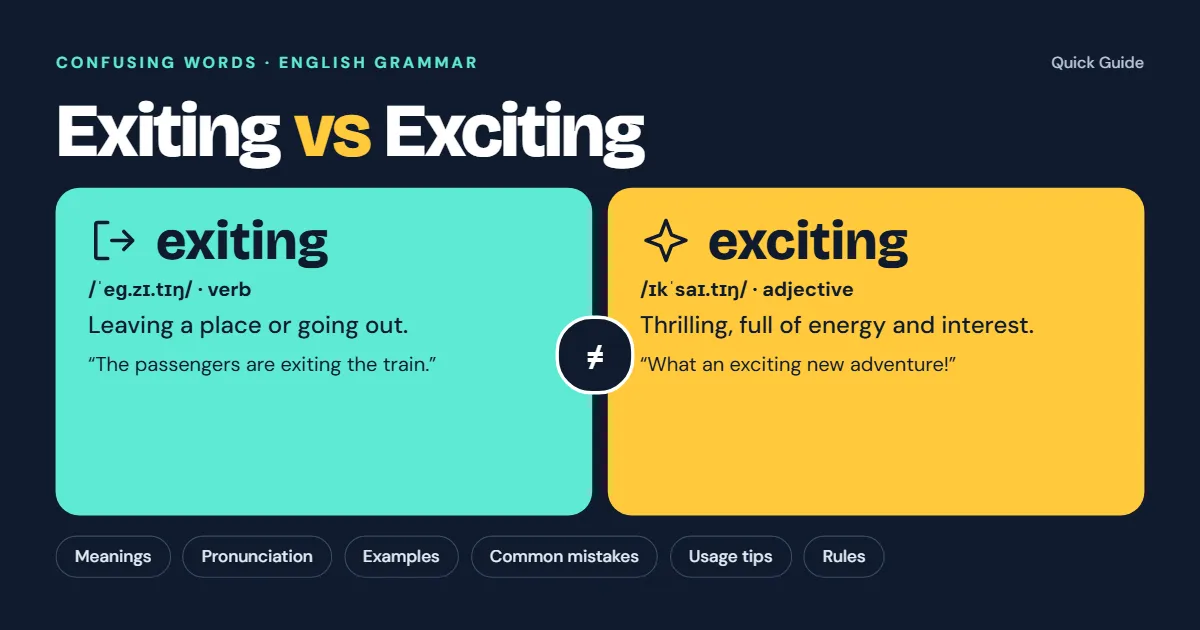
Exiting means leaving a place or situation, while exciting means something that makes you feel happy, interested, or eager.
Imagine you are at a concert. The show is exciting, but when it ends, you start exiting the building. These two words look and sound a little alike, so it is easy to mix them up. Yet, they have very different meanings.
Exiting comes from the verb exit. It means going out or leaving. For example, you may be exiting a room, a bus, a job, or a website. Exciting comes from the verb excite. It describes something that creates excitement, such as an exciting game, movie, trip, or event. Cambridge defines exiting as the present participle of exit and exciting as an adjective meaning “making you feel excited.”
People often search for exiting or exciting because the words have similar spelling. This guide explains the difference with easy examples.
Pronunciation
| Word | US Pronunciation | UK Pronunciation | Syllables | Part of Speech |
| Exiting | /ˈek.sɪ.tɪŋ/ | /ˈek.sɪ.tɪŋ/ | 3 | Verb form |
| Exciting | /ɪkˈsaɪ.t̬ɪŋ/ | /ɪkˈsaɪ.tɪŋ/ | 3 | Adjective |
The main sound difference is easy to notice. Exiting begins with the sound of exit, while exciting has the long “eye” sound in the middle. Cambridge lists exit with US and UK forms that can vary slightly in the first consonant sound, while exciting has its main stress on the second syllable.
Difference Between Exiting and Exciting

1. Basic Meaning
Exiting means leaving.
Exciting means causing interest, joy, or strong feelings.
Examples:
- We are exiting the building now.
- The new movie looks exciting.
2. Word Root
Exiting comes from exit.
Exciting comes from excite.
Examples:
- She is exiting the bus.
- The trip is exciting.
3. Part of Speech
Exiting is the -ing form of the verb exit.
Exciting is usually an adjective.
Examples:
- The students are exiting the classroom.
- The students had an exciting day.
4. Action vs. Description
Exiting shows an action. Someone is going out or leaving.
Exciting describes a person, thing, place, event, or experience that creates excitement.
Examples:
- The guests are exiting the hall.
- The party was exciting.
5. Place and Movement
We often use exiting when someone leaves a building, car, room, road, or other place.
Examples:
- The passengers are exiting the plane.
- The driver is exiting the highway.
Exciting does not show movement out of a place.
Examples:
- The flight was exciting.
- The road trip was exciting.
6. Feelings
Exiting is not normally used to describe a happy or thrilling feeling.
Exciting is used to describe something that creates that feeling.
Examples:
- The children were excited about the trip.
- The trip was exciting.
Remember that excited and exciting are also different. A person is usually excited, while a thing or event is exciting. Cambridge makes the same distinction: excited describes how someone feels, while exciting describes the thing that causes the feeling.
7. Common Sentence Pattern
Exiting often follows a form of be, such as is exiting, are exiting, or was exiting.
Examples:
- They are exiting the stadium.
- He was exiting the office.
Exciting often comes before a noun.
Examples:
- It was an exciting game.
- She planned an exciting trip.
8. Formal Use
Exiting is common in signs, instructions, business writing, technology, and news.
Examples:
- Please keep the doors clear while exiting.
- The company is exiting the market.
Exciting is common in everyday speech and writing.
Examples:
- We have an exciting announcement.
- It was an exciting weekend.
9. Negative and Positive Use
Exiting is usually neutral. It simply tells us that someone or something is leaving.
Examples:
- The players are exiting the field.
- She is exiting the car.
Exciting usually has a positive meaning.
Examples:
- We watched an exciting match.
- She received some exciting news.
10. Easy Memory Trick
Think of exit when you see exiting.
Exiting = going out.
Think of excite when you see exciting.
Exciting = creating excitement.
Examples:
- The students are exiting the school.
- The school trip is exciting.
You may also like https://orchoice.com/allusion-or-illusion/
Nature and Behaviour of Exiting and Exciting
Exiting
Exiting is about leaving. It can describe a person leaving a place or an organization leaving an activity or market. It can also describe a process, such as leaving a computer program.
For example:
- The visitors are exiting the museum.
- The company is exiting the business.
- Click here before exiting the program.
Exciting
Exciting is about interest and strong positive feelings. It can describe a movie, game, trip, story, event, idea, or piece of news.
For example:
- It was an exciting game.
- We have an exciting plan.
- The children had an exciting day.
Why People Get Confused About Exiting and Exciting
The main reason is their spelling.
Both words begin with ex and end with -ing:
- exiting
- exciting
They also have similar sounds. But the middle parts are different.
Exiting comes from exit.
Exciting comes from excite.
The best way to remember them is to focus on the root word.
Exit → exiting → leaving
Excite → exciting → creating excitement
For example:
We are exiting the theater after an exciting movie.
This sentence shows both meanings clearly.
Comparison Table
| Feature | Exiting | Exciting |
| Meaning | Leaving | Causing excitement |
| Root word | Exit | Excite |
| Main use | Action | Description |
| Part of speech | Verb form | Adjective |
| Main idea | Going out | Creating interest |
| Feeling | Usually neutral | Usually positive |
| Example | We are exiting the room. | The movie is exciting. |
| Common places | Buildings, roads, jobs, websites | Movies, games, trips, events |
| Common phrase | Exiting the building | An exciting event |
| Memory word | Exit | Excite |
Similarities
Both words:
- begin with ex
- end with -ing
- have three syllables
- are common English words
- come from different base words
- can appear in everyday writing
The key difference is simple:
Exiting = leaving.
Exciting = creating excitement.
The Origin of Exiting and Exciting
Origin of Exiting
Exiting comes from the verb exit. The English word exit came from Latin exire, meaning “to go out” or “to depart.” The Latin word was made from ex, meaning “out,” and ire, meaning “to go.”
The word exit was first used in English as a stage direction. It told an actor to leave the stage. Later, it gained the wider meaning of a way or act of leaving.
Today, we use exit in many settings:
- exit a building
- exit a highway
- exit a company
- exit a competition
- exit a computer program
Origin of Exciting
Exciting comes from excite. The verb excite entered English in the Middle English period. It came from Old French and Latin roots linked to the idea of calling out, waking, stirring, or setting something in motion.
Over time, excite developed its modern connection with strong feelings and interest.
The adjective exciting later came to mean something that causes excitement. The modern sense of “causing excitement” is recorded from the 19th century.
British vs American English
There is no major spelling difference between exiting and exciting in British and American English.
Both varieties use:
- exiting
- exciting
The pronunciation can have small regional differences, but the meanings stay the same.
| Word | British English | American English |
| Exiting | exiting | exiting |
| Exciting | exciting | exciting |
| Meaning of exiting | Leaving | Leaving |
| Meaning of exciting | Causing excitement | Causing excitement |
British English Examples
- We are exiting the building.
- It was an exciting match.
American English Examples
- We are exiting the building.
- It was an exciting game.
Which One Should You Use?
Use exiting when you mean leaving.
The passengers are exiting the plane.
Use exciting when you mean interesting, thrilling, or full of excitement.
The passengers had an exciting flight.
For US, UK, and global English, these rules are the same.
A simple test can help:
Can you replace the word with “leaving”?
If yes, use exiting.
Can you replace it with “thrilling” or “fun”?
If yes, use exciting.
Common Mistakes
Mistake 1: Using exciting when you mean leaving
Incorrect:
The workers are exciting the building.
Correct:
The workers are exiting the building.
Mistake 2: Using exiting when you mean fun
Incorrect:
The new movie is exiting.
Correct:
The new movie is exciting.
Mistake 3: Confusing excited and exciting
Incorrect:
I am exciting about my holiday.
Correct:
I am excited about my holiday.
Mistake 4: Using exciting for a person when you mean their feeling
Incorrect:
She is exciting about the trip.
Correct:
She is excited about the trip.
Mistake 5: Forgetting the root word
If the sentence is about exit, use exiting.
If the sentence is about excite, use exciting.
Everyday Usage Examples
In Emails
Exiting:
Please check the room before exiting.
Exciting:
We have some exciting news to share with you.
On Social Media
Exiting:
We are exiting the venue after a great event.
Exciting:
What an exciting night!
In News
Exiting:
The company is exiting the market.
Exciting:
The team made an exciting comeback.
In Formal Writing
Exiting:
Visitors should follow the signs when exiting the building.
Exciting:
The project offers an exciting new opportunity.
In Everyday Speech
Exiting:
We are exiting the car now.
Exciting:
That sounds exciting!
Usage Trends

Both words are used around the world, but they appear in different situations.
Exciting is very common in everyday English. People use it when talking about:
- movies
- sports
- travel
- holidays
- events
- news
- plans
- new ideas
Exiting is also common, but its use is more tied to the act of leaving. It often appears in instructions, travel, business, technology, and news.
For example:
- Exiting the building
- Exiting the highway
- Exiting the market
- Exiting the program
Metaphors and Similes
Exiting as a Metaphor
Exiting can be used beyond a physical place. It can describe leaving a job, company, market, competition, or situation.
Example:
The company is exiting the market.
Here, the company is not walking through a door. It is leaving a business area.
Another example:
He is exiting a difficult period in his life.
This can mean he is moving away from a difficult time.
Exciting as a Metaphor
Exciting can describe an idea or change that creates strong interest.
Example:
This new idea could open an exciting door for young workers.
The “door” is not a real door. It means a new chance.
Another example:
The project is entering an exciting new chapter.
This means the project is moving into an interesting stage.
Connotative Meaning
Exiting
Exiting is usually neutral.
It simply tells us that someone or something is leaving.
The passengers are exiting the train.
There is no strong positive or negative feeling in this sentence.
It can sometimes sound negative when used with a business, group, or situation:
The company is exiting the market.
But the word itself remains mostly neutral.
Exciting
Exciting is usually positive.
It suggests fun, interest, energy, or happiness.
We had an exciting weekend.
It can also describe something that is intense or surprising.
The final minutes of the game were exciting.
The exact feeling depends on the situation, but exciting usually has a positive tone.
Idioms and Proverbs
There are no major traditional proverbs built around exiting and exciting themselves. However, several common expressions help show their meanings.
Exit Stage Left
Exit stage left means to leave. It comes from theater language and is also used humorously in everyday English.
Example:
After finishing the job, he decided to exit stage left.
Make an Exit
Make an exit means to leave a place.
Example:
She thanked everyone and made her exit.
On the Edge of Your Seat
This expression means that something is very exciting or keeps you interested.
Example:
The final scene kept us on the edge of our seats.
Heart-Pounding
This phrase describes something that creates strong excitement or tension.
Example:
It was a heart-pounding race.
These expressions can help English learners understand the feeling behind exciting.
Literature and Movies
Literature
The idea of exiting appears often in drama because characters enter and leave scenes. Shakespeare’s plays, for example, use traditional stage directions that tell actors when to enter or leave.
A modern example is Exit West, a 2017 novel by Mohsin Hamid. It is a literary and speculative fiction story about migration, love, and people leaving their homes. The book was shortlisted for the 2017 Booker Prize.
The word exciting is common in adventure, action, mystery, and travel writing. Writers use it to describe events that create strong interest or emotion.
For example, an adventure story may describe an exciting journey, an exciting discovery, or an exciting escape.
Movies
A good example connected to exit is EXIT, a 2019 South Korean action-comedy film directed by Lee Sang-geun. The story follows people trying to escape a dangerous gas that spreads through Seoul.
The word exciting is also common when people describe action and adventure movies. A movie with fast action, danger, or surprise may be called exciting.
The important point is that exit relates to leaving, while exciting relates to the feeling created by an event.
Why This Difference Matters
Knowing the difference between exiting and exciting helps you avoid simple but confusing mistakes.
Imagine writing:
We are exciting the building.
A reader may wonder what you mean because exciting does not normally mean leaving.
Now compare:
We are exiting the building.
The meaning is clear.
The difference also matters in emails, school work, social media posts, business writing, and everyday conversation.
Using the correct word makes your writing clearer. It also helps readers understand your message quickly.
For English learners, the best way to remember the difference is to learn the root words:
Exit → exiting → leaving
Excite → exciting → creating excitement
Usefulness in Daily Life
You can use exiting when talking about:
- leaving a room
- leaving a car
- leaving a bus
- leaving a building
- leaving a road
- leaving a company
- leaving a competition
- closing a computer program
You can use exciting when talking about:
- a movie
- a game
- a trip
- a party
- a holiday
- new plans
- good news
- a special event
- a new opportunity
These words are useful because they appear in many parts of daily English.
Situational Preference
Choose exiting when your sentence is about leaving. Use it for people leaving buildings, vehicles, roads, jobs, companies, competitions, or computer programs. Choose exciting when you want to describe something that creates interest, joy, energy, or strong feelings. In a school email, “Please check your desk before exiting” is correct. In a travel post, “We had an exciting trip” is correct. The words are not different forms of the same meaning. They come from different root words and do different jobs. For US, UK, and global English, the same basic rule works: exiting means leaving, while exciting means causing excitement.
Common Questions and Answers
1. What is the difference between exiting and exciting?
Exiting means leaving. Exciting means causing interest, happiness, or strong feelings.
2. Is exiting a correct English word?
Yes. Exiting is the -ing form of exit.
We are exiting the building.
3. Is exciting a correct English word?
Yes. Exciting is an adjective.
It was an exciting movie.
4. Is “I am exciting” correct?
Usually, no.
If you mean that you feel happy or eager, say:
I am excited.
If you say “I am exciting,” it usually means you make other people feel excited.
5. How can I remember exiting and exciting?
Use the root words:
Exit → exiting → leaving
Excite → exciting → creating excitement
6. Are exiting and exciting spelled differently in British and American English?
No. Both British and American English use exiting and exciting.
7. Which is correct: “The movie is exiting” or “The movie is exciting”?
The movie is exciting is correct when you mean the movie is fun, thrilling, or interesting.
Conclusion
Exiting or exciting look similar, but they have very different meanings. Exiting comes from “exit” and means leaving a place, road, vehicle, company, competition, or program, while exciting comes from “excite” and describes something that creates interest, happiness, energy, or strong feelings. The easiest rule is this: exiting means leaving, and exciting means causing excitement. If someone is leaving a building, they are exiting it, and if a movie makes you feel thrilled, the movie is exciting. The spelling is the same in British and American English, so you do not need to choose a regional form. Learning the root word is the best way to avoid mistakes, because once you remember exit → exiting and excite → exciting, these two words become much easier to use in emails, school work, business writing, social media, and daily conversation.

I’m Samia Jamshaid, an English language specialist, SEO specialist, digital publisher, and researcher. I create clear, accurate, and well-researched content on English grammar, vocabulary, word meanings, and language comparisons, helping readers understand and use English with confidence.









1 thought on “Exiting or Exciting: Which One Should You Use? 2026”