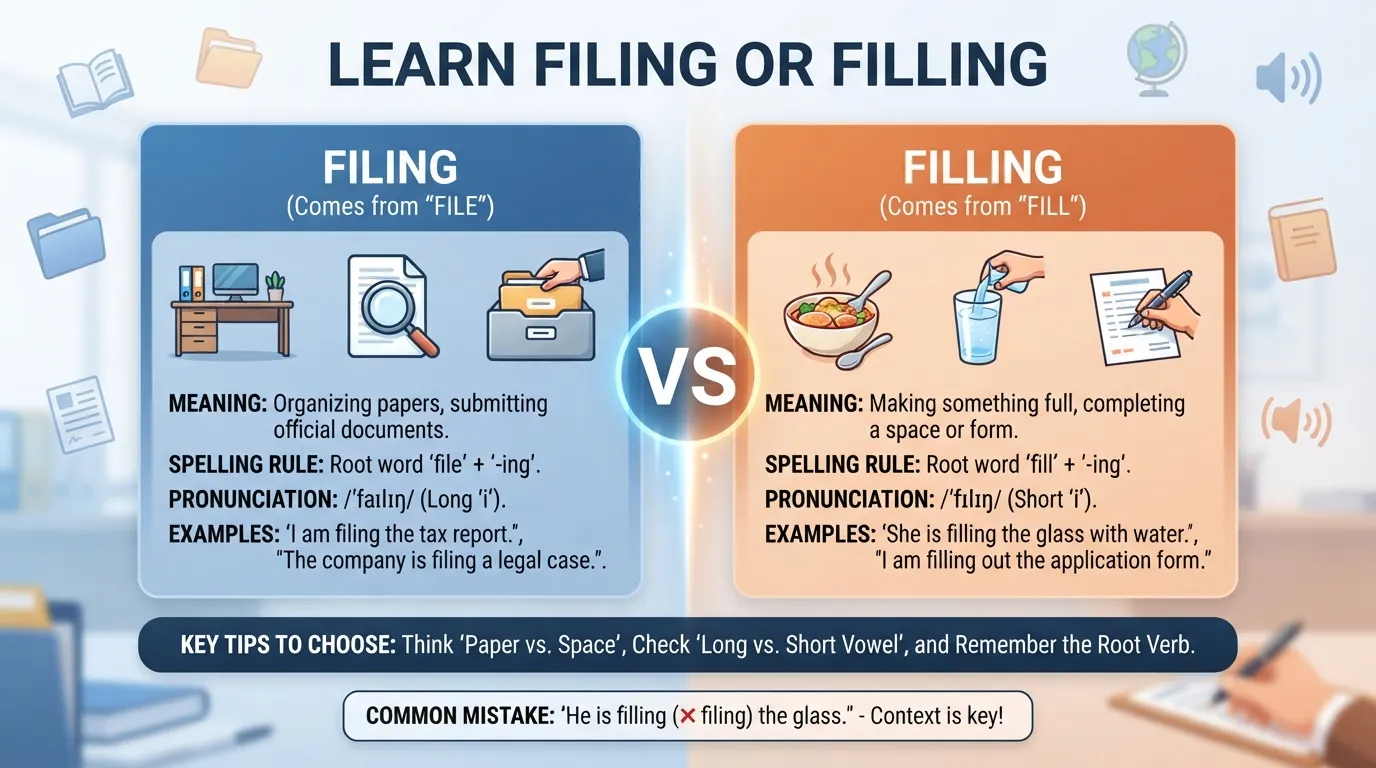
Filing means putting papers in order or sending an official form. Filling means making something full.
Imagine you are at work. Your boss asks you to put some papers in a folder. You are filing the papers. Later, you put water in a glass. You are filling the glass. Both words are correct, but they have different meanings.
The words filing or filling can confuse many English learners. They look almost the same. They also sound very much alike. But one letter changes the meaning.
Filing often relates to papers, records, nails, or legal steps. For example, you may file a report or file a complaint. Filling often means adding something to a space. You can fill a cup with water or fill a bag with books.
People search for filing or filling because they want to spell words correctly in emails, schoolwork, forms, and daily messages. This guide explains the difference in simple words. You will learn their meanings, uses, spelling rules, and common mistakes. Easy examples will help you choose the right word each time.
Pronunciation of Filing and Filling
| Word | US Pronunciation (IPA) | UK Pronunciation (IPA) | Syllables |
| Filing | /ˈfaɪ.lɪŋ/ | /ˈfaɪ.lɪŋ/ | 2 |
| Filling | /ˈfɪl.ɪŋ/ | /ˈfɪl.ɪŋ/ | 2 |
Easy sound tip:
- Filing sounds like “FY-ling.”
- Filling sounds like “FIL-ling.”
The first vowel sound is the key. Filing has the long “i” sound, as in fine. Filling has the short “i” sound, as in fill.
Difference Between Filing and Filling
1. Meaning
Filing often means putting papers or records in order. It can also mean sending an official form.
Filling means making something full or putting something into a space.
Examples:
- I am filing the old reports.
- She is filling the box with toys.
2. Use With Papers
We use filing when we put papers in the right place or send them to an office.
We use filling when we add words or details to spaces on a form.
Examples:
- He is filing the bills by date.
- I am filling in my name on the form.
3. Use With Forms
Filing can mean sending a form or document to an office, court, or other group.
Filling can mean writing the needed details on a form.
Examples:
- She is filing her tax return.
- He is filling out a job application.
4. Use With Space
Filing does not usually mean making a space full.
Filling means adding things until a space has what it needs or has no room left.
Examples:
- The worker is filling the tank with fuel.
- We are filling the basket with apples.
5. Use in Law
Filing is common in legal work. It can mean sending a legal paper to a court.
Filling is not the usual word for this action. It may mean adding details to a legal form.
Examples:
- The lawyer is filing a case.
- She is filling in the court form.
6. Use With Food
Filing is not the word we use for adding food to a pie or sandwich.
Filling can mean the food placed inside another food.
Examples:
- The pie has an apple filling.
- I am filling the sandwich with cheese.
7. Use With Teeth
Filing can mean smoothing a rough edge. A dentist may also use a dental file for certain tasks.
Filling can mean material used to repair a hole in a tooth.
Examples:
- The worker is filing the rough edge.
- The dentist put a filling in my tooth.
8. Word Form
Filing comes from the verb file. You file a report, then you can call the act filing.
Filling comes from the verb fill. You fill a cup, then you can call the act filling.
Examples:
- Filing the papers took an hour.
- Filling the pool took all day.
9. Common Phrases
Some phrases use filing, while others use filling.
Examples:
- The company is filing a report.
- The child is filling a bucket.
More common phrases include filing cabinet, filing a complaint, filling a gap, and filling a bottle.
10. The Main Spelling Rule
Filing has one “l” before “ing” because the silent “e” in file is removed.
Filling has two “l” letters because fill already ends in two “l” letters.
Examples:
- File → filing
- Fill → filling
Keep Exploring https://orchoice.com/exiting-or-exciting/
Nature and Behaviour of Filing and Filling
Nature of Filing
Filing often relates to order, records, and official tasks. It helps people keep papers safe and easy to find. It can also mean sending a form or legal paper to the right place.
Examples:
- The clerk is filing the records.
- They are filing a complaint.
Nature of Filling
Filling often relates to adding something to a space. It can also name the food inside a pie or the material inside a tooth.
Examples:
- She is filling the bottle with water.
- I like the cream filling in this cake.
Why People Get Confused About Filing and Filling
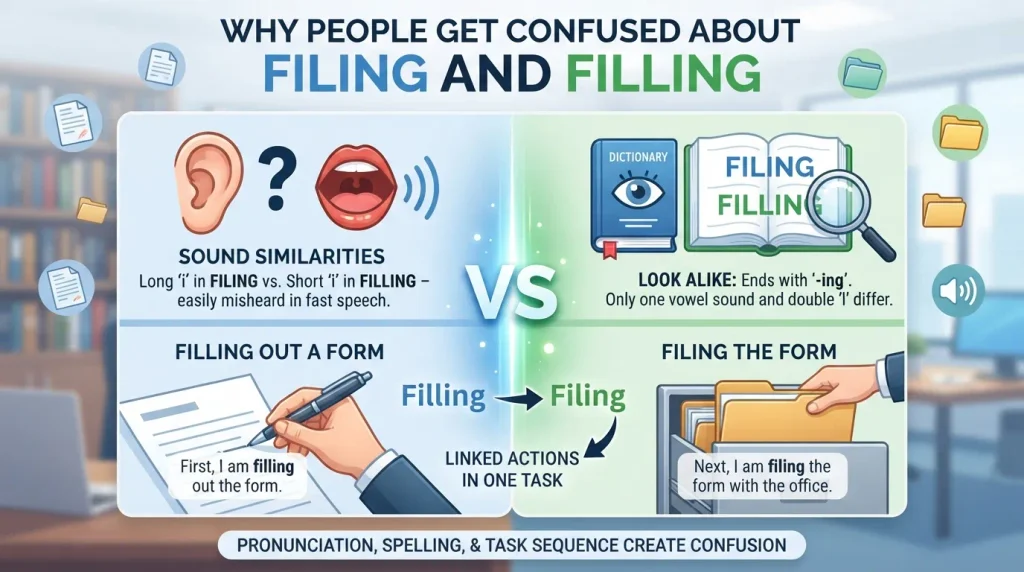
These words are easy to mix up for three main reasons.
1. They look alike. Both words end in “-ing.” Only the first vowel sound and the number of “l” letters help show the difference.
2. They sound similar. In fast speech, the long “i” in filing and the short “i” in filling may be hard for some learners to hear.
3. They can appear in the same task. You may fill out a form and then file it. The two actions are linked, but they are not the same.
For example:
- First, I am filling out the form.
- Next, I am filing the form with the office.
Comparison Table
| Point | Filing | Filling |
| Main meaning | Putting records in order or sending a document | Making something full |
| Base word | File | Fill |
| Spelling | One “l” before “ing” | Two “l” letters |
| Common use | Papers and official records | Spaces, containers, food, and teeth |
| At work | Filing a report | Filling out a form |
| In law | Filing a case | Filling in legal details |
| With food | Rare in this sense | Pie filling |
| With teeth | Smoothing an edge or surface | Material used to repair a tooth |
| Example | Filing the bills | Filling the box |
| Shared feature | Both end in “-ing” | Both end in “-ing” |
The Origin of Filing and Filling
The Origin of Filing
The word file has a long history. It came into English through French and is linked to an older word for a thread. A file could be a line of papers or items kept together.
Over time, file became common for keeping papers in order. Today, people use filing for sorting records and sending official documents.
The Origin of Filling
The word fill comes from Old English fyllan. It means to make full or put something into a space.
The word has kept much of this meaning over time. We now use it for many tasks, from filling a cup to filling a form.
British vs American English
The spelling of filing and filling is the same in British and American English. The main difference is not regional spelling. It is the meaning and the way each word is used.
| Situation | American English | British English |
| Putting papers in order | Filing papers | Filing papers |
| Sending a legal document | Filing a case | Filing a case |
| Adding details to a form | Filling out a form | Filling in a form is common |
| Making a container full | Filling a bottle | Filling a bottle |
| Material in a repaired tooth | A filling | A filling |
Both fill out a form and fill in a form are understood in many places. Fill in is common in British English, while fill out is common in American English.
Examples:
- US: I am filling out the form.
- UK: I am filling in the form.
- Both: She is filing the report.
Which One Should You Use?
The right word depends on what you mean.
Use Filing When:
- You put papers in order.
- You send a report to an office.
- You make an official or legal request.
- You smooth an edge with a file.
Examples:
- I am filing my tax return.
- The office is filing the records.
Use Filling When:
- You make a space full.
- You add details to a form.
- You talk about food inside a pie or sandwich.
- You talk about material used to repair a tooth.
Examples:
- He is filling the glass with juice.
- I need a new tooth filling.
For Global English
Use the word that matches the action. The spelling is the same in the US and UK. If you are unsure, ask yourself: Am I putting records in order, or am I making something full?
Common Mistakes
Here are common errors and how to fix them.
Mistake 1: Using filling for official papers
Incorrect: I am filling the report with the court.
Correct: I am filing the report with the court.
Mistake 2: Using filing for a container
Incorrect: She is filing the bottle with water.
Correct: She is filling the bottle with water.
Mistake 3: Spelling filing with two “l” letters
Incorrect: I am fillling the papers.
Correct: I am filing the papers.
Mistake 4: Spelling filling with one “l” letter
Incorrect: The cake has a tasty filing.
Correct: The cake has a tasty filling.
Mistake 5: Mixing up the actions on a form
Incorrect: I am filing out the form.
Correct: I am filling out the form.
Mistake 6: Using filling when you mean sending a legal case
Incorrect: The lawyer is filling a case.
Correct: The lawyer is filing a case.
Everyday Usage Examples
In Emails
- Please finish filling out the form today.
- I am filing the signed papers now.
On Social Media
- Filling my day with good memories!
- Filing old photos into folders today.
In News
- The company is filing a report with the court.
- The town is filling water tanks before the storm.
In Formal Writing
- The team is filing its yearly report.
- The staff is filling in the missing details.
Usage Trends
Both filing and filling are common English words. They appear in daily life, work, school, and news.
Filing is often used in office work, law, taxes, and record keeping. For example, people may talk about filing a report or filing a claim.
Filling is used in many daily tasks. People fill cups, bags, forms, and gaps. The word also appears in food and dental care.
Their use depends on the topic. There is no need to choose one word over the other. They do different jobs. For clear writing, use filing for the act of filing and filling for the act of making something full.
Metaphors and Similes
Both words can be used in ways that go beyond their basic meaning.
Filing
Filing away a memory means keeping it in your mind for later.
Example: I filed away her advice for the future.
Filing something under a label means placing it in a group or category.
Example: He filed the idea under “future plans.”
Filling
Filling a gap means fixing a missing part or meeting a need.
Example: The new teacher is filling a gap in the school.
Filling someone’s heart with joy means making them feel very happy.
Example: The good news filled her heart with joy.
These phrases help make writing more vivid. Their meaning depends on the words around them.
Connotative Meaning
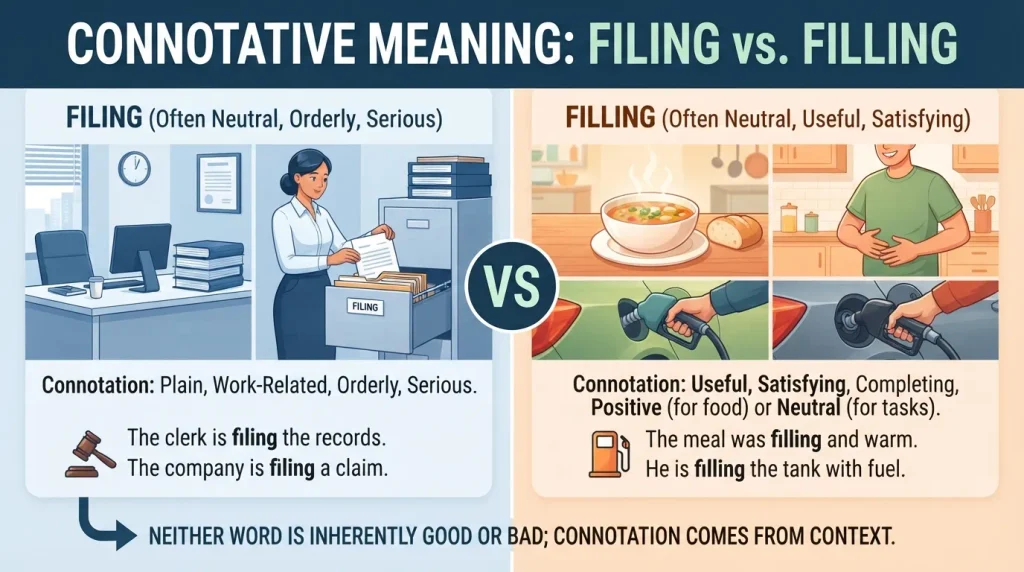
A word’s connotation is the feeling or idea it brings to mind.
Filing: Often Neutral
Filing often sounds plain and work-related. It can suggest order, care, and record keeping.
Example: The clerk is filing the records.
It may also sound serious in legal news.
Example: The company is filing a claim.
Filling: Often Neutral or Positive
Filling often sounds useful or satisfying. It can suggest that a need is being met.
Example: The meal was filling and warm.
It can also be neutral.
Example: He is filling the tank with fuel.
Neither word is always good or bad. The meaning comes from the sentence.
Idioms and Proverbs
There are no widely used idioms that depend only on the difference between filing and filling. However, both words appear in common phrases.
Filing Away
Meaning: To keep something for later use or thought.
Example: She filed away the idea and used it a year later.
File a Complaint
Meaning: To make an official complaint.
Example: The customer filed a complaint about the poor service.
Fill the Gap
Meaning: To provide what is missing.
Example: This short course will fill the gap in my skills.
Fill Someone’s Shoes
Meaning: To take the place of another person and do their job.
Example: The new manager must fill her shoes.
These phrases are useful in everyday speech and writing.
Literature and Movies
The words filing and filling are everyday words. They can appear in many types of books and films, but they are not tied to one famous story.
Literature
- Genre: Mystery and crime stories often show people filing reports or legal papers.
- Genre: Family stories and food writing may use filling when describing meals or cooking.
- Writing tip: Use filing for records and official actions. Use filling for adding something to a space.
Movies
- Genre: Courtroom films often show lawyers filing legal papers.
- Genre: Family and cooking films may show people filling cakes, pies, or containers.
Why This Difference Matters
Using the right word helps people understand you. A small spelling error can change the meaning of a sentence.
Imagine writing, “I am filling a case.” A reader may not know what you mean. If you mean that you are sending a case to court, filing a case is the correct phrase.
The difference also matters at work. You may need to fill out a form before filing it. If you use the wrong word, a task may sound unclear.
For English learners, learning these words builds better spelling and writing skills. It also helps with emails, schoolwork, job forms, and daily talks.
A simple rule can help:
- Fill means make full.
- File means put in order or send an official document.
- Filling comes from fill.
- Filing comes from file.
Usefulness in Daily Life
You may use these words more often than you think.
- At home: Fill a bottle with water.
- At school: Fill in the missing words.
- At work: File your reports in the right folder.
- At a bank: Fill out an account form.
- In court: File a legal paper.
- At a dentist: Get a tooth filling.
- In cooking: Add a filling to a pie.
- On a computer: File your documents in folders.
Situational Preference
Choose filing when you are putting records in order or sending a paper to an office. For example, you may file a report, a tax return, or a legal claim. Choose filling when you add something to a space or make it full. You may fill a cup, fill a bag, or fill out a form. In a form task, you often use both words: first, you fill out the form; then, you file it. The words are spelled the same in US and UK English. Think about the action first, then choose the right word.
More About Filing or Filling
1. What is the main difference between filing and filling?
Filing means putting records in order or sending an official paper. Filling means making something full or adding details to a form.
2. Is filing or filling correct?
Both words are correct. Use filing for records and official papers. Use filling when you make something full.
3. Is it filing out a form or filling out a form?
The correct phrase is filling out a form. It means adding the details that the form asks for.
4. Is it filing a case or filling a case?
The correct phrase is filing a case when you start a legal case by sending the needed papers to a court.
5. How do you spell filing?
The correct spelling is filing. It comes from file. Remove the final “e” before adding “-ing.”
6. How do you spell filling?
The correct spelling is filling. It comes from fill. Keep both “l” letters before adding “-ing.”
7. Are filing and filling pronounced the same?
No. Filing has a long “i” sound, like fine. Filling has a short “i” sound, like fill. Both have two syllables.
Conclusion
Filing or filling may look alike, but they have different meanings, with filing typically referring to putting papers in order or submitting official documents (like a tax return or legal case), while filling means making something full or adding details to a space or form (like filling a glass with water or filling out paperwork). Both words are completely correct in both American and British English, and the choice simply depends on the specific action you are taking remembering that filing comes from file, whereas filling comes from fill. By keeping this simple rule in mind, you can easily avoid common spelling errors and write clear, correct English every time.

I’m Samia Jamshaid, an English language specialist, SEO specialist, digital publisher, and researcher. I create clear, accurate, and well-researched content on English grammar, vocabulary, word meanings, and language comparisons, helping readers understand and use English with confidence.









1 thought on “Filing or Filling: Which Word Should You Use? 2026”