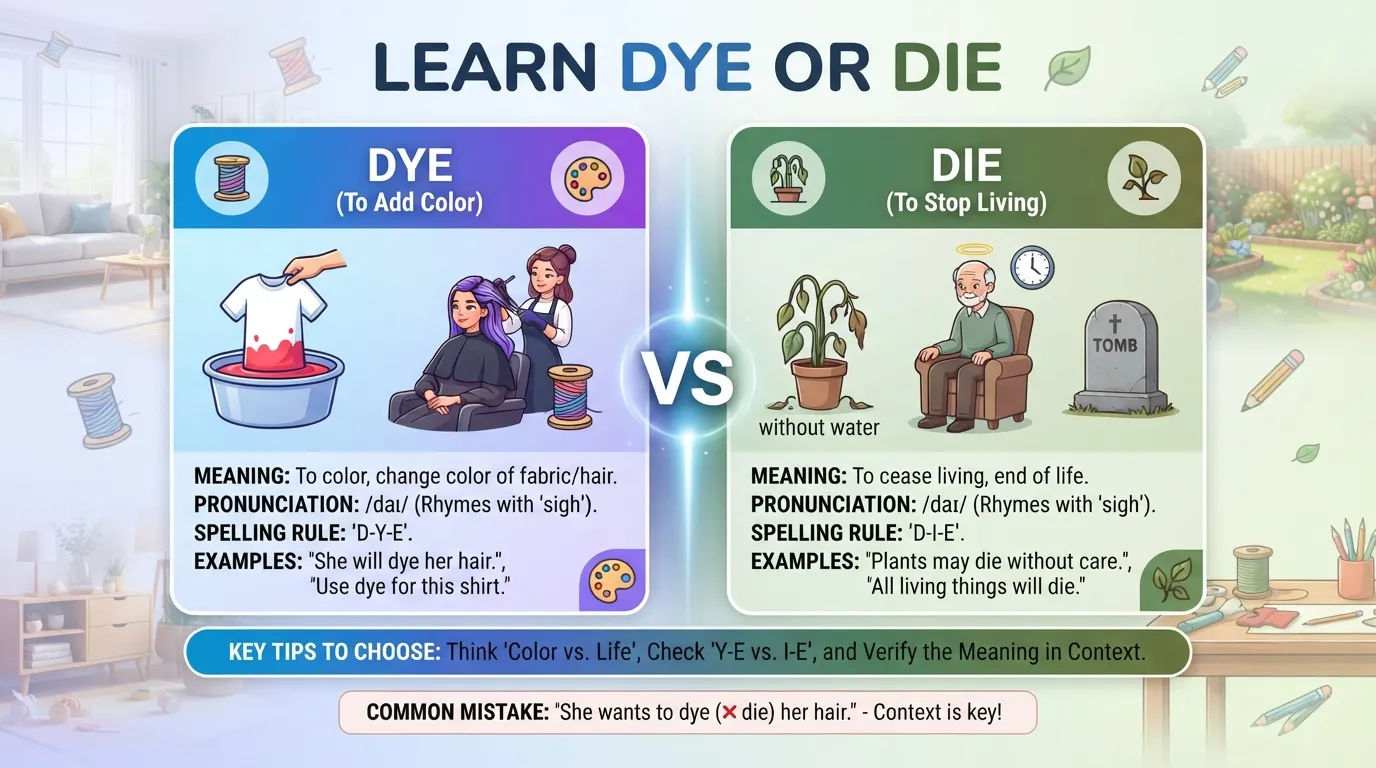
Dye means to add color to something. Die means to stop living.
Imagine you want to change your white shirt to blue. You use a dye to give it a new color. Now imagine a story about an old king who dies. His life comes to an end. These two words have very different meanings, even though they sound the same.
The words dye or die can confuse many English learners. They have only one letter of difference. Both are said in the same way. But using the wrong word can change the whole meaning of a sentence.
Dye is often used when we talk about hair, clothes, and other things that need color. For example, you can dye your hair brown. Die is used when a person, animal, or plant stops living. It can also appear in phrases such as “die of hunger” or “die laughing.”
People search for dye or die because they want to spell these words right in schoolwork, emails, stories, and daily messages. This guide will show you their meanings, spelling rules, and uses with easy examples.
Pronunciation of Dye and Die
The words dye and die sound the same in both American and British English. They are homophones. Homophones are words that sound alike but have different meanings or spellings.
| Word | US Pronunciation | UK Pronunciation | Syllables |
| Dye | /daɪ/ | /daɪ/ | 1 |
| Die | /daɪ/ | /daɪ/ | 1 |
Both words rhyme with my, try, and sky.
- Dye: Think of adding color.
- Die: Think of life coming to an end.
Difference Between Dye and Die
1. Meaning
Dye means to give something a new color.
Die means to stop living.
Examples:
- I want to dye my hair red.
- Plants may die without water.
2. Part of Speech
Dye can be a verb or a noun. As a verb, it means to add color. As a noun, it means a substance used to add color.
Die is a verb when it means to stop living.
Examples:
- She will dye her dress blue.
- The blue dye stained my hands.
3. Use With Hair
We use dye when we change the color of hair.
We use die when talking about the end of life.
Examples:
- He wants to dye his hair black.
- The writer said the old king would die.
4. Use With Clothes
Dye can change the color of clothes, cloth, or other fabric.
Die does not mean to change the color of clothes.
Examples:
- I will dye my white shirt green.
- The flowers may die in the heat.
5. Use With People and Animals
Dye is not used to say that a person or animal stops living.
Die is the correct word for that meaning.
Examples:
- They used safe dye to color the cloth.
- The sick bird may die without care.
6. Use With Plants
Dye may be used to color plant-based materials, such as cotton or wool.
Die describes what happens when a plant stops living.
Examples:
- The artist used plant-based dye on the cloth.
- The small tree may die without enough water.
7. Use in Art and Crafts
Dye is common in art, crafts, and design. It adds color to many materials.
Die may appear in a story about an artist or a character’s life.
Examples:
- We used blue dye to color the yarn.
- The hero did not die at the end of the story.
8. Use in Stories
Dye may appear in a story about clothes, hair, or art.
Die often appears in stories about danger, loss, or the end of life.
Examples:
- The tailor used red dye for the king’s coat.
- The brave soldier chose to die for his people.
9. Word Forms
The word dye has forms such as dyes, dyed, and dyeing.
The word die has forms such as dies, died, and dying.
Examples:
- She is dyeing the fabric.
- The plant is dying in the cold.
Notice the spelling: dyeing keeps the “e,” while dying does not.
10. The Main Spelling Rule
Both words have the same sound, but their meanings help you choose the right one.
Use dye when color is involved. Use die when life comes to an end.
Examples:
- I will dye my old shoes blue.
- Without water, the flowers may die.
You may also like https://orchoice.com/filing-or-filling/
Nature and Behaviour of Dye and Die
Nature of Dye
Dye is linked to color and change. It can be a liquid, powder, or other substance used to color materials. Some dyes come from plants. Others are made in factories.
Dye can be used on:
- Hair
- Clothes
- Wool and cotton
- Paper and crafts
- Some foods, when the dye is made for food use
Examples:
- The shop sells cloth dye.
- My mother will dye the curtains a new color.
Nature of Die
Die is linked to the end of life. It can describe people, animals, plants, and other living things. The word also appears in some phrases with a less direct meaning.
Examples:
- Many plants die when the soil stays dry.
- I laughed so hard that I thought I would die.
Why People Get Confused About Dye and Die
People often mix up these words for three simple reasons.
1. They sound the same. You cannot tell which word someone means just by hearing it. You need to look at the sentence.
2. They look almost the same. Both words have three letters. Only the first letter changes.
3. They have different meanings. One relates to color. The other relates to life.
For example:
- I will dye my shirt blue.
- I hope the plant does not die.
Easy memory tip: If you think about color, use dye. If you mean the end of life, use die.
Comparison Table
| Point | Dye | Die |
| Main meaning | To add color | To stop living |
| Part of speech | Noun or verb | Mainly a verb for this meaning |
| Common use | Hair, clothes, fabric | People, animals, plants |
| Example | Dye the shirt blue | The plant may die |
| Past form | Dyed | Died |
| Form ending in “-ing” | Dyeing | Dying |
| Sound | /daɪ/ | /daɪ/ |
| Syllables | 1 | 1 |
| US spelling | Dye | Die |
| UK spelling | Dye | Die |
The Origin of Dye and Die
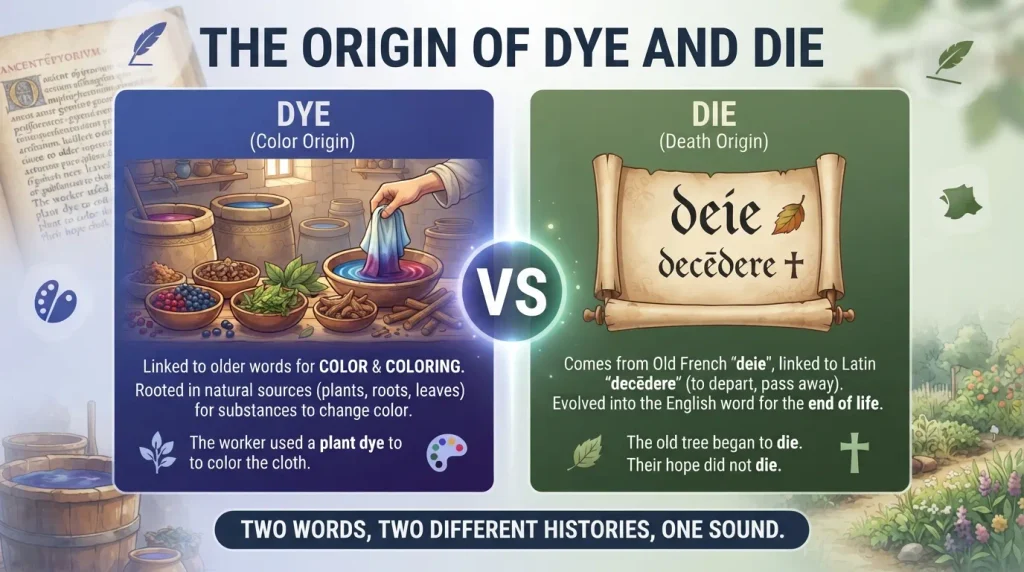
The Origin of Dye
The word dye is linked to older words for color and coloring. It has long been used for substances that change the color of cloth and other materials.
People used natural dyes long before modern factories existed. They took color from plants, roots, leaves, and other natural sources. Today, dyes can be natural or made by people.
Example:
- The worker used a plant dye to color the cloth.
The Origin of Die
The word die comes from Old French deie, which is linked to Latin decēdere, meaning to depart or pass away. Over time, die became the common English word for the end of life.
Today, it is used in both direct and figurative ways.
Examples:
- The old tree began to die.
- Their hope did not die.
British vs American English
There is no spelling difference between dye and die in British and American English. Both forms are used in the same way.
| Use | American English | British English |
| Change hair color | Dye your hair | Dye your hair |
| Change cloth color | Dye the fabric | Dye the fabric |
| End of life | The plant may die | The plant may die |
| Past form of dye | Dyed | Dyed |
| Past form of die | Died | Died |
| Form ending in “-ing” | Dyeing / Dying | Dyeing / Dying |
Examples:
- US: I want to dye my hair brown.
- UK: I want to dye my hair brown.
- US and UK: The flowers may die without water.
Which One Should You Use?
The right word depends on what you want to say.
Use Dye When You Mean Color
Use dye when you want to add or change color.
Examples:
- I will dye my hair black.
- The shop sells red dye for cloth.
Use Die When You Mean Life
Use die when a living thing stops living.
Examples:
- Plants may die without sunlight and water.
- The old man did not want to die alone.
For US, UK, and Global English
The spelling is the same in the United States, the United Kingdom, and other English-speaking places. You do not need to learn two spelling rules.
Just check the meaning of the sentence. If it is about color, choose dye. If it is about life, choose die.
Common Mistakes
Here are some common errors and their correct forms.
Mistake 1: Using Die for Color
Incorrect: I want to die my hair red.
Correct: I want to dye my hair red.
Mistake 2: Using Dye for the End of Life
Incorrect: The plant will dye without water.
Correct: The plant will die without water.
Mistake 3: Mixing Up Dyed and Died
Incorrect: She died her hair brown.
Correct: She dyed her hair brown.
Mistake 4: Mixing Up Dyeing and Dying
Incorrect: I am dying my shirt blue.
Correct: I am dyeing my shirt blue.
Mistake 5: Using Die in a Craft Task
Incorrect: We used blue die to color the wool.
Correct: We used blue dye to color the wool.
Mistake 6: Using Dye in a Story About Death
Incorrect: The old tree dyed last year.
Correct: The old tree died last year.
Remember that dyed comes from dye, while died comes from die.
Everyday Usage Examples
In Emails
- I plan to dye the curtains before the event.
- Please water the plants so they do not die.
On Social Media
- I used a new dye to change my hair color.
- My garden flowers may die in this heat.
In News
- A local shop has started selling natural fabric dye.
- Many plants may die during a long period without rain.
In Formal Writing
- The artist used a natural dye to color the fabric.
- Some plants die when they do not get enough water.
Usage Trends
Both dye and die are common English words. They appear in different types of writing.
Dye is often used in topics about beauty, fashion, crafts, and cloth. You may see it in guides about hair color or in steps for coloring fabric.
Die is common in stories, news, science, and daily speech. It may describe the death of a person, an animal, or a plant. It can also be used in phrases such as “die laughing.”
There is no need to choose one word over the other. They have different jobs. The best way to use them is to learn their meanings and forms.
For clear writing, remember:
- Dye, dyed, dyeing
- Die, died, dying
Metaphors and Similes
A metaphor uses one thing to talk about another. A simile compares two things, often with like or as.
Dye in Figurative Language
“Dye the world with joy” means to fill life with happy feelings or bright things.
Example: Her kind acts dyed the day with joy.
This is a creative phrase, not a common fixed saying.
Die in Figurative Language
The word die can mean that a feeling, hope, or idea comes to an end.
Example: His dream did not die.
Here, the dream does not stop living in a real sense. It means he did not give up on it.
“Die laughing” means to laugh very hard.
Example: That funny story made me nearly die laughing.
These uses make language more lively. The meaning depends on the sentence.
Connotative Meaning
A word’s connotation is the feeling or idea it brings to mind.
Dye: Often Neutral or Positive
Dye often brings to mind color, beauty, and change. It can make clothes, hair, or art look new.
Example: The bright dye made the scarf look fresh.
It can also be neutral.
Example: The worker mixed the dye with water.
Die: Often Negative or Serious
Die often relates to loss, sadness, or fear because it can mean the end of life.
Example: The family felt sad when their pet died.
But the word can also be used in a playful way.
Example: I nearly died laughing at that joke.
Here, the speaker does not mean real death. The phrase shows that the joke was very funny.
The feeling linked to each word depends on how it is used.
Idioms and Proverbs
Die Laughing
Meaning: To laugh very hard.
Example: I nearly died laughing at his silly dance.
Die of Shame
Meaning: To feel very ashamed or embarrassed.
Example: I would die of shame if I forgot my lines on stage.
This phrase is not usually meant in a real sense.
Die Hard
Meaning: To continue to live, last, or remain strong even when things are hard. It can also describe a person who will not give up an old belief or habit.
Example: He is a die-hard fan of the team.
Dye in the Wool
Meaning: The phrase dyed in the wool describes a person who strongly holds a belief or has a deep habit.
Example: She is a dyed-in-the-wool book lover.
This phrase is often used in a figurative way. It does not mean that the person is made of wool.
Literature and Movies
The words dye and die can appear in many types of books and films. One may relate to color, while the other may relate to life, loss, or danger.
Literature
- Genre: Fantasy stories may describe magic cloth, colored robes, or special dyes.
- Genre: Tragedies often deal with death and loss.
- Example of a tragedy: Romeo and Juliet, a play by William Shakespeare, was first published in 1597. It tells the story of two young lovers whose lives end in tragedy.
This play is a useful example of the theme of death, not a work about the spelling difference between dye and die.
Movies
- Genre: Fantasy films may show colorful clothes, magic, or changes in appearance.
- Genre: Drama films may explore death, loss, and the value of life.
- Example: Coco (2017), an animated film from the United States, explores family, memory, and the Mexican Day of the Dead tradition.
Why This Difference Matters
Using the right word helps people understand your message. Since dye and die sound the same, the wrong spelling can change the meaning.
Imagine writing, “I want to die my hair blue.” You may mean that you want to change your hair color. But the sentence uses the word for the end of life. The correct sentence is, “I want to dye my hair blue.”
This difference matters in schoolwork, emails, stories, and online posts. It also helps you read with more care. When you see one of these words, look at the words around it to understand the meaning.
For English learners, this is a useful lesson in spelling and word choice. A small change in letters can make a big change in meaning.
Remember these simple rules:
- Dye means to add color.
- Die means to stop living.
- Dyed means color was added.
- Died means life came to an end.
Usefulness in Daily Life
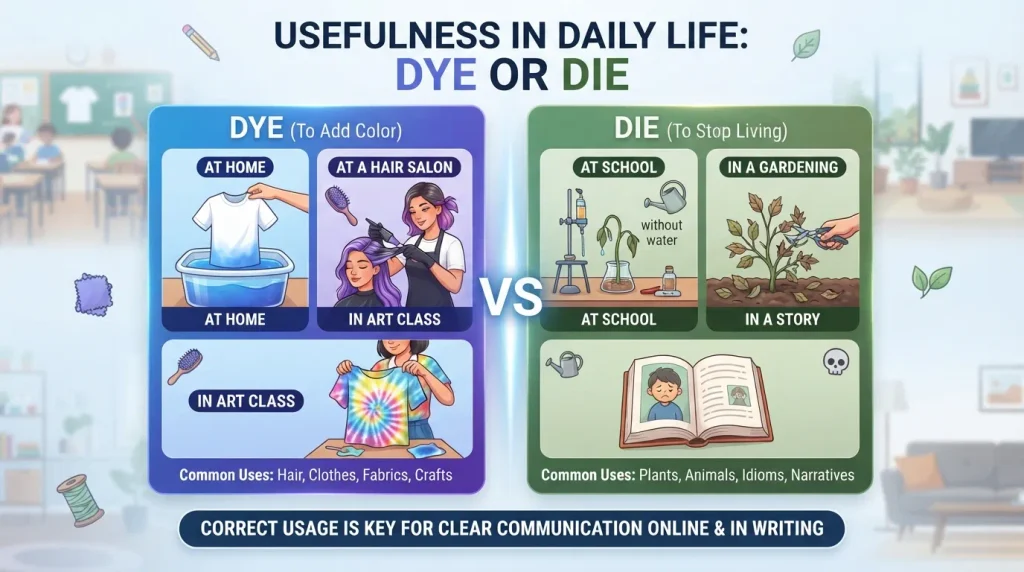
You may see these words in many parts of daily life.
- At home: Dye an old shirt a new color.
- At a hair salon: Choose a dye for your hair.
- At school: Learn why plants may die without water.
- In art class: Use dye to color cloth or yarn.
- In a story: Read about a character who may die.
- In gardening: Learn how to stop plants from dying.
- Online: Write a clear post about hair dye or plant care.
Situational Preference
Use dye when you talk about changing color. This is the right word for hair, clothes, cloth, and many craft tasks. For example, you may dye a white shirt blue or use a natural dye on wool. Use die when you talk about the end of life. It can describe a person, animal, or plant. It also appears in phrases such as “die laughing.” These rules are the same in the US, UK, and other English-speaking places. When you are unsure, read the full sentence. If it is about color, use dye. If it is about life, use die.
More About Dye or Die
1. What is the difference between dye and die?
Dye means to add color to something. Die means to stop living.
2. Is it dye my hair or die my hair?
The correct phrase is dye my hair. It means to change the color of your hair.
3. Is it dyed or died?
Both words are correct, but they have different meanings.
- Dyed: She dyed her hair brown.
- Died: The plant died without water.
4. Are dye and die pronounced the same?
Yes. Both are pronounced /daɪ/ in American and British English. They sound like my and sky.
5. What is the difference between dyeing and dying?
Dyeing means adding color. Dying means coming to the end of life.
Examples:
- She is dyeing the cloth.
- The plant is dying.
6. Is dye or die correct in British English?
Both are correct in British English. Use dye for color and die for the end of life. The same rule applies in American English.
7. How can I remember dye or die?
Think of dye when you see color. Think of die when you think about life ending. This simple tip can help you choose the right word.
Conclusion
Dye or die sound identical, but they have completely different meanings and functions: dye means to add color to something (such as your hair or a shirt), whereas die means to stop living (applied to people, animals, or plants) or to experience an exaggerated idiom like “die laughing.” Both spellings are entirely standard across American and British English without any regional variations. You also need to watch out for their distinct inflections, as dye changes to dyed and dyeing, while die changes to died and dying. Ultimately, if your sentence is about altering colors, use dye, but if it is about the end of life, choose die, allowing you to write clearly and correctly in daily life, school, and work.

I’m Samia Jamshaid, an English language specialist, SEO specialist, digital publisher, and researcher. I create clear, accurate, and well-researched content on English grammar, vocabulary, word meanings, and language comparisons, helping readers understand and use English with confidence.




1 thought on “Dye or Die: Correct Usage in Everyday English 2026”