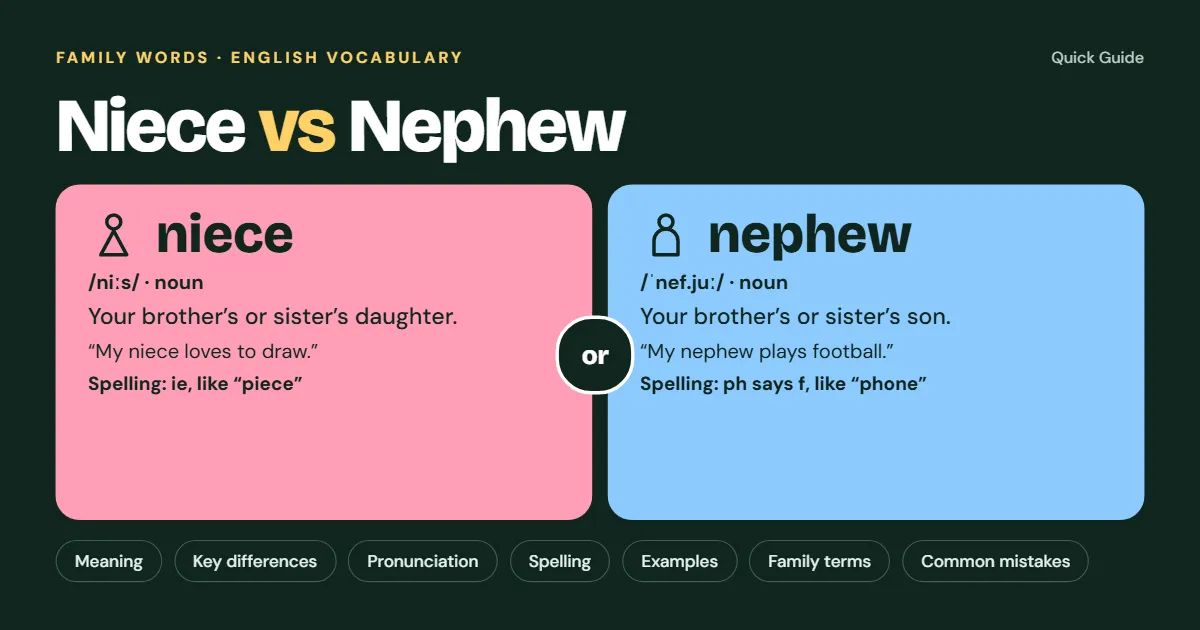
A niece is your brother’s or sister’s daughter. A nephew is your brother’s or sister’s son.
Imagine your sister has a baby girl. You can call the baby your niece. If your brother has a baby boy, he is your nephew. These words help you explain family ties in a clear way.
Many people confuse niece or nephew because both words describe children in the next generation of a family. However, the main difference is simple. Niece means a female relative, while nephew means a male relative. Your own gender does not change these words. A man and a woman can both have nieces and nephews.
You may also see these words in family chats, birthday cards, school tasks, and emails. Knowing the right word helps you speak and write with care. It also helps you tell the difference between a niece, nephew, and cousin.
In this guide, you will learn the meaning, spelling, pronunciation, and use of niece or nephew. You will also see easy examples, common mistakes, and other useful family terms.
Niece or Nephew:
The difference is based on gender.
- Niece: The daughter of your brother or sister.
- Nephew: The son of your brother or sister.
Examples:
- My sister’s daughter is my niece.
- My brother’s son is my nephew.
- I have two nieces and one nephew.
What Does Niece Mean?
A niece is the daughter of your brother or sister. She is part of your extended family.
For example, if your brother has a daughter named Emma, Emma is your niece. You can use this word whether you are her aunt or uncle.
Examples of Niece
- My niece loves to read books.
- I bought a gift for my niece.
- My niece is learning to ride a bike.
- We visited our niece last weekend.
- My niece won a school prize.
Who Is Called a Niece?
You can call a girl your niece when she is your brother’s or sister’s daughter. People also commonly use this word for a spouse’s sibling’s daughter.
A niece is not the same as a cousin. Your aunt’s or uncle’s daughter is usually your cousin.
What Does Nephew Mean?
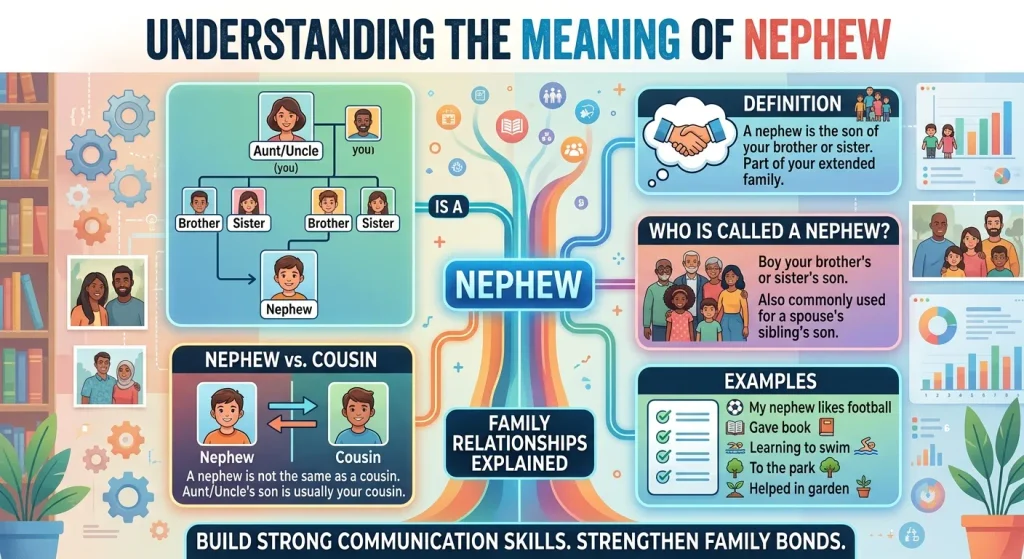
A nephew is the son of your brother or sister. He is also part of your extended family.
For example, if your sister has a son named Jack, Jack is your nephew. You can use this word whether you are his aunt or uncle.
Examples of Nephew
- My nephew likes to play football.
- I gave my nephew a new book.
- My nephew is learning to swim.
- We took our nephew to the park.
- My nephew helped me in the garden.
Who Is Called a Nephew?
You can call a boy your nephew when he is your brother’s or sister’s son. The word is also commonly used for a spouse’s sibling’s son.
A nephew is not the same as a cousin. Your uncle’s or aunt’s son is usually your cousin.
Niece vs. Nephew: Main Differences
| Point | Niece | Nephew |
| Meaning | A brother’s or sister’s daughter | A brother’s or sister’s son |
| Gender | Female | Male |
| Pronouns often used | She, her | He, him |
| Plural form | Nieces | Nephews |
| Family link | One generation below you | One generation below you |
| Your role | You may be her aunt or uncle | You may be his aunt or uncle |
| Spelling | Niece | Nephew |
| US spelling | Niece | Nephew |
| UK spelling | Niece | Nephew |
| Common phrase | My niece | My nephew |
1. Gender
Niece refers to a female relative. Nephew refers to a male relative.
- My niece is a girl.
- My nephew is a boy.
2. Family Relationship
A niece is your brother’s or sister’s daughter. A nephew is your brother’s or sister’s son.
- My brother’s daughter is my niece.
- My sister’s son is my nephew.
3. Pronouns
People usually use she and her for a niece. They usually use he and him for a nephew.
- My niece said she was happy.
- My nephew said he was happy.
4. Plural Forms
The plural of niece is nieces. The plural of nephew is nephews.
- I have three nieces.
- I have two nephews.
5. Family Events
Both words are common when talking about family events. The correct word depends on the person.
- My niece came to the wedding.
- My nephew came to the wedding.
6. Gifts
You can use both words when talking about gifts for family members.
- I bought a doll for my niece.
- I bought a ball for my nephew.
7. School and Work
Both words can appear in school tasks, forms, and everyday messages.
- My niece starts school today.
- My nephew starts school today.
8. Family Stories
Use niece for a female relative and nephew for a male relative when telling family stories.
- My niece learned to bake.
- My nephew learned to cook.
9. Relationship to You
Your own gender does not decide whether someone is your niece or nephew. The child’s gender does.
- A man can have a niece.
- A woman can have a nephew.
10. British and American English
The words have the same spelling and basic meaning in British and American English.
- My niece lives in London.
- My nephew lives in New York.
You may also like https://orchoice.com/dye-or-die/
Niece or Nephew: Pronunciation
Both words have two different sound patterns, and nephew has more than one accepted pronunciation.
| Word | US Pronunciation | UK Pronunciation | Syllables |
| Niece | /niːs/ | /niːs/ | 1 |
| Nephew | /ˈnɛf.juː/ or /ˈnɛv.juː/ | /ˈnev.juː/ or /ˈnɛf.juː/ | 2 |
Easy pronunciation tips:
- Niece: Sounds like “neess.”
- Nephew: Often sounds like “NEF-yoo” or “NEV-yoo.”
Why Do People Confuse Niece and Nephew?
People often confuse these words because they describe similar family relationships. Both refer to a child in the next generation of the family.
The main difference is the child’s gender.
- Use niece for a girl.
- Use nephew for a boy.
Niece, Nephew, Cousin, Aunt, and Uncle
These family words describe different relationships.
| Word | Simple Meaning | Example |
| Niece | Your brother’s or sister’s daughter | My niece is six. |
| Nephew | Your brother’s or sister’s son | My nephew is seven. |
| Cousin | Your aunt’s or uncle’s child | My cousin lives nearby. |
| Aunt | Your parent’s sister, or an aunt by marriage | My aunt is kind. |
| Uncle | Your parent’s brother, or an uncle by marriage | My uncle tells funny stories. |
| Sibling | Your brother or sister | My sibling lives with me. |
| Grandniece or great-niece | Often used for your sibling’s granddaughter; usage can vary | My great-niece is a baby. |
| Grandnephew or great-nephew | Often used for your sibling’s grandson; usage can vary | My great-nephew is two. |
An Easy Way to Remember
- Your brother’s daughter = your niece.
- Your sister’s son = your nephew.
- Your aunt’s daughter = your cousin.
- Your uncle’s son = your cousin.
The Origin of Niece and Nephew
The words niece and nephew came into English through Old French. Their roots go back to Latin family words.
- Niece came through Old French nece.
- Nephew came through Old French neveu.
Both words changed over time. Their meanings became more specific in English. Today, niece means a brother’s or sister’s daughter, while nephew means a brother’s or sister’s son.
The Latin root nepos is also linked to the word nepotism, which means giving unfair help to family members, especially at work.
British English vs. American English
There is no spelling difference between British and American English for these words.
| Feature | American English | British English |
| Female relative | Niece | Niece |
| Male relative | Nephew | Nephew |
| Plural of niece | Nieces | Nieces |
| Plural of nephew | Nephews | Nephews |
| Basic meaning | The same | The same |
Which Word Should You Use?
Choose the word that matches the person.
- Use niece for your brother’s or sister’s daughter.
- Use nephew for your brother’s or sister’s son.
- Use cousin for your aunt’s or uncle’s child.
If you do not know the person’s gender, you can say my sibling’s child or my relative. The word nibling is also used as a gender-neutral term for a niece or nephew, but it is much less common in everyday English.
Common Mistakes with Niece and Nephew
Mistake 1: Using Niece for a Boy
Incorrect: My niece is my brother’s son.
Correct: My nephew is my brother’s son.
Mistake 2: Using Nephew for a Girl
Incorrect: My nephew is my sister’s daughter.
Correct: My niece is my sister’s daughter.
Mistake 3: Calling a Cousin a Niece
Incorrect: My aunt’s daughter is my niece.
Correct: My aunt’s daughter is my cousin.
Mistake 4: Using the Wrong Plural
Incorrect: I have three niece.
Correct: I have three nieces.
Mistake 5: Misspelling Niece
Incorrect: My neice is coming today.
Correct: My niece is coming today.
Remember the spelling niece. The letters i and e appear in that order after the first letter.
Mistake 6: Misspelling Nephew
Incorrect: My nepheu is visiting us.
Correct: My nephew is visiting us.
Remember the standard spelling nephew.
Niece and Nephew in Everyday Life
You can use these words in many daily situations.
In Family Conversations
- My niece is coming over today.
- My nephew has a birthday tomorrow.
Within Emails and Messages
- I will be away because I am visiting my niece.
- I am taking my nephew to his appointment.
In Birthday Cards
- Happy birthday to my lovely niece!
- Happy birthday to my wonderful nephew!
In News and Stories
- The woman visited her niece.
- The man helped his nephew.
Within Formal Writing
You can use both words in schoolwork, family records, and other formal writing. They are standard English words.
Niece and Nephew in Literature and Movies

Family relationships often appear in books and films.
One well-known example is A Christmas Carol by Charles Dickens, first published in 1843. The main character, Ebenezer Scrooge, has a nephew named Fred. Fred is kind and tries to keep a family bond with Scrooge.
This example shows how the word nephew can be used in a story about family, care, and kindness.
Why Are These Words Important?
Knowing the difference between niece and nephew helps you describe family relationships correctly.
It can help you:
- Speak clearly about your family.
- Write better birthday cards and messages.
- Complete school tasks.
- Understand books, films, and news stories.
- Avoid confusion when talking about relatives.
Other Terms Related to Niece and Nephew
Some family terms are useful to know, but they are less common.
| Term | Meaning |
| Half-niece | The daughter of your half-sibling |
| Half-nephew | The son of your half-sibling |
| Sororal niece | Your sister’s daughter |
| Fraternal niece | Your brother’s daughter |
| Sororal nephew | Your sister’s son |
| Fraternal nephew | Your brother’s son |
| Great-niece or grandniece | Often means your sibling’s granddaughter, or your niece’s daughter, depending on usage |
| Great-nephew or grandnephew | Often means your sibling’s grandson, or your nephew’s son, depending on usage |
| Niece-in-law | A term whose meaning can vary; it may refer to a niece related through marriage |
| Nephew-in-law | A term whose meaning can vary; it may refer to a nephew related through marriage |
| Stepniece | A term for a niece relationship through a stepfamily |
| Stepnephew | A term for a nephew relationship through a stepfamily |
Note: Words such as sororal, fraternal, and in-law terms are not often needed in daily conversation. Their meanings may depend on family context. For simple writing, explain the exact relationship if a reader may not understand the term.
Frequently Asked Questions About Niece or Nephew
1. Is a niece a girl or a boy?
A niece is female. She is usually the daughter of your brother or sister.
2. Is a nephew a girl or a boy?
A nephew is male. He is usually the son of your brother or sister.
3. Can a man have a niece?
Yes. A man can have a niece if his brother or sister has a daughter. He is her uncle.
4. Can a woman have a nephew?
Yes. A woman can have a nephew if her brother or sister has a son. She is his aunt.
5. What are niece and nephew together called?
People usually say nieces and nephews. The less common gender-neutral word niblings can refer to both.
6. Is my cousin’s child my niece or nephew?
Usually, no. Your cousin’s child is commonly called your cousin’s child. In some families and cultures, people may use niece or nephew for more distant relatives.
7. Is there a difference between British and American spelling?
No. Both British and American English use niece and nephew with the same spellings and basic meanings.
Conclusion
The difference between niece or nephew is easy to learn. A niece is your brother’s or sister’s daughter, while a nephew is your brother’s or sister’s son. You can use both words whether you are a man or a woman. The child’s gender decides which word to use. These words are common in family talks, birthday cards, schoolwork, and everyday writing. Remember that a cousin is usually the child of your aunt or uncle, while a niece or nephew is usually the child of your brother or sister. Both words have the same spelling in British and American English. Once you learn these simple rules, you can use niece and nephew with confidence. Clear family words help you share stories, describe relatives, and write messages that others can understand.

I’m Samia Jamshaid, an English language specialist, SEO specialist, digital publisher, and researcher. I create clear, accurate, and well-researched content on English grammar, vocabulary, word meanings, and language comparisons, helping readers understand and use English with confidence.






1 thought on “Niece or Nephew: Difference, Grammar & Examples 2026”