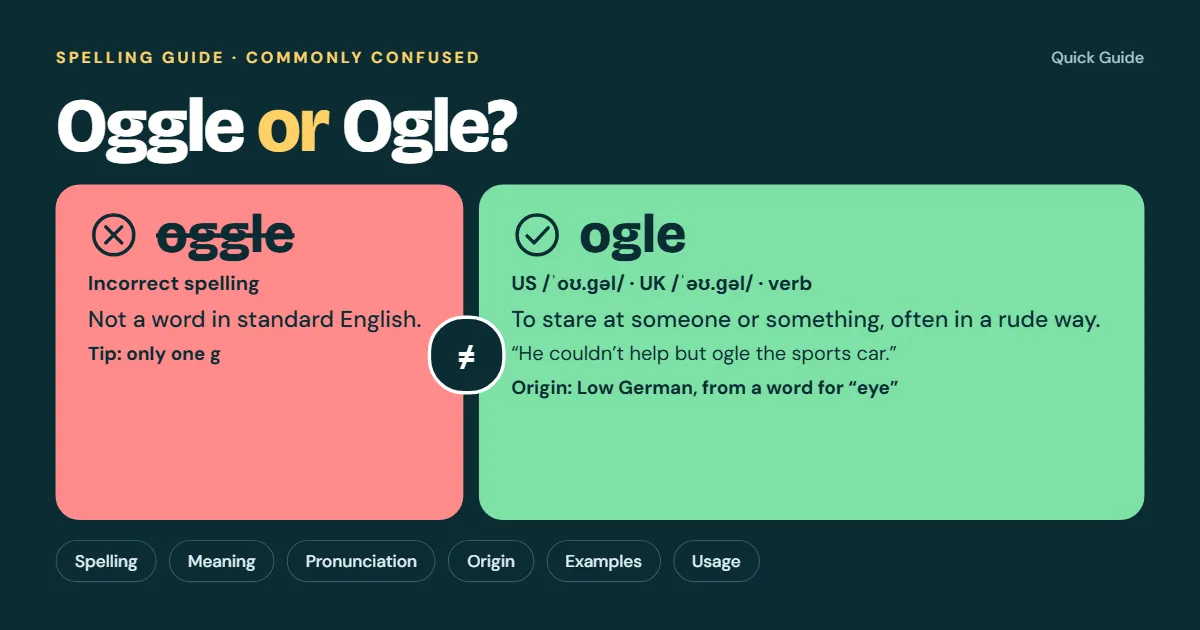
Ogle is the correct spelling when you mean to stare at someone with strong interest or desire. Oggle is usually a misspelling of this word.
Imagine you are at a car show. A new sports car catches everyone’s eye. People stop to look at it. You might say they are ogling the car. Now imagine someone staring at another person for too long. The word ogle can also describe that kind of look.
Many people search for oggle or ogle because the words look almost the same. They may wonder if both spellings are correct. The answer is simple: ogle is the standard English word for this meaning. Oggle is not the usual spelling.
Learning the correct spelling between oggle or ogle helps you write clear emails, schoolwork, stories, and blog posts. It also helps you choose the right word for the situation. Ogle can sound rude when it describes staring at a person. When it describes looking at a car or a shop display, it can sound more playful.
This guide explains the meaning, spelling, pronunciation, and use of ogle. You will also learn common mistakes, easy examples, and words with similar meanings.
Pronunciation of Ogle and Oggle
| Word | US Pronunciation | UK Pronunciation | Syllables |
| Ogle | /ˈoʊ.ɡəl/ | /ˈəʊ.ɡəl/ | 2 |
| Oggle | No standard pronunciation for this intended meaning | No standard pronunciation for this intended meaning | — |
The word ogle has two syllables. The stress falls on the first syllable.
In US English, it sounds like “OH-guhl.” In UK English, the first vowel has a slightly different sound.
There is no standard pronunciation for oggle as a spelling of this word because it is not the usual form.
Difference Between Ogle or Oggle
1. Correct Spelling
Ogle is the standard spelling. Oggle is usually a spelling mistake when you mean to stare at someone or look at something with strong interest.
- Correct: He tried to ogle the singer.
- Incorrect: He tried to oggle the singer.
2. Meaning
Ogle means to look at someone in a bold or often rude way. It can also mean to look at something with strong interest.
- He ogled the new sports car.
- The man ogled the woman on the bus.
Oggle is not the standard spelling for these meanings.
3. Use in Dictionaries
Ogle is a standard English word found in dictionaries. Oggle is not the usual spelling for this meaning.
- I checked the meaning of ogle in a dictionary.
- She learned how to use ogle in a sentence.
4. Part of Speech
Ogle is mainly used as a verb. A verb tells us what someone does.
- They ogle the cars at the show.
- He ogled the painting.
5. Present Tense
Use ogle with I, you, we, and they. Use ogles with he, she, and it.
- I do not ogle strangers.
- He ogles people in a rude way.
6. Past Tense
The past tense of ogle is ogled. Do not add another g.
- She ogled the new dress.
- The visitors ogled the old cars.
7. The -ing Form
The -ing form is ogling. Drop the final e before adding -ing.
- Stop ogling strangers.
- We saw people ogling the new car.
8. Tone
Ogle can sound rude when it describes staring at a person. It can sound playful when people look at things they find exciting.
- It is rude to ogle someone.
- The children ogled the toys in the shop.
9. British and American English
Both British and American English use ogle. Neither uses oggle as the standard spelling for this meaning.
- The British writer used the word ogle.
- The American writer used the word ogle.
10. Best Word for Writing
Use ogle in schoolwork, stories, emails, and blog posts. Avoid oggle when you mean this word.
- Please use the correct spelling, ogle.
- The writer changed oggle to ogle.
You may also like https://orchoice.com/niece-or-nephew/
Nature and Behaviour of Ogle and Oggle
Nature of Ogle
Ogle is a verb. It often means to stare at someone in a way that shows desire or feels rude. It can also describe looking at something with great interest.
For example, people may ogle a sports car at a show. They may stop to ogle a large cake in a shop window. In these cases, the word shows that the object has caught their attention.
When used for people, the word can have a more negative meaning. A person who ogles someone may make that person feel uneasy.
Nature of Oggle
Oggle is not the standard word for this action. If you use it in an essay or work email, readers may think you made a spelling mistake.
Use these forms instead:
- Ogle: I do not ogle strangers.
- Ogled: He ogled the car.
- Ogling: They were ogling the display.
Why People Get Confused About Ogle or Oggle
The two spellings look almost the same. They differ by only one letter. This can make it easy to type the wrong form.
Some people also think that a double letter makes a word look correct. However, English spelling does not always follow one simple rule.
The best way to remember the correct spelling is to learn the word as a group:
- Ogle
- Ogled
- Ogling
- Ogler
These forms all come from ogle. Notice that the past form has one g, and the -ing form drops the final e.
Easy rule: Use ogle with one g when you mean to stare with strong interest or desire.
Comparison Table
| Feature | Ogle | Oggle |
| Standard spelling for this meaning | Yes | No |
| Main use | To stare with desire or strong interest | Usually a spelling mistake for this meaning |
| Part of speech | Mainly a verb | Not the standard form for this meaning |
| Present form | Ogle | Not standard |
| Third-person form | Ogles | Not standard |
| Past form | Ogled | Not standard |
| -ing form | Ogling | Not standard |
| US English | Used | Usually incorrect for this meaning |
| UK English | Used | Usually incorrect for this meaning |
| Best choice | Use this word | Avoid it for this meaning |
The Origin of Ogle
The word ogle has been used in English since the late 1600s. Its exact history is not fully clear. It is often linked to older Dutch or Low German words about looking or making eyes at someone.
Over time, ogle came to mean looking at someone with desire or in a bold way. Today, it can also describe looking at something with great interest.
For example, someone may ogle a new car, a beautiful painting, or a display in a shop.
The spelling oggle is not the standard spelling for this word. If you are writing for school, work, or a website, use ogle.
British vs. American English
There is no spelling difference between British and American English for ogle.
| Feature | American English | British English |
| Correct spelling | Ogle | Ogle |
| Past tense | Ogled | Ogled |
| -ing form | Ogling | Ogling |
| Basic meaning | The same | The same |
| Oggle for this meaning | Usually incorrect | Usually incorrect |
Examples:
- US: The visitors stopped to ogle the cars.
- UK: The visitors stopped to ogle the cars.
Which One Should You Use? Oggle or ogle
Use ogle in both American and British English. It is also the best choice for readers around the world.
Use it when you want to describe a strong look that may show desire or seem rude. You can also use it when people look at something with great interest.
Examples:
- He tried to ogle the actor.
- The crowd stopped to ogle the new train.
- The shoppers ogled the cakes in the window.
Avoid oggle when you mean this word. If you want a simple word, use look at. If you mean a long look, use stare at. Whether you mean a kind or respectful look, use admire.
Common Mistakes
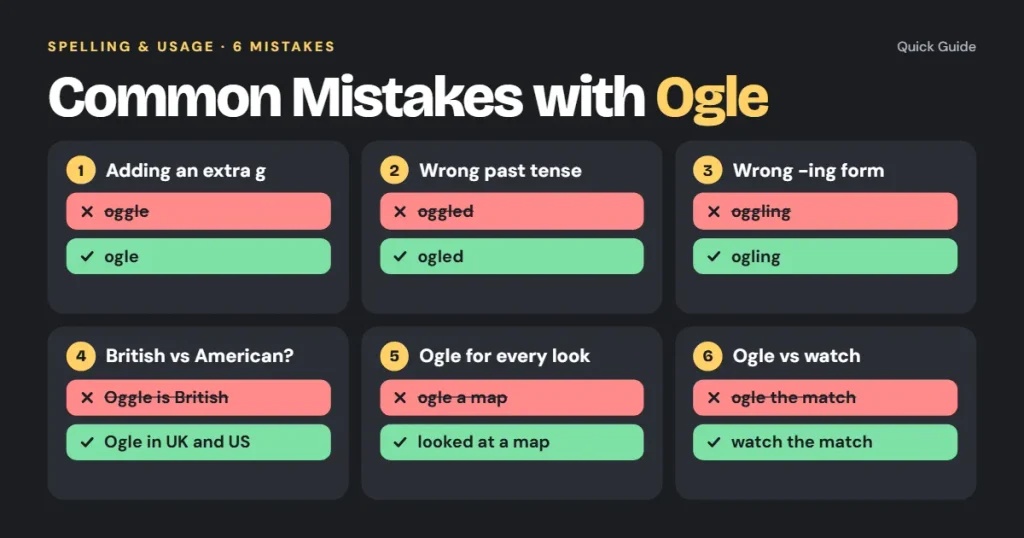
Mistake 1: Adding an Extra G
Incorrect: He likes to oggle people.
Correct: He likes to ogle people.
Mistake 2: Using the Wrong Past Tense
Incorrect: She oggled the new dress.
Correct: She ogled the new dress.
Mistake 3: Using the Wrong -ing Form
Incorrect: They were oggling the cars.
Correct: They were ogling the cars.
Mistake 4: Thinking It Is a British or American Spelling Choice
Incorrect: Oggle is the British spelling.
Correct: Ogle is the standard spelling in both British and American English.
Mistake 5: Using Ogle for Every Kind of Look
Ogle often suggests desire or a rude stare. It may not fit a normal look.
- Better: I looked at the map.
- Better: I admired the painting.
Mistake 6: Using Ogle When You Mean Watch
Watch often means to look at something that is moving or happening. Ogle suggests a strong or bold look.
- Better: We watched the football match.
- Better: The visitors ogled the new cars.
Everyday Usage Examples
In Emails
You may use ogle in an email when describing someone’s behavior or the way people look at an object.
- Please do not ogle other guests.
- Visitors can stop to ogle the display.
In a formal email, a simple word such as stare at may sound clearer.
On Social Media
People may use ogle in posts about cars, clothes, food, or famous people.
- Here is a car to ogle!
- Fans gathered to ogle the new outfits.
The word can make a post sound playful. Still, use it with care when talking about people.
In News
A writer may use ogle to describe people looking at a display or staring at someone.
- Visitors came to ogle the rare cars.
- The report asked people not to ogle others in public.
In Formal Writing
Ogle is a real English word, but it can sound strong or judgmental. Use it only when that meaning fits.
- The story showed how some guests ogled the performers.
- The visitors stopped to ogle the historic building.
Usage Trends
Ogle is a long-standing English word. It appears in books, news stories, reviews, and everyday writing. Writers use it to describe staring at people or looking at things with strong interest.
Oggle is usually a typo when a writer means ogle. It is not a British or American spelling choice.
In simple daily speech, people may use look at or stare at more often. However, ogle is useful when the writer wants to show a strong or unwanted look.
Metaphors and Similes
A metaphor describes one thing as another. A simile compares two things using words such as like or as.
Ogle is not a fixed metaphor or simile by itself. Writers can still use it in creative ways.
Example of a Simile
- He stared at the prize like a child ogling a toy.
This compares his strong interest to a child’s interest in a toy.
Simple Creative Examples
- The crowd ogled the car as if it were a movie star.
- The shoppers ogled the cakes behind the glass.
- The fans ogled the singer as she walked by.
These examples use ogle in its normal sense. They show how the word can add feeling to a sentence.
Connotative Meaning
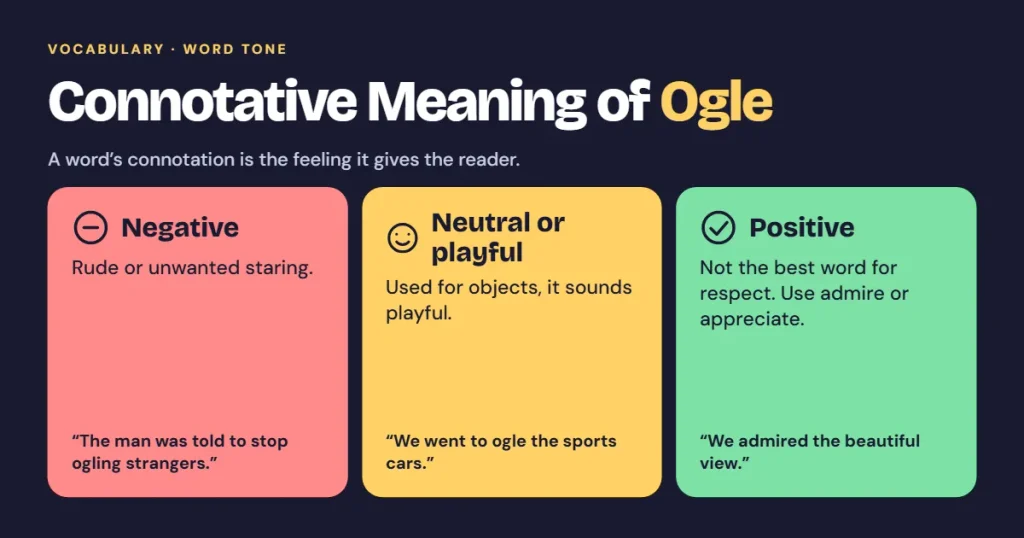
A word’s connotation is the feeling it gives the reader. Ogle often has a negative meaning when it describes looking at a person.
Negative Meaning
Ogle can suggest rude or unwanted staring.
- He ogled the woman, making her feel uneasy.
- The man was told to stop ogling strangers.
Neutral or Playful Meaning
When used for objects, ogle can sound playful.
- We went to ogle the sports cars.
- The children ogled the toys in the shop.
Positive Meaning
Ogle is not usually the best word for a respectful look. If you want to show respect or kind interest, use admire or appreciate.
- I admired her artwork.
- We admired the beautiful view.
Idioms and Proverbs
There is no widely used English proverb based on the spelling oggle. The word ogle may appear in phrases about looking, but it is not part of many fixed idioms.
Here are some useful expressions with similar meanings.
Keep Your Eyes on Something
This means to watch or pay attention to something.
- Keep your eyes on the road while driving.
Stare at Someone
This means to look at someone for a long time.
- Please do not stare at people on the bus.
Feast Your Eyes on Something
This means to enjoy looking at something beautiful or pleasing.
- Feast your eyes on this lovely painting.
Use these phrases when they fit the meaning better than ogle.
Literature and Movies
Writers use ogle to show strong interest, desire, or rude staring. The word can appear in stories, novels, and film reviews.
Literature
The word ogle has a long history in English writing. It can appear in novels and stories where a character looks at someone or something with strong interest. When using a literary example in an article, check the exact text and edition before quoting a line. Different editions and translations may use different words.
Movies
Film reviews may use ogle when characters stare at people, clothes, cars, or other attractive things. A reviewer might describe a crowd as ogling a famous actor or a new car.
The word can help show a character’s feelings or behavior. However, it should only be used when the scene fits its meaning. These examples explain how the word may be used; they do not make oggle a correct spelling.
Why This Difference Matters
Using the correct spelling helps readers understand your message. A spelling mistake can distract people from your main point.
This difference matters when you:
- Write school assignments.
- Create blog posts.
- Send work emails.
- Write social media captions.
- Learn new English words.
- Edit stories or reports.
Using ogle also helps you choose the right tone. The word can suggest rude staring, so it may not fit every situation.
Usefulness in Daily Life
You may not use ogle every day, but it can help you describe a certain kind of look.
Use it when someone stares at a person in a bold or unwanted way. You can also use it when people look at something with great interest.
Examples:
- The crowd stopped to ogle the new car.
- Please do not ogle strangers.
- The children ogled the cakes in the shop.
If you only mean a normal look, use look at. If you mean a long, direct look, use stare at. Whether you mean a kind or respectful look, use admire.
Situational Preference
Choose ogle when you want to describe a strong look that may show desire or seem rude. It can also work in a playful way when people look at exciting things, such as cars or food. For schoolwork or work emails, make sure the tone fits the topic. If you mean a normal look, use look at. If you mean a long look, use stare at. Whether you mean respect or pleasure, use admire. Do not use oggle as a spelling choice for British or American English. In both, ogle is the standard spelling.
What People Ask About Oggle or Ogle
1. Is Oggle a Real Word?
Oggle is not the standard spelling for the meaning “to stare with desire or strong interest.” Use ogle.
2. What Does Ogle Mean?
Ogle means to stare at someone in a bold or often rude way. It can also mean looking at something with strong interest.
3. How Do You Spell Ogle?
The correct spelling is ogle, with one g.
4. Is Ogle Used in British English?
Yes. British English uses ogle, just like American English.
5. What Is the Past Tense of Ogle?
The past tense is ogled.
Example: He ogled the new car.
6. What Is the -ing Form of Ogle?
The -ing form is ogling.
Example: They were ogling the cars.
7. What Words Can I Use Instead of Ogle?
Depending on the meaning, you can use stare at, look at, admire, or gaze at. These words do not all mean the same thing, so choose the one that fits your sentence.
Conclusion
The difference between oggle or ogle is mainly about correct spelling. Ogle is the standard English word. It means to stare at someone with desire or in a way that may seem rude. It can also describe looking at something with great interest, such as a car, a work of art, or a shop display. The word oggle is usually a spelling mistake when used for this meaning.
Remember that ogle is used in both British and American English. Its past tense is ogled, and its -ing form is ogling. If you mean a normal look, use look at. If you mean a long look, use stare at. Whether you mean a respectful look, use admire. Choosing the right word helps your writing stay clear. When you are unsure, check a trusted dictionary and remember: ogle has one g.

I’m Samia Jamshaid, an English language specialist, SEO specialist, digital publisher, and researcher. I create clear, accurate, and well-researched content on English grammar, vocabulary, word meanings, and language comparisons, helping readers understand and use English with confidence.


1 thought on “Oggle or Ogle: Learn the Difference with Examples 2026”