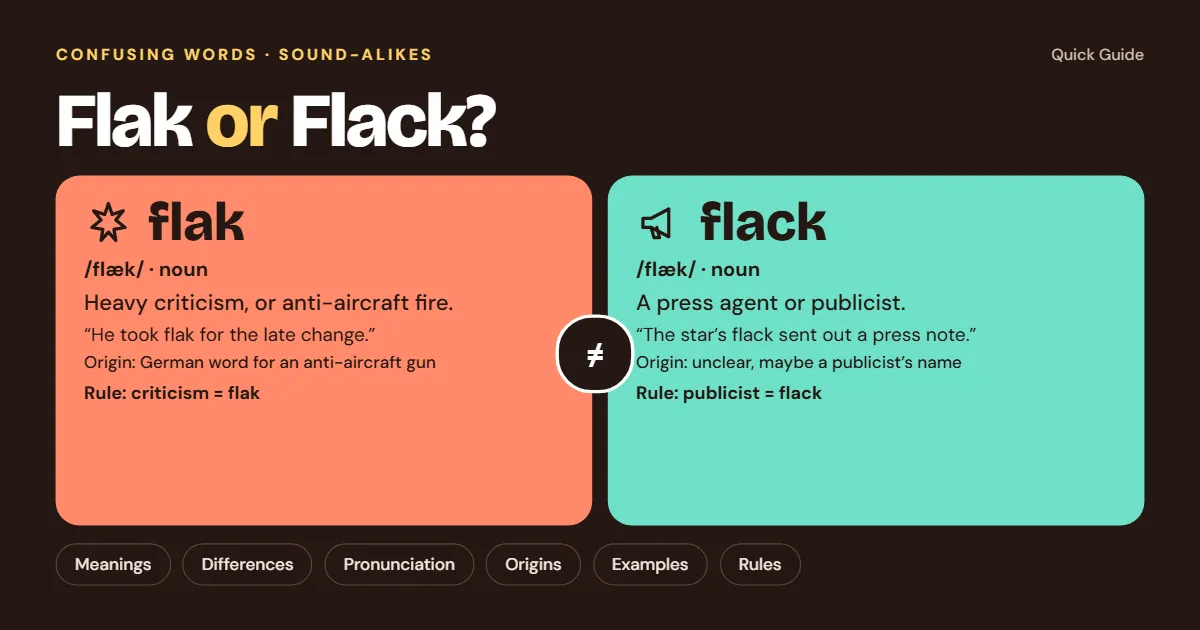
Have you ever wondered whether to write flak or flack? These words sound the same, but they can have different meanings. Flak usually means harsh criticism. It can also mean fire from anti-aircraft guns. Flack usually means a person who works to promote someone or something. It can also be used as another spelling of flak when talking about criticism.
Imagine that a school changes its rules. Many students become upset and complain about the change. You could say, “The school received a lot of flak.” Now imagine that a famous singer hires someone to help with interviews and news stories. That person may be called a flack.
Both words can be confusing because they sound alike. However, their meanings and histories can help you choose the right one. In this guide, you will learn how to pronounce these words, what they mean, where they came from, and how to use them in daily life. You will also learn common mistakes and see simple examples.
1. Flak vs. Flack:
| Word | Meaning | Example |
| Flak | Harsh criticism or anti-aircraft fire | The coach received flak after the game. |
| Flack | A person who works to promote someone or something | The singer’s flack spoke to reporters. |
| Flack | Another spelling for criticism | The company got flack for its mistake. |
| To flack | To promote or publicize something | She was hired to flack for a new film. |
2. How to Pronounce Flak and Flack
Both words sound exactly the same.
- Flak: /flæk/
- Flack: /flæk/
They rhyme with back, pack, and black.
Examples:
- The player received flak from angry fans.
- The actor’s flack answered questions.
- The company received flack for its poor service.
You cannot hear the spelling when someone says these words. You must use the meaning of the sentence to understand them.
3. What Does Flak Mean?
Flak has two main meanings.
Meaning 1: Fire from anti-aircraft guns
In the past, flak meant fire from guns used to attack aircraft. The word became well known during World War II.
Examples:
- The pilots flew through heavy flak.
- The plane came under enemy flak.
These sentences describe a real military attack.
Meaning 2: Harsh criticism
Today, flak often means strong criticism or blame. People use it when others are angry about a choice or action.
Examples:
- The coach received flak after the team lost.
- The mayor got flak for the new rule.
- The company took flak for raising its prices.
4. What Does Flack Mean?
Flack has a few meanings.
Meaning 1: A publicist
A flack is a person who helps a famous person or company get good attention from the public. This person may arrange interviews, share news, and speak to reporters.
Examples:
- The singer’s flack arranged a TV interview.
- The actor asked his flack to answer the reporters.
- The company hired a flack to help with its public image.
The word flack is informal. In formal writing, publicist is often a better choice.
Meaning 2: Another spelling for criticism
Some people spell the word flak as flack when they mean criticism. Dictionaries accept this use, too.
Examples:
- The teacher received flack for changing the test date.
- The shop got flack after raising its prices.
Still, flak is the more traditional spelling for criticism.
Meaning 3: To promote something
Flack can also be a verb. It means to promote or publicize a person, product, or event.
Examples:
- She was hired to flack for a new movie.
- The team flacked for the new product.
This use is informal. In simple, clear writing, you can use promote instead.
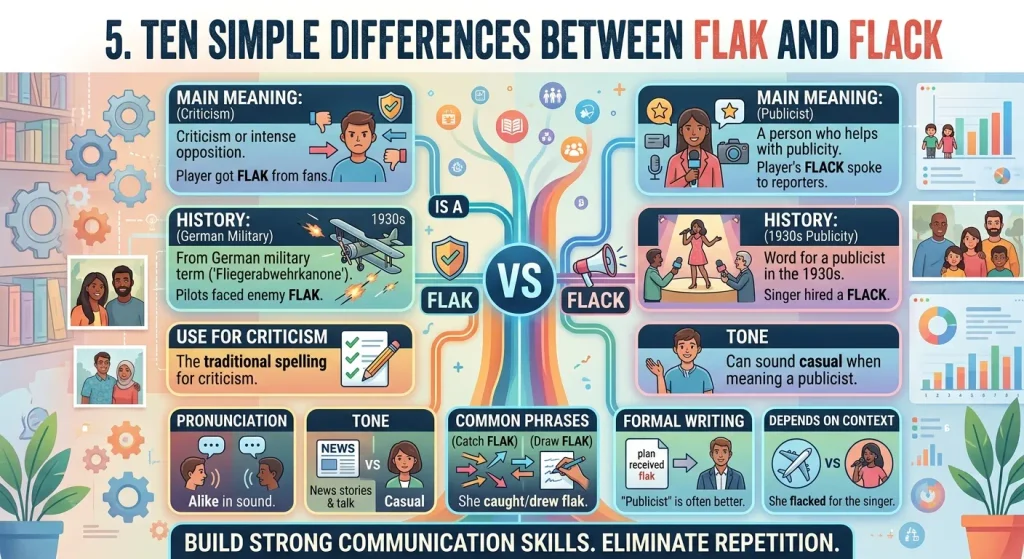
5. Ten Simple Differences Between Flak and Flack
1. Main meaning
Flak usually means criticism. Flack usually means a publicist.
- The player got flak from fans.
- The player’s flack spoke to reporters.
2. History
Flak came from a German military term. Flack became known as a word for a publicist in the 1930s.
- The pilots faced enemy flak.
- The singer hired a flack.
3. Use for criticism
Flak is the traditional spelling for criticism. Flack is also used this way.
- The mayor received flak.
- The mayor received flack.
Both sentences mean that the mayor received criticism.
4. Use for a publicist
Flack can mean a person who helps with publicity.
- The actor’s flack called the newspaper.
- The actor’s publicist called the newspaper.
The second sentence is clearer for most readers.
5. Word type
Flak is mainly a noun. Flack can be a noun or a verb.
- The company faced flak.
- She flacked for the singer.
6. Pronunciation
Both words sound alike.
- He caught flak.
- He caught flack.
The meaning comes from the spelling and the sentence.
7. Tone
Flak is common in news stories and everyday talk. Flack can sound casual when it means a publicist.
- The plan received flak.
- The star’s flack gave an answer.
8. Common phrases
People often say catch flak, take flak, or draw flak.
- She caught flak for her choice.
- She drew flak for her choice.
Both mean that she received criticism.
9. Formal writing
Flak is a good choice for criticism. Publicist is often better than flack in formal writing.
- The plan received flak.
- The actor hired a publicist.
10. Meaning depends on context
The words around flak or flack help explain the meaning.
- The plane flew through flak.
- The singer’s flack answered questions.
For Further information https://orchoice.com/oggle-or-ogle/
6. Flak vs. Flack: Comparison Table
| Feature | Flak | Flack |
| Sound | /flæk/ | /flæk/ |
| Main use | Criticism or gunfire | Publicist |
| Can mean criticism? | Yes | Yes |
| Can mean a publicist? | Not usually | Yes |
| Can be a verb? | Not in normal use | Yes, informally |
| Best choice for criticism | Yes | Accepted, but less traditional |
| Formal alternative | Use flak | Use publicist |
7. Where Did Flak and Flack Come From?
The history of flak
The word flak comes from a German word for anti-aircraft guns. These guns were used to fire at planes during wars.
During World War II, pilots often faced this kind of gunfire. Later, people began using flak to mean criticism. Today, someone can receive flak without being near a battlefield.
Example:
“The coach caught flak after the team lost.”
This means that people criticized the coach.
The history of flack
The word flack began to be used for a publicist in the 1930s. A publicist helps people and companies share news and manage their public image.
Some people believe the word came from the name of a Hollywood publicity agent called Gene Flack. However, this story has not been proved. It is better to say that the exact origin is unknown.
Later, people also began spelling the criticism word as flack. This is why both spellings are now used for criticism.
8. Flak and Flack in American and British English
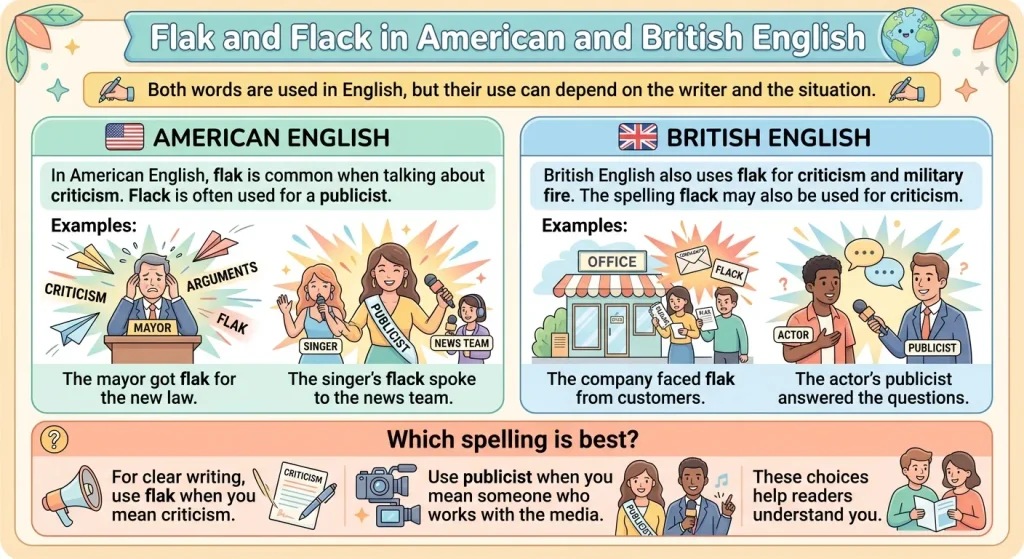
Both words are used in English, but their use can depend on the writer and the situation.
American English
In American English, flak is common when talking about criticism. Flack is often used for a publicist.
Examples:
- The mayor got flak for the new law.
- The singer’s flack spoke to the news team.
British English
British English also uses flak for criticism and military fire. The spelling flack may also be used for criticism.
Examples:
- The company faced flak from customers.
- The actor’s publicist answered the questions.
Which spelling is best?
For clear writing, use flak when you mean criticism. Use publicist when you mean someone who works with the media. These choices help readers understand you.
9. Common Mistakes to Avoid
Mistake 1: Saying flack is always wrong
This is not true. Flack is a real word and can also mean criticism.
Better: Use flak as the usual spelling for criticism, but remember that flack is also accepted.
Mistake 2: Using flak for a publicist
Unclear: The singer hired a flak.
Better: The singer hired a flack.
Clearer: The singer hired a publicist.
Mistake 3: Thinking the words never share a meaning
Both flak and flack can mean criticism. The spelling depends on the writer’s choice and the style being followed.
Mistake 4: Saying Gene Flack definitely gave the word its name
The story about Gene Flack is only a theory. The true origin of the publicist meaning is not certain.
Mistake 5: Confusing flak with slack
Flak means criticism. Slack can mean being less strict or giving someone more time or freedom.
Examples:
- The coach caught flak for the loss.
- The coach gave the new player some slack.
Mistake 6: Using flack when a simple word works better
Less clear: The company flacked its new product.
Clearer: The company promoted its new product.
10. Everyday Examples of Flak and Flack
Here are examples from daily life.
At work
- The boss received flak for changing the work schedule.
- The company hired a publicist to share its news.
At school
- The student caught flak for not finishing the project.
- The school hired a publicist for its big event.
In politics
- The leader received flak for the new rule.
- The leader’s flack spoke to the reporters.
In entertainment
- The actor caught flak for his rude comments.
- The singer’s flack arranged a news interview.
On social media
- The video creator received flak for a careless post.
- The company asked its publicist to write a reply.
In sports
- The coach took flak after the team lost.
- The club’s publicist shared news about a new player.
These examples show how the words can be used in different situations.
11. Which Spelling Is More Common?
Flak is the traditional spelling for criticism. It is also the spelling used for anti-aircraft fire.
Flack is the usual informal word for a publicist. However, many writers also use flack to mean criticism. Major dictionaries recognize this use.
So, it is not correct to say that every use of flack for criticism is a spelling mistake.
For clear writing, follow these tips:
- Use flak for criticism.
- Use flak for anti-aircraft fire.
- Use flack for a publicist.
- Use publicist in formal writing when you want to avoid confusion.
12. Metaphors and Similes With Flak
A metaphor describes something by comparing it to something else. A simile uses words such as like or as.
The word flak can help describe strong criticism.
Metaphor 1: A storm of flak
“The company faced a storm of flak after raising prices.”
This means the company received a lot of criticism.
Metaphor 2: A wall of flak
“The coach faced a wall of flak after the game.”
This means many people criticized the coach.
Simile 1: Like a plane under fire
“The manager felt like a plane under fire during the meeting.”
This means the manager faced many hard questions or complaints.
Simile 2: Like a target
“The actor felt like a target after the interview.”
This means many people focused their criticism on the actor.
These examples show how the word can make writing more vivid.
13. Feelings Linked to Flak and Flack
The word flak often gives a negative feeling because it means strong criticism.
Example: “The shop received flak for poor service.”
This sentence tells us that people were unhappy with the shop.
The word flack, when it means a publicist, can sound casual. Sometimes it may sound a little rude because it is an informal term.
Example: “The star’s flack refused to answer.”
When flack means criticism, it has the same general meaning as flak.
14. Common Expressions With Flak
Catch flak
This means to receive criticism.
Example: The teacher caught flak for changing the test date.
Take flak
This means to face criticism.
Example: The company took flak for its new prices.
Draw flak
This means to attract criticism.
Example: The new rule drew flak from parents.
Come in for flak
This means to become the target of criticism.
Example: The mayor came in for flak after the speech.
Flak jacket
A flak jacket is a type of protective clothing used to help protect a person from certain flying objects.
Example: The soldier wore a flak jacket.
Flak-catcher
A flak-catcher is someone who deals with criticism aimed at another person or group. The writer Tom Wolfe helped make this term well known in his 1970 work Mau-Mauing the Flak Catchers.
15. Flak and Flack in Books and Media
The word flak is often found in stories about war because it first referred to anti-aircraft fire. It is also common in news reports about people who face public criticism.
Writer Tom Wolfe used the term flak-catchers in his 1970 work Mau-Mauing the Flak Catchers. It described people who handled complaints and criticism for others.
The word flack is often used in stories about actors, singers, and other famous people. A flack may arrange interviews or speak to reporters for a client.
These examples show that the words are useful in both history and modern media.
16. Why Does the Difference Matter?
Knowing the difference helps you write clearly.
Look at these sentences:
- The singer received flak for the performance.
- The singer’s flack arranged an interview.
The first sentence means people criticized the singer. The second means a publicity agent arranged an interview.
Using the right word helps readers understand your message. It can also improve your writing at school, at work, and online.
Remember that flack can also mean criticism. Context is important.
17. Which Word Should You Use in Daily Life?
Use flak when you mean criticism. It is the traditional spelling and is a good choice for schoolwork, news stories, and formal writing.
Use flack when you mean a publicist. A publicist helps a person or company deal with the media.
You may also see flack used for criticism. This spelling is accepted, but flak is the more traditional choice.
If you are unsure, use flak for criticism and publicist for the person. These words make your meaning clear and help prevent confusion.
18. Frequently Asked Questions
1. Is it flak or flack?
Both are real words. Flak usually means criticism or anti-aircraft fire. Flack usually means a publicist, but it can also mean criticism.
2. What does catch flak mean?
It means to receive criticism or blame.
Example: “The coach caught flak after the game.”
3. Is flack a real word?
Yes. Flack can mean a publicist. It can also be used as a verb meaning to promote something. It is also accepted as another spelling for criticism.
4. Does flak mean criticism?
Yes. People often use flak to mean harsh criticism.
Example: “The company received flak for its mistake.”
5. Did the word flack come from Gene Flack?
Some people believe it did, but the story has not been proved. The exact origin is unknown.
6. What is the difference between flak and slack?
Flak means criticism or anti-aircraft fire. Slack can mean being less strict or giving someone more freedom.
Example: “The student caught flak for being late, but the teacher gave him some slack.”
7. Which word should I use in formal writing?
Use flak for criticism and publicist for someone who handles publicity. This is a clear and safe choice.
Conclusion
Flak or flack sound the same, but they often have different uses. Flak first referred to fire from anti-aircraft guns, but today it also means harsh criticism. Flack usually means a publicist, but it can also be used as another spelling for criticism. For clear writing, use flak when you mean criticism and publicist when you mean a person who works with the media. Remember that flack is not always wrong when it means criticism, as both spellings appear in modern English. Learning these words and their histories will help you understand news stories, books, and everyday conversations and make it easier to choose the right word.

I’m Samia Jamshaid, an English language specialist, SEO specialist, digital publisher, and researcher. I create clear, accurate, and well-researched content on English grammar, vocabulary, word meanings, and language comparisons, helping readers understand and use English with confidence.











1 thought on “Flak or Flack: What Is the Difference? 2026”