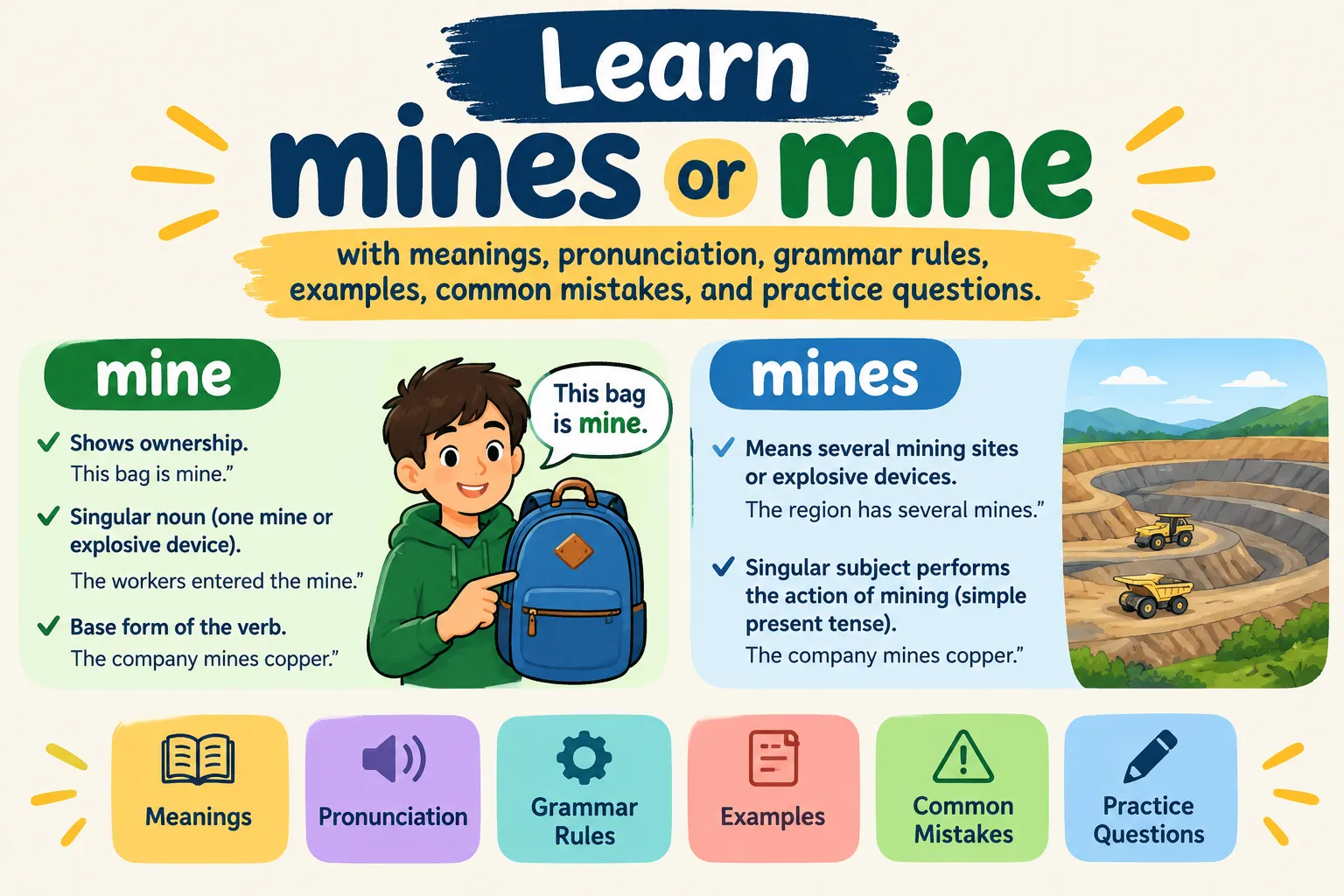
Use mine to show that something belongs to you, to name one mining site or explosive device, or as the base form of a verb. Use mines for more than one mining site or explosive device, or as a verb with he, she, or it. The possessive pronoun is always mine in standard English, even when you own several things.
Imagine that your friend points to two bags and asks, “Which bags are yours?” You can answer, “They are mine.” You should not say, “They are mines” if you mean that the bags belong to you.
Now imagine a different situation. You are reading about a town with several coal mines. In this case, it is correct because the word refers to more than one place where coal is extracted.
They look almost the same, but they have different uses. Both are correct English words. The right choice depends on the meaning of your sentence and the job the word performs.
In this guide, you will learn the meanings, pronunciation, grammar rules, examples, common mistakes. You will also find a comparison table, practice questions, and answers to common questions.
What Is the Difference Between Mines and Mine?
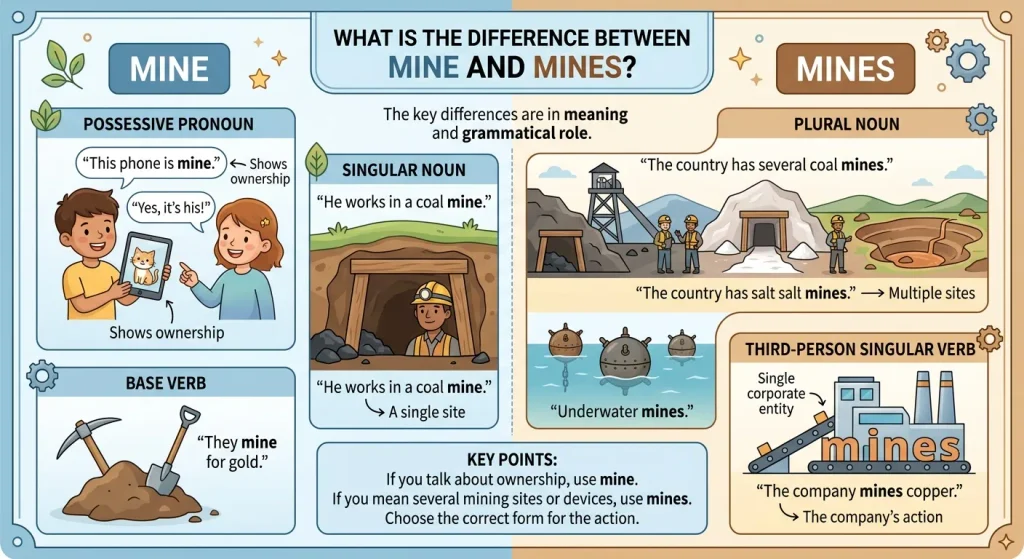
The main difference depends on their meaning and grammatical role.
- Mine can be a possessive pronoun, a singular noun, or the base form of a verb.
- Other is the plural form of the noun mine. It is also the present-tense verb form used with a third-person singular subject, such as he, she, or it.
For example:
- “This phone is mine.” — Mine shows ownership.
- “He works in a coal mine.” — Mine is a singular noun.
- “The country has several coal mines.” — It is a plural noun.
- “The company mines copper.” — It is a verb.
The key is to look at the meaning of the sentence. If you are talking about ownership, use mine. If you mean several mining sites or explosive devices, use mines. Whether you are describing an action performed by one person or thing, it may be the correct verb form.
Mine vs. Mines: Quick Comparison Table
| Feature | Mine | Mines |
| Part of speech | Pronoun, noun, verb | Plural noun, verb |
| Shows ownership | Yes | No, in standard English |
| Refers to one mining site | Yes | No |
| Refers to several mining sites | No | Yes |
| Refers to one explosive device | Yes | No |
| Refers to several explosive devices | No | Yes |
| Used as a present-tense verb | Base form | With he, she, or it |
| Example | This book is mine. | The company mines coal. |
Correct: “These books are mine.”
Incorrect for standard English: “These books are mines.”
What Does Mine Mean?
The word mine has several meanings. It can show ownership, name a place where minerals are extracted, refer to an explosive device, or describe an action.
1. Mine as a Possessive Pronoun
As a possessive pronoun, mine means belonging to me. It shows that something belongs to the person speaking or writing.
Examples:
- This pen is mine.
- That house is mine.
- The blue jacket is mine.
- These shoes are mine.
- The final decision is mine.
In each sentence, mine shows ownership.
A possessive pronoun can replace a phrase such as my pen, my house, or my shoes. It helps you avoid repeating the noun.
Compare these sentences:
- This is my book.
- This book is mine.
Both sentences express ownership, but they use different grammatical forms. My comes before a noun, while mine stands on its own.
Another example:
- Is this your seat?
- No, that seat is mine.
Here, mine replaces the phrase my seat.
Important rule: Do not put a noun directly after mine when using it as a possessive pronoun.
Incorrect: “This is mine bag.”
Correct: “This is my bag.”
Correct: “This bag is mine.”
2. Mine as a Noun: A Place for Extracting Minerals
The word mine can also mean a place where people dig into the earth to obtain coal, gold, copper, salt, or other valuable materials.
Examples:
- My uncle works in a coal mine.
- The company opened a new gold mine.
- The old mine closed several years ago.
- Workers entered the mine early in the morning.
- The town grew around a large copper mine.
Common types include:
- Coal mine
- Gold mine
- Silver mine
- Copper mine
- Salt mine
- Diamond mine
- Uranium mine
When you are talking about only one of these places, use mine.
Example: “The village has a large salt mine.”
When you are talking about more than one, use mines.
Example: “The region has several salt mines.”
3. Mine as a Noun: An Explosive Device
A mine can also be an explosive device designed to explode under certain conditions, such as when it is touched, disturbed, or triggered.
Examples:
- The soldiers found a land mine.
- The road was closed because of a hidden mine.
- The naval mine was discovered near the coast.
- The team worked to remove the dangerous mine.
Examples:
- The soldiers found several mines.
- The area was cleared of land mines.
- The map showed where the mines had been placed.
4. Mine as a Verb
The verb mine means to extract minerals or other resources from the earth. It can also mean to place explosive mines in an area.
Examples of mining for resources:
- Workers mine coal in this region.
- The company plans to mine copper.
- They mine gold from the mountains.
- The country mines valuable minerals.
Examples involving explosive devices:
- The army mined the road.
- The area was mined during the conflict.
The verb changes according to the subject and tense.
- I mine.
- You mine.
- We mine.
- They mine.
- He mines.
- She mines.
- The company mines.
The form mines is used with a third-person singular subject in the simple present tense.
Example: “The company mines silver.”
The form mined is the simple past and past participle.
Example: “The company mined silver in the region.”
The form mining is used in continuous tenses and other grammatical constructions.
Example: “The company is mining silver.”
Keep exploring https://orchoice.com/flak-or-flack/
What Does Mines Mean?
It has two common grammatical uses: it is the plural form of the noun mine, and it is the third-person singular present-tense form of the verb mine.
1. Mines as a Plural Noun
When mine refers to a mining site or an explosive device, its plural form is mines.
Examples:
- The country has many coal mines.
- Several gold mines operate in the region.
- The workers inspected the abandoned mines.
- The soldiers searched for hidden mines.
- The coastal area was protected against naval mines.
A simple way to remember the rule is:
- One mine
- Two mines
- Several mines
2. Mines as a Verb
It is also a verb. It describes an action performed by a singular subject in the simple present tense.
Examples:
- She mines coal for a living.
- He mines gold in the mountains.
- The company mines copper.
- This machine mines the rock for valuable minerals.
Compare:
- They mine coal.
- He mines coal.
Mine vs. Mines: Pronunciation
These have similar pronunciations. The main difference is the final sound.
Mine
IPA: /maɪn/
Rhymes with line, fine, and wine.
Syllables: 1
Singular / pronoun
Mines
IPA: /maɪnz/
Rhymes with lines, fines, and wines.
Syllables: 1
Plural / verb
Both words have one syllable. The word mines adds a final /z/ sound.
The standard pronunciation of mine is /maɪn/ in both British and American English. The pronunciation of mines is /maɪnz/.
Mine vs. My: What Is the Difference?
Learners often confuse my and mine because both show ownership. However, they are used differently in a sentence.
My is a possessive determiner. It comes before a noun.
Mine is a possessive pronoun. It can stand alone and replace a possessive phrase.
| My | Mine |
| This is my phone. | This phone is mine. |
| My shoes are new. | The new shoes are mine. |
| I lost my keys. | The keys are mine. |
| My room is clean. | The clean room is mine. |
A simple rule will help you remember:
- Use my before a noun.
- Use mine when the noun does not follow it directly.
For example, say “my book,” not “mine book.” Say “the book is mine,” not “the book is my.”
Does Mine Have a Plural Form?
As a possessive pronoun, mine does not change when the thing owned is singular or plural.
Examples:
- This pencil is mine.
- These pencils are mine.
- That bag is mine.
- Those bags are mine.
The number of items does not affect the form of the possessive pronoun.
However, when mine is a noun meaning a place or an explosive device, it has a regular plural form: mines.
Examples:
- One coal mine
- Two coal mines
- One land mine
- Several land mines
This is an important difference. The possessive pronoun mine stays the same, but the noun mine becomes mines when you mean more than one.
Can You Say “Those Are Mines”?
Yes, but the meaning matters.
If you mean that several objects belong to you, say:
“Those are mine.”
If you mean that the objects are mining sites or explosive devices, say:
“Those are mines.”
Compare these examples:
Ownership
“Whose bags are those?”
“Those are mine.”
Mining sites
“What are those places on the map?”
“Those are mines.”
Explosive devices
“What did the soldiers find?”
“They found mines.”
The sentence must make the intended meaning clear.
Common Mistakes to Avoid
Mistake 1: Using “Mines” to Show Ownership
Incorrect: “That laptop is mines.”
Correct: “That laptop is mine.”
In standard English, mine is the possessive pronoun. Do not add -s to it just because the sentence refers to more than one item.
Mistake 2: Changing Mine to Mines for Plural Objects
Incorrect: “These books are mines.”
Correct: “These books are mine.”
The noun books is plural, but the possessive pronoun remains mine.
Mistake 3: Using Mine Before a Noun
Incorrect: “This is mine car.”
Correct: “This is my car.”
Correct: “This car is mine.”
Use my before a noun and mine when it stands alone as a possessive pronoun.
Mistake 4: Thinking Mines Is Always Wrong
Incorrect understanding: “Mines is not a real English word.”
Correct understanding: Mines is a correct plural noun and a correct verb form.
Examples:
- The region has several mines.
- The company mines gold.
It is incorrect only when it is used as the standard possessive pronoun.
Mistake 5: Forgetting the Verb Rule
Incorrect: “She mine coal.”
Correct: “She mines coal.”
Use mines with he, she, or it in the simple present tense.
Compare:
- I mine coal.
- They mine coal.
- She mines coal.
Everyday Examples of Mine and Mines
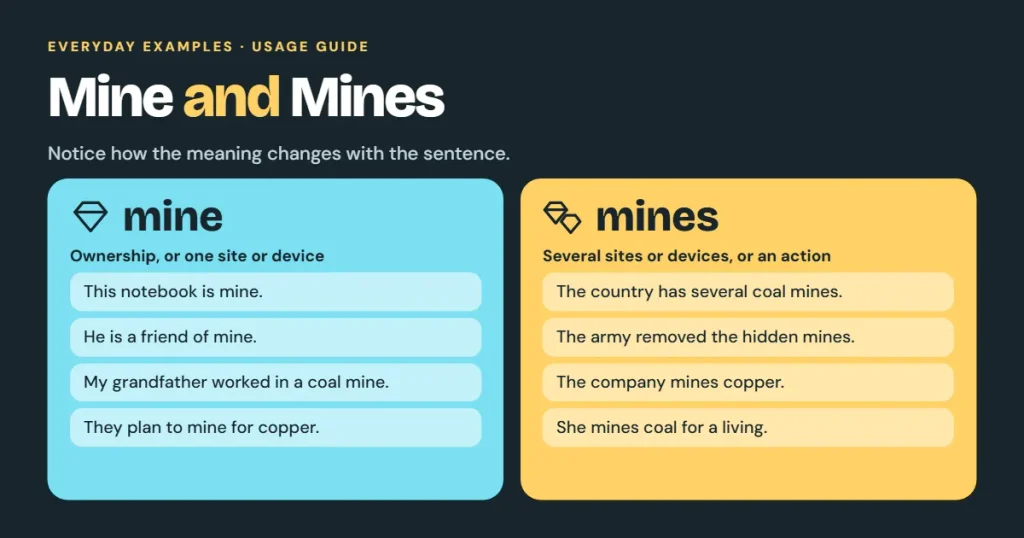
Here are more examples to help you understand how the words work in daily English.
Examples of Mine
- This notebook is mine.
- The black umbrella is mine.
- That seat is mine.
- These headphones are mine.
- The responsibility is mine.
- He is a friend of mine.
- My grandfather worked in a coal mine.
- The old gold mine is now closed.
- The soldiers discovered a mine.
- They plan to mine for copper.
Examples of Mines
- The country has several coal mines.
- Many gold mines are found in this region.
- The workers entered the mines early.
- The army removed the hidden mines.
- The company mines copper.
- She mines coal for a living.
- The machine mines valuable materials.
- The region’s mines provide many jobs.
- The map shows abandoned mines.
- The company mines minerals from the earth.
Notice how the meaning changes with the sentence. Mine can show ownership or refer to one site or device. Mines can refer to several sites or devices, or describe an action.
Word Origin: Where Do Mine and Mines Come From?
The possessive pronoun mine comes from Old English mīn, meaning “my” or “belonging to me.” It is related to other Germanic words, including Dutch mijn and German mein.
Oxford Learner’s Dictionaries
+1
The noun mine, referring to a place where minerals are extracted, has a different history. It entered English through Middle English and French, with its deeper origin generally linked to a word for a mineral excavation or tunnel.
American Heritage Dictionary
+1
Although the possessive pronoun and the mining noun have the same spelling, they have different meanings and histories.
The second word formed by adding the regular plural ending to the noun mine. It is also the third-person singular form of the verb mine.
How to Choose Between Mine and Mines
When you are unsure which word to use, follow these steps.
Step 1: Are you showing ownership?
Use mine.
Example: “The blue jacket is mine.”
Step 2: Are you talking about one mining site or explosive device?
Use mine.
Example: “The workers entered the mine.”
Step 3: Are you talking about more than one site or device?
Use mines.
Example: “The region has several mines.”
Step 4: Are you describing an action performed by he, she, it, or a singular noun?
Use it in the simple present tense.
Example: “The company mines gold.”
Step 5: Is the subject I, you, we, or they?
Use mine as the base verb.
Example: “They mine gold.”
This simple method will help you choose the correct word in most everyday situations.
Practice Exercise: Mine or Mines?
Choose the correct word to complete each sentence.
1. This phone belongs to me. It is ___.
mine
mines
2. The region has several coal ___.
mine
mines
3. The company ___ copper in the mountains.
mine
mines
4. These notebooks are ___.
mine
mines
5. My uncle works in a gold ___.
mine
mines
6. They ___ minerals from the earth.
mine
mines
7. The soldiers discovered several land ___.
mine
mines
8. That red bicycle is ___.
mine
mines
Check answers
Possible Questions and Answers
1. Which is correct: mine or mines?
Both words are correct, but they have different uses. Mine can show ownership or refer to one mining site or explosive device. Second is the plural noun or the third-person singular form of the verb mine.
2. Is “This book is mines” correct?
No. In standard English, the correct sentence is “This book is mine.” The word mine is the possessive pronoun.
3. Can I say “These books are mine”?
Yes. Mine does not change when you own more than one thing. Both “This book is mine” and “These books are mine” are correct.
4. What is the plural of mine?
The plural of the noun mine is mines.
Example: “The country has several gold mines.”
This plural form is used when mine refers to a mining site or an explosive device.
5. Is mines a verb?
Yes. it is the simple present form of the verb mine used with a third-person singular subject.
Example: “She mines copper.”
6. What is the difference between my and mine?
My comes before a noun, as in “my bag.” Mine stands alone, as in “The bag is mine.”
7. How do you pronounce mine and mines?
Mine is pronounced /maɪn/, rhyming with line. While other word is pronounced /maɪnz/, rhyming with lines.
8. Does mine mean a place where people dig?
Yes. As a noun, mine can refer to a place where people extract minerals, coal, or other materials from the earth. It can also refer to an explosive device.
9. Is “The company mines coal” correct?
Yes. it is the correct verb form because the company is a singular subject.
10. Is mine the same in British and American English?
The standard uses of mine and mines are the same in British and American English. Mine shows ownership, while it is used as a plural noun or a verb form.
Conclusion
Mine or mines can have different meanings depending on how they are used in a sentence. Use mine to show ownership, as in “This bag is mine.” It can also be a singular noun for one mining site or explosive device, or the base form of the verb. Use it when you mean several mining sites or explosive devices, or when a singular subject performs the action of mining in the simple present tense. For example, “This book is mine,” “The workers entered the mine,” “The region has several mines,” and “The company mines copper.” The most important rule is that the possessive pronoun mine never changes to mines simply because the things you own are plural. Once you remember this distinction, you can use both words clearly and confidently.

I’m Samia Jamshaid, an English language specialist, SEO specialist, digital publisher, and researcher. I create clear, accurate, and well-researched content on English grammar, vocabulary, word meanings, and language comparisons, helping readers understand and use English with confidence.







1 thought on “Mines or Mine: Word Origins and Everyday Examples 2026”