Have you ever wondered whether to write hypothesis or hypotheses? These words look almost the same, but we use them in different ways.
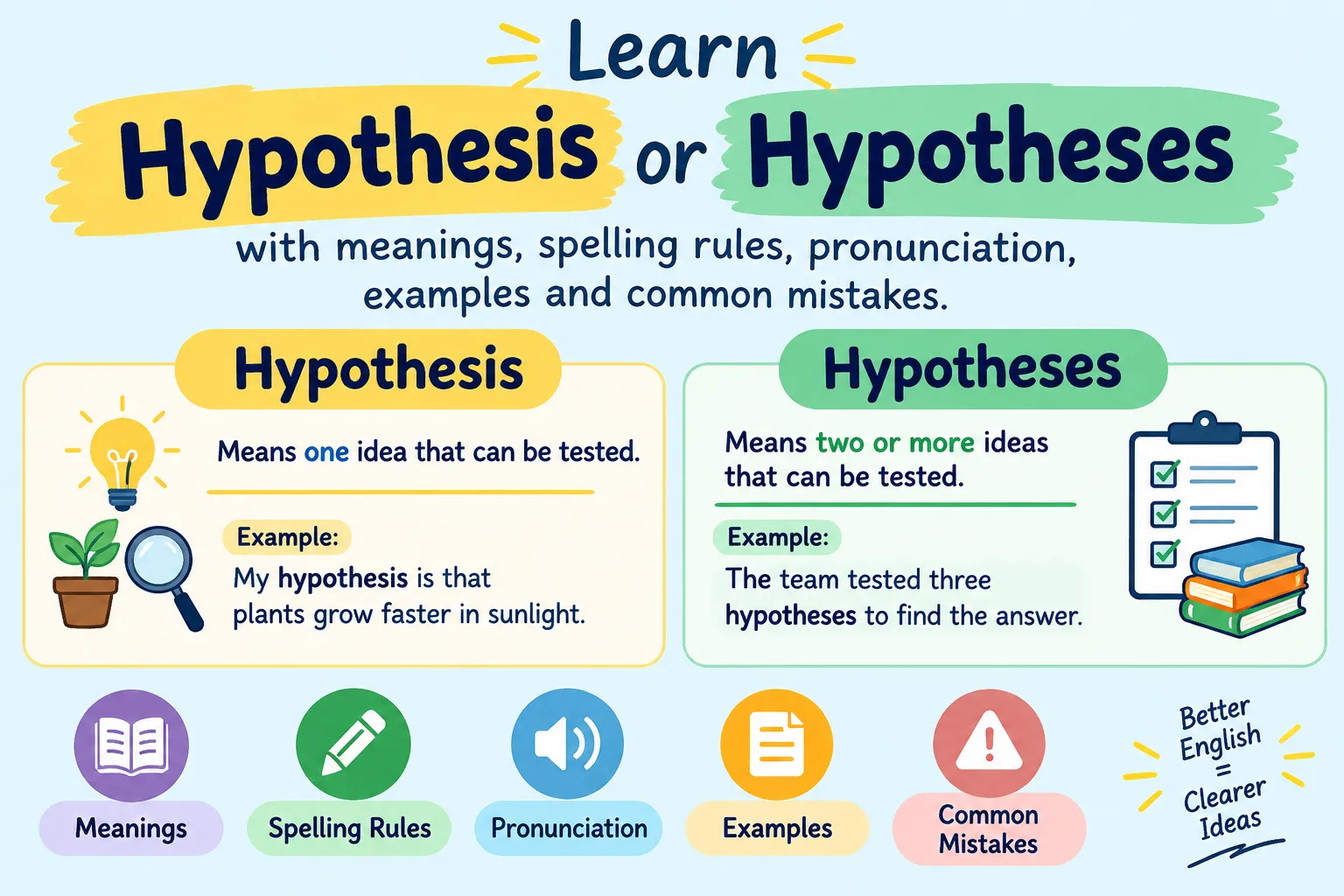
The rule is simple. Hypothesis means one idea that can be tested. Hypotheses means two or more ideas that can be tested.
For example:
- The student made one hypothesis about plant growth.
- The students made three hypotheses about plant growth.
The spelling changes when we talk about more than one idea. We change the ending from -is to -es.
In this guide, you will learn the meaning of both words, how to spell them, how to say them, and how to use them in sentences. You will also learn common mistakes and easy ways to remember the difference.
Hypothesis vs. Hypotheses at a Glance
| Hypothesis | Hypotheses |
| Means one idea | Means two or more ideas |
| Singular form | Plural form |
| One hypothesis | Two hypotheses |
| This hypothesis is correct. | These hypotheses are correct. |
Remember:
- One = hypothesis
- More than one = hypotheses
What Does Hypothesis Mean?
A hypothesis is an idea that you can test to find out if it is true.
It is not a proven fact. You need to check it first.
For example, you notice that a plant near a window grows faster than a plant in a dark room.
You might think:
My hypothesis is that plants grow faster when they get more sunlight.
You can test this idea by giving plants different amounts of sunlight and watching how they grow.
Examples of hypothesis
- My hypothesis is that rain will start soon.
- The student made a hypothesis about plant growth.
- Her hypothesis was that the dog was hungry.
- The teacher tested one hypothesis.
- His hypothesis is that we took the wrong road.
Each sentence talks about one idea.
Can you use hypothesis in daily life?
Yes! You do not need to be a scientist to use this word.
For example:
- My hypothesis is that Dad is still at work.
- Her hypothesis was that the bus was late.
- Our hypothesis is that the cat is hiding under the bed.
What Does Hypotheses Mean?
Hypotheses is the plural form of hypothesis. Use it when you have two or more ideas to test.
For example:
- The students tested two hypotheses.
- The scientists shared their hypotheses.
- We have several hypotheses about the missing keys.
Here is another example.
Imagine that your plant is not growing well. You have three ideas about why this is happening:
- The plant needs more water.
- The plant needs more sunlight.
- The plant needs better soil.
Why Does Hypothesis Change to Hypotheses?
Most English words become plural by adding s or es. But some words change in a different way.
The correct spelling is:
hypothesis → hypotheses
The ending changes from -is to -es.
Here are some other words that follow a similar pattern.
| One | More than one |
| Hypothesis | Hypotheses |
| Thesis | Theses |
| Analysis | Analyses |
| Diagnosis | Diagnoses |
| Crisis | Crises |
When Should You Use Hypothesis or Hypotheses?
The number of ideas tells you which word to use.
Use hypothesis for one idea
Use hypothesis when you are talking about just one idea.
Examples:
- I have one hypothesis.
- The student wrote a hypothesis.
- This hypothesis may be correct.
- Her hypothesis is easy to test.
- The teacher explained the hypothesis.
Words such as one, a, and this can help you spot the singular form.
Use hypotheses for two or more ideas
Use hypotheses when you are talking about more than one idea.
Examples:
- We have two hypotheses.
- The class tested three hypotheses.
- These hypotheses may explain the problem.
- The scientists checked several hypotheses.
- Both hypotheses need more testing.
Hypothesis vs. Hypotheses: Examples in Sentences
Here are examples from different parts of life.
| Topic | Hypothesis | Hypotheses |
| Science | My hypothesis is that plants need sunlight. | Our hypotheses explain why the plants look different. |
| School | The student’s hypothesis is about reading. | The students wrote two hypotheses. |
| Weather | My hypothesis is that it will rain. | We have two hypotheses about the storm. |
| Animals | Her hypothesis is that the cat is hungry. | The children shared their hypotheses about the cat. |
| Technology | His hypothesis is that the computer needs a restart. | The team tested several hypotheses about the problem. |
How Do You Pronounce Hypothesis and Hypotheses?
The two words sound a little different at the end.
| Word | Easy pronunciation |
| Hypothesis | hy-POTH-uh-sis |
| Hypotheses | hy-POTH-uh-seez |
In both words, the strongest sound is in the middle part, POTH.
The last part is different:
- Hypothesis ends with a sound like sis.
- Hypotheses ends with a sound like seez.
Is Hypotheses Singular or Plural?
Hypotheses is plural. It means two or more ideas.
Correct: The hypotheses are easy to test.
Incorrect: The hypotheses is easy to test.
Why? Because hypotheses means more than one idea, so we use are in this sentence.
Compare these examples:
- One hypothesis is correct.
- Two hypotheses are correct.
Keep exploring https://orchoice.com/mines-or-mine/
Is Hypothesis Singular or Plural?
Hypothesis is singular. It means one idea that can be tested.
Correct: The hypothesis is interesting.
Incorrect: The hypothesis are interesting.
Remember:
- Hypothesis = one
- Hypotheses = more than one
Hypotheses vs. Hypothesises: Which Is Correct?
These words look similar, but they do not have the same job.
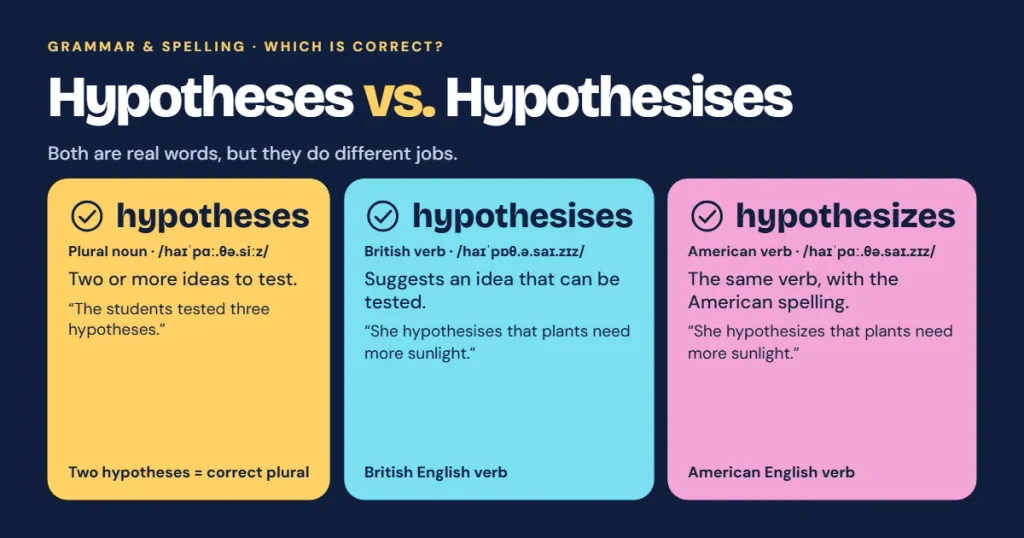
Hypotheses is the correct plural noun. Use it when talking about two or more ideas.
Example: The students tested three hypotheses.
Hypothesises is also a real word, but it is a verb used in British English. It means that someone suggests an idea that can be tested.
Example: She hypothesises that plants need more sunlight.
In American English, people usually write hypothesizes in that sentence.
So, remember:
- Two hypotheses = correct plural noun.
- She hypothesises = correct British English verb.
- She hypothesizes = correct American English verb.
Common Mistakes With Hypothesis and Hypotheses
Let’s look at some mistakes people often make.
Mistake 1: Writing hypothesis after a plural number
Incorrect: The class tested three hypothesis.
Correct: The class tested three hypotheses.
Use hypotheses because there are three ideas.
Mistake 2: Writing hypothesises as the plural noun
Incorrect: The students wrote two hypothesises.
Correct: The students wrote two hypotheses.
The plural noun is hypotheses.
Mistake 3: Using is with hypotheses
Incorrect: The hypotheses is correct.
Correct: The hypotheses are correct.
Use are with the plural noun in this sentence.
Mistake 4: Using hypotheses for one idea
Incorrect: I have one hypotheses.
Correct: I have one hypothesis.
Use hypothesis when you mean one idea.
Mistake 5: Thinking a hypothesis is a fact
A hypothesis is an idea that needs to be tested. It may turn out to be right or wrong.
For example, you may think a plant is dying because it gets too little water. That is your hypothesis. You need to check the plant and test your idea before you know the cause.
Hypothesis vs. Hypotheses in School and Science
Students and scientists often use these words when they study questions or solve problems.
Example with one hypothesis
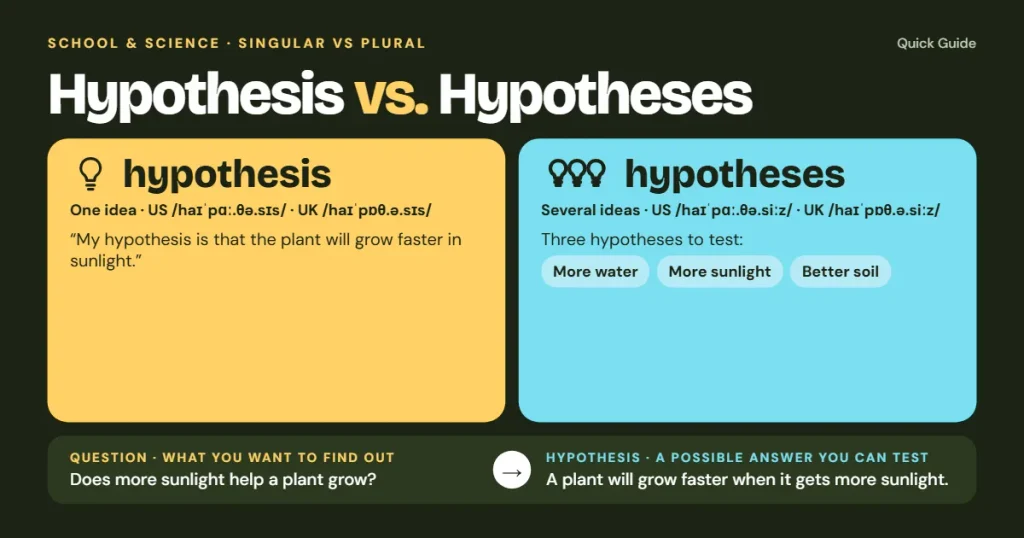
A student asks, “Does more sunlight help a plant grow?”
The student makes one prediction:
My hypothesis is that the plant will grow faster in sunlight.
The student can then test the idea.
Example with several hypotheses
Now imagine the plant is not growing well. The student has three possible ideas:
- The plant needs more water.
- The plant needs more sunlight.
- The plant needs better soil.
These are three hypotheses. The student can test each idea to learn more about the plant.
What is the difference between a question and a hypothesis?
A question asks what you want to find out.
A hypothesis gives a possible answer that you can test.
For example:
Question: Does more sunlight help a plant grow?
Hypothesis: A plant will grow faster when it gets more sunlight.
Both are useful, but they do different jobs.
How to Remember the Difference
Here is the easiest way to remember the two words:
One hypothesis. Two hypotheses.
Try this quick test:
- I have one ______. Answer: hypothesis.
- I have two ______. Answer: hypotheses.
- The three ______ are ready to test. Answer: hypotheses.
- This ______ may be correct. Answer: hypothesis.
You can also remember the spelling change:
hypothesis → hypotheses
Hypothesis vs. Hypotheses: Grammar Table
Use this table when you need a quick reminder.
| Grammar rule | Correct example |
| One idea | One hypothesis |
| More than one idea | Two hypotheses |
| Singular word with is | The hypothesis is correct. |
| Plural word with are | The hypotheses are correct. |
| Singular with this | This hypothesis |
| Plural with these | These hypotheses |
| Correct plural spelling | Hypotheses |
Possible Asked Questions
1. What is the plural of hypothesis?
The plural is hypotheses.
Example: One hypothesis was tested, and two hypotheses were tested later.
2. Is hypothesis singular or plural?
Hypothesis is singular. It means one idea that can be tested.
3. Is hypotheses singular or plural?
Hypotheses is plural. It means two or more ideas that can be tested.
4. Can I say “two hypothesis”?
No. Say “two hypotheses.”
5. Is hypothesises wrong?
It is not always wrong. Hypothesises is a British English verb form, as in “She hypothesises that it will rain.” But the plural noun is hypotheses.
6. How do you pronounce hypotheses?
Say it like hy-POTH-uh-seez. The ending sounds like “seez.”
7. Can I use hypothesis outside science?
Yes. You can use it for an idea about daily life, such as why a bus is late or where you left your bag.
Conclusion
The difference between hypothesis or hypotheses is easy to learn. Hypothesis means one idea that can be tested, while hypotheses means two or more ideas that can be tested. Remember the simple rule: one hypothesis, two hypotheses. The spelling changes from -is to -es, which is different from the usual way of forming plurals in English. Also, hypothesises is a British English verb meaning “suggests an idea,” but it is not the plural noun. You can use these words in science, schoolwork, and daily life. Before writing, ask yourself how many ideas you mean. If there is one, use hypothesis. If there are two or more, use hypotheses. With a little practice, you can choose the correct word with confidence.

I’m Samia Jamshaid, an English language specialist, SEO specialist, digital publisher, and researcher. I create clear, accurate, and well-researched content on English grammar, vocabulary, word meanings, and language comparisons, helping readers understand and use English with confidence.






2 thoughts on “Hypothesis or Hypotheses: How to Use Each Word Correctly”